
Join Our JEE Preparation Group
Prep with like-minded aspirants; Get access to free daily tests and study material.
Sign in
Please select an account to continue using cracku.in
↓ →
Join Our JEE Preparation Group
Prep with like-minded aspirants; Get access to free daily tests and study material.
Let $$a, b, c$$ be the length of three sides of a triangle satisfying the condition $$(a^2 + b^2)x^2 - 2b(a + c)x + (b^2 + c^2) = 0$$. If the set of all possible values of $$x$$ is in the interval $$(\alpha, \beta)$$, then $$12(\alpha^2 + \beta^2)$$ is equal to
Correct Answer: 36
For $$x$$ to be real, the discriminant $$D \ge 0$$:
$$[2b(a+c)]^2 - 4(a^2 + b^2)(b^2 + c^2) \ge 0$$
Expanding and simplifying:
$$b^2(a^2 + c^2 + 2ac) - (a^2b^2 + a^2c^2 + b^4 + b^2c^2) \ge 0$$
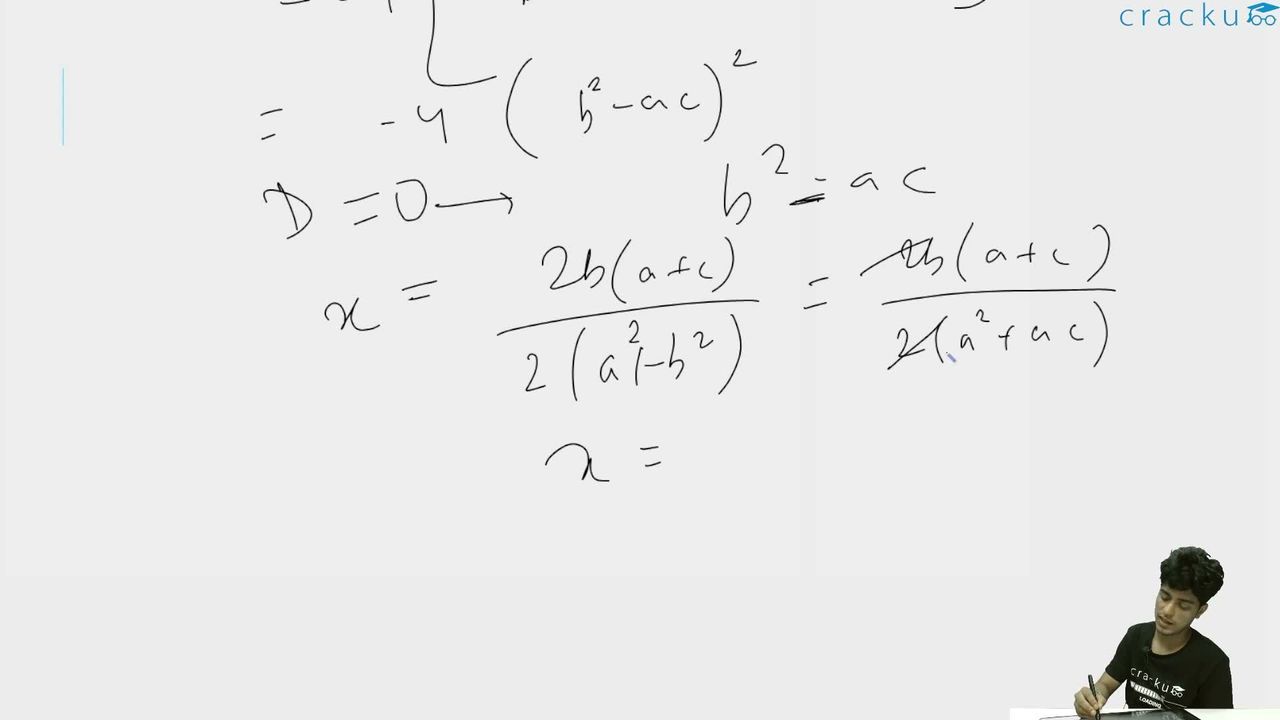
$$2ab^2c - a^2c^2 - b^4 \ge 0 \implies -(b^2 - ac)^2 \ge 0$$
This is only possible if $$b^2 - ac = 0$$, meaning $$b^2 = ac$$ (Geometric Progression).
If $$D=0$$, $$x = \frac{2b(a+c)}{2(a^2+b^2)} = \frac{b(a+c)}{a^2+ac} = \frac{b(a+c)}{a(a+c)} = \frac{b}{a}$$.
Since $$b^2=ac$$, we can also write $$x = \frac{\sqrt{ac}}{a} = \sqrt{\frac{c}{a}}$$.
For a triangle: $$a+b > c$$, $$b+c > a$$, and $$a+c > b$$.
Using $$b = \sqrt{ac}$$, the set of $$x$$ (where $$x = b/a = \sqrt{c/a}$$) must satisfy:
$$1 + x > x^2$$, $$x + x^2 > 1$$, and $$1 + x^2 > x$$.
Solving these gives $$x \in (\frac{\sqrt{5}-1}{2}, \frac{\sqrt{5}+1}{2})$$.
So $$\alpha = \frac{\sqrt{5}-1}{2}$$ and $$\beta = \frac{\sqrt{5}+1}{2}$$.
$$\alpha^2 + \beta^2 = (\frac{6-2\sqrt{5}}{4}) + (\frac{6+2\sqrt{5}}{4}) = \frac{12}{4} = 3$$.
Value = $$12(3) = \mathbf{36}$$
Was this solution helpful?
Click on the Email ☝️ to Watch the Video Solution
Create a FREE account and get:
_1.webp)

Educational materials for JEE preparation

Ask our AI anything

AI can make mistakes. Please verify important information.
AI can make mistakes. Please verify important information.
