
Join Our JEE Preparation Group
Prep with like-minded aspirants; Get access to free daily tests and study material.
Sign in
Please select an account to continue using cracku.in
↓ →
Join Our JEE Preparation Group
Prep with like-minded aspirants; Get access to free daily tests and study material.
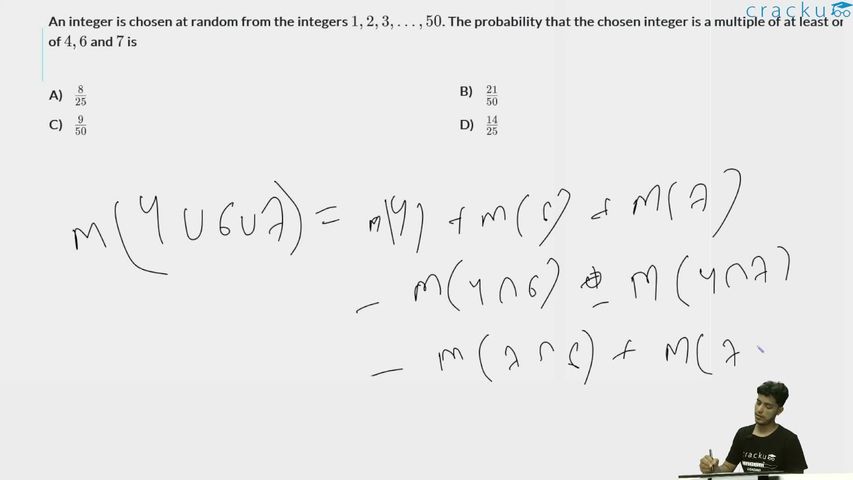
An integer is chosen at random from the integers $$1, 2, 3, \ldots, 50$$. The probability that the chosen integer is a multiple of at least one of $$4, 6$$ and $$7$$ is
We use the Principle of Inclusion-Exclusion for three sets $$A$$ (multiples of 4), $$B$$ (multiples of 6), and $$C$$ (multiples of 7).
• $$n(A) = \lfloor 50/4 \rfloor = 12$$
• $$n(B) = \lfloor 50/6 \rfloor = 8$$
• $$n(C) = \lfloor 50/7 \rfloor = 7$$
• $$n(A \cap B) = \text{multiples of } \text{lcm}(4, 6) = 12 \implies \lfloor 50/12 \rfloor = 4$$
• $$n(B \cap C) = \text{multiples of } \text{lcm}(6, 7) = 42 \implies \lfloor 50/42 \rfloor = 1$$
• $$n(A \cap C) = \text{multiples of } \text{lcm}(4, 7) = 28 \implies \lfloor 50/28 \rfloor = 1$$
• $$n(A \cap B \cap C) = \text{multiples of } \text{lcm}(4, 6, 7) = 84 \implies 0$$
Total count: $$12 + 8 + 7 - (4 + 1 + 1) + 0 = 21$$.
Probability: $$P = \frac{21}{50}$$
Was this solution helpful?
Click on the Email ☝️ to Watch the Video Solution
Create a FREE account and get:
_1.webp)

Educational materials for JEE preparation

Ask our AI anything

AI can make mistakes. Please verify important information.
AI can make mistakes. Please verify important information.
