
Join Our JEE Preparation Group
Prep with like-minded aspirants; Get access to free daily tests and study material.
Sign in
Please select an account to continue using cracku.in
↓ →
Join Our JEE Preparation Group
Prep with like-minded aspirants; Get access to free daily tests and study material.
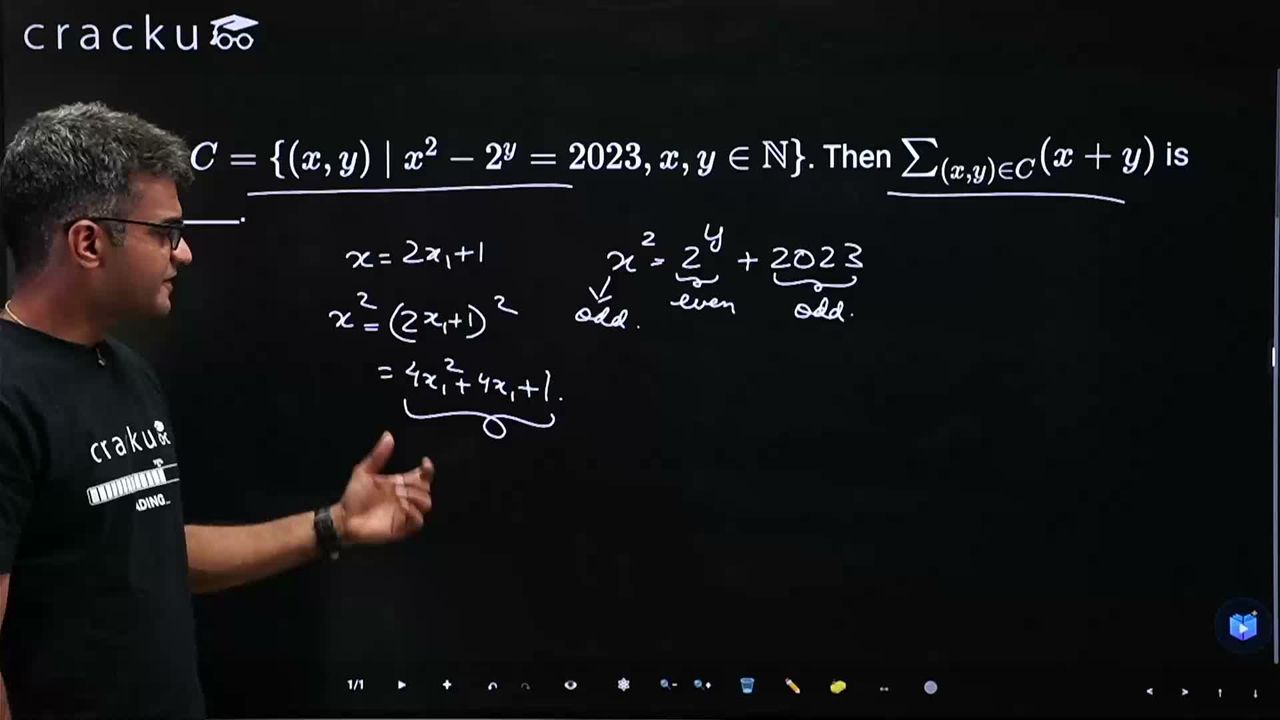
Let the set $$C = \{(x, y) \mid x^2 - 2^y = 2023, x, y \in \mathbb{N}\}$$. Then $$\sum_{(x,y) \in C}(x + y)$$ is equal to ______.
Correct Answer: 46
We need to find all natural number solutions $$(x, y)$$ of $$x^2 - 2^y = 2023$$.
This gives $$x^2 = 2023 + 2^y$$.
Check small values of y: for $$y = 1$$: $$x^2 = 2023 + 2 = 2025 = 45^2$$. ✓ So $$(45, 1)$$ is a solution.
For $$y = 2$$: $$x^2 = 2027$$, not a perfect square.
For $$y = 3$$: $$x^2 = 2031$$, not a perfect square.
For $$y = 4$$: $$x^2 = 2039$$, not a perfect square.
For $$y = 5$$: $$x^2 = 2055$$, not a perfect square.
For $$y = 6$$: $$x^2 = 2087$$, not a perfect square.
For $$y = 7$$: $$x^2 = 2151$$, not a perfect square.
For $$y = 8$$: $$x^2 = 2279$$, not a perfect square.
For $$y = 9$$: $$x^2 = 2535$$, not a perfect square.
For $$y = 10$$: $$x^2 = 3047$$, not a perfect square.
For $$y = 11$$: $$x^2 = 4071$$, not a perfect square.
For large y, use modular arithmetic: for $$y \geq 2$$: $$x^2 \equiv 2023 \pmod{4}$$. Since $$2023 = 505 \times 4 + 3$$, we get $$x^2 \equiv 3 \pmod{4}$$. But squares are $$\equiv 0$$ or $$1 \pmod{4}$$, which is a contradiction.
So no solutions exist for $$y \geq 2$$.
Compute the answer: the only solution is $$(x, y) = (45, 1)$$.
$$ \sum_{(x,y) \in C} (x + y) = 45 + 1 = 46 $$
The answer is $$\boxed{46}$$.
Was this solution helpful?
Click on the Email ☝️ to Watch the Video Solution
Create a FREE account and get:
_1.webp)

Educational materials for JEE preparation

Ask our AI anything

AI can make mistakes. Please verify important information.
AI can make mistakes. Please verify important information.
