
Join Our JEE Preparation Group
Prep with like-minded aspirants; Get access to free daily tests and study material.
Sign in
Please select an account to continue using cracku.in
↓ →
Join Our JEE Preparation Group
Prep with like-minded aspirants; Get access to free daily tests and study material.
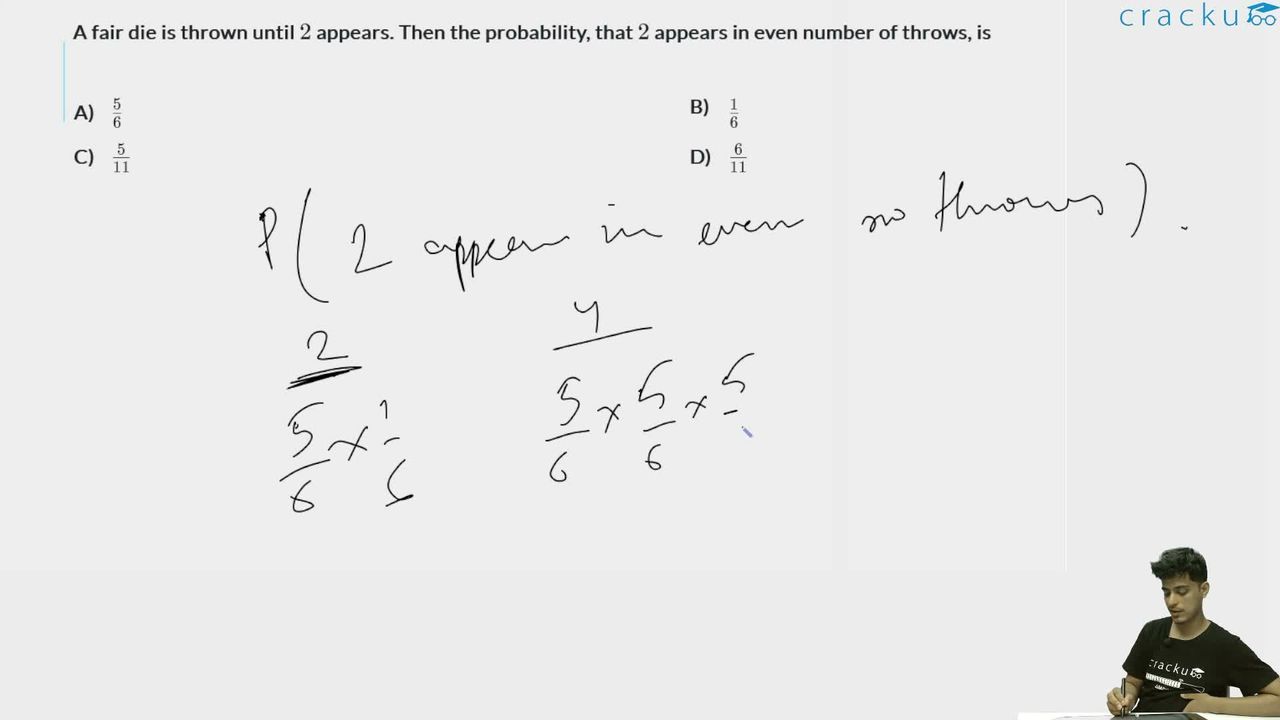
A fair die is thrown until $$2$$ appears. Then the probability, that $$2$$ appears in even number of throws, is
Let $$p$$ be the probability of getting a $$2$$ in a single throw: $$p = \frac{1}{6}$$.
Let $$q$$ be the probability of not getting a $$2$$: $$q = 1 - p = \frac{5}{6}$$.
The event "2 appears in an even number of throws" happens if it occurs on the 2nd, 4th, 6th... throw.
The total probability $$P$$ is an infinite geometric series:
$$P = (q \cdot p) + (q^3 \cdot p) + (q^5 \cdot p) + \dots$$
$$P = qp(1 + q^2 + q^4 + \dots)$$
Using the sum of an infinite GP $$S = \frac{a}{1-r}$$:
$$P = \frac{qp}{1 - q^2} = \frac{\frac{5}{6} \cdot \frac{1}{6}}{1 - (\frac{5}{6})^2} = \frac{\frac{5}{36}}{1 - \frac{25}{36}} = \frac{\frac{5}{36}}{\frac{11}{36}} = \frac{5}{11}$$
Was this solution helpful?
Click on the Email ☝️ to Watch the Video Solution
Create a FREE account and get:
_1.webp)

Educational materials for JEE preparation

Ask our AI anything

AI can make mistakes. Please verify important information.
AI can make mistakes. Please verify important information.
