
Join Our JEE Preparation Group
Prep with like-minded aspirants; Get access to free daily tests and study material.
Sign in
Please select an account to continue using cracku.in
↓ →
Join Our JEE Preparation Group
Prep with like-minded aspirants; Get access to free daily tests and study material.
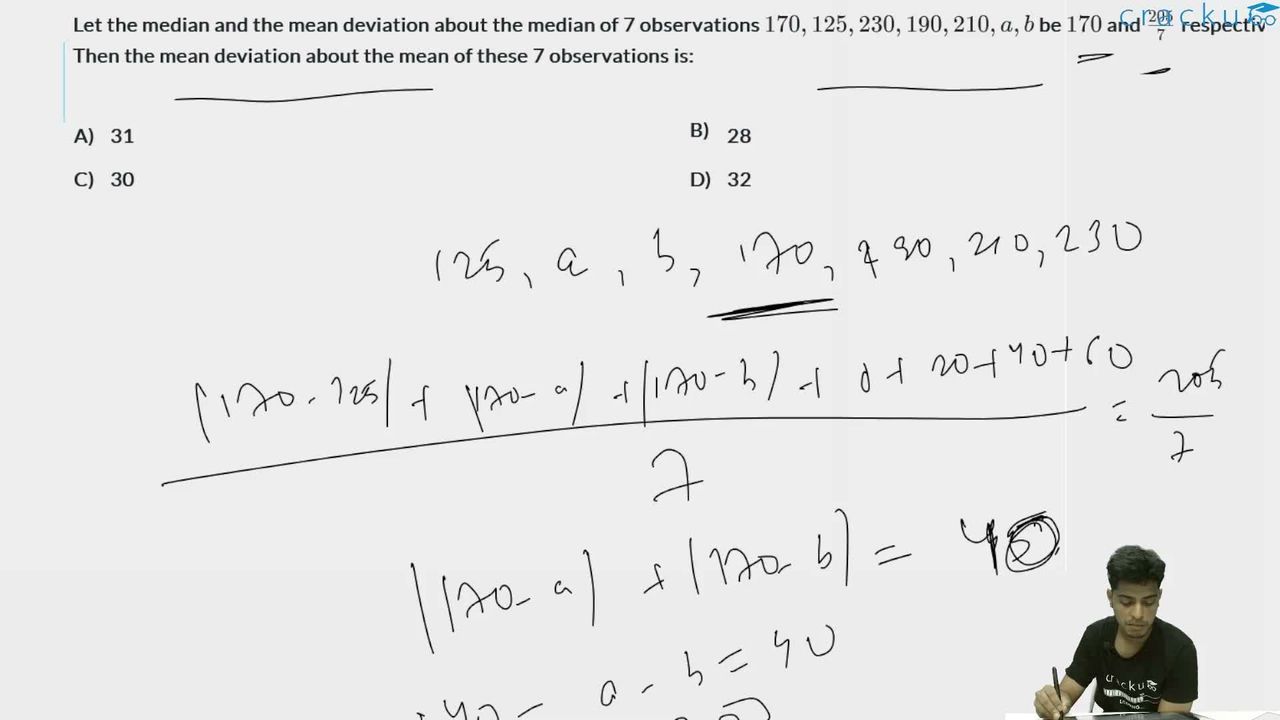
Let the median and the mean deviation about the median of 7 observations $$170, 125, 230, 190, 210, a, b$$ be $$170$$ and $$\frac{205}{7}$$ respectively. Then the mean deviation about the mean of these 7 observations is:
The median of the 7 observations is given as 170. Since there are 7 observations (an odd number), the median is the 4th observation when arranged in ascending order. The known observations are 125, 170, 190, 210, and 230. To have the median as 170, the 4th position must be 170, which requires at least three observations ≤ 170 and at least three observations ≥ 170.
Currently, there is one observation < 170 (125) and one observation = 170. There are three observations > 170 (190, 210, 230). Thus, there are two observations ≤ 170 (125 and 170) and four observations ≥ 170 (170, 190, 210, 230). To satisfy the median condition, both unknown observations $$a$$ and $$b$$ must be ≤ 170, ensuring exactly three observations ≤ 170 and three ≥ 170 (with the 4th being 170).
The mean deviation about the median is given as $$\frac{205}{7}$$. The formula for mean deviation about the median is:
$$\text{MD}(\text{median}) = \frac{1}{n} \sum_{i=1}^{n} |x_i - \text{median}|$$
Here, $$n = 7$$, median = 170, and $$\text{MD}(\text{median}) = \frac{205}{7}$$. Thus,
$$\sum_{i=1}^{7} |x_i - 170| = 205$$
The observations are 125, $$a$$, $$b$$, 170, 190, 210, 230. Since $$a \leq 170$$ and $$b \leq 170$$, $$|a - 170| = 170 - a$$ and $$|b - 170| = 170 - b$$. The absolute deviations are:
Summing these:
$$45 + (170 - a) + (170 - b) + 0 + 20 + 40 + 60 = 205$$
Simplifying the constants:
$$45 + 170 + 170 + 20 + 40 + 60 = 505$$
So,
$$505 - a - b = 205$$
$$-a - b = -300$$
$$a + b = 300$$
Next, find the mean deviation about the mean. First, compute the mean. The sum of the observations is:
$$125 + a + b + 170 + 190 + 210 + 230$$
Substituting $$a + b = 300$$:
$$125 + 300 + 170 + 190 + 210 + 230 = 1225$$
The mean $$\bar{x}$$ is:
$$\bar{x} = \frac{1225}{7} = 175$$
The mean deviation about the mean is:
$$\text{MD}(\text{mean}) = \frac{1}{7} \sum_{i=1}^{7} |x_i - 175|$$
The absolute deviations from 175 are:
Summing these:
$$50 + (175 - a) + (175 - b) + 5 + 15 + 35 + 55$$
Simplifying the constants:
$$50 + 175 + 175 + 5 + 15 + 35 + 55 = 510$$
So,
$$510 - a - b = 510 - 300 = 210$$
Thus, the mean deviation about the mean is:
$$\frac{210}{7} = 30$$
Therefore, the mean deviation about the mean is 30.
Was this solution helpful?
Click on the Email ☝️ to Watch the Video Solution
Create a FREE account and get:
_1.webp)

Educational materials for JEE preparation

Ask our AI anything

AI can make mistakes. Please verify important information.
AI can make mistakes. Please verify important information.
