
Join Our JEE Preparation Group
Prep with like-minded aspirants; Get access to free daily tests and study material.
Sign in
Please select an account to continue using cracku.in
↓ →
Join Our JEE Preparation Group
Prep with like-minded aspirants; Get access to free daily tests and study material.
For $$0 < \theta < \pi/2$$, if the eccentricity of the hyperbola $$x^2 - y^2\csc^2\theta = 5$$ is $$\sqrt{7}$$ times eccentricity of the ellipse $$x^2\csc^2\theta + y^2 = 5$$, then the value of $$\theta$$ is:
The given hyperbola is $$x^{2}-y^{2}\csc^{2}\theta = 5$$.
Divide by $$5$$ to convert it into the standard form $$\dfrac{x^{2}}{a^{2}}-\dfrac{y^{2}}{b^{2}}=1$$:
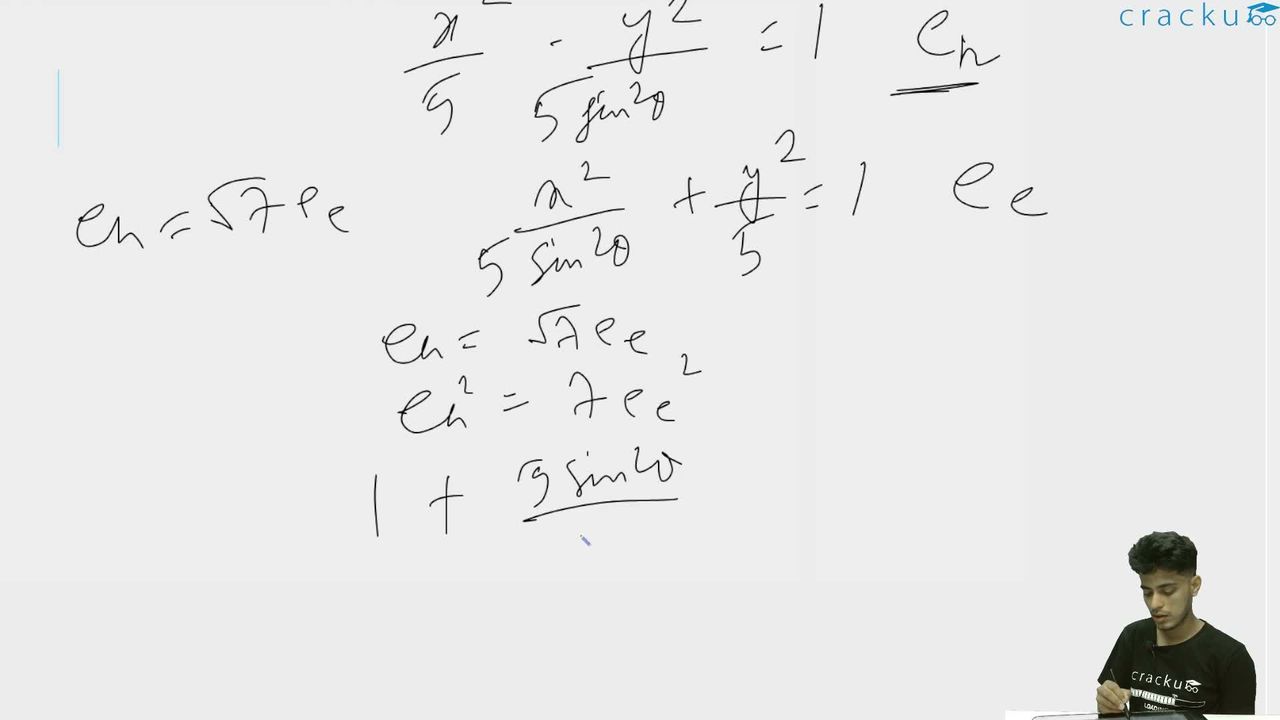
$$\frac{x^{2}}{5}-\frac{y^{2}\csc^{2}\theta}{5}=1 \;\;\Longrightarrow\;\; \frac{x^{2}}{5}-\frac{y^{2}}{\,5/\csc^{2}\theta\,}=1.$$
Hence for the hyperbola $$a^{2}=5,\qquad b^{2}= \frac{5}{\csc^{2}\theta}=5\sin^{2}\theta.$$ For a hyperbola $$\frac{x^{2}}{a^{2}}-\frac{y^{2}}{b^{2}}=1,$$ the eccentricity is $$e_{h}=\sqrt{1+\frac{b^{2}}{a^{2}}}.$$
Therefore $$e_{h}= \sqrt{1+\frac{5\sin^{2}\theta}{5}} =\sqrt{1+\sin^{2}\theta}.$$
The given ellipse is $$x^{2}\csc^{2}\theta + y^{2}=5.$$
Divide by $$5$$ to write it as $$\dfrac{x^{2}}{a^{2}}+\dfrac{y^{2}}{b^{2}}=1$$:
$$\frac{x^{2}\csc^{2}\theta}{5} + \frac{y^{2}}{5}=1 \;\;\Longrightarrow\;\; \frac{x^{2}}{\,5\sin^{2}\theta\,}+\frac{y^{2}}{5}=1.$$
Thus for the ellipse $$a^{2}=5\sin^{2}\theta,\qquad b^{2}=5.$$ Since $$b^{2}\gt a^{2},$$ the semi-major axis is $$b=\sqrt{5}.$$
For an ellipse $$\frac{x^{2}}{a^{2}}+\frac{y^{2}}{b^{2}}=1\;(b\gt a),$$ the eccentricity is $$e_{e}= \sqrt{1-\frac{a^{2}}{b^{2}}}.$$
Hence $$e_{e}= \sqrt{1-\frac{5\sin^{2}\theta}{5}} =\sqrt{1-\sin^{2}\theta} =\cos\theta.$$
According to the question, $$e_{h}= \sqrt{7}\,e_{e}.$$ Substitute the expressions for $$e_{h}$$ and $$e_{e}$$:
$$\sqrt{1+\sin^{2}\theta}= \sqrt{7}\,\cos\theta.$$
Square both sides:
$$1+\sin^{2}\theta = 7\cos^{2}\theta.$$
Using $$\cos^{2}\theta = 1-\sin^{2}\theta,$$ get an equation in $$s=\sin^{2}\theta$$:
$$1+s = 7(1-s) \;\;\Longrightarrow\;\; 1+s = 7-7s \;\;\Longrightarrow\;\; 8s = 6 \;\;\Longrightarrow\;\; s = \frac{3}{4}.$$
Thus $$\sin^{2}\theta = \frac{3}{4} \;\;\Longrightarrow\;\; \sin\theta = \frac{\sqrt{3}}{2}.$$
For $$0 \lt \theta \lt \frac{\pi}{2},$$ this gives $$\theta = \frac{\pi}{3}.$$
Hence the correct option is Option C: $$\displaystyle \frac{\pi}{3}$$.
Was this solution helpful?
Click on the Email ☝️ to Watch the Video Solution
Create a FREE account and get:
_1.webp)

Educational materials for JEE preparation

Ask our AI anything

AI can make mistakes. Please verify important information.
AI can make mistakes. Please verify important information.
