
Join Our JEE Preparation Group
Prep with like-minded aspirants; Get access to free daily tests and study material.
Sign in
Please select an account to continue using cracku.in
↓ →
Join Our JEE Preparation Group
Prep with like-minded aspirants; Get access to free daily tests and study material.
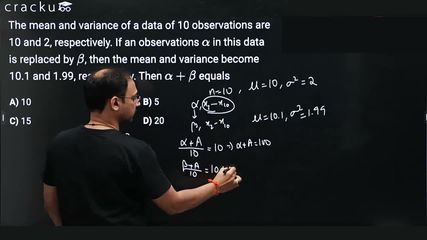
The mean and variance of a data of 10 observations are 10 and 2, respectively. If an observations $$\alpha$$ in this data is replaced by $$\beta$$, then the mean and variance become 10.1 and 1.99, respectively. Then $$\alpha+\beta$$ equals
We need to find $$\alpha + \beta$$ when one observation $$\alpha$$ is replaced by $$\beta$$, causing the mean to shift from 10 to 10.1 and the variance to shift from 2 to 1.99.
Using the mean condition, the original sum of observations is $$\sum x_i = 10 \times 10 = 100$$, and after the replacement we have $$100 - \alpha + \beta = 10.1 \times 10 = 101$$, which gives $$\beta - \alpha = 1$$ … (i)
Similarly, applying the variance condition, the original variance satisfies $$\frac{\sum x_i^2}{10} - 100 = 2$$ so that $$\sum x_i^2 = 1020$$. After replacement we get $$\frac{1020 - \alpha^2 + \beta^2}{10} - (10.1)^2 = 1.99$$, leading to $$\frac{1020 - \alpha^2 + \beta^2}{10} = 1.99 + 102.01 = 104$$ and hence $$1020 - \alpha^2 + \beta^2 = 1040$$, which simplifies to $$\beta^2 - \alpha^2 = 20$$ … (ii)
Factoring (ii) yields $$(\beta - \alpha)(\beta + \alpha) = 20$$, and substituting the result of (i), namely $$\beta - \alpha = 1$$, gives $$\beta + \alpha = 20$$. This matches Option D: $$\alpha + \beta = 20$$, so the answer is Option D.
Was this solution helpful?
Click on the Email ☝️ to Watch the Video Solution
Create a FREE account and get:
_1.webp)

Educational materials for JEE preparation

Ask our AI anything

AI can make mistakes. Please verify important information.
AI can make mistakes. Please verify important information.
