
Join Our JEE Preparation Group
Prep with like-minded aspirants; Get access to free daily tests and study material.
Sign in
Please select an account to continue using cracku.in
↓ →
Join Our JEE Preparation Group
Prep with like-minded aspirants; Get access to free daily tests and study material.
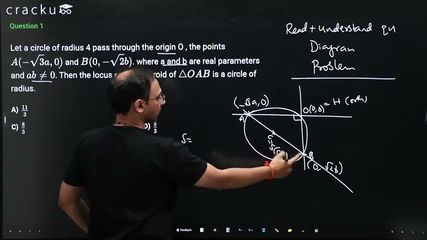
Let a circle of radius 4 pass through the origin O , the points $$A(-\sqrt{3}a,0)$$ and $$B(0,-\sqrt{2}b)$$. where a and b are real parameters and $$ab\neq 0$$. Then the locus of the centroid of $$\triangle OAB$$ is a circle of radius.
We need to find the radius of the locus of the centroid of $$\triangle OAB$$ where $$O$$ is the origin, $$A(-\sqrt{3}a, 0)$$ and $$B(0, -\sqrt{2}b)$$ as points on a circle of radius 4 passing through all three vertices.
Since the circle passes through the origin its equation can be written as $$x^2 + y^2 + Dx + Ey = 0$$, and substituting $$A(-\sqrt{3}a, 0)$$ gives $$3a^2 - \sqrt{3}aD = 0\Rightarrow D = \sqrt{3}a$$ while substituting $$B(0, -\sqrt{2}b)$$ leads to $$2b^2 - \sqrt{2}bE = 0\Rightarrow E = \sqrt{2}b$$.
Because the radius equals $$\frac12\sqrt{D^2 + E^2} = \frac12\sqrt{3a^2 + 2b^2}$$ and is given as 4, it follows that $$3a^2 + 2b^2 = 64$$.
The centroid of $$\triangle OAB$$ is $$G = \Bigl(\frac{-\sqrt{3}a}{3}, \frac{-\sqrt{2}b}{3}\Bigr)$$, so setting $$h = \frac{-\sqrt{3}a}{3}$$ and $$k = \frac{-\sqrt{2}b}{3}$$ yields $$a = -\sqrt{3}\,h$$ and $$b = -\frac{3k}{\sqrt2}$$.
Substituting these expressions into the constraint gives $$3\times3h^2 + 2\times\frac{9k^2}{2} = 64$$, which simplifies to $$9h^2 + 9k^2 = 64$$ and hence $$h^2 + k^2 = \frac{64}{9}$$.
Therefore the locus of the centroid is a circle of radius $$\frac{8}{3}$$, so the answer is Option C.
Was this solution helpful?
Click on the Email ☝️ to Watch the Video Solution
Create a FREE account and get:
_1.webp)

Educational materials for JEE preparation

Ask our AI anything

AI can make mistakes. Please verify important information.
AI can make mistakes. Please verify important information.
