
Join Our JEE Preparation Group
Prep with like-minded aspirants; Get access to free daily tests and study material.
Sign in
Please select an account to continue using cracku.in
↓ →
Join Our JEE Preparation Group
Prep with like-minded aspirants; Get access to free daily tests and study material.
Let $$S= z \left\{\in \mathbb{C}:|\frac{z-6i}{z-2i}|=1\text{ and }|\frac{z-8+2i}{z+2i}|=\frac{3}{5} \right\}$$. Then $$\sum_{z\in s}^{}|z|^{2}$$ is equal to
$$\left|\dfrac{z - 6i}{z - 2i}\right| = 1$$ implies $$|z - 6i| = |z - 2i|$$, so $$z$$ is equidistant from $$6i$$ and $$2i$$.
The midpoint of these points is $$(0,4)$$, and the perpendicular bisector is the horizontal line $$y = 4$$, giving $$z = x + 4i$$ for some real $$x$$.
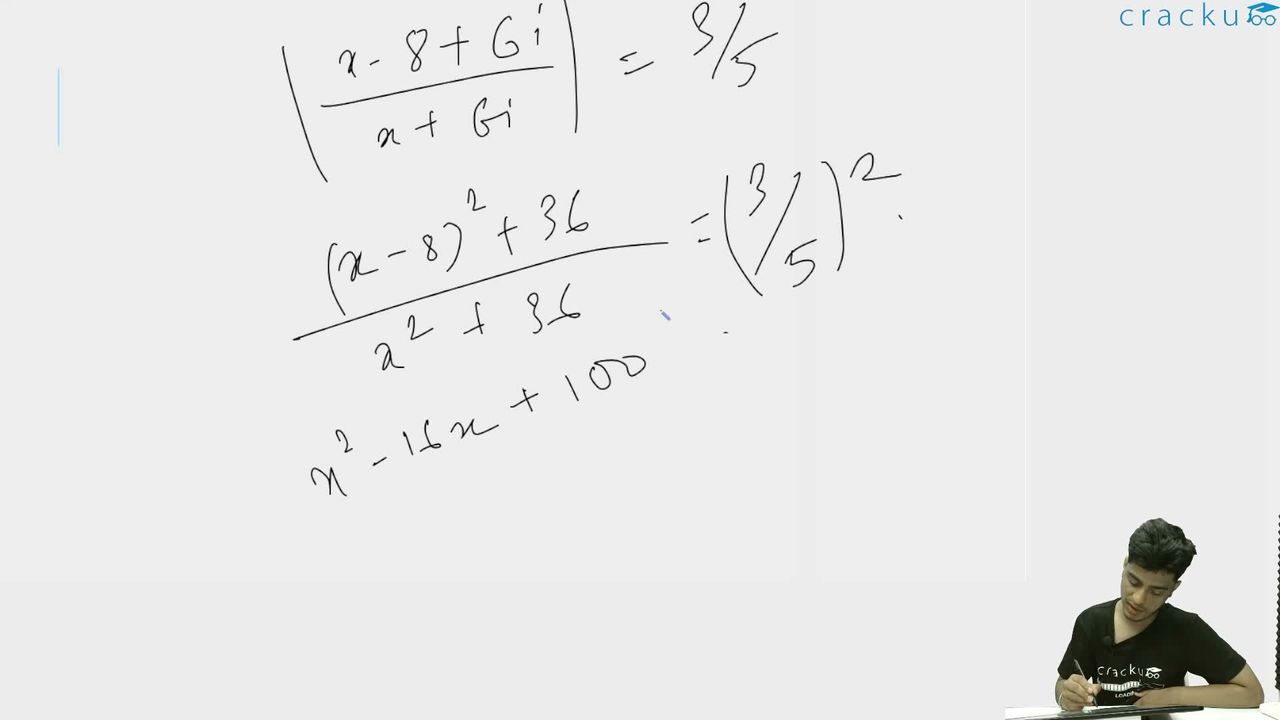
Next, substituting $$z = x + 4i$$ into the second condition yields $$z - 8 + 2i = (x - 8) + 6i$$ so $$|z - 8 + 2i| = \sqrt{(x-8)^2 + 36}$$, and $$z + 2i = x + 6i$$ so $$|z + 2i| = \sqrt{x^2 + 36}$$.
$$\frac{\sqrt{(x-8)^2 + 36}}{\sqrt{x^2 + 36}} = \frac{3}{5}$$
$$\frac{(x-8)^2 + 36}{x^2 + 36} = \frac{9}{25}$$
$$x^2 - 25x + 136 = 0$$
$$x = 17$$ or $$x = 8$$, which yields the points $$z_1 = 17 + 4i$$ and $$z_2 = 8 + 4i$$.
$$|z_1|^2 = 17^2 + 4^2 = 289 + 16 = 305$$
$$|z_2|^2 = 8^2 + 4^2 = 64 + 16 = 80$$
$$\sum |z|^2 = 305 + 80 = 385$$
Was this solution helpful?
Click on the Email ☝️ to Watch the Video Solution
Create a FREE account and get:
_1.webp)

Educational materials for JEE preparation

Ask our AI anything

AI can make mistakes. Please verify important information.
AI can make mistakes. Please verify important information.
