
Join Our JEE Preparation Group
Prep with like-minded aspirants; Get access to free daily tests and study material.
Sign in
Please select an account to continue using cracku.in
↓ →
Join Our JEE Preparation Group
Prep with like-minded aspirants; Get access to free daily tests and study material.
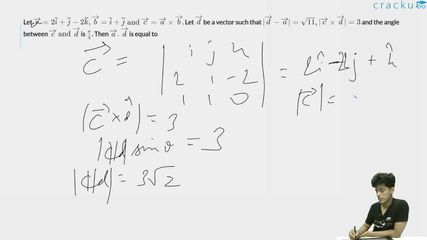
Let $$\overrightarrow{a}=2\widehat{i}+\widehat{j}-2\widehat{k}, \overrightarrow{b}=\widehat{i}+\widehat{j}\text{ and }\overrightarrow{c}=\overrightarrow{a}\times \overrightarrow{b}$$. Let $$\overrightarrow{d}$$ be a vector such that $$|\overrightarrow{d}-\overrightarrow{a}|=\sqrt{11},|\overrightarrow{c}\times \overrightarrow{d}|=3$$ and the angle between $$\overrightarrow{c}\text{ and }\overrightarrow{d}$$ is $$\frac{\pi}{4}$$. Then $$\overrightarrow{a}. \overrightarrow{d}$$ is equal to
Consider the vectors $$\vec{a} = 2\hat{i} + \hat{j} - 2\hat{k}$$ and $$\vec{b} = \hat{i} + \hat{j}$$, with $$\vec{c} = \vec{a} \times \vec{b}$$. It is also given that $$|\vec{d} - \vec{a}| = \sqrt{11}$$, $$|\vec{c} \times \vec{d}| = 3$$, and the angle between $$\vec{c}$$ and $$\vec{d}$$ is $$\frac{\pi}{4}$$.
First, computing the cross product yields $$\vec{c} = \begin{vmatrix} \hat{i} & \hat{j} & \hat{k} \\ 2 & 1 & -2 \\ 1 & 1 & 0 \end{vmatrix} = \hat{i}(0+2) - \hat{j}(0+2) + \hat{k}(2-1) = 2\hat{i} - 2\hat{j} + \hat{k}$$, and therefore $$|\vec{c}| = \sqrt{4+4+1} = 3$$.
Since $$|\vec{c} \times \vec{d}| = |\vec{c}||\vec{d}|\sin\theta$$ we have $$3\cdot|\vec{d}|\cdot\sin\frac{\pi}{4} = 3$$, implying $$|\vec{d}|\cdot\frac{1}{\sqrt{2}} = 1$$ and hence $$|\vec{d}| = \sqrt{2}$$.
Similarly, the dot product is given by $$\vec{c} \cdot \vec{d} = |\vec{c}||\vec{d}|\cos\frac{\pi}{4} = 3\cdot\sqrt{2}\cdot\frac{1}{\sqrt{2}} = 3$$.
Using $$|\vec{d} - \vec{a}|^2 = |\vec{d}|^2 - 2\vec{a}\cdot\vec{d} + |\vec{a}|^2 = 11$$ and noting $$|\vec{a}| = \sqrt{4+1+4} = 3$$ so that $$|\vec{a}|^2 = 9$$, we substitute to obtain $$2 - 2(\vec{a}\cdot\vec{d}) + 9 = 11$$, which leads to $$\vec{a}\cdot\vec{d} = \frac{11 - 9 - 2}{-2} = 0$$.
Therefore $$\vec{a} \cdot \vec{d} = 0$$, which corresponds to Option 2.
Was this solution helpful?
Click on the Email ☝️ to Watch the Video Solution
Create a FREE account and get:
_1.webp)

Educational materials for JEE preparation

Ask our AI anything

AI can make mistakes. Please verify important information.
AI can make mistakes. Please verify important information.
