Join WhatsApp Icon JEE WhatsApp Group
JEE Laws of Thermodynamics Questions

JEE Laws of Thermodynamics Questions

Question 1

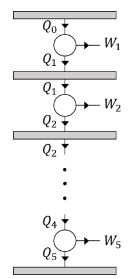
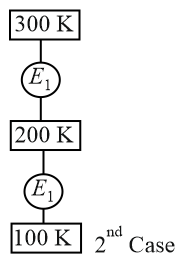
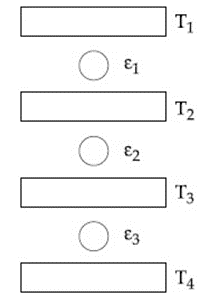
As shown in the figure, five Carnot engines, each with efficiency $$\eta$$ and same number of cycles per unit time, are operating between six heat reservoirs. The amount of heat released per cycle by one engine is completely absorbed by the next engine. Consider $$Q_0$$ to be the amount of heat absorbed per cycle by the first engine and $$W$$ as the amount of total work done by all the engines per cycle, then the net efficiency of the system is found to be $$\eta_{\text{net}}=\dfrac{W}{Q_0}=\dfrac{211}{243}$$. The value of $$\eta$$ is:

image
Question 2

One mole of an ideal diatomic gas expands from volume $$V$$ to $$2 V$$ isothermally at a temperature $$27^{o}C$$ and does W joule of work. lf the gas undergoes same magnitude of expansion adiabatically from $$27^{o}C$$ doing the same amount of work $$W$$, then its final temperature will be (close to) ____ $$^{\circ}C.$$
$$(\log_{e}2 = 0.693)$$

Question 3

The volume of an ideal gas increases 8 times and temperature becomes $$(1/4)^{th}$$ of initial temperature during a reversible change. If there is no exchange of heat in this process $$(\triangle Q = 0)$$ then identify the gas from the following options (Assuming the gases given in the options are ideal gases):

Question 4

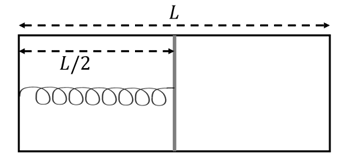
A cylinder with adiabatic walls is closed at both ends and is divided into two compartments by a frictionless adiabatic piston. Ideal gas is filled in both (left and right) the compartments at same P, V, T. Heating is started from left side until pressure changes to $$27 P/8$$. If initial volume of each compartment was 9 litres then the final volume in right-hand side compartment is __________ litres. (for this ideal gas $$C_P/C_V = 1.5$$)

Question 5

Given below are two statements: one is labelled as Assertion A and the other is labelled as Reason R.
Statement I: Change in internal energy of a system containing $$n$$ mole of ideal gas can be written as $$\Delta U = n C_v (T_f - T_i) = \frac{nR}{\gamma - 1}(T_f - T_i)$$, where $$\gamma = \frac{C_p}{C_v}$$, $$T_i$$ = initial temperature, $$T_f$$ = final temperature.
Statement II: Relation between degree of freedom $$f$$ and $$ \gamma$$ (= $$C_p/C_v$$) is $$\left(\gamma = 1 + \frac{2}{f}\right)$$.
Choose the correct answer from the options given below

Question 6

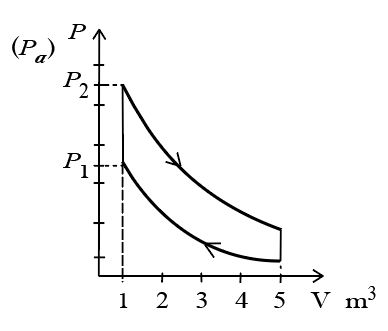
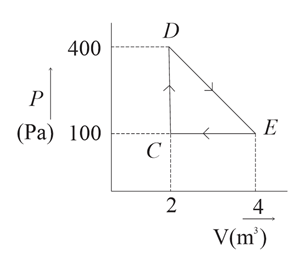
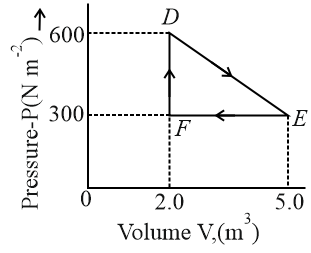
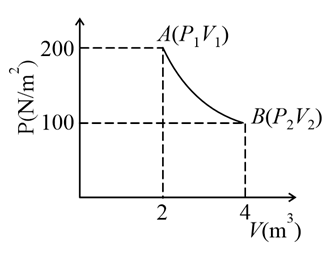
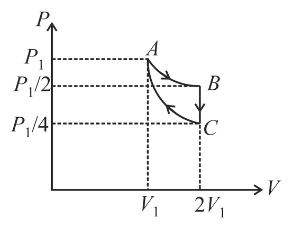
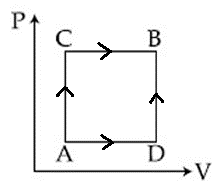
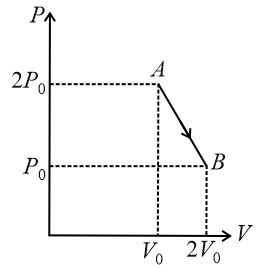
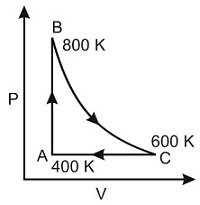
10 mole of an ideal gas is undergoing the process showu in the figure. The heat involved in the process from $$P_{1}$$ to $$P_{2}$$ is $$\alpha$$ Joule(P_{1}= 21.7Pa and $$P_{2} = 30$$ Pa, $$C_{v}=21J/K.mol, R=8.3 J/mol.K.$$) The value of $$\alpha$$ is _________.

image
Question 7

Consider the following statements:
A. Zeroth law of thermodynamics gives concept of temperature
B. First law of thermodynamics gives concept of internal energy
C. In isothermal expansion of ideal gas, $$\Delta Q \neq \Delta W$$
D. Product of intensive and extensive variables is extensive
E. The ratio of any extensive variable to mass will be an extensive variable
Choose the correct combination of statements from the options given below:

Question 8

Heat is supplied to a diatomic gas at constant pressure. Then the ratio of $$\Delta Q : \Delta U : \Delta W$$ is __________.

Question 9

One mole of diatomic gas having rotational modes only is kept in a cylinder with a piston system. The cross-section area of the cylinder is 4 cm$$^2$$. The gas is heated slowly to raise the temperature by 1.2 $$^\circ$$C during which the piston moves by 25 mm. The amount of heat supplied to the gas is __________ J. (Atmospheric pressure = 100 kPa, $$R = 8.3$$ J/mol. K) (Neglect mass of the piston)

Question 10

10 mole of oxygen is heated at constant volume from $$30^{\circ}C  \text{to}  40^{\circ}C$$. The change in the internal energy of the gas is ____ cal (the molecular specific heat of oxygen at constant pressure, $$C_{p}= 7 \text{cal}/\text{mol}.^{\circ}C \text{and} R = 2 \text{cal}./\text{mol}.^{\circ}C).$$

Question 11

A diatomic gas ( y= 1.4) does 100 J of work when it is expanded isobarically. Then the heat given to the gas ____ J.

Question 12

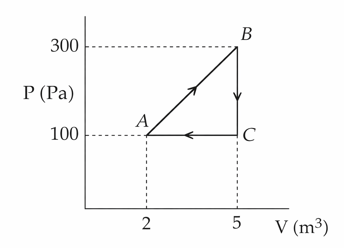
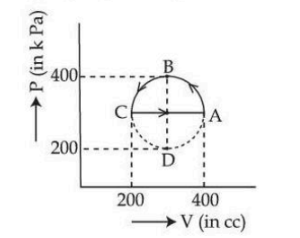
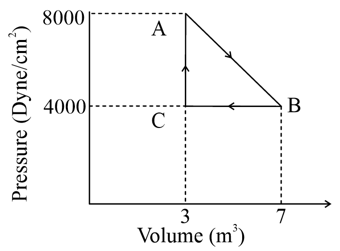
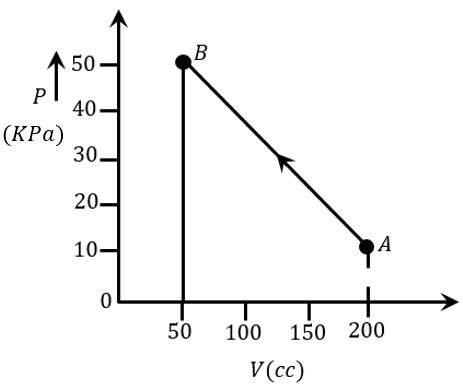
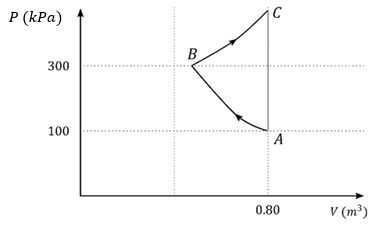
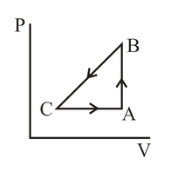
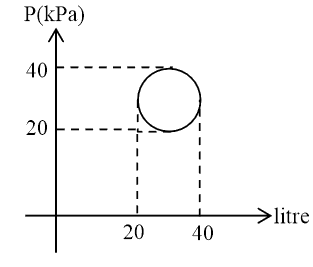
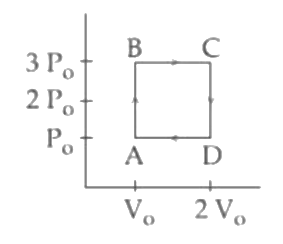
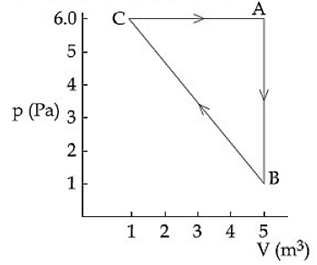
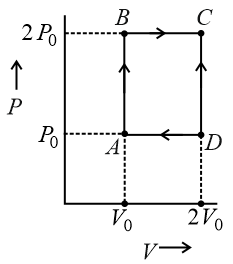
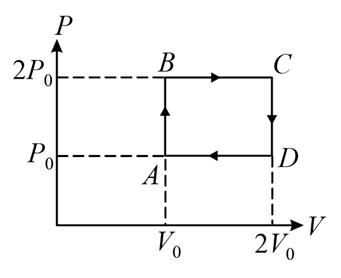
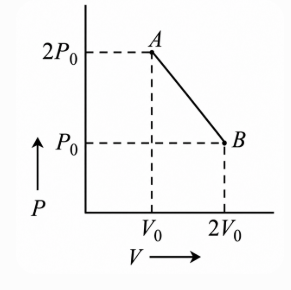
A thermodynamic system is taken through the cyclic process $$ABC$$ as shown in the figure. The total work done by the system during the cycle $$ABC$$ is ______ J.

image
Video Solution
Question 13

A vessel contains 0.15 m$$^3$$ of a gas at pressure 8 bar and temperature 140 °C with $$c_p = 3R$$ and $$c_v = 2R$$. It is expanded adiabatically till pressure falls to 1 bar. The work done during this process is __________ kJ. (R is gas constant)
Question 14

5 moles of unknown gas is heated at constant volume from 10 °C to 20 °C. The molar specific heat of this gas at constant pressure $$c_p = 8$$ cal/mol.°C and $$R = 8.36$$ J/mol.°C. The change in internal energy of the gas is _________ calorie.

Question 15

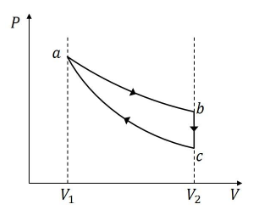
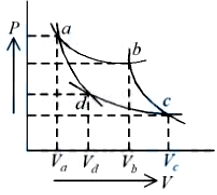
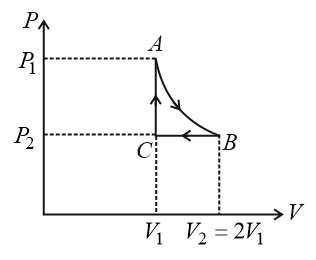
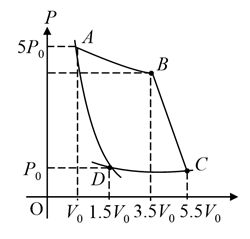
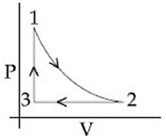
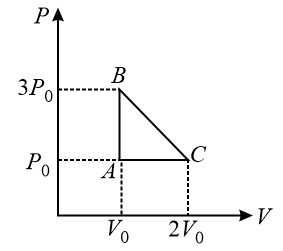
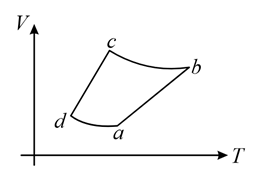
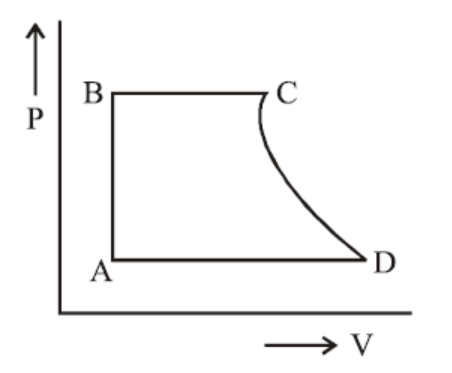
A quasi-static cycle of a monoatomic ideal gas contains an isothermal process ($$\boldsymbol{ab}$$), followed by an isochoric process ($$\boldsymbol{bc}$$) and an adiabatic process ($$\boldsymbol{ca}$$) as shown in the figure. The volumes of the gas are $$V_1$$ and $$V_2$$ at $$\boldsymbol{a}$$ and $$\boldsymbol{b}$$, respectively. If the cycle has heat input $$Q_{\text{in}}$$ and output $$Q_{\text{out}}$$, then the efficiency of the cycle is defined as $$\eta=\dfrac{Q_{\text{in}}-Q_{\text{out}}}{Q_{\text{in}}}$$. The correct statement(s) is(are):

[Given: $$\ln 2\approx 0.7$$]

image
Question 16

Ten moles of an ideal monatomic gas, initially in state $$\boldsymbol{a}$$ at atmospheric pressure and temperature $$T_a=27^\circ\mathrm{C}$$, is enclosed in a metal cylinder of volume $$V_0$$ fitted with a frictionless piston. The gas is suddenly compressed to state $$\boldsymbol{b}$$ with volume $$V_0/3$$. Now, keeping the piston stationary, the cylinder is submerged in a water bath of temperature $$11^\circ\mathrm{C}$$ until the gas reaches the temperature of the water bath, which is denoted as state $$\boldsymbol{c}$$. Finally, while still in the water bath, the piston is brought slowly to its initial position, which is denoted as state $$\boldsymbol{f}$$. If $$R$$ is universal gas constant, then the correct option(s) is/are:

[Given: $$9^{1/3}=2.08$$]

50,000+ JEE Students Trusted Our Score Calculator

Predict your JEE Main percentile, rank & performance in seconds