
Join Our JEE Preparation Group
Prep with like-minded aspirants; Get access to free daily tests and study material.
Sign in
Please select an account to continue using cracku.in
↓ →
Join Our JEE Preparation Group
Prep with like-minded aspirants; Get access to free daily tests and study material.
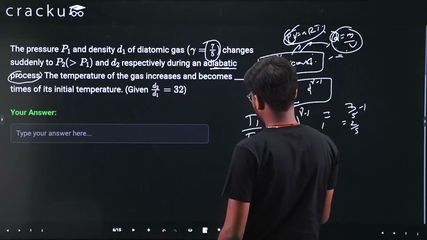
The pressure $$P_1$$ and density $$d_1$$ of diatomic gas $$(\gamma = \frac{7}{5})$$ changes suddenly to $$P_2(> P_1)$$ and $$d_2$$ respectively during an adiabatic process. The temperature of the gas increases and becomes _____ times of its initial temperature. (Given $$\frac{d_2}{d_1} = 32$$)
Correct Answer: 4
We have a diatomic gas with $$\gamma = \dfrac{7}{5}$$ undergoing an adiabatic process, where the density changes from $$d_1$$ to $$d_2$$ with $$\dfrac{d_2}{d_1} = 32$$, and the temperature becomes $$\alpha^2$$ times the initial temperature.
For an adiabatic process, we have the relation $$T \propto d^{\gamma - 1}$$, where $$d$$ is the density. This follows from combining the adiabatic law $$PV^{\gamma} = \text{constant}$$ with the ideal gas law $$PV = nRT$$ and the relation $$d = \dfrac{m}{V}$$.
Therefore, $$\dfrac{T_2}{T_1} = \left(\dfrac{d_2}{d_1}\right)^{\gamma - 1} = 32^{\gamma - 1}$$. Now $$\gamma - 1 = \dfrac{7}{5} - 1 = \dfrac{2}{5}$$, and $$32 = 2^5$$, so $$32^{2/5} = (2^5)^{2/5} = 2^2 = 4$$.
Since the temperature becomes $$\alpha^2$$ times the initial temperature, we have $$\alpha^2 = 4$$. The question asks for the value that the temperature ratio equals, which is $$\alpha^2 = 4$$.
Hence, the correct answer is 4.
Was this solution helpful?
Click on the Email ☝️ to Watch the Video Solution
Create a FREE account and get:
_1.webp)

Educational materials for JEE preparation

Ask our AI anything

AI can make mistakes. Please verify important information.
AI can make mistakes. Please verify important information.
