
Join Our JEE Preparation Group
Prep with like-minded aspirants; Get access to free daily tests and study material.
Sign in
Please select an account to continue using cracku.in
↓ →
Join Our JEE Preparation Group
Prep with like-minded aspirants; Get access to free daily tests and study material.
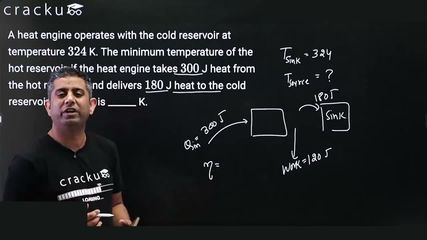
A heat engine operates with the cold reservoir at temperature $$324$$ K. The minimum temperature of the hot reservoir, if the heat engine takes $$300$$ J heat from the hot reservoir and delivers $$180$$ J heat to the cold reservoir per cycle, is ______ K.
Correct Answer: 540
We need to find the minimum temperature of the hot reservoir for a heat engine.
Since the cold reservoir temperature is $$T_C = 324$$ K, the heat absorbed from the hot reservoir is $$Q_H = 300$$ J, and the heat delivered to the cold reservoir is $$Q_C = 180$$ J, the engine must operate at maximum (Carnot) efficiency to achieve the minimum hot reservoir temperature.
For a Carnot engine, the relationship between heat exchanged and reservoir temperatures is given by
$$\frac{Q_C}{Q_H} = \frac{T_C}{T_H}$$
Substituting the given values into this expression, we have
$$\frac{180}{300} = \frac{324}{T_H}$$
From this,
$$\frac{3}{5} = \frac{324}{T_H}$$
This gives
$$T_H = \frac{324 \times 5}{3}$$
Next, simplifying the right-hand side yields
$$T_H = \frac{1620}{3} = 540$$ K
The minimum temperature of the hot reservoir is 540 K.
Was this solution helpful?
Click on the Email ☝️ to Watch the Video Solution
Create a FREE account and get:
_1.webp)

Educational materials for JEE preparation

Ask our AI anything

AI can make mistakes. Please verify important information.
AI can make mistakes. Please verify important information.
