Join WhatsApp Icon JEE WhatsApp Group
JEE Coordination Compounds Questions

JEE Coordination Compounds Questions

Question 1

Given below are h¥o statements:
Statement I: Hybridisation, shape and spin only magnetic moment of $$K_{3}[Co(CO_{3})_{3}]$$ is $$sp^{3}d^{2}$$, octahedral and 4.9 BM respectively.
Statement II: Geometty, hybridisation and spin only magnetic moment values (BM) of the ions $$[Ni(CN)_{4}]^{2-},[MnBr_{4}]^{2-}\text{ and }[CoF_{6}]^{3-}$$ respectively are square planar, tetrahedral, octahedral;$$dsp^{2},sp^{3},sp^{3}d^{2}$$ and 0, 5.9, 4.9.
In the light of the above statements, choose the correct answer from the options given below

Question 2

The statements that are incorrect about the nickel(II) complex of dimethylglyoxime are:
A. It is red in colour.
B. It has a high solubility in water at pH =9.
C. The Ni ion has two unpaired d-electrons.
D. The N - Ni - N bond angle is almost close to 90°
E. The complex contains four five-membered metallacycles (metal containing rings).
Choose the correct answer from the options given below :

Question 3

The correct statement among the followring is:

Question 4

Given below are two statements:
Statement I: Among $$[Cu(NH_{3})_{4}]^{2+},[Ni(en)_{3})]^{2+},[Ni(NH_{3})_{6}]^{2+}$$ and $$[Mn(H_{2}O)_{6}]^{2+},[Mn(H_{2}O)_{6}]^{2+}$$ has the maximum number of unpaired electrons.
Statement II : The number of pairs among $$\left\{[Ni(Cl_{4}]^{2-},[Ni(CO)_{4}]\right\}$$, $$\left\{[NiCl_{4}]^{2-},[Ni(CN)_{4}]^{2-}\right\}$$ and $$\left\{[Ni(CO)_{4}],[Ni(CN)_{4}]^{2-}\right\}$$ that contain only diamagnetic species is two.
ln the light of the above statements, choose the correct answer from the options given below:

Question 5

Given below are two statements:
Statement I : Crystal Field Stabilization Energy (CFSE) of $$\left[Cr\left( H_{2}O \right)_{6} \right]^{2+}$$ is greater than that of $$\left[Mn\left( H_{2}O \right)_{6} \right]^{2+}$$.
Statement II: Potassium ferricyanide has a greater spin-only magnetic moment than sodium ferrocyanide.
In the light of the above statements, choose the correct answer from the options given below :

Question 6

Given below are two statements :
Statement I: $$[CoBr_{4}]^{2-}$$ ion will absorb light of lower energy than $$[CoCl_{4}]^{2-}$$ ion.
Statement II: In $$[Col_{4}]^{2-}$$ ion, the energy separation between the two set of d-orbitals is more than $$[CoCl_{4}]^{2-}$$ ion.
ln the light of the above statements, choose the correct answer from the options given below:

Question 7

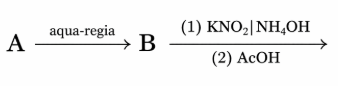
Consider the following reactions.
$$PbCl_{2}+K_{2}CrO_{4}\rightarrow A+2KCI$$
(Hot solution)
$$A+NaOH\rightleftharpoons B+Na_{2}CrO_{4}$$
$$PbSO_{4}+4CH_{3}COONH_{4}\rightarrow (NH_{4})_{2}SO_{4}+X$$
In the above reactions, A, Band X are respectively.

Question 8

The correct increasing o rd e r of spin-only magnetic moment values of the complex ions $$[MnBr_{4}]^{2-}(A),[Cu(H_{2}O)_{6}]^{2+}(B),[Ni(CN)_{4}]^{2-}(C)$$ and $$[Ni(H_{2}O)_{6}]^{2+}(D)$$ is:

Question 9

Identify the CORRECT set of details from the following:

A. $$[Co(NH_3)_6]^{3+}$$ : Inner orbital compex; $$d^{2}sp^{3}$$ hybridized

B. $$[MnCl_6]^{3-}$$ : Outer orbital complex; $$sp^{3}d^{2}$$ hybridized

C. $$[CoF_6]^{3-}$$ : Outer orbital complex; $$d^{2}sp^{3}$$ hybridized

D. $$[FeF_6]^{3-}$$ : Outer orbital complex; $$sp^{3}d^{2}$$ hybridized

E. $$[Ni(CN)_4]^{2-}$$ : Inner orbital complex; $$sp^{3}d^{2}$$ hybridized

Choose the correct answer from the options given below:

Question 10

Consider a mixtm-e 'X' which is made by dissolving 0.4 mol of $$[Co(NH_{3})_{5}SO_{4}]Br$$ and 0.4 mol of $$[Co(NH_{3})_{5}Br]SO_{4}$$ in water to make 4 L of solution. When 2 L of mixture 'X' is allowed to react with excess of $$AgNO_{3}$$,it fonns precipitate 'Y'. The rest 2 L of mixture 'X' reacts with excess $$BaCl_{2}$$ to fonn precipitate 'Z'. Which of the following statements is CORRECT?

Question 11

Consider the metal complexes $$[Ni(en)_3]^{2+}$$ (A), $$[NiCl_4]^{2-}$$ (B) and $$[Ni(NH_3)_6]^{2+}$$ (C). Choose the CORRECT option by considering the number of unpaired electrons present in (A), (B) and (C) respectively and the order of frequency of absorption

Question 12

Identify the correct statements from the following

$$\textbf{A.}$$ $$[\text{Fe}(\text{C}_2\text{O}_4)_3]^{3-}$$ is the most stable complex among $$[\text{Fe}(\text{OH})_6]^{3-}$$, $$[\text{Fe}(\text{C}_2\text{O}_4)_3]^{3-}$$ and $$[\text{Fe}(\text{SCN})_6]^{3-}$$

$$\textbf{B.}$$ The stability of $$[\text{Cu}(\text{NH}_3)_4]^{2+}$$ is greater than that of $$[\text{Cu}(\text{en})_2]^{2+}$$

$$\textbf{C.}$$ The hybridization of Fe in $$\text{K}_4[\text{Fe}(\text{CN})_6]$$ is $$d^2sp^3$$

$$\textbf{D.}$$ $$[\text{Fe}(\text{NO}_2)_3\text{Cl}_3]^{3-}$$ exhibits linkage isomerism

$$\textbf{E.}$$ $$\text{NO}_2^{-}$$ and $$\text{SCN}^{-}$$ ligands are NOT ambidentate ligands

Choose the correct answer from the options given below:

Question 13

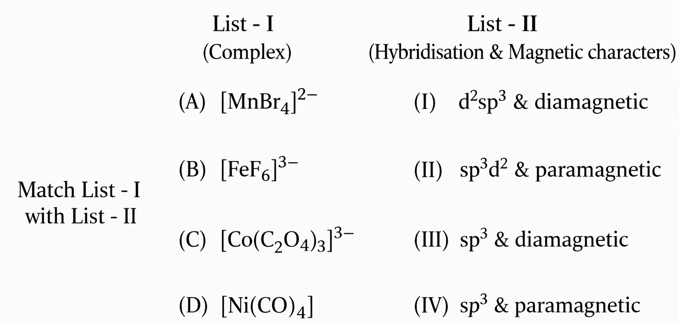
Match List - I with List - Il according to shape.
        List - I                      List - II
A. $$ XeO_3 $$                   I.     $$ BrF_5 $$
B. $$ XeF_2 $$                    II.    $$ NH_3 $$
C. $$ XeO_2 F_2 $$              III.   $$ [I_3]^-{} $$
D. $$ XeOF_4 $$                IV.   $$ SF_4 $$
Choose the correct answer from the options given below:

Question 14

Match the LIST-I with LIST-II

List-I
Electronic configuration of tetrahedral metal ion
List-II
Crystal Field Stabilization Energy ($$\Delta_t$$)
A.d$$^2$$I.-0.6
B.d$$^4$$II.-0.8
C.d$$^6$$III.-1.2
D.d$$^8$$IV.-0.4

Choose the correct answer from the options given below:
Question 15

Which of the following complexes will show coordination isomerism?
A. $$[Ag(NH_3)_2][Ag(CN)_2]$$
B. $$[Co(NH_3)_6][Cr(CN)_6]$$
C. $$[Co(NH_3)_6][Co(CN)_6]$$
D. $$[Fe(NH_3)_6][Co(CN)_6]$$
E. $$[Co(NH_3)_6][Fe(CN)_6]$$
Choose the correct answer from the options given below :

Question 16

Which of the following sequences of hybridisation, geometry and magnetic nature are correct for the given coordination compounds?
A. $$[NiCl_4]^{2-}$$ -- sp$$^3$$, tetrahedral, paramagnetic
B. $$[Ni(NH_3)_6]^{2+}$$ -- sp$$^3$$d$$^2$$, octahedral, paramagnetic
C. $$[Ni(CO)_4]$$ -- sp$$^3$$, tetrahedral, paramagnetic
D. $$[Ni(CN)_4]^{2-}$$ -- dsp$$^2$$, square planar, diamagnetic
Choose the correct answer from the options given below :

Question 17

Given below are two statements:
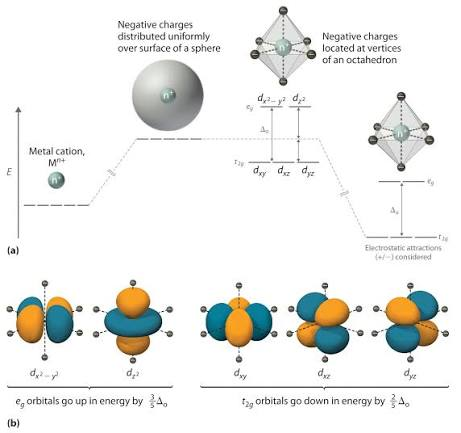
Statement I: Each electron in $$e_g$$ orbitals destabilizes the orbitals by $$+0.6 \Delta_o$$ and each electron in the $$t_{2g}$$ orbitals stabilizes the orbitals by $$-0.4 \Delta_o$$ in an octahedral field on the basis of crystal field theory.
Statement II: All the d-orbitals of the transition metals have the same energy in their free atomic state but when a complex is formed the ligands destroy the degeneracy of these orbitals on the basis of crystal field theory.
In the light of the above statements, choose the correct answer from the options given below

Question 18

Given below are two statements:
Statement I: The number of paramagnetic species among $$[CoF_{6}]^{3-},[TiF_{6}]^{3-},V_{2}O_{5}\text{ and }[Fe(CN)_{6}]^{3-}$$ is 3.
Statement II: $$K_{4}[Fe(CN)_{6}] < K_{3}[Fe(CN)_{6}] < [Fe(H_{2}O)_{6}]SO_{4}.H_{2}O < [Fe(H_{2}O)_{6}]Cl_{3}$$ is the correct order in terms of number of unpaired electron(s) present in the complexes.
In the light of the above statements, choose the correct answer from the options given below

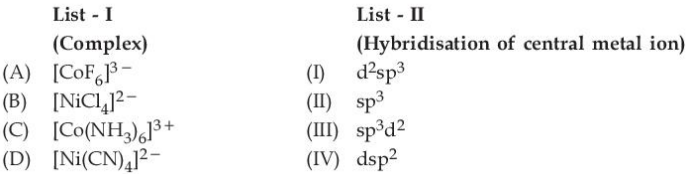
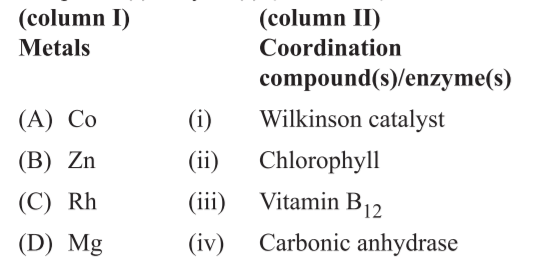
Question 19

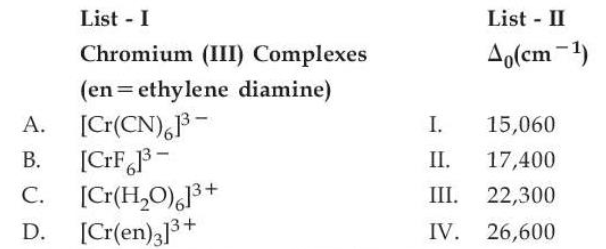
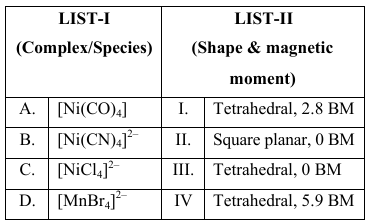
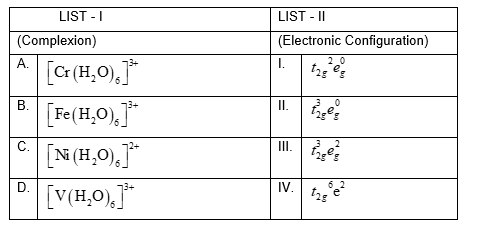
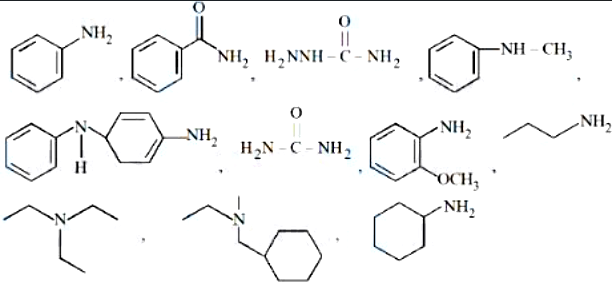
Match List - I with List - II. 

image

Choose the correct answer from the options given below :

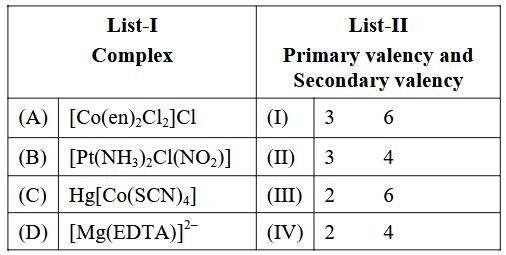
Question 20

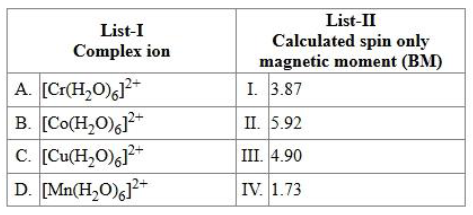
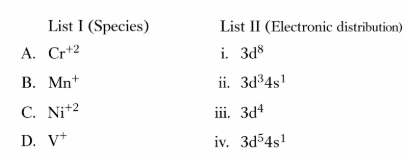
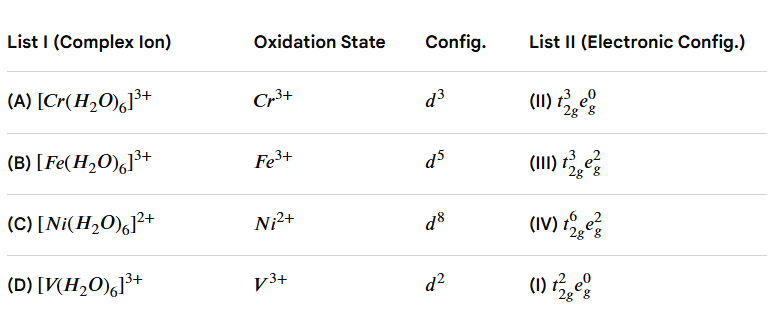
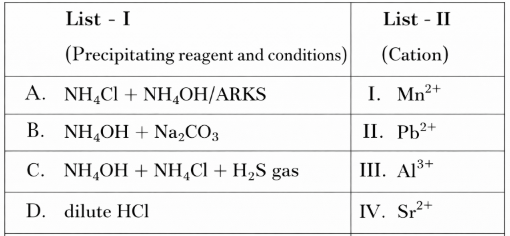
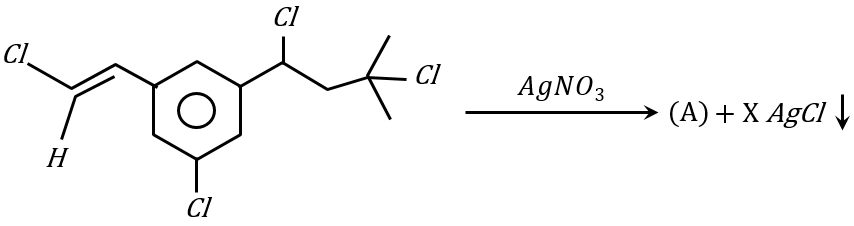
Match the LIST-I with LIST-II.

image

choose the correct answer from the options given below

Question 21

Which of the following are true about the energy of the given d-orbitals of a tetrahedral complex?

A. $$d_{xy} = d_{xz} > d_{x^2-y^2}$$
B. $$d_{xy} = d_{yz} > d_{z^2}$$
C. $$d_{x^2-y^2} > d_{z^2} > d_{xz}$$
D. $$d_{x^2-y^2} = d_{z^2} < d_{xz}$$

Choose the correct answer from the given below:

Question 22

Among the following, the CORRECT combinations are
$$\text{A. IF}_{3} \rightarrow \text{T-shaped}(\text{sp}^{3}\text{d})$$
$$\text{B. IF}_{5} \rightarrow \text{Square pyramidal(sp}^{3}\text{d}^{2})$$
$$\text{C. IF}_{7} \rightarrow \text{Pentagonal bipyrnmidal(sp}_{3}\text{d}^{3})$$
$$\text{D. ClO}_{4}^{-} \rightarrow \text{Square planar(sp}^{3}\text{d})$$
Choose the correct answer from the options given below:

Question 23

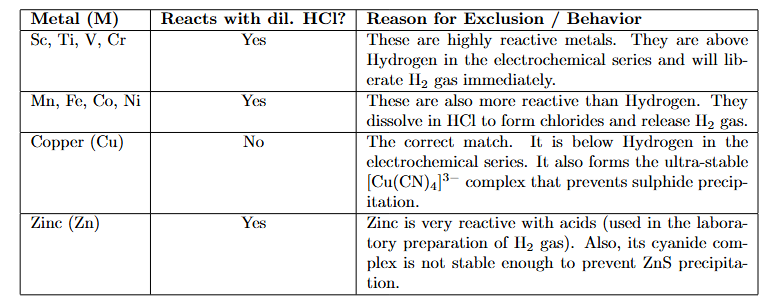
A first row transition metal (M) does not liberate $$H_{2}$$ gas from dilute HCI. 1 mol of aqueous solution of $$MSO_{4}$$ is treated with excess of aqueous KCN and then $$H_{2} S(g)$$ is passed through the solution. The amount of MS (metal sulphide) formed from the above reaction is _______ mol.

Video Solution
Question 24

Consider the following statements about manganate and permanganate ions. Identify the correct statements.
A. The geometry of both manganate and permanganate ions is tetrahedral
B. The oxidation states of Mn in manganate and permanganate are + 7 and + 6, respectively.
C. Oxidation of Mn(II) salt by peroxodisulphate gives manganate ion as the final product.
D. Manganate ion is paramagnetic and permanganate ions is diamagnetic.
E. Acidified permanganate ion reduces oxalate, nitrite and iodide ions.
Choose the correct answer from the options given below :

Question 25

Two p-block elements $$X$$ and $$Y$$ form fluorides of the type $$EF_{3}$$. The fluoride compound $$XF_{3}$$ is a Lewis acid and $$YF_{3}$$ is a Lewis base. The hybridizations of the central atoms of $$XF_{3}$$ and $$YF_{3}$$ respectively are

Question 26

$$[Ni (PPh_{3})_{2}Cl_{2} ]$$ is a paramagnetic complex. Identify the INCORRECT statements about this complex.
A. The complex exhibits geometrical isomerism.
B. The complex is white in colour.
C. The calculated spin-only magnetic moment of the complex is 2.84 BM.
D. The calculated CFSE (Crystal Field Stabilization Energy) of Ni in this complex is $$-0.8 \triangle_{0}$$
E. The geometrical arrangement of ligands in this complex is similar to that in $$Ni(CO)_{4}$$.
Choose the correct answer from the options given below :

Question 27

Given below are two statements:
Statement I :
The number of species among $$SF_{4},NH_4^+,[NiCl_{4}]^{2-},XeF_{4},[PtCl_{4}]^{2-},SeF_{4}$$ and $$[Ni(CN)_{4}]^{2-}$$, tha t have tetrahedral geometry is 3.
Statement II :
In the set $$[NO_{2},BeH_{2},BF_{3},AlCl_{3}]$$ all the molecules have incomplete octet around central atom.
In the light of the above statements, choose the correct answer from the options given below :

Question 28

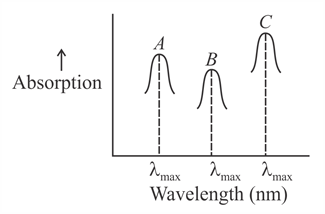
The wavelength of light absorbed for the following complexes are in the order
(I)$$\left[Co{(NH_{3})}_{6}\right]^{3+}$$
(II)$$\left[Co{(H_{2}O)}_{6}\right]^{3+}$$
(III)$$\left[Co{(CN)}_{6}\right]^{3-}$$
(IV)$$\left[Co(NH_{3})_{5}(H_{2}O)\right]^{3+}$$
(V)$$\left[CoF_{6}\right]^{3-}$$

Question 29

5.33 g of CrCl$$_3$$·6H$$_2$$O, which is a 1 : 3 electrolyte, is dissolved in water and is passed through a cation exchanger. The chloride ions in the eluted solution, on treatment with AgNO$$_3$$ results in 8.61 g of AgCl. The ratio of moles of complex reacted and moles of AgCl formed is __________ × 10$$^{-2}$$. (Nearest integer) [Molar mass in g mol$$^{-1}$$ Cr : 52, Ag : 108, Cl : 35.5, H : 1, O : 16]

Question 30

An excess of AgNO$$_3$$ is added to 100 mL of a 0.05 M solution of tetraaquadichloridochromium (III) chloride. The number of moles of AgCl precipitated will be __________ $$\times 10^{-3}$$. (Nearest integer)

Question 31

Number of paramagnetic complexes among the following is __________.
$$[\text{MnBr}_4]^{2-}$$, $$[\text{NiCl}_4]^{2-}$$, $$[\text{Ni(CN)}_4]^{2-}$$, $$[\text{Ni(CO)}_4]$$, $$[\text{CoF}_6]^{3-}$$, $$[\text{Fe(CN)}_6]^{4-}$$, $$[\text{Mn(CN)}_6]^{3-}$$, $$[\text{Ti(CN)}_6]^{3-}$$, $$[\text{Cu(H}_2\text{O)}_6]^{2+}$$, $$[\text{Co(C}_2\text{O}_4)_3]^{3-}$$

Question 32

The crystal field splitting energy of $$[Co(oxalate)_{3}]^{3-}$$ complex is 'n' times that of the $$[Cr(oxalate)_{3}]^{3-}$$ complex. Here 'n' is_______. (Assume d $$\triangle_{\circ} > > P$$)

Question 33

The total number of unpaired electrons present in the $$d^3$$, $$d^4$$ (low spin), $$d^5$$ (high spin), $$d^6$$ (high spin), and $$d^7$$ (low spin) octahedral complexes systems is :

Question 34

The numbei of isoelectronic species among $$Sc^{3+},Cr^{2+},Mn^{3+},Co^{3+}\text{ and }Fe^{3+}$$ is 'n'. If 'n' moles of AgCl is formed during the reaction of complex with formula $$CoCl_{3}(en)_{2}NH_{3}$$ with excess of $$AgNO_{3}$$ solution, then the number of electrons present in the $$t_{2g}$$ orbital of the complex is ________.

Question 35

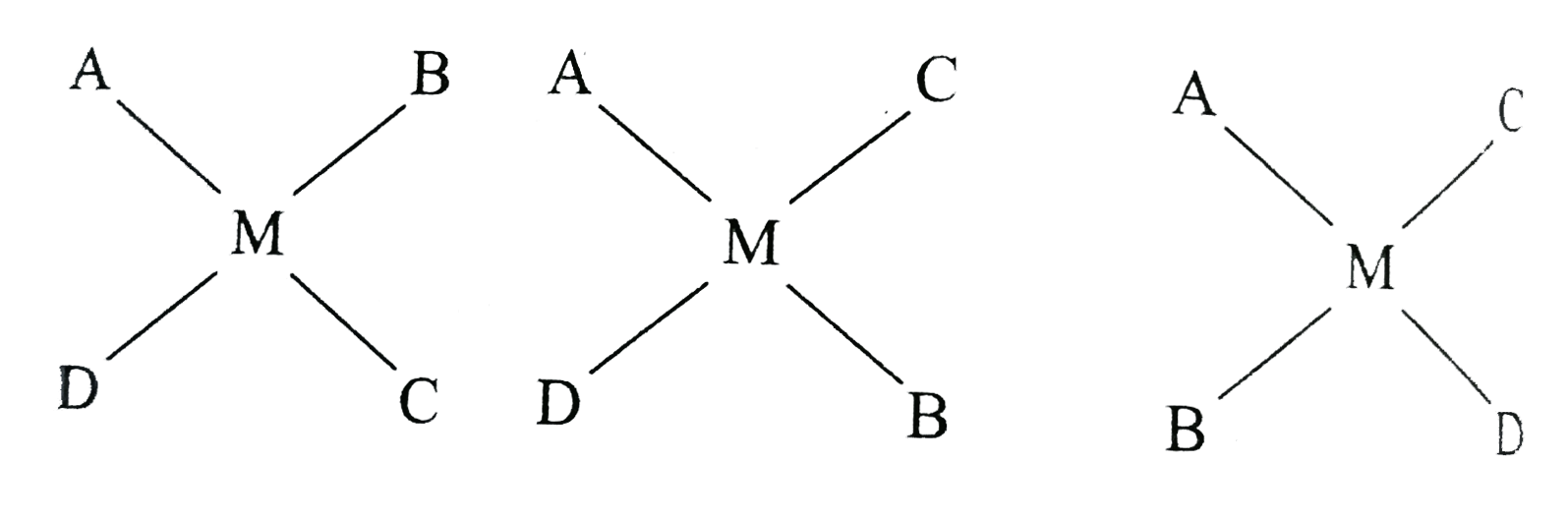
X is the number of geometrical isomers exhibited by $$[Pt(NH_{3})(H_{2}O)BrCl]$$.
Y is the number of optically inactive isomer(s) exhibited by $$[CrCl_{2}(ox)_{2}]^{3-}$$
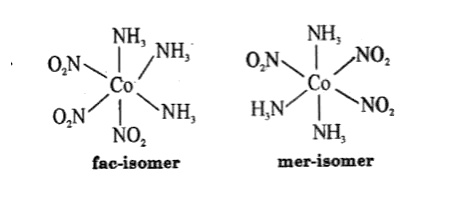
z is the number of geometrical isomers exhibited by $$[Co(NH_{3})_{3}(NO_{2})_{3}]$$.
The value of X + Y + Z is________.

Question 36

A chromium complex with a formula $$CrCl_{3}.6H_{2}O$$ has a spin only magnetic moment value of 3.87 BM and its solution conductivity corresponds to 1:2 electrolyte. 2.75 g of the complex solution was initially passed through a cation exchanger. The solution obtained after the process was reacted with excess of $$AgNO_{3}$$. The amount of AgCI formed in the above process is __ g. (Nearest
integer)
[Given: Molar massing $$mol^{-1}$$ Cr:52; Cl:35.5, Ag:108, 0:16, H:1]

Question 37

Identify the metal ions among $$Co^{2+}, Ni^{2+}, Fe^{2+}, V^{3+} \text{ and } Ti^{2+}$$ having a spin-only magnetic moment value more than 3.0 BM. The sum of unpaired electrons present in the high spin octahedral complexes formed by those metal ions is __________.

Question 38

Total number of unpaired electrons present in the central met al atoms/ions of
$$[Ni(CO)_4],[NiCl_4]^{2-},[PtCl_2(NH_3)_2],[Ni(CN)_4]^{2-}$$ and $$[Pt(CN)_4]^{2-}$$ is_____

50,000+ JEE Students Trusted Our Score Calculator

Predict your JEE Main percentile, rank & performance in seconds