
Join Our JEE Preparation Group
Prep with like-minded aspirants; Get access to free daily tests and study material.
Sign in
Please select an account to continue using cracku.in
↓ →
Join Our JEE Preparation Group
Prep with like-minded aspirants; Get access to free daily tests and study material.
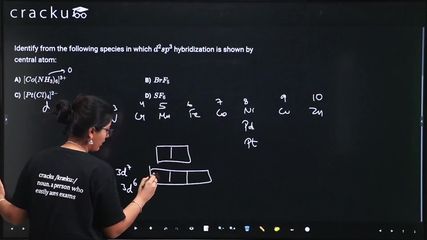
Identify from the following species in which $$d^2sp^3$$ hybridization is shown by central atom:
We need to identify from the given options the species in which the central atom exhibits $$d^2sp^3$$ hybridization.
Statement (A): $$[Co(NH_3)_6]^{3+}$$ In this complex, the central cobalt atom is in the $$+3$$ oxidation state, giving it a $$3d^6$$ electronic configuration. Ammonia ($$NH_3$$) acts as a strong field ligand, forcing the unpaired electrons in the $$3d$$ orbitals to pair up. This leaves two internal $$3d$$ orbitals vacant, allowing the cobalt atom to undergo $$d^2sp^3$$ (inner orbital octahedral) hybridization. This is TRUE.
Statement (B): $$BrF_5$$ The central bromine atom has 7 valence electrons and forms 5 single bonds with fluorine atoms, leaving 1 lone pair. With a steric number of 6 ($$5 \text{ bond pairs} + 1 \text{ lone pair}$$), the hybridization of bromine is $$sp^3d^2$$ (outer orbital square pyramidal). This is FALSE.
Statement (C): $$[Pt(Cl)_4]^{2-}$$ Platinum(II) belongs to the $$5d$$ transition series and possesses a $$5d^8$$ configuration. Due to the high crystal field splitting energy of $$5d$$ elements, the electrons pair up even with weak ligands like chloride. With a coordination number of 4, it undergoes $$dsp^2$$ hybridization to form a square planar geometry. This is FALSE.
Statement (D): $$SF_6$$ The central sulfur atom has 6 valence electrons, all of which are shared with 6 fluorine atoms to form 6 bond pairs and 0 lone pairs. With a steric number of 6, it uses its outer $$d$$ orbitals, resulting in $$sp^3d^2$$ hybridization with an octahedral geometry. This is FALSE.
Therefore, only the central atom in $$[Co(NH_3)_6]^{3+}$$ shows $$d^2sp^3$$ hybridization.
Answer: Option A — $$[Co(NH_3)_6]^{3+}$$
Was this solution helpful?
Click on the Email ☝️ to Watch the Video Solution
Create a FREE account and get:
Educational materials for JEE preparation

Ask our AI anything

AI can make mistakes. Please verify important information.
AI can make mistakes. Please verify important information.

_1.webp)
