
Join Our JEE Preparation Group
Prep with like-minded aspirants; Get access to free daily tests and study material.
Sign in
Please select an account to continue using cracku.in
↓ →
Join Our JEE Preparation Group
Prep with like-minded aspirants; Get access to free daily tests and study material.
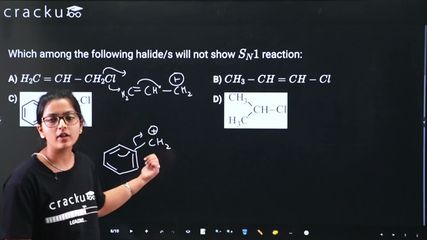
We need to identify which of the given halides will not undergo an $$S_N1$$ reaction.
Key Concept: The rate of an $$S_N1$$ reaction depends directly on the stability of the carbocation intermediate formed during the rate-determining step. Compounds that form highly unstable carbocations, or compounds where the leaving group carbon cannot easily bear a positive charge due to resonance or hybridization factors, will not show an $$S_N1$$ reaction.
Option A: $$H_2C=CH-CH_2Cl$$ (Allyl chloride). When the chloride ion leaves, it forms the allyl carbocation: $$H_2C=CH-CH_2^+ \leftrightarrow H_2C^+-CH=CH_2$$ This carbocation is highly stabilized by resonance. Therefore, it undergoes an $$S_N1$$ reaction very easily. This is FALSE.
Option B: $$CH_3-CH=CH-Cl$$ (1-Chloroprop-1-ene). This is a vinylic halide. The lone pair of electrons on the chlorine atom is in conjugation with the $$\pi$$-bond of the double bond: $$CH_3-CH=CH-\ddot{Cl}: \leftrightarrow CH_3-\bar{CH}-CH=\overset{+}{Cl}:$$ Due to resonance, the carbon-chlorine bond acquires a partial double-bond character, making it extremely difficult to break. Furthermore, the vinylic carbocation ($$$CH_3-CH=CH^+$$$) that would form is highly unstable because the positive charge resides on an $$sp^2$$ hybridized carbon atom. Thus, it will not show an $$S_N1$$ reaction. This is TRUE.
Option C: Vinyl chloride derivatives / Aryl halides. If the option represents a vinyl or aryl halide structure (where chlorine is directly attached to an $$sp^2$$ carbon of a double bond or aromatic ring), it will experience the same partial double-bond character due to resonance and will not undergo an $$S_N1$$ reaction.
Option D: Chlorobenzene or Bridgehead halides. If the option contains an aryl halide or a bridgehead halide, it cannot undergo $$S_N1$$ because aryl carbocations are highly unstable, and bridgehead positions cannot form the planar carbocation required for $$S_N1$$ stability (Bredt's rule).
Among the structural choices, the vinyl halide $$CH_3-CH=CH-Cl$$ strictly prevents the formation of a carbocation intermediate under standard conditions.
Answer: Option B — $$CH_3-CH=CH-Cl$$
Was this solution helpful?
Click on the Email ☝️ to Watch the Video Solution
Create a FREE account and get:
_1.webp)

Educational materials for JEE preparation

Ask our AI anything

AI can make mistakes. Please verify important information.
AI can make mistakes. Please verify important information.
