
Join Our JEE Preparation Group
Prep with like-minded aspirants; Get access to free daily tests and study material.
Sign in
Please select an account to continue using cracku.in
↓ →
Join Our JEE Preparation Group
Prep with like-minded aspirants; Get access to free daily tests and study material.
Identify B formed in the reaction.
$$Cl-(CH_2)_4-Cl \xrightarrow{excess\ NH_3} A \xrightarrow{NaOH} B + H_2O + NaCl$$
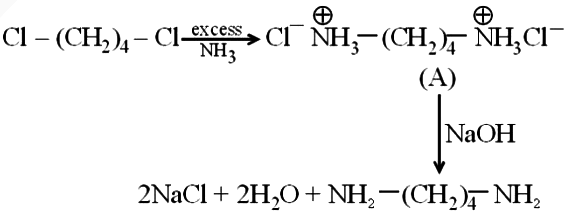
We need to identify the compound $$B$$ formed in the given two-step reaction sequence starting from 1,4-dichlorobutane.
Key Concept: When an alkyl halide reacts with excess ammonia ($$NH_3$$), it undergoes nucleophilic substitution ($$S_N2$$) to form an amine salt. Treating this salt with a strong base like sodium hydroxide ($$NaOH$$) liberates the free amine.
Step 1: Reaction of 1,4-dichlorobutane with excess ammonia to form intermediate A
In this step, both terminal chlorine atoms of $$Cl-(CH_2)_4-Cl$$ are substituted by ammonia molecules. Because ammonia is used in excess, it prevents further alkylation and yields the corresponding dicationic ammonium salt as intermediate $$A$$:
$$Cl-(CH_2)_4-Cl + 2NH_3 \rightarrow [^{-}ClH_3N^{+}-(CH_2)_4-^{+}NH_3Cl^{-}]$$
Thus, intermediate $$A$$ is butane-1,4-diaminium chloride.
Step 2: Reaction of intermediate A with sodium hydroxide to form B
When the ammonium salt intermediate $$A$$ is treated with $$NaOH$$, a neutralization reaction takes place. The hydroxide ions ($$OH^-$$) deprotonate the ammonium groups, releasing the free diamine, water, and sodium chloride:
$$[^{-}ClH_3N^{+}-(CH_2)_4-^{+}NH_3Cl^{-}] + 2NaOH \rightarrow H_2N-(CH_2)_4-NH_2 + 2H_2O + 2NaCl$$
The free amine $$B$$ formed is butane-1,4-diamine (putrescine), which has the structural formula $$H_2N-(CH_2)_4-NH_2$$.
Therefore, compound $$B$$ is $$H_2N-(CH_2)_4-NH_2$$, which corresponds to Option B.
Answer: Option B — $$H_2N-(CH_2)_4-NH_2$$
Was this solution helpful?
Click on the Email ☝️ to Watch the Video Solution
Create a FREE account and get:
_1.webp)

Educational materials for JEE preparation

Ask our AI anything

AI can make mistakes. Please verify important information.
AI can make mistakes. Please verify important information.
