
Join Our JEE Preparation Group
Prep with like-minded aspirants; Get access to free daily tests and study material.
Sign in
Please select an account to continue using cracku.in
↓ →
Join Our JEE Preparation Group
Prep with like-minded aspirants; Get access to free daily tests and study material.
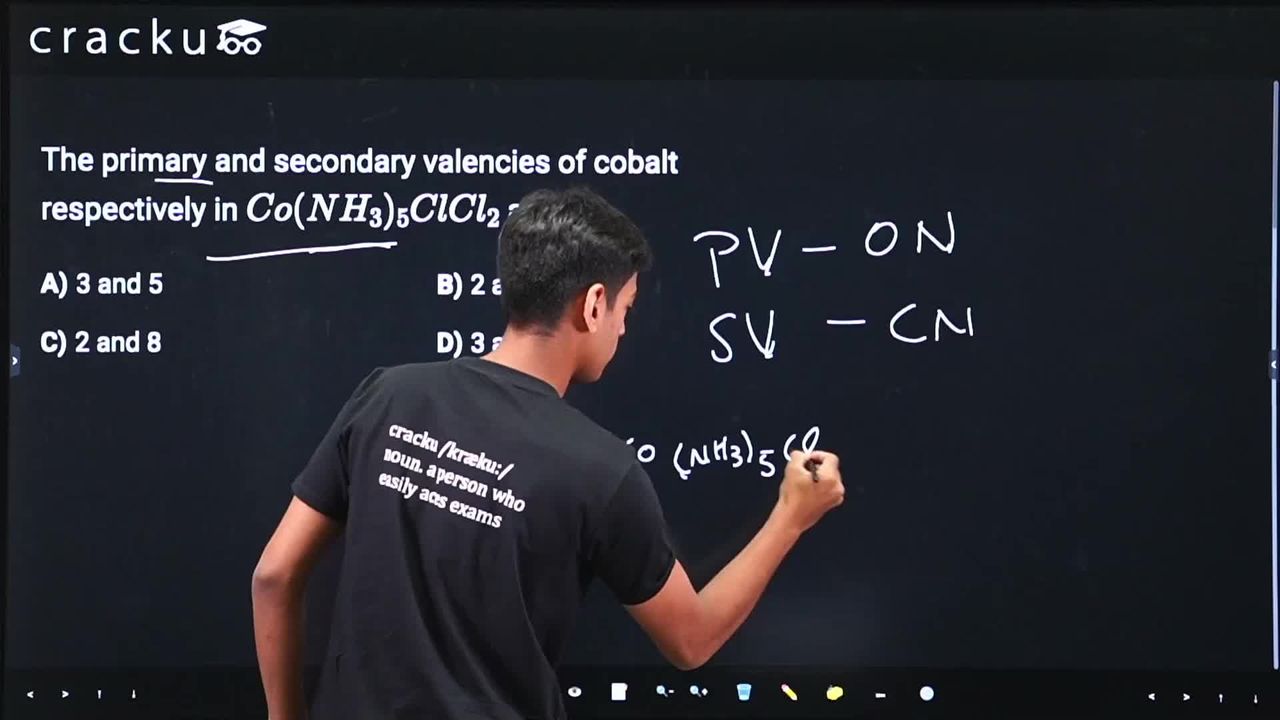
The primary and secondary valencies of cobalt respectively in $$Co(NH_3)_5ClCl_2$$ are:
We need to find the primary and secondary valencies of cobalt in $$Co(NH_3)_5ClCl_2$$.
Understand Werner's theory of coordination compounds.
According to Werner's theory:
- Primary valency corresponds to the oxidation state of the metal ion. It is ionisable and is satisfied by negative ions.
- Secondary valency corresponds to the coordination number. It is non-ionisable and represents the number of ligands directly bonded to the metal ion.
Write the coordination compound in proper notation.
$$Co(NH_3)_5ClCl_2$$ can be written as $$[Co(NH_3)_5Cl]Cl_2$$, where:
- The part inside square brackets is the coordination sphere: $$[Co(NH_3)_5Cl]^{2+}$$
- The two $$Cl^-$$ outside are counter ions (satisfy primary valency)
Determine the primary valency (oxidation state).
Let the oxidation state of Co be $$x$$. The overall charge on the complex ion is +2 (to balance two $$Cl^-$$):
$$x + 5(0) + (-1) = +2$$
$$x = +3$$
Primary valency = 3.
Determine the secondary valency (coordination number).
Count the total number of ligands directly attached to Co: 5 $$NH_3$$ molecules + 1 $$Cl^-$$ = 6 ligands.
Secondary valency = 6.
The correct answer is Option (4): 3 and 6.
Was this solution helpful?
Click on the Email ☝️ to Watch the Video Solution
Create a FREE account and get:
_1.webp)

Educational materials for JEE preparation

Ask our AI anything

AI can make mistakes. Please verify important information.
AI can make mistakes. Please verify important information.
