
Join Our JEE Preparation Group
Prep with like-minded aspirants; Get access to free daily tests and study material.
Sign in
Please select an account to continue using cracku.in
↓ →
Join Our JEE Preparation Group
Prep with like-minded aspirants; Get access to free daily tests and study material.
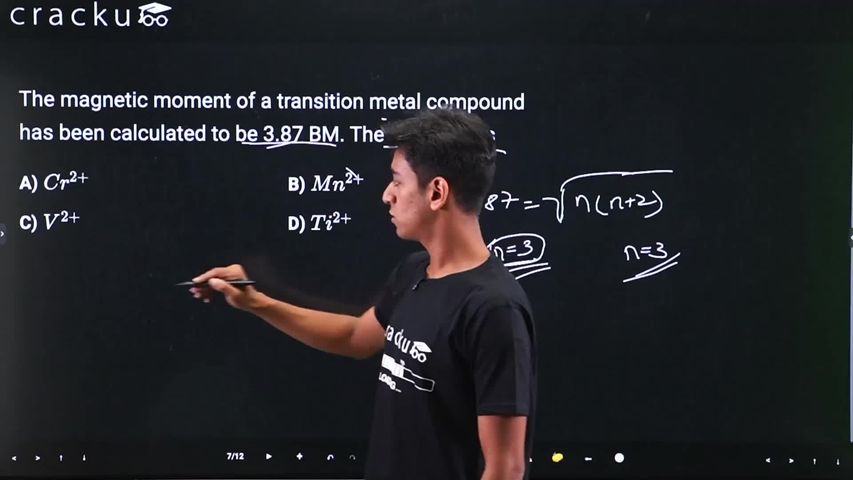
The magnetic moment of a transition metal compound has been calculated to be 3.87 BM. The metal ion is
The magnetic moment is given by the formula:
$$\mu = \sqrt{n(n+2)} \text{ BM}$$
where $$n$$ is the number of unpaired electrons.
Given $$\mu = 3.87 \text{ BM}$$, substitute into the formula:
$$3.87 = \sqrt{n(n+2)}$$
Square both sides:
$$(3.87)^2 = n(n+2)$$
Calculate $$(3.87)^2$$:
$$3.87 \times 3.87 = 14.9769 \approx 15$$
So,
$$n(n+2) = 15$$
Solve the quadratic equation:
$$n^2 + 2n - 15 = 0$$
Factorize:
$$(n + 5)(n - 3) = 0$$
Thus, $$n = 3$$ or $$n = -5$$. Since the number of unpaired electrons cannot be negative, $$n = 3$$.
Now, determine which metal ion has 3 unpaired electrons by examining their electron configurations:
Option A: $$Cr^{2+}$$
Chromium (atomic number 24) has electron configuration $$[Ar] 4s^1 3d^5$$. $$Cr^{2+}$$ loses two electrons: first the 4s electron, then one from 3d, resulting in $$[Ar] 3d^4$$. For a free ion, the 3d orbitals are degenerate. Placing 4 electrons in 5 orbitals with maximum unpaired electrons gives 4 unpaired electrons.
Option B: $$Mn^{2+}$$
Manganese (atomic number 25) has configuration $$[Ar] 4s^2 3d^5$$. $$Mn^{2+}$$ loses two 4s electrons, resulting in $$[Ar] 3d^5$$. With 5 electrons in degenerate orbitals, all are unpaired, giving 5 unpaired electrons.
Option C: $$V^{2+}$$
Vanadium (atomic number 23) has configuration $$[Ar] 4s^2 3d^3$$. $$V^{2+}$$ loses two 4s electrons, resulting in $$[Ar] 3d^3$$. Placing 3 electrons in degenerate orbitals gives 3 unpaired electrons.
Option D: $$Ti^{2+}$$
Titanium (atomic number 22) has configuration $$[Ar] 4s^2 3d^2$$. $$Ti^{2+}$$ loses two 4s electrons, resulting in $$[Ar] 3d^2$$. Placing 2 electrons in degenerate orbitals gives 2 unpaired electrons.
Therefore, only $$V^{2+}$$ has 3 unpaired electrons, matching the calculated magnetic moment.
Verification of magnetic moments:
Thus, the correct answer is option C: $$V^{2+}$$.
Was this solution helpful?
Click on the Email ☝️ to Watch the Video Solution
Create a FREE account and get:
_1.webp)

Educational materials for JEE preparation

Ask our AI anything

AI can make mistakes. Please verify important information.
AI can make mistakes. Please verify important information.
