
Join Our JEE Preparation Group
Prep with like-minded aspirants; Get access to free daily tests and study material.
Sign in
Please select an account to continue using cracku.in
↓ →
Join Our JEE Preparation Group
Prep with like-minded aspirants; Get access to free daily tests and study material.
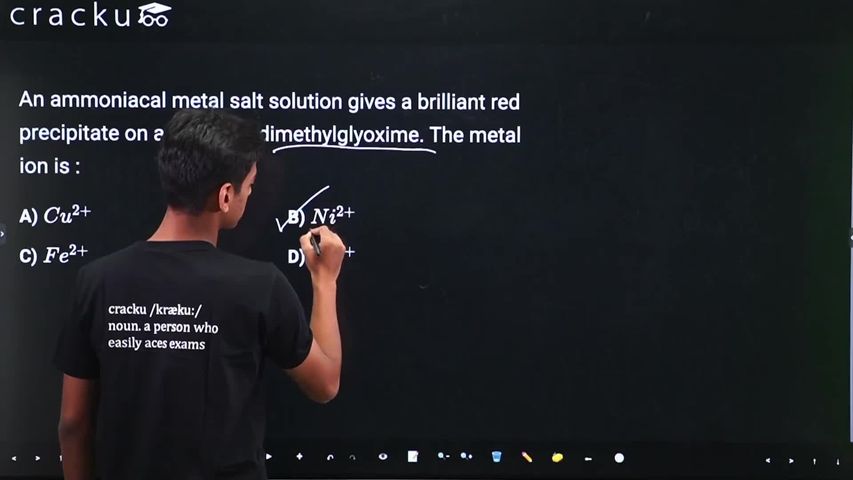
An ammoniacal metal salt solution gives a brilliant red precipitate on addition of dimethylglyoxime. The metal ion is :
We need to identify the metal ion that gives a brilliant red precipitate with dimethylglyoxime (DMG) in ammoniacal solution.
Recall the DMG test.
The dimethylglyoxime (DMG) test is a classic qualitative analytical test used specifically for the identification of nickel(II) ions ($$Ni^{2+}$$). When an ammoniacal solution containing $$Ni^{2+}$$ is treated with an alcoholic solution of DMG, a characteristic brilliant red (or rosy red) precipitate is formed.
Understand the chemistry.
The red precipitate is nickel dimethylglyoximate, $$[Ni(DMG)_2]$$. In this complex:
- $$Ni^{2+}$$ forms a square planar complex with two DMG molecules
- Each DMG acts as a bidentate ligand, coordinating through its two nitrogen atoms
- The complex is stabilised by intramolecular O-H...O hydrogen bonds between the two DMG ligands
- The ammonia provides the basic medium necessary for DMG to deprotonate and act as a ligand
Why not the other options?
- $$Cu^{2+}$$ does not give a red precipitate with DMG
- $$Fe^{2+}$$ gives a red colour with DMG but in different conditions
- $$Co^{2+}$$ gives a brown precipitate with DMG, not red
The correct answer is Option (2): $$Ni^{2+}$$.
Was this solution helpful?
Click on the Email ☝️ to Watch the Video Solution
Create a FREE account and get:
_1.webp)

Educational materials for JEE preparation

Ask our AI anything

AI can make mistakes. Please verify important information.
AI can make mistakes. Please verify important information.
