Join WhatsApp Icon JEE WhatsApp Group
Question 48

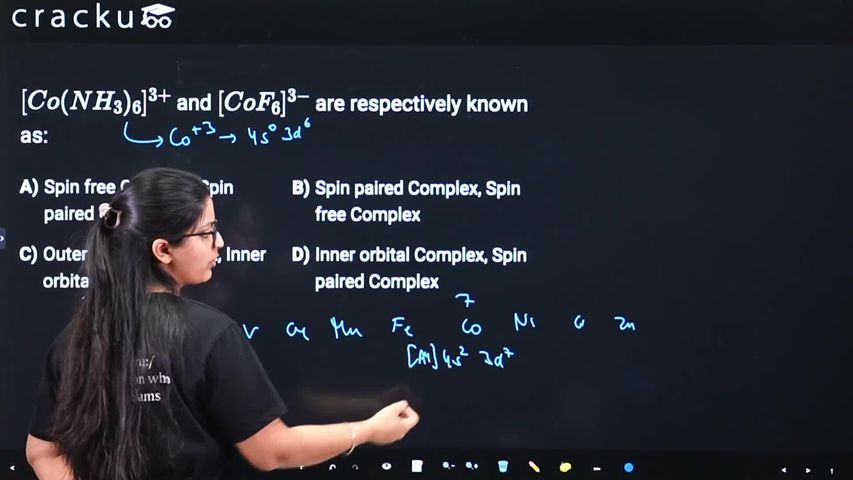
$$[Co(NH_3)_6]^{3+}$$ and $$[CoF_6]^{3-}$$ are respectively known as:

1. $$[\text{Co}(\text{NH}_3)_6]^{3+}$$

  • Oxidation State: Cobalt is in the +3 oxidation state and has  $$d^6$$ valence electron configuration.
  • Ligand Nature: Ammonia acts as a strong field ligand with $$\text{Co}^{3+}$$.
  • Spin Behavior: It provides a large crystal field splitting energy ($$\Delta_o$$), forcing all 6 d-electrons to pair up completely in the lower-energy $$t_{2g}$$ orbitals ($$t_{2g}^6 e_g^0$$).
  • Classification: Since the electrons are paired up by the ligand field, it is known as a Spin paired complex (or low-spin / inner orbital complex).

2. $$[\text{CoF}_6]^{3-}$$

  • Oxidation State: Cobalt is again in the +3 oxidation state ($$\text{Co}^{3+}$$, $$d^6$$).
  • Ligand Nature: Fluoride ($$\text{F}^-$$) is a classic weak field ligand.
  • Spin Behavior: The crystal field splitting energy ($$\Delta_o$$) is small, meaning it is energetically cheaper for electrons to remain unpaired and occupy higher energy $$e_g$$ orbitals according to Hund's rule ($$t_{2g}^4 e_g^2$$).
  • Classification: Because the electrons remain free from forced pairing, it is known as a Spin free complex (or high-spin / outer orbital complex).

Get AI Help

Video Solution

video

Create a FREE account and get:

  • Free JEE Mains Previous Papers PDF
  • Take JEE Mains paper tests
Ask AI