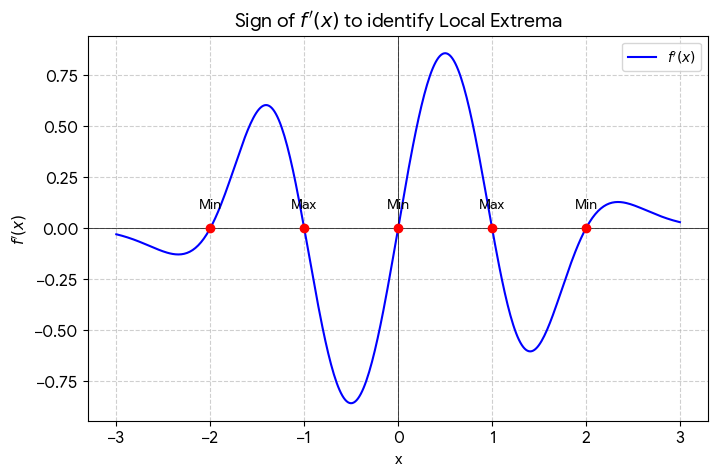
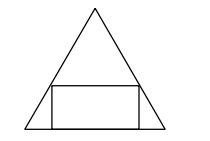
Let $$f(x)$$ be a polynomial of degree 5, and have extrema at $$x = 1$$ and $$x = -1$$. If $$\lim_{x \to 0} \left(\frac{f(x)}{x^3}\right ) = -5$$, then $$f(2) - f(-2)$$ is equal to :
JEE Applications of Derivatives Questions
Since $$f(x)$$ is a degree-5 polynomial, its derivative $$f'(x)$$ is degree 4.
Given that $$f(x)$$ has extrema at $$x = 1$$ and $$x = -1$$, we must have $$f'(1)=0$$ and $$f'(-1)=0$$.
Therefore $$(x-1)$$ and $$(x+1)$$ are factors of $$f'(x)$$, so:
$$f'(x)= (x-1)(x+1) \, q(x)= (x^2-1)\,q(x)$$ where $$q(x)$$ is a quadratic (degree 2) so the overall degree of $$f'(x)$$ remains 4.
Write $$q(x)=Ax^2+Bx+C$$, hence $$f'(x)=(x^2-1)(Ax^2+Bx+C)$$ $$-(1)$$
Integrating $$f'(x)$$ will give $$f(x)$$. First expand $$f'(x)$$:
$$f'(x)=A x^4 + B x^3 + C x^2 - A x^2 - B x - C$$ $$\;\;=A x^4 + B x^3 +(C-A)x^2 - B x - C$$
Integrate term by term:
$$f(x)=\int f'(x)\,dx$$ $$= \frac{A}{5}x^5 + \frac{B}{4}x^4 + \frac{C-A}{3}x^3 - \frac{B}{2}x^2 - Cx + D$$ $$-(2)$$
The limit condition is $$\lim_{x\to 0}\frac{f(x)}{x^3}=-5$$ $$-(3)$$
To make the limit finite, the terms $$x^0, x^1,$$ and $$x^2$$ must vanish in $$f(x)$$, i.e.
From $$(2)$$ we require $$f(0)=0 \;\Rightarrow\; D=0$$ $$f'(0)=0 \;\Rightarrow\; -C = 0 \;\Rightarrow\; C = 0$$ $$f''(0)=0 \;\Rightarrow\; -B = 0 \;\Rightarrow\; B = 0$$
Thus $$B=C=D=0$$. Equation $$(2)$$ simplifies to
$$f(x)=\frac{A}{5}x^5-\frac{A}{3}x^3$$ $$=A\left(\frac{x^5}{5}-\frac{x^3}{3}\right)$$ $$-(4)$$
Now use the limit $$(3)$$. Divide $$(4)$$ by $$x^3$$ and let $$x\to 0$$:
$$\frac{f(x)}{x^3}=A\left(\frac{x^2}{5}-\frac{1}{3}\right)\xrightarrow[x\to 0]{} -\frac{A}{3}$$
Set this equal to $$-5$$:
$$-\frac{A}{3}=-5\;\;\Longrightarrow\;\;A=15$$
Hence
$$f(x)=15\left(\frac{x^5}{5}-\frac{x^3}{3}\right)=3x^5-5x^3$$ $$-(5)$$
Finally compute $$f(2)-f(-2)$$:
$$f(2)=3(2)^5-5(2)^3=3\cdot32-5\cdot8=96-40=56$$ $$f(-2)=3(-2)^5-5(-2)^3=3(-32)-5(-8)=-96+40=-56$$
Therefore $$f(2)-f(-2)=56-(-56)=112$$
Option D which is: $$112$$
The number of critical points of the function $$f(x) = \begin{cases} \left|\frac{\sin x}{x}\right|, & x \neq 0 \\ 1, & x = 0 \end{cases}$$ in the interval $$(-2\pi, 2\pi)$$ is equal to :
For $$x\neq 0$$ write $$f(x)=\left|\dfrac{\sin x}{x}\right|$$.
Put $$g(x)=\dfrac{\sin x}{x}\;(x\neq 0).$$ Then
$$f(x)=\begin{cases} \;g(x), & g(x)\gt 0\\[2mm] \;-g(x),& g(x)\lt 0 \end{cases}$$
Critical points are those numbers in $$(-2\pi,2\pi)$$ where
(i) $$f'(x)=0$$ (local maxima/minima), or
(ii) $$f'(x)$$ does not exist while $$f$$ is defined (corners/cusps).
1. Points where the derivative can be zero
For regions where $$g(x)\gt 0$$ we have $$f(x)=g(x)$$ and $$f'(x)=g'(x)$$.
For regions where $$g(x)\lt 0$$ we have $$f(x)=-g(x)$$ and $$f'(x)=-g'(x)$$.
Thus $$f'(x)=0$$ exactly where $$g'(x)=0$$ (because $$\pm g'(x)=0$$ gives the same condition).
Differentiate $$g(x)$$ (quotient rule):
$$g'(x)=\dfrac{x\cos x-\sin x}{x^{2}}.$$
Setting the numerator to zero gives
$$x\cos x-\sin x=0\;\Longleftrightarrow\;x=\tan x.$$
Inside $$(-2\pi,2\pi)$$ the equation $$x=\tan x$$ has three solutions:
• $$x=0$$ (trivial root).
• One positive root $$x=c\approx 4.493$$ lying in $$(\pi,\,3\pi/2).$$
• The corresponding negative root $$x=-c\approx -4.493.$$
(There are no other intersections because the straight line $$y=x$$ meets each branch of $$y=\tan x$$ at most once between its vertical asymptotes.)
Hence $$f'(x)=0$$ at $$x=0,\;x=\pm c.$$ That already contributes three critical points.
2. Points where the derivative does not exist but the function is defined
The absolute value creates sharp corners wherever $$g(x)=0$$ (sign change).
Since $$g(x)=\dfrac{\sin x}{x},\;g(x)=0$$ when $$\sin x=0$$ and $$x\neq 0$$; i.e. at $$x=\pm\pi,\;\pm2\pi,\ldots$$
Inside the open interval $$(-2\pi,2\pi)$$ the only such points are $$x=-\pi,\;x=\pi.$$ At both places $$f$$ is continuous but the left- and right-hand derivatives have opposite signs, so $$f'(x)$$ does not exist. Each gives a critical point.
3. Behaviour at $$x=0$$
Although $$g(x)$$ is undefined at the origin, the function is defined by $$f(0)=1.$$ Using $$\sin x=x-\dfrac{x^{3}}{6}+O(x^{5})$$ we get
$$f(x)=\left|\dfrac{\sin x}{x}\right| =\left|1-\dfrac{x^{2}}{6}+O(x^{4})\right| =1-\dfrac{x^{2}}{6}+O(x^{4}).$$
Hence
$$\lim_{h\to 0}\dfrac{f(h)-f(0)}{h} =\lim_{h\to 0}\dfrac{-h^{2}/6+O(h^{4})}{h}=0,$$ so $$f'(0)=0,$$ confirming that $$x=0$$ is already counted as a critical point (from part 1).
4. Total count in $$(-2\pi,2\pi)$$
• From $$f'(x)=0$$: $$x=0,\;\;x=\pm c$$ → 3 points.
• From nondifferentiability: $$x=\pm\pi$$ → 2 points.
Thus the total number of critical points is $$3+2=5$$.
Option C which is: 5
Let $$a > 0$$. If the function $$f(x) = 6x^3 - 45ax^2 + 108a^2x + 1$$ attains its local maximum and minimum values at the points $$x_1$$ and $$x_2$$ respectively such that $$x_1 x_2 = 54$$, then $$a + x_1 + x_2$$ is equal to :
The local maxima and minima of a differentiable function occur at the critical points where its first derivative is zero.
Given $$f(x)=6x^{3}-45ax^{2}+108a^{2}x+1$$ with $$a\gt 0$$.
First find the derivative:
$$f'(x)=\frac{d}{dx}\bigl(6x^{3}-45ax^{2}+108a^{2}x+1\bigr)$$
$$\;\;\;=18x^{2}-90ax+108a^{2}$$
Set the derivative equal to zero to locate the critical points:
$$18x^{2}-90ax+108a^{2}=0$$
Divide every term by $$18$$ to simplify:
$$x^{2}-5ax+6a^{2}=0 \; -(1)$$
The two roots of equation $$(1)$$ are the critical points.
Let the roots be $$x_1$$ (local maximum) and $$x_2$$ (local minimum).
For a quadratic $$x^{2}+bx+c=0$$, the relationships between its roots and coefficients are:
• Sum of roots $$x_1+x_2=-b$$
• Product of roots $$x_1x_2=c$$
Comparing with $$(1)$$, we get
$$x_1 + x_2 = 5a$$
$$x_1 x_2 = 6a^{2} \; -(2)$$
The question states that $$x_1 x_2 = 54$$.
Using $$(2)$$:
$$6a^{2}=54$$
$$a^{2}=9$$
Because $$a\gt 0$$, take the positive root:
$$a=3$$
Now calculate $$x_1+x_2$$ using $$x_1+x_2=5a$$:
$$x_1+x_2 = 5(3)=15$$
Finally evaluate $$a + x_1 + x_2$$:
$$a + x_1 + x_2 = 3 + 15 = 18$$
Hence $$a + x_1 + x_2 = 18$$.
Option B (18)
Let $$f : \mathbb{R} \to \mathbb{R}$$ be a function defined by $$f(x) = ||x + 2| - 2|x||$$. If m is the number of points of local minima and n is the number of points of local maxima of f, then $$m + n$$ is
A spherical chocolate ball has a layer of ice-cream of uniform thickness around it. When the thickness of the ice-cream layer is 1 cm , the ice-cream melts at the rate of $$81 cm^{3}/min$$ and the thickness of the ice-cream layer decreases at the rate of $$\frac{1}{4\pi} cm/min$$. The surface area $$(in cm^{2})$$ of the chocolate ball (without the ice-cream layer) is :
A spherical chocolate ball has an ice-cream layer of uniform thickness. When the thickness is 1 cm, the ice-cream melts at 81 cm³/min and the thickness decreases at $$\frac{1}{4\pi}$$ cm/min.
Set up variables
Let r = radius of the chocolate ball and t = thickness of ice-cream layer.
The outer radius is R = r + t.
Volume of ice-cream: $$V = \frac{4}{3}\pi(r+t)^3 - \frac{4}{3}\pi r^3$$
Find the rate of change of volume
$$\frac{dV}{dt_{time}} = 4\pi(r+t)^2 \cdot \frac{d(r+t)}{dt_{time}} = 4\pi(r+t)^2 \cdot \frac{dt}{dt_{time}}$$
(since r is constant, $$\frac{d(r+t)}{dt_{time}} = \frac{dt}{dt_{time}}$$)
Note: The volume is decreasing, so $$\frac{dV}{dt_{time}} = -81$$ cm³/min
And the thickness decreases, so $$\frac{dt}{dt_{time}} = -\frac{1}{4\pi}$$ cm/min
Substitute values when t = 1 cm
$$-81 = 4\pi(r+1)^2 \times \left(-\frac{1}{4\pi}\right)$$
$$-81 = -(r+1)^2$$
$$(r+1)^2 = 81$$
$$r+1 = 9$$
$$r = 8$$ cm
Find the surface area of the chocolate ball
$$S = 4\pi r^2 = 4\pi(8)^2 = 256\pi \text{ cm}^2$$
The correct answer is Option 2: $$256\pi$$.
Let $$\mathbb{R}$$ denote the set of all real numbers. Let $$f: \mathbb{R} \to \mathbb{R}$$ and $$g: \mathbb{R} \to (0, 4)$$ be functions defined by
$$f(x) = \log_e(x^2 + 2x + 4)$$, $$\quad$$ and $$\quad g(x) = \frac{4}{1 + e^{-2x}}$$.
Define the composite function $$f \circ g^{-1}$$ by $$(f \circ g^{-1})(x) = f(g^{-1}(x))$$, where $$g^{-1}$$ is the inverse of the function $$g$$.
Then the value of the derivative of the composite function $$f \circ g^{-1}$$ at $$x = 2$$ is ______.
We have two functions: $$f(x)=\log_e(x^2+2x+4)$$ for all $$x\in\mathbb{R}$$ and $$g(x)=\dfrac{4}{1+e^{-2x}}$$ whose range is $$(0,\,4)$$.
The composite function is$$(f\circ g^{-1})(y)=f\!\bigl(g^{-1}(y)\bigr),\qquad 0\lt y\lt 4.$$We must find its derivative at $$y=2$$.
Step 1: Find the inverse $$g^{-1}$$.
Let $$y=g(x)=\dfrac{4}{1+e^{-2x}}.$$
Multiply: $$y\,(1+e^{-2x})=4\;\;\Longrightarrow\;\;y\,e^{-2x}=4-y.$$
Therefore $$e^{-2x}=\dfrac{4-y}{y}.$$
Taking natural logarithm,
$$-2x=\ln\!\Bigl(\dfrac{4-y}{y}\Bigr)\;\;\Longrightarrow\;\;x=\dfrac12\ln\!\Bigl(\dfrac{y}{4-y}\Bigr).$$
Thus$$g^{-1}(y)=\dfrac12\ln\!\Bigl(\dfrac{y}{4-y}\Bigr),\qquad 0\lt y\lt4.$$
For convenience, write$$x=g^{-1}(y)=\dfrac12\ln\!\Bigl(\dfrac{y}{4-y}\Bigr).$$
Step 2: Differentiate $$f(x)$$.
$$f(x)=\ln(x^2+2x+4)$$
Using $$\dfrac{d}{dx}\ln u=\dfrac{u'}{u}$$,
$$f'(x)=\dfrac{2x+2}{x^2+2x+4}= \dfrac{2(x+1)}{x^2+2x+4}.$$
At $$x=0$$ (value found later),
$$f'(0)=\dfrac{2(0+1)}{0^2+0+4}= \dfrac{2}{4}= \dfrac12.$$
Step 3: Differentiate $$x=g^{-1}(y)$$ with respect to $$y$$.
$$x=\dfrac12\ln\!\Bigl(\dfrac{y}{4-y}\Bigr).$$
Let $$u(y)=\dfrac{y}{4-y}.$$ Then $$x=\dfrac12\ln u.$$
First evaluate $$u'(y)$$ using the quotient rule:
$$u'(y)=\dfrac{(4-y)\cdot1-y(-1)}{(4-y)^2}= \dfrac{4}{(4-y)^2}.$$
Now$$\dfrac{d}{dy}\ln u=\dfrac{u'(y)}{u(y)}=\dfrac{4}{(4-y)^2}\,\bigg/\,\dfrac{y}{4-y}= \dfrac{4}{y(4-y)}.$$
Hence$$\dfrac{dx}{dy}= \dfrac12\cdot\dfrac{4}{y(4-y)}= \dfrac{2}{y(4-y)}.$$
At $$y=2$$,
$$\dfrac{dx}{dy}\bigg|_{y=2}= \dfrac{2}{2\,(4-2)}= \dfrac{2}{4}= \dfrac12.$$
Step 4: Value of $$x$$ when $$y=2$$.
$$x=g^{-1}(2)=\dfrac12\ln\!\Bigl(\dfrac{2}{4-2}\Bigr)=\dfrac12\ln 1=0.$$
Step 5: Apply the Chain Rule.
For the composite $$h(y)=(f\circ g^{-1})(y)=f(x)\,,$$
$$h'(y)=f'(x)\,\dfrac{dx}{dy}.$$
At $$y=2$$ (so $$x=0$$):
$$h'(2)=f'(0)\times\dfrac{dx}{dy}\bigg|_{y=2}= \dfrac12 \times \dfrac12= \dfrac14=0.25.$$
Therefore the derivative of the composite function at $$x=2$$ is $$0.25$$, which lies in the required range $$0.2-0.3$$.
Let $$(2,3)$$ be the largest open interval in which the function $$f(x)=2\log_e(x-2)-x^2+ax+1$$ is strictly increasing and $$(b,c)$$ be the largest open interval in which the function $$g(x)=(x-1)^3(x+2-a)^2$$ is strictly decreasing. Then $$100(a+b-c)$$ is equal to:
$$f'(x) = \frac{2}{x-2} - 2x + a$$.
Given $$f'(x) = 0$$ at $$x=3$$ (boundary of increasing interval):
$$\frac{2}{3-2} - 2(3) + a = 0 \implies 2 - 6 + a = 0 \implies \mathbf{a = 4}$$.
Analyze $$g(x)$$ with $$a=4$$.
$$g(x) = (x-1)^3(x-2)^2$$.
$$g'(x) = 3(x-1)^2(x-2)^2 + 2(x-1)^3(x-2) = (x-1)^2(x-2)[3(x-2) + 2(x-1)]$$
$$g'(x) = (x-1)^2(x-2)(5x - 8)$$.
For $$g(x)$$ to be strictly decreasing, $$g'(x) < 0$$.
Critical points are $$x=1, x=2, x=8/5$$. Since $$(x-1)^2$$ is always positive, we look at $$(x-2)(5x-8) < 0$$.
This happens when $$x \in (8/5, 2)$$. So, $$\mathbf{b = 1.6}$$ and $$\mathbf{c = 2}$$.
$$100(4 + 1.6 - 2) = 100(3.6) = 360$$.
Correct Option: B (360)
Let the area of the bounded region $$\{(x, y) : 0 \le 9x \le y^2, y \ge 3x - 6\}$$ be A. Then 6A is equal to _____.
Write the two inequalities separately.
• From $$0 \le 9x \le y^{2}$$ we get $$x \ge 0$$ and $$y^{2} \ge 9x$$.
• From $$y \ge 3x-6$$ we have the straight line $$y = 3x-6$$ (the region is above this line).
The parabola $$y^{2}=9x$$ can be written as two branches:
Upper branch $$y = 3\sqrt{x}$$,
Lower branch $$y = -3\sqrt{x}$$.
The condition $$y^{2}\ge 9x$$ means the point must lie outside the parabola, that is,
either $$y \ge 3\sqrt{x}$$ or $$y \le -3\sqrt{x}$$.
The extra condition $$y \ge 3x-6$$ cuts away much of this unbounded region.
Let us find where the lower branch $$y=-3\sqrt{x}$$ meets the line $$y=3x-6$$:
Set them equal:
$$-3\sqrt{x}=3x-6$$ $$\Longrightarrow$$
divide by 3: $$-\sqrt{x}=x-2$$.
Put $$t=\sqrt{x}\; (t\ge 0)$$,
$$-t = t^{2}-2 \quad\Longrightarrow\quad t^{2}+t-2=0$$.
Solving, $$t=\dfrac{-1+\sqrt{1+8}}{2}=1 \;(\text{positive root})$$,
so $$\sqrt{x}=1 \Longrightarrow x=1$$ and the common point is $$(1,-3).$$
Next, compare the two curves for $$0\le x\le 1$$.
Take any $$x$$ in this interval (say $$x=0.25$$):
• $$y=-3\sqrt{0.25}=-3\times 0.5=-1.5,$$
• $$y=3(0.25)-6=-5.25.$$
Thus $$-3\sqrt{x} > 3x-6$$ in $$0\le x\le 1$$, so for these $$x$$ the region that satisfies
$$y\le -3\sqrt{x}\quad\text{and}\quad y\ge 3x-6$$ lies between the two curves.
For $$x\gt 1$$ the inequality reverses, giving no overlap between $$y\le -3\sqrt{x}$$ and $$y\ge 3x-6$$.
Hence the only bounded part of the region is the strip
$$0\le x\le 1,\quad 3x-6\le y\le -3\sqrt{x}.$$
Now compute its area $$A$$ by integrating with respect to $$x$$:
$$ \begin{aligned} A &= \int_{0}^{1}\Bigl[\;y_{\text{top}}-y_{\text{bottom}}\Bigr]\,dx \\ &= \int_{0}^{1}\Bigl[\,-3\sqrt{x}\;-\;(3x-6)\Bigr]\,dx \\ &= \int_{0}^{1}\!\bigl(-3x^{1/2}-3x+6\bigr)\,dx. \end{aligned} $$
Integrate term by term:
$$ \begin{aligned} A &= \left[-2x^{3/2}-\dfrac{3}{2}x^{2}+6x\right]_{0}^{1} \\ &= \Bigl(-2(1)^{3/2}-\dfrac{3}{2}(1)^{2}+6(1)\Bigr) \;-\;\Bigl(0+0+0\Bigr) \\ &= \bigl(-2 -1.5 +6\bigr)=2.5=\dfrac{5}{2}. \end{aligned} $$
Finally, the question asks for $$6A$$:
$$6A = 6 \times \dfrac{5}{2} = 15.$$
Therefore, $$6A = 15.$$
Let $$F : \left(0,\infty\right)\rightarrow R$$ be a twice differentiable function. If for some $$a \neq 0,\int_{0}^{1}f(\lambda x)d\lambda = af(x),f(1)=1$$ and $$f(16)=\frac{1}{8}$$, then $$16-f'\left(\frac{1}{16}\right)$$ is equal to _______.
Given the function $$ f: (0, \infty) \to \mathbb{R} $$ is twice differentiable, and for some $$ a \neq 0 $$, the equation $$ \int_{0}^{1} f(\lambda x) d\lambda = a f(x) $$ holds, with $$ f(1) = 1 $$ and $$ f(16) = \frac{1}{8} $$. We need to find $$ 16 - f'\left( \frac{1}{16} \right) $$.
First, simplify the integral equation. Substitute $$ u = \lambda x $$, so $$ du = x d\lambda $$ and $$ d\lambda = \frac{du}{x} $$. When $$ \lambda = 0 $$, $$ u = 0 $$; when $$ \lambda = 1 $$, $$ u = x $$. Thus,
$$ \int_{0}^{1} f(\lambda x) d\lambda = \int_{0}^{x} f(u) \cdot \frac{du}{x} = \frac{1}{x} \int_{0}^{x} f(u) du $$
So the equation becomes:
$$ \frac{1}{x} \int_{0}^{x} f(u) du = a f(x) $$
Multiply both sides by $$ x $$:
$$ \int_{0}^{x} f(u) du = a x f(x) \quad \text{(1)} $$
Differentiate both sides of equation (1) with respect to $$ x $$. The left side, by the Fundamental Theorem of Calculus, is $$ f(x) $$. The right side, using the product rule, is $$ a \left[ f(x) + x f'(x) \right] $$. So,
$$ f(x) = a f(x) + a x f'(x) $$
Rearrange terms:
$$ f(x) - a f(x) = a x f'(x) $$
$$ f(x)(1 - a) = a x f'(x) $$
Thus,
$$ f'(x) = \frac{1 - a}{a} \cdot \frac{f(x)}{x} \quad \text{(2)} $$
Equation (2) is separable. Write it as:
$$ \frac{f'(x)}{f(x)} = \frac{1 - a}{a} \cdot \frac{1}{x} $$
Integrate both sides with respect to $$ x $$:
$$ \int \frac{f'(x)}{f(x)} dx = \frac{1 - a}{a} \int \frac{1}{x} dx $$
$$ \ln |f(x)| = \frac{1 - a}{a} \ln |x| + C $$
Since $$ x > 0 $$ and $$ f(x) $$ is defined for positive $$ x $$, drop the absolute values:
$$ \ln f(x) = \frac{1 - a}{a} \ln x + C $$
Exponentiate both sides:
$$ f(x) = e^C \cdot x^{\frac{1 - a}{a}} $$
Let $$ k = e^C $$, so
$$ f(x) = k x^{\frac{1 - a}{a}} \quad \text{(3)} $$
Use the given conditions. First, $$ f(1) = 1 $$:
$$ k \cdot (1)^{\frac{1 - a}{a}} = k \cdot 1 = k = 1 $$
Thus, $$ k = 1 $$, and
$$ f(x) = x^{\frac{1 - a}{a}} \quad \text{(4)} $$
Second, $$ f(16) = \frac{1}{8} $$:
$$ 16^{\frac{1 - a}{a}} = \frac{1}{8} $$
Express in terms of base 2: $$ 16 = 2^4 $$ and $$ \frac{1}{8} = 2^{-3} $$, so
$$ \left(2^4\right)^{\frac{1 - a}{a}} = 2^{-3} $$
$$ 2^{4 \cdot \frac{1 - a}{a}} = 2^{-3} $$
Equate exponents:
$$ 4 \cdot \frac{1 - a}{a} = -3 \quad \text{(5)} $$
Solve for $$ a $$:
$$ 4(1 - a) = -3a $$
$$ 4 - 4a = -3a $$
$$ 4 = 4a - 3a $$
$$ 4 = a $$
So $$ a = 4 $$.
Substitute $$ a = 4 $$ into equation (4):
$$ f(x) = x^{\frac{1 - 4}{4}} = x^{-\frac{3}{4}} $$
Now find the derivative:
$$ f(x) = x^{-\frac{3}{4}} $$
$$ f'(x) = -\frac{3}{4} x^{-\frac{3}{4} - 1} = -\frac{3}{4} x^{-\frac{7}{4}} $$
Evaluate at $$ x = \frac{1}{16} $$:
$$ f'\left( \frac{1}{16} \right) = -\frac{3}{4} \left( \frac{1}{16} \right)^{-\frac{7}{4}} $$
Note that $$ \left( \frac{1}{16} \right)^{-\frac{7}{4}} = 16^{\frac{7}{4}} $$, and $$ 16 = 2^4 $$, so
$$ 16^{\frac{7}{4}} = (2^4)^{\frac{7}{4}} = 2^{4 \cdot \frac{7}{4}} = 2^7 = 128 $$
Thus,
$$ f'\left( \frac{1}{16} \right) = -\frac{3}{4} \cdot 128 = -\frac{384}{4} = -96 $$
Finally, compute:
$$ 16 - f'\left( \frac{1}{16} \right) = 16 - (-96) = 16 + 96 = 112 $$
The answer is 112.
Let $$f(x)=\int_{0}^{x^{2}}\frac{t^{2}-8t+15}{e^{t}}dt,x\in R$$. Then the numbers of local maximum and local minimum points of f.respectively, are :
We need to find the number of local maximum and local minimum points of $$f(x) = \int_0^{x^2} \frac{t^2 - 8t + 15}{e^t}\,dt\,. $$
By the Leibniz rule (chain rule with integral) we have $$f'(x) = \frac{(x^2)^2 - 8(x^2) + 15}{e^{x^2}}\cdot 2x = \frac{2x\bigl(x^4 - 8x^2 + 15\bigr)}{e^{x^2}}\,. $$ Factoring the quartic by setting $$u = x^2$$ gives $$x^4 - 8x^2 + 15 = u^2 - 8u + 15 = (u - 3)(u - 5) = (x^2 - 3)(x^2 - 5)\,. $$ This yields $$f'(x) = \frac{2x\,(x^2 - 3)\,(x^2 - 5)}{e^{x^2}}\,. $$
Since $$e^{x^2}\gt 0$$ always, the critical points occur when the numerator is zero, namely when $$2x=0$$ or $$x^2-3=0$$ or $$x^2-5=0\,. $$ Hence the critical points are $$x=0,\quad x=\pm\sqrt{3},\quad x=\pm\sqrt{5}\,, $$ giving five critical values in all.
To determine the nature of each critical point, we examine the sign of $$f'(x)=\frac{2x\,(x^2-3)\,(x^2-5)}{e^{x^2}}\,. $$ For $$x\lt -\sqrt{5}$$ all three factors $$2x$$, $$(x^2-3)$$ and $$(x^2-5)$$ have signs $$-$$, $$+$$, $$+$$ respectively, so $$f'(x)\lt 0\,. $$ In the interval $$-\sqrt{5} \lt x \lt -\sqrt{3}$$ the factors are $$(-){\cdot}(+){\cdot}(-)$$ so $$f'(x) \gt 0\,. $$ For $$-\sqrt{3} \lt x \lt 0$$ the signs are $$(-){\cdot}(-){\cdot}(-)$$ giving $$f'(x) \lt 0\,, $$ and for $$0 \lt x \lt \sqrt{3}$$ they are $$(+){\cdot}(-){\cdot}(-)$$ giving $$f'(x) \gt 0\,. $$ In $$\sqrt{3} \lt x \lt \sqrt{5}$$ the signs are $$(+){\cdot}(+){\cdot}(-)$$ so $$f'(x) \lt 0\,, $$ while for $$x \gt \sqrt{5}$$ all three factors are positive and $$f'(x)\gt 0\,. $$
Since $$f'(x)$$ changes from negative to positive at $$x=-\sqrt{5},\;0,\;\sqrt{5}$$ these are local minima, and since it changes from positive to negative at $$x=-\sqrt{3},\;\sqrt{3}$$ these are local maxima. Thus there are 2 local maxima and 3 local minima. The answer is Option A: 2 and 3.
If the function $$f(x) = 2x^3 - 9ax^2 + 12a^2x + 1$$, where $$a > 0$$, attains its local maximum and local minimum values at $$p$$ and $$q$$, respectively, such that $$p^2 = q$$, then $$f(3)$$ is equal to:
We are given $$f(x) = 2x^3 - 9ax^2 + 12a^2x + 1$$ where $$a \gt 0$$.
Finding critical points: $$f'(x) = 6x^2 - 18ax + 12a^2 = 6(x^2 - 3ax + 2a^2) = 6(x - a)(x - 2a)$$.
So the critical points are $$x = a$$ and $$x = 2a$$.
Since the coefficient of $$x^3$$ is positive, $$f$$ has a local maximum at $$x = a$$ and a local minimum at $$x = 2a$$. Therefore $$p = a$$ and $$q = 2a$$.
Given $$p^2 = q$$: $$a^2 = 2a$$, so $$a(a - 2) = 0$$. Since $$a \gt 0$$, we get $$a = 2$$.
Now $$f(x) = 2x^3 - 18x^2 + 48x + 1$$.
$$f(3) = 2(27) - 18(9) + 48(3) + 1 = 54 - 162 + 144 + 1 = 37$$.
Hence, the correct answer is Option D.
The maximum area of a triangle whose one vertex is at $$(0, 0)$$ and the other two vertices lie on the curve $$y = -2x^2 + 54$$ at points $$(x, y)$$ and $$(-x, y)$$ where $$y > 0$$ is :
One vertex is at the origin $$(0,0)$$, and the other two are at $$(x, y)$$ and $$(-x, y)$$ on the curve $$y = -2x^2 + 54$$ where $$y > 0$$.
The base of the triangle = $$2x$$, and the height = $$y$$.
Area = $$\frac{1}{2} \times 2x \times y = xy = x(-2x^2 + 54) = -2x^3 + 54x$$.
To maximize, take the derivative and set it to zero:
$$ \frac{dA}{dx} = -6x^2 + 54 = 0 \Rightarrow x^2 = 9 \Rightarrow x = 3 $$
(taking positive value since $$x > 0$$)
$$ y = -2(9) + 54 = -18 + 54 = 36 $$
Maximum area = $$3 \times 36 = 108$$.
Verify it's a maximum: $$\frac{d^2A}{dx^2} = -12x = -36 < 0$$. Confirmed maximum.
The answer is Option (4): $$\boxed{108}$$.
For the function $$f(x) = (\cos x) - x + 1, x \in \mathbb{R}$$, between the following two statements (S1) $$f(x) = 0$$ for only one value of $$x$$ in $$[0, \pi]$$. (S2) $$f(x)$$ is decreasing in $$\left[0, \frac{\pi}{2}\right]$$ and increasing in $$\left[\frac{\pi}{2}, \pi\right]$$.
Given ( $$f(x)=\cos x-x+1$$) on$$([0,\pi])$$
(S1): (f(x)=0) has only one solution in ([0,\pi])
Check endpoints:
$$f(0)=1-0+1=2>0,\quad f(\pi)=\cos\pi-\pi+1=-1-\pi+1=-\pi<0$$
Since (f) is continuous, there is at least one root.
Now derivative:
$$f'(x)=-\sin x-1$$
$$Since(\sin x\ge0)on([0,\pi]),$$
$$f'(x)=-(\sin x+1)<0$$
So (f) is strictly decreasing, hence it can cross zero only once.
(S1) is true
(S2): decreasing in ([0,\pi/2]) and increasing in ([\pi/2,\pi])
But we already have:
$$f'(x)<0\quad\text{for all }x\in[0,\pi]$$
So (f) is decreasing everywhere — never increasing.
(S2) is false
Only (S1) is correct
If the function $$f(x) = \left(\frac{1}{x}\right)^{2x}; x \gt 0$$ attains the maximum value at $$x = \frac{1}{e}$$ then :
We are given that $$f(x)$$ is maximized at $$x = 1/e$$. This implies that for any $$x \neq 1/e$$, $$f(1/e) > f(x)$$.
Let's look at a simpler related function $$g(x) = x^{1/x}$$. It is well known (via $$g'(x)$$) that $$x^{1/x}$$ is maximized at $$x = e$$.
Step 2: Compare the values.
Since $$e < \pi$$, and the function $$g(x) = x^{1/x}$$ is strictly decreasing for $$x > e$$:
$$e^{1/e} > \pi^{1/\pi}$$
Raise both sides to the power of $$e\pi$$:
$$(e^{1/e})^{e\pi} > (\pi^{1/\pi})^{e\pi} \implies e^\pi > \pi^e$$
Correct Option: B ($$e^\pi > \pi^e$$)
Let $$g(x) = 3f\left(\frac{x}{3}\right) + f(3 - x)$$ and $$f''(x) > 0$$ for all $$x \in (0, 3)$$. If g is decreasing in $$(0, \alpha)$$ and increasing in $$(\alpha, 3)$$, then $$8\alpha$$ is
We are told that $$f''(x) \gt 0$$ for every $$x \in (0,3)$$.
A positive second derivative means $$f(x)$$ is strictly convex and its first derivative $$f'(x)$$ is strictly increasing on $$(0,3)$$.
Define $$g(x)=3\,f\!\left(\tfrac{x}{3}\right)+f(3-x)\,.$$
Step 1 : Differentiate $$g(x)$$
Use the chain rule term-by-term:
$$\frac{d}{dx}\Bigl[3\,f\!\left(\tfrac{x}{3}\right)\Bigr] = 3\;f'\!\left(\tfrac{x}{3}\right)\cdot\frac{1}{3} = f'\!\left(\tfrac{x}{3}\right)$$
$$\frac{d}{dx}\Bigl[f(3-x)\Bigr] = f'(3-x)\cdot(-1) = -\,f'(3-x)$$
Therefore
$$g'(x)=f'\!\left(\tfrac{x}{3}\right)-f'(3-x)\,.$$
Step 2 : Locate the point $$\alpha$$ where $$g(x)$$ switches from decreasing to increasing
The description “$$g$$ is decreasing on $$(0,\alpha)$$ and increasing on $$(\alpha,3)$$” means $$g'(x)\lt 0$$ for $$0\lt x\lt\alpha$$, $$g'(\alpha)=0$$, and $$g'(x)\gt 0$$ for $$\alpha\lt x\lt3$$.
Hence $$g'(\alpha)=0$$.
Set $$g'(\alpha)=0$$:
$$f'\!\left(\tfrac{\alpha}{3}\right)-f'(3-\alpha)=0 \;\Longrightarrow\; f'\!\left(\tfrac{\alpha}{3}\right)=f'(3-\alpha)\,.$$
Step 3 : Use the strict monotonicity of $$f'(x)$$
Because $$f'(x)$$ is strictly increasing on $$(0,3)$$, it is a one-to-one (injective) function there.
If two inputs give the same output, the inputs themselves must be equal:
$$\tfrac{\alpha}{3}=3-\alpha\,.$$
Step 4 : Solve for $$\alpha$$
Multiply both sides by $$3$$: $$\alpha = 9-3\alpha$$.
Bring like terms together: $$4\alpha = 9$$.
Hence $$\alpha = \dfrac{9}{4}=2.25$$, which indeed lies inside $$(0,3)$$.
Step 5 : Compute $$8\alpha$$
$$8\alpha = 8 \times \dfrac{9}{4} = 18.$$
Therefore $$8\alpha = 18$$, which corresponds to Option C.
The function $$f(x) = 2x + 3x^{\frac{2}{3}}, x \in R$$, has
We need to determine the local maxima and minima of $$f(x) = 2x + 3x^{2/3}$$ for $$x \in \mathbb{R}$$.
$$f'(x) = 2 + 3 \cdot \frac{2}{3}\, x^{-1/3} = 2 + \frac{2}{x^{1/3}}$$
This can be written as:
$$f'(x) = \frac{2x^{1/3} + 2}{x^{1/3}} = \frac{2(x^{1/3} + 1)}{x^{1/3}}$$
Critical points occur where $$f'(x) = 0$$ or $$f'(x)$$ is undefined.
Case 1: $$f'(x) = 0$$: The numerator $$2(x^{1/3} + 1) = 0 \implies x^{1/3} = -1 \implies x = -1$$.
Case 2: $$f'(x)$$ undefined: The denominator $$x^{1/3} = 0 \implies x = 0$$.
So the critical points are $$x = -1$$ and $$x = 0$$.
| Interval | $$x^{1/3}$$ | $$x^{1/3}\!+\!1$$ | $$f'(x)$$ | Trend |
|---|---|---|---|---|
| $$x < -1$$ | $$< -1$$ | $$< 0$$ | $$+ve$$ | Increasing |
| $$-1 < x < 0$$ | $$(-1, 0)$$ | $$> 0$$ | $$-ve$$ | Decreasing |
| $$x > 0$$ | $$> 0$$ | $$> 0$$ | $$+ve$$ | Increasing |
At $$x = -1$$: $$f'(x)$$ changes from $$+ve$$ to $$-ve$$ → local maximum.
$$f(-1) = 2(-1) + 3(-1)^{2/3} = -2 + 3(1) = 1$$
At $$x = 0$$: $$f'(x)$$ changes from $$-ve$$ to $$+ve$$ → local minimum.
$$f(0) = 0$$
Conclusion: The function has exactly one point of local maxima (at $$x = -1$$) and exactly one point of local minima (at $$x = 0$$).
The answer is Option C: exactly one local maxima and exactly one local minima.
Let $$f(x) = x+3^{2}x-2^3$$, $$x \in [-4, 4]$$. If $$M$$ and $$m$$ are the maximum and minimum values of $$f$$, respectively in $$[-4, 4]$$, then the value of $$M - m$$ is:
The function appears to be $$f(x) = (x+3)^2(x-2)^3$$ on $$[-4, 4]$$.
$$f'(x) = 2(x+3)(x-2)^3 + 3(x+3)^2(x-2)^2 = (x+3)(x-2)^2[2(x-2)+3(x+3)] = (x+3)(x-2)^2(5x+5) = 5(x+3)(x-2)^2(x+1)$$
Critical points: $$x = -3, -1, 2$$.
$$f(-4) = (-1)^2(-6)^3 = -216$$. $$f(-3) = 0$$. $$f(-1) = (2)^2(-3)^3 = 4(-27) = -108$$. $$f(2) = 0$$. $$f(4) = (7)^2(2)^3 = 49(8) = 392$$.
Maximum $$M = 392$$ at $$x = 4$$. Minimum $$m = -216$$ at $$x = -4$$.
$$M - m = 392 - (-216) = 608$$.
The answer is Option (3): $$\boxed{608}$$.
The function $$f(x) = \frac{x}{x^2 - 6x - 16}, x \in \mathbb{R} - \{-2, 8\}$$
Consider the function $$f(x) = \frac{x}{x^2 - 6x - 16}$$ whose domain is $$\mathbb{R} - \{-2, 8\}$$. To determine its monotonicity, we compute its derivative using the quotient rule:
$$ f'(x) = \frac{(x^2 - 6x - 16)\cdot 1 - x\cdot (2x - 6)}{(x^2 - 6x - 16)^2}. $$
The numerator simplifies as follows:
$$ x^2 - 6x - 16 - 2x^2 + 6x = -x^2 - 16 = -(x^2 + 16). $$
Therefore,
$$ f'(x) = \frac{-(x^2 + 16)}{(x^2 - 6x - 16)^2}. $$
Since $$x^2 + 16 > 0$$ for all real $$x$$, the numerator is always negative, and the denominator $$(x^2 - 6x - 16)^2$$ is always positive (being a perfect square and nonzero in the domain). Hence $$f'(x) < 0$$ on every interval of its domain.
It follows that $$f(x)$$ is decreasing on $$(-\infty, -2)\cup(-2, 8)\cup(8, \infty)$$.
The correct answer is Option (2).
Let the set of all positive values of $$\lambda$$, for which the point of local minimum of the function $$(1 + x(\lambda^2 - x^2))$$ satisfies $$\frac{x^2 + x + 2}{x^2 + 5x + 6} < 0$$, be $$(\alpha, \beta)$$. Then $$\alpha^2 + \beta^2$$ is equal to _________
Find $$\alpha^2 + \beta^2$$ where $$(\alpha, \beta)$$ is the set of positive $$\lambda$$ values for which the local minimum of $$(1 + x(\lambda^2 - x^2))$$ satisfies $$\frac{x^2+x+2}{x^2+5x+6} < 0$$.
$$f'(x) = \lambda^2 - 3x^2 = 0 \Rightarrow x = \pm \frac{\lambda}{\sqrt{3}}$$
$$f''(x) = -6x$$. At $$x = \lambda/\sqrt{3}$$: $$f'' = -6\lambda/\sqrt{3} < 0$$ (local max). At $$x = -\lambda/\sqrt{3}$$: $$f'' = 6\lambda/\sqrt{3} > 0$$ (local min).
The local minimum is at $$x_0 = -\frac{\lambda}{\sqrt{3}}$$ (negative value since $$\lambda > 0$$).
$$\frac{x_0^2 + x_0 + 2}{x_0^2 + 5x_0 + 6} < 0$$
Numerator: $$x_0^2 + x_0 + 2$$. Discriminant = $$1 - 8 = -7 < 0$$. Since leading coefficient > 0, numerator is always positive.
Denominator: $$x_0^2 + 5x_0 + 6 = (x_0+2)(x_0+3) < 0$$
This requires $$-3 < x_0 < -2$$.
$$-3 < -\frac{\lambda}{\sqrt{3}} < -2$$
$$2 < \frac{\lambda}{\sqrt{3}} < 3$$
$$2\sqrt{3} < \lambda < 3\sqrt{3}$$
So $$\alpha = 2\sqrt{3}$$, $$\beta = 3\sqrt{3}$$.
$$\alpha^2 + \beta^2 = 12 + 27 = 39$$
The correct answer is $$\boxed{39}$$.
Let the set of all values of $$p$$, for which $$f(x) = (p^2 - 6p + 8)(\sin^2 2x - \cos^2 2x) + 2(2 - p)x + 7$$ does not have any critical point, be the interval $$(a, b)$$. Then $$16ab$$ is equal to ________
$$f(x)=(p^2-6p+8)(\sin^22x-\cos^22x)+2(2-p)x+7$$
$$\sin^22x-\cos^22x=-\cos4x$$
$$\Rightarrow f'(x)=4(p^2-6p+8)\sin4x+2(2-p)$$
For no critical point:
$$4(p^2-6p+8)\sin4x+2(2-p)\ne0$$
$$\Rightarrow\left|\frac{2(p-2)}{4(p^2-6p+8)}\right|>1$$
$$\Rightarrow|p-2|>2|p^2-6p+8|$$
$$(p^2-6p+8)=(p-2)(p-4)$$
$$\Rightarrow|p-2|>2|p-2||p-4|$$
$$For(p\ne2):$$
$$1>2|p-4|\Rightarrow|p-4|<\frac{1}{2}$$
$$\Rightarrow p\in\left(\frac{7}{2},\frac{9}{2}\right)$$
16ab=16$$\cdot$$ $$\frac{7}{2}\cdot$$ $$\frac{9}{2}$$=252
Let $$f$$ and $$g$$ be twice differentiable functions on $$R$$ such that
$$f''(x) = g''(x) + 6x$$
$$f'(1) = 4g'(1) - 3 = 9$$
$$f(2) = 3, g(2) = 12$$
Then which of the following is NOT true?
Integrating $$f''(x) = g''(x) + 6x$$ gives $$f'(x) = g'(x) + 3x^2 + C_1$$. From $$f'(1) = 9$$ and $$4g'(1) - 3 = 9 \Rightarrow g'(1) = 3$$: $$9 = 3 + 3 + C_1$$, so $$C_1 = 3$$. Thus $$f'(x) - g'(x) = 3x^2 + 3$$.
Integrating again: $$f(x) - g(x) = x^3 + 3x + C_2$$. Using $$f(2) = 3$$ and $$g(2) = 12$$: $$3 - 12 = 8 + 6 + C_2$$, giving $$C_2 = -23$$. Hence $$f(x) - g(x) = x^3 + 3x - 23$$.
Option (B) states: if $$-1 < x < 2$$, then $$|f(x) - g(x)| < 8$$. Since $$h(x) = x^3 + 3x - 23$$ is strictly increasing ($$h'(x) = 3x^2 + 3 > 0$$), its values on $$(-1, 2)$$ range from $$h(-1) = -27$$ to $$h(2) = -9$$. So $$|f(x) - g(x)|$$ ranges from $$9$$ to $$27$$, which is always greater than $$8$$. Option (B) is NOT true.
The answer is $$\boxed{\text{Option (B)}}$$.
A square piece of tin of side 30 cm is to be made into a box without top by cutting a square from each corner and folding up the flaps to form a box. If the volume of the box is maximum, then its surface area (in cm$$^2$$) is equal to
A square piece of tin of side 30 cm. Cut squares of side $$x$$ from each corner.
After folding: length = width = $$30 - 2x$$, height = $$x$$.
Volume: $$V = x(30-2x)^2$$
$$\frac{dV}{dx} = (30-2x)^2 + x \cdot 2(30-2x)(-2) = (30-2x)[(30-2x) - 4x] = (30-2x)(30-6x)$$
Setting $$\frac{dV}{dx} = 0$$: $$x = 15$$ (rejected, gives V=0) or $$x = 5$$.
At $$x = 5$$: length = width = 20 cm, height = 5 cm.
Surface area (without top) = base + 4 sides:
$$= 20 \times 20 + 4 \times (20 \times 5) = 400 + 400 = 800 \text{ cm}^2$$
The correct answer is Option 1: 800.
Let the function $$f(x) = 2x^3 + (2p-7)x^2 + 3(2p-9)x - 6$$ have a maxima for some value of $$x < 0$$ and a minima for some value of $$x > 0$$. Then, the set of all values of $$p$$ is
Let $$x = 2$$ be a local minima of the function $$f(x) = 2x^4 - 18x^2 + 8x + 12$$, $$x \in (-4, 4)$$. If $$M$$ is local maximum value of the function $$f$$ in $$(-4, 4)$$, then $$M =$$
If the total maximum value of the function $$f(x) = \left(\frac{\sqrt{3e}}{2\sin x}\right)^{\sin^2 x}$$, $$x \in \left(0, \frac{\pi}{2}\right)$$, is $$\frac{k}{e}$$, then $$\left(\frac{k}{e}\right)^8 + \frac{k^8}{e^5} + k^8$$ is equal to
We need to find the maximum value of $$f(x) = \left(\frac{\sqrt{3e}}{2\sin x}\right)^{\sin^2 x}$$ for $$x \in \left(0, \frac{\pi}{2}\right)$$.
Let $$g(x) = \ln f(x) = \sin^2 x \cdot \ln\left(\frac{\sqrt{3e}}{2\sin x}\right)$$.
Let $$t = \sin x$$ where $$t \in (0, 1)$$. Then:
$$ g = t^2 \left[\frac{1}{2}\ln(3e) - \ln(2t)\right] = t^2 \left[\frac{1}{2}\ln 3 + \frac{1}{2} - \ln 2 - \ln t\right] $$
Differentiating with respect to $$t$$:
$$ \frac{dg}{dt} = 2t\left[\frac{1}{2}\ln(3e) - \ln(2t)\right] + t^2 \cdot \left(-\frac{1}{t}\right) $$
$$ = t\left[\ln\left(\frac{3e}{4t^2}\right) - 1\right] $$
Setting $$\frac{dg}{dt} = 0$$ (with $$t > 0$$):
$$ \ln\left(\frac{3e}{4t^2}\right) = 1 \implies \frac{3e}{4t^2} = e \implies t^2 = \frac{3}{4} \implies t = \frac{\sqrt{3}}{2} $$
This corresponds to $$\sin x = \frac{\sqrt{3}}{2}$$, i.e., $$x = \frac{\pi}{3}$$.
At $$t = \frac{\sqrt{3}}{2}$$:
$$ f = \left(\frac{\sqrt{3e}}{2 \cdot \frac{\sqrt{3}}{2}}\right)^{3/4} = \left(\frac{\sqrt{3e}}{\sqrt{3}}\right)^{3/4} = \left(\sqrt{e}\right)^{3/4} = e^{3/8} $$
So the maximum value of $$f(x)$$ is $$\frac{k}{e} = e^{3/8}$$, giving $$k = e^{11/8}$$.
$$\left(\frac{k}{e}\right)^8 = \left(e^{3/8}\right)^8 = e^3$$
$$\frac{k^8}{e^5} = \frac{\left(e^{11/8}\right)^8}{e^5} = \frac{e^{11}}{e^5} = e^6$$
$$k^8 = \left(e^{11/8}\right)^8 = e^{11}$$
Therefore: $$\left(\frac{k}{e}\right)^8 + \frac{k^8}{e^5} + k^8 = e^3 + e^6 + e^{11}$$
The correct answer is Option A: $$e^3 + e^6 + e^{11}$$.
The number of points on the curve $$y = 54x^5 - 135x^4 - 70x^3 + 180x^2 + 210x$$ at which the normal lines are parallel to $$x + 90y + 2 = 0$$ is:
The sum of the absolute maximum and minimum values of the function $$f(x) = |x^2 - 5x + 6| - 3x + 2$$ in the interval $$[-1, 3]$$ is equal to:
Given $$f(x)=\left|x^{2}-5x+6\right|-3x+2$$ on the closed interval $$[-1,\,3]$$. Write the quadratic inside the modulus in factored form:
$$x^{2}-5x+6=(x-2)(x-3)$$
Its zeros are $$x=2$$ and $$x=3$$, which lie inside $$[-1,3]$$. Hence the sign of $$x^{2}-5x+6$$ is:
• positive on $$[-1,\,2]$$, because a test point $$x=0$$ gives $$6\gt0$$.
• negative on $$(2,\,3]$$, because a test point $$x=2.5$$ gives $$-0.25\lt0$$.
Therefore split $$f(x)$$ into two smooth pieces.
Case 1:For $$x\in[-1,\,2]$$, $$|x^{2}-5x+6|=x^{2}-5x+6$$, so
$$f_1(x)=x^{2}-5x+6-3x+2=x^{2}-8x+8.$$ Find extrema of $$f_1(x)$$ on $$[-1,\,2]$$.
Derivative: $$f_1'(x)=2x-8.$$ Set $$f_1'(x)=0\ \Rightarrow\ 2x-8=0\ \Rightarrow\ x=4,$$ which lies outside $$[-1,2]$$. Thus only the endpoints need checking.
$$f_1(-1)=(-1)^{2}-8(-1)+8=1+8+8=17$$
$$f_1(2)=2^{2}-8\cdot2+8=4-16+8=-4$$
On $$[-1,2]$$: absolute maximum $$=17$$, absolute minimum $$=-4$$.
Case 2:For $$x\in[2,\,3]$$, $$|x^{2}-5x+6|=-(x^{2}-5x+6)=-x^{2}+5x-6,$$ so
$$f_2(x)=-x^{2}+5x-6-3x+2=-x^{2}+2x-4.$$ Find extrema of $$f_2(x)$$ on $$[2,\,3]$$.
Derivative: $$f_2'(x)=-2x+2.$$ Set $$f_2'(x)=0\ \Rightarrow\ -2x+2=0\ \Rightarrow\ x=1,$$ which lies outside $$[2,3]$$. Again, check only the endpoints.
$$f_2(2)=-(2)^{2}+2\cdot2-4=-4+4-4=-4$$
$$f_2(3)=-(3)^{2}+2\cdot3-4=-9+6-4=-7$$
On $$[2,3]$$: absolute maximum $$=-4$$, absolute minimum $$=-7$$.
Combining both cases, on the whole interval $$[-1,3]$$ we have absolute maximum value $$=17$$ (at $$x=-1$$) and absolute minimum value $$=-7$$ (at $$x=3$$).
Required sum = $$17+(-7)=10$$.
Hence the correct option is Option A $$(10)$$.
A wire of length 20 m is to be cut into two pieces. A piece of length $$\ell_1$$ is bent to make a square of area $$A_1$$ and the other piece of length $$\ell_2$$ is made into a circle of area $$A_2$$. If $$2A_1 + 3A_2$$ is minimum then $$\pi\ell_1 : \ell_2$$ is equal to:
A wire of length 20 m is cut into two pieces. Piece of length $$\ell_1$$ forms a square, and piece of length $$\ell_2$$ forms a circle, where $$\ell_1 + \ell_2 = 20$$.
Area of the square: $$A_1 = \left(\frac{\ell_1}{4}\right)^2 = \frac{\ell_1^2}{16}$$
Area of the circle: Circumference = $$\ell_2 = 2\pi r$$, so $$r = \frac{\ell_2}{2\pi}$$ and $$A_2 = \pi r^2 = \frac{\ell_2^2}{4\pi}$$
Minimize: $$f = 2A_1 + 3A_2 = \frac{\ell_1^2}{8} + \frac{3\ell_2^2}{4\pi}$$
Substituting $$\ell_2 = 20 - \ell_1$$ and differentiating:
$$ f'(\ell_1) = \frac{\ell_1}{4} - \frac{3(20 - \ell_1)}{2\pi} = 0 $$
$$ \frac{\pi\ell_1}{4} = \frac{3(20 - \ell_1)}{2} $$
$$ \frac{\pi\ell_1}{2} = 3(20 - \ell_1) = 60 - 3\ell_1 $$
$$ \pi\ell_1 + 6\ell_1 = 120 $$
$$ \ell_1 = \frac{120}{\pi + 6}, \quad \ell_2 = 20 - \frac{120}{\pi + 6} = \frac{20\pi}{\pi + 6} $$
The ratio:
$$ \frac{\pi\ell_1}{\ell_2} = \frac{\pi \times \frac{120}{\pi+6}}{\frac{20\pi}{\pi+6}} = \frac{120}{20} = 6 $$
Therefore, $$\pi\ell_1 : \ell_2 = 6 : 1$$.
If $$A$$ is the area in the first quadrant enclosed by the curve $$C: 2x^2 - y + 1 = 0$$, the tangent to $$C$$ at the point $$(1, 3)$$ and the line $$x + y = 1$$, then the value of $$60A$$ is _______
Let the area enclosed by the lines $$x + y = 2$$, $$y = 0$$, $$x = 0$$ and the curve $$f(x) = \min\left\{x^2 + \frac{3}{4}, 1 + [x]\right\}$$ where $$[x]$$ denotes the greatest integer $$\leq x$$, be $$A$$. Then the value of $$12A$$ is _____.
To find $$A$$, we integrate $$f(x) = \min \{x^2 + \frac{3}{4}, 1 + [x]\}$$ within the region bounded by $$x+y=2$$ (i.e., $$y = 2-x$$) and the axes.
1. Breakdown of $$f(x)$$ for $$x \in [0, 2]$$
- $$x \in [0, \frac{1}{2}]$$: $$x^2 + \frac{3}{4} \le 1$$, so $$f(x) = x^2 + \frac{3}{4}$$
- $$x \in [\frac{1}{2}, 1]$$: $$x^2 + \frac{3}{4} > 1$$, so $$f(x) = 1$$
- $$x \in [1, 2]$$: Here $$1 + [x] = 2$$. Since the line $$y = 2-x$$ is always $$\le 2$$ in this range, the boundary of the enclosed area is $$y = 2-x$$.
2. Integration for Area $$A$$
The area $$A$$ is the integral of the lower boundary:
$$A = \int_{0}^{1/2} (x^2 + \frac{3}{4}) dx + \int_{1/2}^{1} 1 dx + \int_{1}^{2} (2-x) dx$$
Calculations:
- $$\int_{0}^{1/2} (x^2 + \frac{3}{4}) dx = [\frac{x^3}{3} + \frac{3x}{4}]_0^{1/2} = \frac{1}{24} + \frac{3}{8} = \frac{10}{24} = \frac{5}{12}$$
- $$\int_{1/2}^{1} 1 dx = 1 - \frac{1}{2} = \frac{1}{2}$$
- $$\int_{1}^{2} (2-x) dx = [2x - \frac{x^2}{2}]_1^2 = (4 - 2) - (2 - \frac{1}{2}) = 2 - 1.5 = \frac{1}{2}$$
3. Final Value
$$A = \frac{5}{12} + \frac{1}{2} + \frac{1}{2} = \frac{5}{12} + 1 = \frac{17}{12}$$
Therefore:
$$12A = 12 \times \frac{17}{12} = \mathbf{17}$$
Let the quadratic curve passing through the point (-1, 0) and touching the line $$y = x$$ at (1, 1) be $$y = f(x)$$. Then the $$x$$-intercept of the normal to the curve at the point $$(\alpha, \alpha + 1)$$ in the first quadrant is _______.
Quadratic $$f(x) = ax^2+bx+c$$ passes through (-1,0) and touches y=x at (1,1).
f(-1)=0: a-b+c=0. f(1)=1: a+b+c=1. f'(1)=1: 2a+b=1.
From first two: 2a+2c=1. From third: b=1-2a. From first: a-(1-2a)+c=0, 3a+c=1.
Also 2a+2c=1, so c=(1-2a)/2. Substituting: 3a+(1-2a)/2=1, (6a+1-2a)/2=1, 4a=1, a=1/4.
b=1/2, c=1/4. So f(x)=(x²+2x+1)/4=(x+1)²/4.
f(α)=α+1: (α+1)²/4=α+1, α+1=4 (since α+1≠0 in first quadrant), α=3.
f'(3)=(3+1)/2=2. Normal slope=-1/2. Normal at (3,4): y-4=-1/2(x-3).
x-intercept: y=0: -4=-1/2(x-3), x-3=8, x=11.
The answer is 11.
The number of points, where the curve $$y = x^5 - 20x^3 + 50x + 2$$ crosses the x-axis, is ______.
We need to find the number of points where $$y = x^5 - 20x^3 + 50x + 2$$ crosses the x-axis.
Let $$f(x) = x^5 - 20x^3 + 50x + 2$$.
Find critical points.
$$f'(x) = 5x^4 - 60x^2 + 50 = 5(x^4 - 12x^2 + 10) = 0$$
Treating as a quadratic in $$x^2$$:
$$x^2 = \frac{12 \pm \sqrt{144 - 40}}{2} = 6 \pm \sqrt{26}$$
$$\sqrt{26} \approx 5.099$$
$$x^2 \approx 11.099 \text{ or } 0.901$$
Critical points: $$x \approx \pm 3.331$$ and $$x \approx \pm 0.949$$.
Evaluate $$f$$ at critical points.
$$f(-3.331) \approx 164.55 > 0$$
$$f(-0.949) \approx -29.13 < 0$$
$$f(0.949) \approx 33.13 > 0$$
$$f(3.331) \approx -160.55 < 0$$
Count sign changes using the Intermediate Value Theorem.
Since $$f$$ is continuous and changes sign between consecutive critical values and at the extremes:
1. $$f(x) \to -\infty$$ as $$x \to -\infty$$, and $$f(-3.331) > 0$$: one crossing in $$(-\infty, -3.331)$$.
2. $$f(-3.331) > 0$$ and $$f(-0.949) < 0$$: one crossing in $$(-3.331, -0.949)$$.
3. $$f(-0.949) < 0$$ and $$f(0.949) > 0$$: one crossing in $$(-0.949, 0.949)$$.
4. $$f(0.949) > 0$$ and $$f(3.331) < 0$$: one crossing in $$(0.949, 3.331)$$.
5. $$f(3.331) < 0$$ and $$f(x) \to +\infty$$ as $$x \to +\infty$$: one crossing in $$(3.331, +\infty)$$.
Each interval contains exactly one root (since $$f'$$ doesn't change sign within any interval between consecutive critical points), and each root is a simple root ($$f'$$ is nonzero there), so the curve truly crosses the x-axis at each.
The answer is $$5$$.
If the minimum value of $$f(x) = \frac{5x^2}{2} + \frac{\alpha}{x^5}, x \gt 0$$, is 14, then the value of $$\alpha$$ is equal to
We need to find the value of $$\alpha such that the minimum value of f(x) = \frac{5x^2}{2} + \frac{\alpha}{x^5} for x \gt 0$$ is 14.
Since the location of the minimum occurs where the derivative vanishes, we differentiate $$f(x) with respect to x: f'(x) = 5x - \frac{5\alpha}{x^6}. Setting f'(x)=0 gives 5x = \frac{5\alpha}{x^6}, which simplifies to x^7 = \alpha and hence x = \alpha^{1/7}$$.
To confirm that this critical point corresponds to a minimum, we compute the second derivative: $$f''(x) = 5 + \frac{30\alpha}{x^7}. Since for x \gt 0 and \alpha \gt 0 we have f''(x) \gt 0, the function attains a minimum at x = \alpha^{1/7}$$.
Substituting $$x = \alpha^{1/7} back into f(x) yields f(\alpha^{1/7}) = \frac{5(\alpha^{1/7})^2}{2} + \frac{\alpha}{(\alpha^{1/7})^5} = \frac{5\alpha^{2/7}}{2} + \frac{\alpha}{\alpha^{5/7}} = \frac{5\alpha^{2/7}}{2} + \alpha^{2/7} = \alpha^{2/7}\left(\frac{5}{2} + 1\right) = \frac{7\alpha^{2/7}}{2}\,.$$
Setting this minimum value equal to 14 gives $$\frac{7\alpha^{2/7}}{2} = 14, so \alpha^{2/7} = 4. Therefore, \alpha = 4^{7/2} = (2^2)^{7/2} = 2^7 = 128.
Thus, the correct answer is Option C: 128.
$$Let $$x, y > 0$$. If $$x^3 y^2 = 2^{15}$$, then the least value of $$3x + 2y$$ is
We are given $$x, y > 0$$ with the constraint $$x^3 y^2 = 2^{15}$$, and we need to find the least value of $$3x + 2y$$.
Since the expression involves five terms, we apply the AM-GM inequality by writing $$ 3x + 2y = x + x + x + y + y $$ and then using $$ \frac{x + x + x + y + y}{5} \ge (x \cdot x \cdot x \cdot y \cdot y)^{1/5}. $$
From this we obtain $$ \frac{3x + 2y}{5} \ge (x^3 y^2)^{1/5}. $$ Substituting $$x^3 y^2 = 2^{15}$$ gives $$ \frac{3x + 2y}{5} \ge (2^{15})^{1/5} = 2^3 = 8, $$ so $$ 3x + 2y \ge 40. $$
Equality holds when all five terms are equal, which requires $$x = y$$. In that case, $$ x^3 \cdot x^2 = x^5 = 2^{15} \implies x = 2^3 = 8, $$ so $$x = y = 8$$ and $$ 3(8) + 2(8) = 24 + 16 = 40, $$ confirming the minimum value.
Therefore, the least value of $$3x + 2y$$ is 40, and the correct option is Option D.
If the circle $$x^2 + y^2 - 2gx + 6y - 19c = 0$$, $$g, c \in \mathbb{R}$$ passes through the point $$(6, 1)$$ and its centre lies on the line $$x - 2cy = 8$$, then the length of intercept made by the circle on $$x$$-axis is
The curve is $$y = x^3 + 3x^2 + 5$$, so $$\dfrac{dy}{dx} = 3x^2 + 6x$$.
The tangent at $$(x_1, y_1)$$ is: $$y - y_1 = (3x_1^2 + 6x_1)(x - x_1)$$.
Since it passes through the origin $$(0, 0)$$: $$-y_1 = (3x_1^2 + 6x_1)(0 - x_1) = -x_1(3x_1^2 + 6x_1)$$.
So $$y_1 = 3x_1^3 + 6x_1^2$$ $$-(1)$$
Since $$(x_1, y_1)$$ lies on the curve: $$y_1 = x_1^3 + 3x_1^2 + 5$$ $$-(2)$$
From $$(1)$$ and $$(2)$$: $$x_1^3 + 3x_1^2 + 5 = 3x_1^3 + 6x_1^2$$
$$2x_1^3 + 3x_1^2 - 5 = 0$$
We can factor this as $$(x_1 - 1)(2x_1^2 + 5x_1 + 5) = 0$$.
The quadratic $$2x_1^2 + 5x_1 + 5 = 0$$ has discriminant $$25 - 40 = -15 < 0$$, so the only real solution is $$x_1 = 1$$.
$$y_1 = 1 + 3 + 5 = 9$$. So the point is $$(1, 9)$$.
Now we check each option:
Option A: $$x^2 + \dfrac{y^2}{81} = 1 + \dfrac{81}{81} = 1 + 1 = 2$$ ✓ The point lies on this curve.
Option B: $$\dfrac{y^2}{9} - x^2 = \dfrac{81}{9} - 1 = 9 - 1 = 8$$ ✓ The point lies on this curve.
Option C: $$y = 4x^2 + 5 = 4(1) + 5 = 9$$ ✓ The point lies on this curve.
Option D: $$\dfrac{x}{3} - y^2 = \dfrac{1}{3} - 81 = -\dfrac{242}{3} \neq 0$$ ✗ The point does NOT lie on this curve.
The answer is Option D: $$\dfrac{x}{3} - y^2 = 0$$.
If the absolute maximum value of the function $$f(x) = (x^2 - 2x + 7)e^{(4x^3 - 12x^2 - 180x + 31)}$$ in the interval $$[-3, 0]$$ is $$f(\alpha)$$, then
The function $$f(x) = xe^{x(1-x)}$$, $$x \in \mathbb{R}$$, is
We have $$f(x) = xe^{x(1-x)}$$. To find where this function is increasing or decreasing, we compute the derivative.
$$f'(x) = e^{x(1-x)} + x \cdot e^{x(1-x)} \cdot (1 - 2x) = e^{x(1-x)}[1 + x(1 - 2x)]$$ $$= e^{x(1-x)}[1 + x - 2x^2]$$ $$= e^{x(1-x)}[-2x^2 + x + 1]$$ $$= -e^{x(1-x)}[2x^2 - x - 1]$$ $$= -e^{x(1-x)}(2x + 1)(x - 1)$$Since $$e^{x(1-x)} > 0$$ always, the sign of $$f'(x)$$ is determined by $$-(2x+1)(x-1)$$.
The critical points are $$x = -\frac{1}{2}$$ and $$x = 1$$.
For $$x < -\frac{1}{2}$$: $$(2x+1) < 0$$ and $$(x-1) < 0$$, so $$(2x+1)(x-1) > 0$$, hence $$f'(x) < 0$$ (decreasing).
For $$-\frac{1}{2} < x < 1$$: $$(2x+1) > 0$$ and $$(x-1) < 0$$, so $$(2x+1)(x-1) < 0$$, hence $$f'(x) > 0$$ (increasing).
For $$x > 1$$: $$(2x+1) > 0$$ and $$(x-1) > 0$$, so $$(2x+1)(x-1) > 0$$, hence $$f'(x) < 0$$ (decreasing).
So the function is increasing on $$\left(-\frac{1}{2}, 1\right)$$.
Checking the options: Option 1 says increasing in $$\left(-\frac{1}{2}, 1\right)$$, which matches perfectly.
Hence, the correct answer is Option 1.
The number of distinct real roots of $$x^4 - 4x + 1 = 0$$ is
Let $$f(x) = 3(x^2 - 2)^3 + 4$$, $$x \in \mathbb{R}$$. Then which of the following statements are true?
P: $$x = 0$$ is a point of local minima of f
Q: $$x = \sqrt{2}$$ is a point of inflection of f
R: $$f'$$ is increasing for $$x > \sqrt{2}$$
We have $$f(x) = 3(x^2 - 2)^3 + 4$$. We compute $$f'(x) = 3 \cdot 3(x^2 - 2)^2 \cdot 2x = 18x(x^2 - 2)^2$$.
Setting $$f'(x) = 0$$: either $$x = 0$$ or $$x^2 - 2 = 0$$, giving $$x = 0, \pm\sqrt{2}$$.
Statement P: $$x = 0$$ is a point of local minima. We observe that $$(x^2 - 2)^2 \geq 0$$ always, so the sign of $$f'(x)$$ is determined by the sign of $$x$$. For $$x$$ slightly less than 0, $$f'(x) < 0$$ (decreasing), and for $$x$$ slightly greater than 0, $$f'(x) > 0$$ (increasing). Since $$f'$$ changes sign from negative to positive, $$x = 0$$ is indeed a local minimum. P is true.
Statement Q: $$x = \sqrt{2}$$ is a point of inflection. We compute $$f''(x)$$. Differentiating $$f'(x) = 18x(x^2 - 2)^2$$: $$f''(x) = 18(x^2 - 2)^2 + 18x \cdot 2(x^2 - 2) \cdot 2x = 18(x^2 - 2)\big[(x^2 - 2) + 4x^2\big] = 18(x^2 - 2)(5x^2 - 2)$$.
At $$x = \sqrt{2}$$: $$f''(\sqrt{2}) = 18(2 - 2)(10 - 2) = 0$$. We check for a sign change: for $$x$$ slightly less than $$\sqrt{2}$$, $$x^2 - 2 < 0$$ while $$5x^2 - 2 > 0$$, so $$f'' < 0$$. For $$x$$ slightly greater than $$\sqrt{2}$$, both factors are positive, so $$f'' > 0$$. Since $$f''$$ changes sign, $$x = \sqrt{2}$$ is a point of inflection. Q is true.
Statement R: $$f'$$ is increasing for $$x > \sqrt{2}$$. This requires $$f''(x) > 0$$ for $$x > \sqrt{2}$$. We have $$f''(x) = 18(x^2 - 2)(5x^2 - 2)$$. For $$x > \sqrt{2}$$: $$x^2 > 2$$ so $$x^2 - 2 > 0$$, and $$5x^2 > 10 > 2$$ so $$5x^2 - 2 > 0$$. Hence $$f''(x) > 0$$, confirming $$f'$$ is increasing. R is true.
Since all three statements P, Q, and R are true, the correct answer is Option D.
Hence, the correct answer is Option D.
The curve $$y(x) = ax^3 + bx^2 + cx + 5$$ touches the $$x$$-axis at the point $$P(-2, 0)$$ and cuts the $$y$$-axis at the point $$Q$$ where $$y'$$ is equal to $$3$$. Then the local maximum value of $$y(x)$$ is
The curve $$ y(x) = ax^3 + bx^2 + cx + 5 $$ touches the $$ x $$-axis at $$ P(-2, 0) $$ and cuts the $$ y $$-axis at $$ Q $$ where $$ y' = 3 $$. We need to find the local maximum value.
Since the curve touches the $$ x $$-axis at $$ P(-2, 0) $$, both $$ y(-2) = 0 $$ and $$ y'(-2) = 0 $$.
At the $$ y $$-axis ($$ x = 0 $$): $$ y(0) = 5 $$ (point Q) and $$ y'(0) = 3 $$.
$$y'(x) = 3ax^2 + 2bx + c$$
From $$ y'(0) = 3 $$: $$ c = 3 $$.
From $$ y(-2) = 0 $$:
$$a(-8) + b(4) + c(-2) + 5 = 0$$
$$-8a + 4b - 6 + 5 = 0$$
$$-8a + 4b = 1 \quad \cdots (1)$$
From $$ y'(-2) = 0 $$:
$$3a(4) + 2b(-2) + 3 = 0$$
$$12a - 4b + 3 = 0$$
$$12a - 4b = -3 \quad \cdots (2)$$
Adding (1) and (2):
$$4a = -2 \implies a = -\frac{1}{2}$$
From (1): $$ -8(-\frac{1}{2}) + 4b = 1 \implies 4 + 4b = 1 \implies b = -\frac{3}{4} $$
So $$ y(x) = -\frac{1}{2}x^3 - \frac{3}{4}x^2 + 3x + 5 $$.
$$y'(x) = -\frac{3}{2}x^2 - \frac{3}{2}x + 3 = -\frac{3}{2}(x^2 + x - 2) = -\frac{3}{2}(x + 2)(x - 1)$$
$$ y'(x) = 0 $$ at $$ x = -2 $$ and $$ x = 1 $$.
$$y''(x) = -3x - \frac{3}{2}$$
At $$ x = -2 $$: $$ y''(-2) = 6 - \frac{3}{2} = \frac{9}{2} > 0 $$ — local minimum.
At $$ x = 1 $$: $$ y''(1) = -3 - \frac{3}{2} = -\frac{9}{2} < 0 $$ — local maximum.
$$y(1) = -\frac{1}{2}(1) - \frac{3}{4}(1) + 3(1) + 5 = -\frac{1}{2} - \frac{3}{4} + 3 + 5$$
$$= -\frac{2}{4} - \frac{3}{4} + 8 = -\frac{5}{4} + 8 = \frac{-5 + 32}{4} = \frac{27}{4}$$
The local maximum value is $$ \dfrac{27}{4} $$, which corresponds to Option A.
The lengths of the sides of a triangle are $$10 + x^2, 10 + x^2$$ and $$20 - 2x^2$$. If for $$x = k$$, the area of the triangle is maximum, then $$3k^2$$ is equal to
The number of distinct real roots of the equation $$x^7 - 7x - 2 = 0$$ is
We need to find the number of distinct real roots of $$x^7 - 7x - 2 = 0$$.
Let $$f(x) = x^7 - 7x - 2$$.
Finding critical points: $$f'(x) = 7x^6 - 7 = 7(x^6 - 1) = 0$$
This gives $$x^6 = 1$$, so $$x = 1$$ and $$x = -1$$ are the only real critical points.
$$f''(x) = 42x^5$$
At $$x = -1$$: $$f''(-1) = -42 < 0$$, so $$x = -1$$ is a local maximum.
At $$x = 1$$: $$f''(1) = 42 > 0$$, so $$x = 1$$ is a local minimum.
Evaluating $$f$$ at the critical points:
$$f(-1) = (-1)^7 - 7(-1) - 2 = -1 + 7 - 2 = 4 > 0$$
$$f(1) = 1 - 7 - 2 = -8 < 0$$
Since $$f$$ is a degree 7 polynomial with positive leading coefficient:
As $$x \to -\infty$$, $$f(x) \to -\infty$$ and as $$x \to +\infty$$, $$f(x) \to +\infty$$.
Analyzing sign changes:
From $$-\infty$$ to $$x = -1$$: $$f$$ goes from $$-\infty$$ to $$f(-1) = 4 > 0$$. So there is exactly one root in $$(-\infty, -1)$$.
From $$x = -1$$ to $$x = 1$$: $$f$$ goes from $$4 > 0$$ to $$f(1) = -8 < 0$$. So there is exactly one root in $$(-1, 1)$$.
From $$x = 1$$ to $$+\infty$$: $$f$$ goes from $$-8 < 0$$ to $$+\infty$$. So there is exactly one root in $$(1, +\infty)$$.
Since the function is monotonically decreasing between the local max and local min, and monotonically increasing outside, there are exactly 3 distinct real roots.
The correct answer is Option D.
The number of real solutions of $$x^7 + 5x^3 + 3x + 1 = 0$$ is equal to ______
We need to find the number of real solutions of $$x^7 + 5x^3 + 3x + 1 = 0$$. Let $$f(x) = x^7 + 5x^3 + 3x + 1$$, so $$f'(x) = 7x^6 + 15x^2 + 3$$. Since $$7x^6 \geq 0$$ and $$15x^2 \geq 0$$ for all real $$x$$ and $$3 > 0$$, it follows that $$f'(x) \geq 3 > 0$$ for all $$x \in \mathbb{R}$$, and hence $$f(x)$$ is strictly increasing on $$\mathbb{R}$$.
As $$x \to -\infty$$, $$f(x) \to -\infty$$ (dominated by $$x^7$$), and as $$x \to +\infty$$, $$f(x) \to +\infty$$. Since $$f$$ is continuous and strictly increasing, by the Intermediate Value Theorem it crosses the $$x$$-axis exactly once.
The equation $$x^7 + 5x^3 + 3x + 1 = 0$$ has exactly 1 real solution. Therefore, the correct answer is Option B: $$1$$.
The sum of the absolute maximum and absolute minimum values of the function $$f(x) = \tan^{-1}(\sin x - \cos x)$$ in the interval $$[0, \pi]$$ is
We have $$f(x) = \tan^{-1}(\sin x - \cos x)$$ on $$[0, \pi]$$. Since $$\tan^{-1}$$ is an increasing function, the extrema of $$f(x)$$ correspond to the extrema of $$g(x) = \sin x - \cos x$$.
Now $$g(x) = \sin x - \cos x = \sqrt{2}\sin\left(x - \frac{\pi}{4}\right)$$.
On $$[0, \pi]$$, the argument $$x - \frac{\pi}{4}$$ ranges over $$\left[-\frac{\pi}{4}, \frac{3\pi}{4}\right]$$.
The maximum of $$\sin\left(x - \frac{\pi}{4}\right)$$ on this interval is 1, occurring at $$x - \frac{\pi}{4} = \frac{\pi}{2}$$, i.e., $$x = \frac{3\pi}{4}$$. So the maximum of $$g$$ is $$\sqrt{2}$$.
The minimum of $$\sin\left(x - \frac{\pi}{4}\right)$$ on $$\left[-\frac{\pi}{4}, \frac{3\pi}{4}\right]$$ is $$\sin\left(-\frac{\pi}{4}\right) = -\frac{\sqrt{2}}{2}$$, occurring at $$x = 0$$. So the minimum of $$g$$ is $$\sqrt{2} \cdot \left(-\frac{\sqrt{2}}{2}\right) = -1$$.
Therefore:
Absolute maximum of $$f = \tan^{-1}(\sqrt{2})$$
Absolute minimum of $$f = \tan^{-1}(-1) = -\frac{\pi}{4}$$
The sum is $$\tan^{-1}(\sqrt{2}) - \frac{\pi}{4}$$.
Now we need to check if $$\tan^{-1}(\sqrt{2}) = \cos^{-1}\left(\frac{1}{\sqrt{3}}\right)$$. If $$\theta = \tan^{-1}(\sqrt{2})$$, then $$\tan\theta = \sqrt{2}$$, so $$\sec^2\theta = 1 + 2 = 3$$, giving $$\cos^2\theta = \frac{1}{3}$$, hence $$\cos\theta = \frac{1}{\sqrt{3}}$$ (since $$\theta$$ is in the first quadrant). Therefore $$\theta = \cos^{-1}\left(\frac{1}{\sqrt{3}}\right)$$.
So the sum equals $$\cos^{-1}\left(\frac{1}{\sqrt{3}}\right) - \frac{\pi}{4}$$.
Hence, the correct answer is Option 3.
Consider a cuboid of sides $$2x, 4x$$ and $$5x$$ and a closed hemisphere of radius $$r$$. If the sum of their surface areas is constant $$k$$, then the ratio $$x : r$$, for which the sum of their volumes is maximum, is
We need to find the ratio $$x : r$$ that maximizes the sum of volumes of a cuboid with sides $$2x, 4x, 5x$$ and a closed hemisphere of radius $$r$$, given that the sum of their surface areas is a constant $$k$$.
First, we write the surface area constraint. The surface area of the cuboid is $$2(2x \cdot 4x + 4x \cdot 5x + 2x \cdot 5x) = 2(8x^2 + 20x^2 + 10x^2) = 76x^2$$, and the surface area of the closed hemisphere (curved surface + flat circular base) is $$2\pi r^2 + \pi r^2 = 3\pi r^2$$. Since the total surface area is constant, we have $$76x^2 + 3\pi r^2 = k$$.
Next, we write the total volume. The volume of the cuboid is $$2x \cdot 4x \cdot 5x$$, and the volume of the hemisphere is $$\frac{2}{3}\pi r^3$$, so that the combined volume is $$V = 40x^3 + \frac{2}{3}\pi r^3$$.
Now, we differentiate the constraint with respect to $$x$$ in order to relate $$\frac{dr}{dx}$$. Differentiating $$76x^2 + 3\pi r^2 = k$$ gives $$152x + 6\pi r \frac{dr}{dx} = 0$$, which implies $$\frac{dr}{dx} = -\frac{152x}{6\pi r} = -\frac{76x}{3\pi r}$$.
Then, we set $$\frac{dV}{dx} = 0$$ for maximum volume. Since $$\frac{dV}{dx} = 120x^2 + 2\pi r^2 \cdot \frac{dr}{dx}$$, substituting the expression for $$\frac{dr}{dx}$$ yields $$120x^2 + 2\pi r^2 \left(-\frac{76x}{3\pi r}\right) = 0$$, which simplifies to $$120x^2 - \frac{152xr}{3} = 0$$. Therefore, $$120x = \frac{152r}{3}$$, so that $$360x = 152r$$ and hence $$\frac{x}{r} = \frac{152}{360} = \frac{19}{45}$$.
Subsequently, we conclude that $$x : r = 19 : 45$$, and thus the answer is Option B: $$19 : 45$$.
For the function $$f(x) = 4\log_e(x-1) - 2x^2 + 4x + 5, x > 1$$, which one of the following is NOT correct?
We are given $$f(x) = 4\log_e(x-1) - 2x^2 + 4x + 5$$ for $$x > 1$$.
Find f'(x) and critical points.
$$f'(x) = \frac{4}{x-1} - 4x + 4 = \frac{4}{x-1} - 4(x-1) = \frac{4 - 4(x-1)^2}{x-1}$$
Setting $$f'(x) = 0$$: $$4 - 4(x-1)^2 = 0 \implies (x-1)^2 = 1 \implies x = 2$$ (since $$x > 1$$).
For $$x \in (1, 2)$$, $$(x-1)^2 < 1$$, so $$f'(x) > 0$$ (increasing).
For $$x \in (2, \infty)$$, $$(x-1)^2 > 1$$, so $$f'(x) < 0$$ (decreasing).
So Option A is correct.
Find f(2) and check Option B.
$$f(2) = 4\ln(1) - 8 + 8 + 5 = 5$$
Since $$f$$ increases on $$(1,2)$$ and decreases on $$(2,\infty)$$, the maximum is $$f(2) = 5$$. As $$x \to 1^+$$, $$f(x) \to -\infty$$, and as $$x \to \infty$$, $$f(x) \to -\infty$$. So $$f(x) = -1$$ (which is less than 5) has exactly two solutions (one on each side of $$x = 2$$). Option B is correct.
Compute f'(e) and f''(2) to check Option C.
$$f'(e) = \frac{4}{e-1} - 4(e-1) = \frac{4 - 4(e-1)^2}{e-1}$$
Since $$(e-1)^2 \approx (1.718)^2 \approx 2.952$$, we get $$f'(e) = \frac{4 - 11.81}{1.718} \approx -4.55$$.
$$f''(x) = -\frac{4}{(x-1)^2} - 4$$
$$f''(2) = -\frac{4}{1} - 4 = -8$$
$$f'(e) - f''(2) \approx -4.55 - (-8) = 3.45 > 0$$
Option C claims $$f'(e) - f''(2) < 0$$, which is false.
Check Option D.
$$f(e) = 4\ln(e-1) - 2e^2 + 4e + 5 = 4\ln(1.718) - 2(7.389) + 4(2.718) + 5 \approx 2.164 - 14.778 + 10.873 + 5 = 3.26 > 0$$
$$f(e+1) = 4\ln(e) - 2(e+1)^2 + 4(e+1) + 5 = 4 - 2(13.87) + 14.87 + 5 \approx -3.87 < 0$$
By the Intermediate Value Theorem, $$f(x) = 0$$ has a root in $$(e, e+1)$$. Option D is correct.
Answer: Option C is NOT correct.
If $$m$$ and $$n$$ respectively are the number of local maximum and local minimum points of the function $$f(x) = \int_0^{x^2} \frac{t^2 - 5t + 4}{2 + e^t} dt$$, then the ordered pair $$(m, n)$$ is equal to
Let $$f : R \to R$$ and $$g : R \to R$$ be two functions defined by $$f(x) = \log_e(x^2 + 1) - e^{-x} + 1$$ and $$g(x) = \frac{1 - 2e^{2x}}{e^x}$$. Then, for which of the following range of $$\alpha$$, the inequality $$f\left(g\left(\frac{\alpha - 1}{3}\right)\right) > f\left(g\left(\alpha - \frac{5}{3}\right)\right)$$ holds?
Let $$f : R \to R$$ be a function defined by $$f(x) = (x-3)^{n_1}(x-5)^{n_2}$$, $$n_1, n_2 \in N$$. The, which of the following is NOT true?
Given $$f(x) = (x - 3)^{n_1}(x - 5)^{n_2}$$ where $$n_1, n_2 \in \mathbb{N}$$. We need to determine which statement about local maxima in $$(3, 5)$$ is NOT true.
Finding the critical point: Differentiating:
$$f'(x) = (x-3)^{n_1-1}(x-5)^{n_2-1}\left[n_1(x-5) + n_2(x-3)\right]$$
Setting the linear factor to zero: $$n_1(x-5) + n_2(x-3) = 0$$ gives $$\alpha = \dfrac{5n_1 + 3n_2}{n_1 + n_2}$$, which lies in $$(3, 5)$$ for all positive $$n_1, n_2$$.
Nature of the critical point: Since $$f(3) = f(5) = 0$$, if $$f(x) > 0$$ in $$(3, 5)$$, then $$f$$ has a local maximum; if $$f(x) < 0$$ in $$(3, 5)$$, then $$f$$ has a local minimum.
In $$(3, 5)$$: $$(x-3)^{n_1} > 0$$ always (since $$x - 3 > 0$$). The sign of $$(x-5)^{n_2}$$ depends on the parity of $$n_2$$ (since $$x - 5 < 0$$).
- $$n_2$$ even $$\Rightarrow$$ $$(x-5)^{n_2} > 0$$ $$\Rightarrow$$ $$f(x) > 0$$ $$\Rightarrow$$ local maximum.
- $$n_2$$ odd $$\Rightarrow$$ $$(x-5)^{n_2} < 0$$ $$\Rightarrow$$ $$f(x) < 0$$ $$\Rightarrow$$ local minimum.
Checking Option C ($$n_1 = 3, n_2 = 5$$): Since $$n_2 = 5$$ is odd, $$f(x) < 0$$ throughout $$(3, 5)$$ while $$f(3) = f(5) = 0$$. The function dips below zero and returns, giving a local minimum at $$\alpha$$, not a local maximum.
We can verify using the first derivative test at $$\alpha = \dfrac{5(3)+3(5)}{3+5} = \dfrac{30}{8} = 3.75$$:
$$f'(x) = (x-3)^2(x-5)^4(8x - 30)$$
For $$x < 3.75$$: $$(x-3)^2 > 0$$, $$(x-5)^4 > 0$$, $$(8x-30) < 0$$ $$\Rightarrow$$ $$f'(x) < 0$$.
For $$x > 3.75$$: $$(8x-30) > 0$$ $$\Rightarrow$$ $$f'(x) > 0$$.
Since $$f'$$ changes from negative to positive, $$\alpha = 3.75$$ is a point of local minimum, confirming that Option C's claim of local maxima is false.
The correct answer is Option C.
Let $$f(x) = \begin{cases} x^3 - x^2 + 10x - 7, & x \le 1 \\ -2x + \log_2(b^2 - 4), & x > 1 \end{cases}$$. Then the set of all values of $$b$$, for which $$f(x)$$ has maximum value at $$x = 1$$, is:
We need to find all values of $$b$$ for which $$f(x)$$ has a maximum value at $$x = 1$$.
Using the first piece since $$x \le 1$$ gives $$f(1) = 1 - 1 + 10 - 7 = 3$$.
Next, for $$x \le 1$$ the function is $$f(x) = x^3 - x^2 + 10x - 7$$ and $$f'(x) = 3x^2 - 2x + 10$$. Since the discriminant of $$3x^2 - 2x + 10$$ is $$4 - 120 = -116 < 0$$ and the leading coefficient is positive, $$f'(x) > 0$$ on $$(-\infty,1]$$. This means $$f$$ is strictly increasing on $$(-\infty,1]$$, so $$f(x) \le f(1) = 3$$ for all $$x \le 1$$.
For $$x > 1$$, $$f(x) = -2x + \log_2(b^2 - 4)$$. Since the coefficient of $$x$$ is $$-2 < 0$$, this expression is strictly decreasing on $$(1,\infty)$$, so its supremum occurs as $$x \to 1^+$$: $$\lim_{x \to 1^+} f(x) = -2 + \log_2(b^2 - 4)$$.
To ensure a maximum at $$x = 1$$, we require $$f(x) \le 3$$ for all $$x > 1$$, which gives $$-2 + \log_2(b^2 - 4) \le 3$$, then $$\log_2(b^2 - 4) \le 5$$, so $$b^2 - 4 \le 32$$, hence $$b^2 \le 36$$ and $$-6 \le b \le 6$$.
Moreover, for $$\log_2(b^2 - 4)$$ to be defined we require $$b^2 - 4 > 0$$, i.e., $$b < -2$$ or $$b > 2$$. Combining this with $$-6 \le b \le 6$$ gives $$b \in [-6, -2) \cup (2, 6]$$.
The correct answer is Option C: $$[-6, -2) \cup (2, 6]$$.
Let $$\lambda^*$$ be the largest value of $$\lambda$$ for which the function $$f_\lambda(x) = 4\lambda x^3 - 36\lambda x^2 + 36x + 48$$ is increasing for all $$x \in \mathbb{R}$$. Then $$f_{\lambda^*}(1) + f_{\lambda^*}(-1)$$ is equal to:
We are given $$f_\lambda(x) = 4\lambda x^3 - 36\lambda x^2 + 36x + 48$$ and need to find the largest $$\lambda$$ for which $$f_\lambda$$ is increasing for all $$x \in \mathbb{R}$$.
For $$f_\lambda$$ to be increasing for all $$x$$, we need $$f'_\lambda(x) \geq 0$$ for all $$x$$.
$$f'_\lambda(x) = 12\lambda x^2 - 72\lambda x + 36$$
If $$\lambda = 0$$: $$f'(x) = 36 > 0$$ for all $$x$$, so $$\lambda = 0$$ works. But we want the largest $$\lambda$$.
If $$\lambda < 0$$: The quadratic $$12\lambda x^2 - 72\lambda x + 36$$ opens downward (since $$12\lambda < 0$$), so it will eventually become negative. Hence $$\lambda < 0$$ does not work.
If $$\lambda > 0$$: The quadratic opens upward. For it to be non-negative for all $$x$$, we need the discriminant $$\leq 0$$.
Discriminant $$= (72\lambda)^2 - 4(12\lambda)(36) = 5184\lambda^2 - 1728\lambda$$
Setting discriminant $$\leq 0$$:
$$5184\lambda^2 - 1728\lambda \leq 0$$
$$\lambda(5184\lambda - 1728) \leq 0$$
$$\lambda(3\lambda - 1) \leq 0$$ (dividing by 1728)
Since $$\lambda > 0$$, we need $$3\lambda - 1 \leq 0$$, i.e., $$\lambda \leq \frac{1}{3}$$.
Therefore $$\lambda^* = \frac{1}{3}$$.
Now computing $$f_{1/3}(1) + f_{1/3}(-1)$$:
$$f_{1/3}(x) = \frac{4}{3}x^3 - 12x^2 + 36x + 48$$
$$f_{1/3}(1) = \frac{4}{3} - 12 + 36 + 48 = \frac{4}{3} + 72 = \frac{220}{3}$$
$$f_{1/3}(-1) = -\frac{4}{3} - 12 - 36 + 48 = -\frac{4}{3} + 0 = -\frac{4}{3}$$
$$f_{1/3}(1) + f_{1/3}(-1) = \frac{220}{3} - \frac{4}{3} = \frac{216}{3} = 72$$
The correct answer is Option D.
Let $$P$$ and $$Q$$ be any points on the curves $$(x-1)^2 + (y+1)^2 = 1$$ and $$y = x^2$$, respectively. The distance between $$P$$ and $$Q$$ is minimum for some value of the abscissa of $$P$$ in the interval
Water is being filled at the rate of $$1$$ cm$$^3$$ sec$$^{-1}$$ in a right circular conical vessel (vertex downwards) of height $$35$$ cm and diameter $$14$$ cm. When the height of the water level is $$10$$ cm, the rate (in cm$$^2$$ sec$$^{-1}$$) at which the wet conical surface area of the vessel increases is
Since the conical vessel has height $$H = 35$$ cm and radius $$R = 7$$ cm, by similar triangles at water level height $$h$$ one obtains $$\frac{r}{h} = \frac{7}{35} = \frac{1}{5} \Rightarrow r = \frac{h}{5}$$.
The volume of water is given by $$V = \frac{1}{3}\pi r^2 h = \frac{1}{3}\pi \left(\frac{h}{5}\right)^2 h = \frac{\pi h^3}{75}$$, so differentiating with respect to time yields $$\frac{dV}{dt} = \frac{\pi h^2}{25} \cdot \frac{dh}{dt} = 1$$. Substituting $$h = 10$$ gives $$\frac{\pi (100)}{25} \cdot \frac{dh}{dt} = 1 \Rightarrow 4\pi \cdot \frac{dh}{dt} = 1 \Rightarrow \frac{dh}{dt} = \frac{1}{4\pi}$$.
Next, the slant height satisfies $$l = \sqrt{r^2 + h^2} = \sqrt{\frac{h^2}{25} + h^2} = h\sqrt{\frac{26}{25}} = \frac{h\sqrt{26}}{5}$$, and hence the wet conical surface area is $$S = \pi r l = \pi \cdot \frac{h}{5} \cdot \frac{h\sqrt{26}}{5} = \frac{\pi h^2 \sqrt{26}}{25}$$.
Therefore, differentiating gives $$\frac{dS}{dt} = \frac{2\pi h \sqrt{26}}{25} \cdot \frac{dh}{dt}$$, and at $$h = 10$$ one finds $$\frac{dS}{dt} = \frac{2\pi \cdot 10 \cdot \sqrt{26}}{25} \cdot \frac{1}{4\pi} = \frac{20\pi\sqrt{26}}{25} \cdot \frac{1}{4\pi} = \frac{20\sqrt{26}}{100} = \frac{\sqrt{26}}{5}$$.
Therefore, the rate of increase of wet conical surface area is $$\frac{\sqrt{26}}{5}$$ cm$$^2$$/sec, which is Option C.
If the maximum value of $$a$$, for which the function $$f_a(x) = \tan^{-1}(2x) - 3ax + 7$$ is non-decreasing in $$\left(-\dfrac{\pi}{6}, \dfrac{\pi}{6}\right)$$, is $$\bar{a}$$, then $$f_{\bar{a}}\left(\dfrac{\pi}{8}\right)$$ is equal to
If the tangent at the point $$(x_1, y_1)$$ on the curve $$y = x^3 + 3x^2 + 5$$ passes through the origin, then $$(x_1, y_1)$$ does NOT lie on the curve
We are given the curve $$y = x^3 + 3x^2 + 5$$ and the tangent at $$(x_1, y_1)$$ passes through the origin.
Find the tangent equation.
The slope at $$(x_1, y_1)$$ is $$y' = 3x_1^2 + 6x_1$$.
The tangent line: $$y - y_1 = (3x_1^2 + 6x_1)(x - x_1)$$.
Apply the condition that the tangent passes through the origin.
Substituting $$(0, 0)$$: $$-y_1 = (3x_1^2 + 6x_1)(-x_1)$$
$$y_1 = 3x_1^3 + 6x_1^2$$
Use the fact that $$(x_1, y_1)$$ lies on the curve.
$$y_1 = x_1^3 + 3x_1^2 + 5$$
Equating: $$x_1^3 + 3x_1^2 + 5 = 3x_1^3 + 6x_1^2$$
$$2x_1^3 + 3x_1^2 - 5 = 0$$
Solve the cubic.
Testing $$x_1 = 1$$: $$2 + 3 - 5 = 0$$ ✓
Factoring: $$(x_1 - 1)(2x_1^2 + 5x_1 + 5) = 0$$
The discriminant of $$2x_1^2 + 5x_1 + 5$$ is $$25 - 40 = -15 < 0$$, so the only real solution is $$x_1 = 1$$.
$$y_1 = 1 + 3 + 5 = 9$$. So $$(x_1, y_1) = (1, 9)$$.
Check which curve (1, 9) does NOT lie on.
Option A: $$1 + \frac{81}{81} = 1 + 1 = 2$$ ✓
Option B: $$\frac{81}{9} - 1 = 9 - 1 = 8$$ ✓
Option C: $$4(1) + 5 = 9$$ ✓
Option D: $$\frac{1}{3} - 81 = -\frac{242}{3} \neq 2$$ ✗
Answer: Option D
If the angle made by the tangent at the point $$(x_0, y_0)$$ on the curve $$x = 12(t + \sin t \cos t), y = 12(1 + \sin t)^2, 0 < t < \frac{\pi}{2}$$, with the positive $$x$$-axis is $$\frac{\pi}{3}$$, then $$y_0$$ is equal to
We are given the parametric curve $$x = 12(t + \sin t \cos t)$$ and $$y = 12(1 + \sin t)^2$$ where $$0 < t < \frac{\pi}{2}$$.
The slope of the tangent is $$\frac{dy}{dx} = \frac{dy/dt}{dx/dt}$$.
First, compute $$\frac{dx}{dt}$$:
$$\frac{dx}{dt} = 12(1 + \cos^2 t - \sin^2 t) = 12(1 + \cos 2t) = 24\cos^2 t$$
Next, compute $$\frac{dy}{dt}$$:
$$\frac{dy}{dt} = 12 \cdot 2(1 + \sin t) \cdot \cos t = 24(1 + \sin t)\cos t$$
Therefore:
$$\frac{dy}{dx} = \frac{24(1 + \sin t)\cos t}{24\cos^2 t} = \frac{1 + \sin t}{\cos t}$$
Since the tangent makes angle $$\frac{\pi}{3}$$ with the positive $$x$$-axis:
$$\frac{1 + \sin t}{\cos t} = \tan\frac{\pi}{3} = \sqrt{3}$$
So $$1 + \sin t = \sqrt{3}\cos t$$.
Rearranging: $$\sqrt{3}\cos t - \sin t = 1$$
This can be written as $$2\sin\left(\frac{\pi}{3} - t\right) = 1$$, giving $$\sin\left(\frac{\pi}{3} - t\right) = \frac{1}{2}$$.
Since $$0 < t < \frac{\pi}{2}$$, we get $$\frac{\pi}{3} - t = \frac{\pi}{6}$$, so $$t = \frac{\pi}{6}$$.
Now compute $$y_0$$:
$$y_0 = 12\left(1 + \sin\frac{\pi}{6}\right)^2 = 12\left(1 + \frac{1}{2}\right)^2 = 12 \cdot \frac{9}{4} = 27$$
The answer is Option C: $$27$$.
The sum of absolute maximum and absolute minimum values of the function $$f(x) = |2x^2 + 3x - 2| + \sin x \cos x$$ in the interval $$[0, 1]$$ is
We need the sum of the absolute maximum and minimum of $$f(x) = |2x^2 + 3x - 2| + \sin x \cos x$$ on $$[0, 1]$$.
Analyze the expression inside the absolute value.
$$2x^2 + 3x - 2 = (2x - 1)(x + 2)$$
On $$[0, 1]$$: $$(x + 2) > 0$$ always. $$(2x - 1) < 0$$ for $$x \in [0, 1/2)$$ and $$(2x - 1) > 0$$ for $$x \in (1/2, 1]$$.
Write f(x) piecewise.
For $$x \in [0, 1/2]$$: $$f(x) = -(2x^2 + 3x - 2) + \frac{\sin 2x}{2} = -2x^2 - 3x + 2 + \frac{\sin 2x}{2}$$
For $$x \in [1/2, 1]$$: $$f(x) = 2x^2 + 3x - 2 + \frac{\sin 2x}{2}$$
Find critical points on [0, 1/2].
$$f'(x) = -4x - 3 + \cos 2x$$
At $$x = 0$$: $$f'(0) = -3 + 1 = -2 < 0$$. Since $$\cos 2x \leq 1$$ and $$-4x - 3 \leq -3$$, we have $$f'(x) < 0$$ on $$(0, 1/2)$$.
So $$f$$ is strictly decreasing on $$[0, 1/2]$$.
Find critical points on [1/2, 1].
$$f'(x) = 4x + 3 + \cos 2x$$
Since $$4x + 3 \geq 5$$ for $$x \geq 1/2$$ and $$\cos 2x \geq -1$$, we have $$f'(x) \geq 4 > 0$$.
So $$f$$ is strictly increasing on $$[1/2, 1]$$.
Evaluate at key points.
$$f(0) = 2 + 0 = 2$$
$$f(1/2) = 0 + \frac{\sin 1}{2} = \frac{\sin 1}{2}$$
$$f(1) = 2 + 3 - 2 + \frac{\sin 2}{2} = 3 + \frac{\sin 2}{2}$$
Determine absolute max and min.
$$f$$ decreases from $$f(0) = 2$$ to $$f(1/2) = \frac{\sin 1}{2}$$, then increases to $$f(1) = 3 + \frac{\sin 2}{2}$$.
Absolute minimum = $$\frac{\sin 1}{2}$$ (at $$x = 1/2$$).
Absolute maximum = $$3 + \frac{\sin 2}{2}$$ (at $$x = 1$$).
Compute the sum.
$$\text{Sum} = \frac{\sin 1}{2} + 3 + \frac{\sin 2}{2} = 3 + \frac{\sin 1 + \sin 2}{2}$$
Using $$\sin 2 = 2\sin 1 \cos 1$$:
$$= 3 + \frac{\sin 1 + 2\sin 1 \cos 1}{2} = 3 + \frac{\sin 1(1 + 2\cos 1)}{2}$$
Answer: Option B
The surface area of a balloon of spherical shape being inflated, increases at a constant rate. If initially, the radius of balloon is $$3$$ units and after $$5$$ seconds, it becomes $$7$$ units, then its radius after $$9$$ seconds is
The surface area of a sphere is $$S = 4\pi r^2$$. The surface area increases at a constant rate, so $$\frac{dS}{dt} = k$$ (constant).
Express S as a linear function of time.
Since $$\frac{dS}{dt} = k$$, we have $$S(t) = S(0) + kt$$.
Use the given conditions.
At $$t = 0$$: $$r = 3$$, so $$S(0) = 4\pi(3^2) = 36\pi$$.
At $$t = 5$$: $$r = 7$$, so $$S(5) = 4\pi(7^2) = 196\pi$$.
$$k = \frac{196\pi - 36\pi}{5} = \frac{160\pi}{5} = 32\pi$$
Find the radius at t = 9.
$$S(9) = 36\pi + 9 \times 32\pi = 36\pi + 288\pi = 324\pi$$
$$4\pi r^2 = 324\pi$$
$$r^2 = 81$$
$$r = 9$$
Answer: Option A (r = 9)
Let $$\vec{a} = \alpha \hat{i} + \hat{j} + \beta \hat{k}$$ and $$\vec{b} = 3\hat{i} - 5\hat{j} + 4\hat{k}$$ be two vectors, such that $$\vec{a} \times \vec{b} = -\hat{i} + 9\hat{j} + 12\hat{k}$$. Then the projection of $$\vec{b} - 2\vec{a}$$ on $$\vec{b} + \vec{a}$$ is equal to
For $$x \leq 1$$: $$f(x) = x^3 - x^2 + 10x - 7$$, so $$f(1) = 1 - 1 + 10 - 7 = 3$$.
$$f'(x) = 3x^2 - 2x + 10$$. The discriminant is $$4 - 120 = -116 < 0$$, and the leading coefficient is positive, so $$f'(x) > 0$$ for all $$x$$. This means $$f$$ is strictly increasing on $$(-\infty, 1]$$, and $$f(1) = 3$$ is the maximum on this interval.
For $$x > 1$$: $$f(x) = -2x + \log_2(b^2 - 4)$$. Since the coefficient of $$x$$ is $$-2 < 0$$, this is a decreasing function. Its supremum as $$x \to 1^+$$ is $$-2 + \log_2(b^2 - 4)$$.
For $$f(x)$$ to have maximum at $$x = 1$$, we need:
(i) $$\log_2(b^2-4)$$ must be defined: $$b^2 - 4 > 0$$, i.e., $$|b| > 2$$, so $$b \in (-\infty, -2) \cup (2, \infty)$$.
(ii) $$f(1^+) \leq f(1)$$: $$-2 + \log_2(b^2 - 4) \leq 3$$, i.e., $$\log_2(b^2 - 4) \leq 5$$.
$$b^2 - 4 \leq 2^5 = 32$$, so $$b^2 \leq 36$$, giving $$|b| \leq 6$$, i.e., $$b \in [-6, 6]$$.
Taking the intersection of (i) and (ii): $$b \in [-6, -2) \cup (2, 6]$$.
The answer is Option C: $$[-6, -2) \cup (2, 6]$$.
The mean and variance of $$10$$ observations were calculated as $$15$$ and $$15$$ respectively by a student who took by mistake $$25$$ instead of $$15$$ for one observation. Then, the correct standard deviation is______.
We are given a function $$f: [0, 1] \to \mathbb{R}$$ that is twice differentiable on $$(0, 1)$$ with $$f(0) = 3$$ and $$f(1) = 5$$, and we know the line $$y = 2x + 3$$ intersects the graph of $$f$$ at exactly two distinct points in $$(0, 1)$$. Noting that at $$x = 0$$ we have $$y = 3 = f(0)$$ and at $$x = 1$$ we have $$y = 5 = f(1)$$, the line passes through the endpoints of the graph of $$f$$.
Define $$g(x) = f(x) - (2x + 3)$$. Then $$g(0) = 0$$ and $$g(1) = 0$$, and by hypothesis there are exactly two points $$x_1, x_2 \in (0, 1)$$ where $$g(x) = 0$$.
Since $$g$$ vanishes at four points $$0, x_1, x_2, 1$$, Rolle’s theorem implies the existence of points $$c_1 \in (0, x_1)$$, $$c_2 \in (x_1, x_2)$$, and $$c_3 \in (x_2, 1)$$ such that $$g'(c_1) = g'(c_2) = g'(c_3) = 0$$. Applying Rolle’s theorem again to $$g'$$ on the intervals $$(c_1, c_2)$$ and $$(c_2, c_3)$$ yields points $$d_1 \in (c_1, c_2)$$ and $$d_2 \in (c_2, c_3)$$ where $$g''(d_1) = g''(d_2) = 0$$. Since $$g''(x) = f''(x)$$, it follows that $$f''(d_1) = f''(d_2) = 0$$.
Hence, the minimum number of points in $$(0, 1)$$ where $$f''(x) = 0$$ is $$\boxed{2}$$.
The sum of the maximum and minimum values of the function $$f(x) = |5x - 7| + [x^2 + 2x]$$ in the interval $$\left[\dfrac{5}{4}, 2\right]$$, where $$[t]$$ is the greatest integer $$\le t$$, is ______.
A water tank has the shape of a right circular cone with axis vertical and vertex downwards. Its semivertical angle is $$\tan^{-1}\frac{3}{4}$$. Water is poured in it at a constant rate of 6 cubic meter per hour. The rate (in square meter per hour), at which the wet curved surface area of the tank is increasing, when the depth of water in the tank is 4 meters, is _______.
A right circular cone has its vertex downward and semivertical angle $$\theta = \tan^{-1}\frac{3}{4}$$. Water is poured into the cone at a constant rate of 6 cubic meters per hour, and we seek the rate of increase of the wet curved surface area when the depth of the water is $$h = 4$$ meters.
Denote by $$h the depth of the water and by r the radius of the water surface. Since \tan\theta = \frac{3}{4}$$ and the triangle formed by the radius and the depth is similar to the triangle defined by the semivertical angle, we have $$\frac{r}{h} = \frac{3}{4}, hence r = \frac{3h}{4}$$.
The volume of water in the cone is given by $$V = \frac{1}{3}\pi r^2 h, which on substituting for r becomes V = \frac{1}{3}\pi\left(\frac{3h}{4}\right)^2 h = \frac{3\pi h^3}{16}\,. Differentiating with respect to time t yields \frac{dV}{dt} = \frac{9\pi h^2}{16}\cdot\frac{dh}{dt}\,, and since \frac{dV}{dt} = 6, we have \frac{9\pi h^2}{16}\frac{dh}{dt} = 6\,. At h = 4 this gives 9\pi\frac{dh}{dt} = 6 and thus \frac{dh}{dt} = \frac{2}{3\pi}\,.$$
Next, the slant height $$l of the water surface satisfies l = \frac{h}{\cos\theta}. From \tan\theta = \frac{3}{4} one finds \sin\theta = \frac{3}{5} and \cos\theta = \frac{4}{5}, so l = \frac{5h}{4}\,. The wet curved surface area is S = \pi r\,l = \pi\cdot\frac{3h}{4}\cdot\frac{5h}{4} = \frac{15\pi h^2}{16}\,. $$
Differentiating $$S with respect to time gives \frac{dS}{dt} = \frac{15\pi\cdot 2h}{16}\cdot\frac{dh}{dt} = \frac{30\pi h}{16}\cdot\frac{dh}{dt}\,. Substituting h = 4 and \frac{dh}{dt} = \frac{2}{3\pi} yields \frac{dS}{dt} = \frac{30\pi\cdot 4}{16}\cdot\frac{2}{3\pi} = 5\,. $$ Therefore, the wet curved surface area is increasing at the rate $$5$$ square meters per hour.
Let $$f$$ and $$g$$ be twice differentiable even functions on $$(-2, 2)$$ such that $$f\left(\frac{1}{4}\right) = 0$$, $$f\left(\frac{1}{2}\right) = 0$$, $$f(1) = 1$$ and $$g\left(\frac{3}{4}\right) = 0$$, $$g(1) = 2$$. Then, the minimum number of solutions of $$f(x)g''(x) + f'(x)g'(x) = 0$$ in $$(-2, 2)$$ is equal to ______.
We are given that $$f$$ and $$g$$ are twice differentiable even functions on $$(-2, 2)$$ satisfying $$f(1/4) = 0$$, $$f(1/2) = 0$$, $$f(1) = 1$$, $$g(3/4) = 0$$, and $$g(1) = 2$$, and we want to determine the minimum number of solutions of $$f(x)g''(x) + f'(x)g'(x) = 0$$ in $$(-2, 2)$$. Noting that $$f(x)g''(x) + f'(x)g'(x) = \frac{d}{dx}[f(x)g'(x)]$$, we set $$h(x) = f(x)g'(x)$$ and focus on the zeros of $$h'(x)$$.
Since $$f$$ is even, its zeros at $$x=1/4$$ and $$x=1/2$$ also occur at $$x=-1/4$$ and $$x=-1/2$$. The evenness of $$g$$ makes $$g'$$ odd and hence $$g'(0)=0$$. In addition, $$g(3/4) = 0$$ and $$g(1) = 2$$ together with Rolle’s theorem on the interval $$[-3/4,3/4]$$ confirm at least one zero of $$g'$$ in $$(-3/4,3/4)$$, which we already have at $$x=0$$.
Therefore, the zeros of $$h(x)=f(x)g'(x)$$ occur at least at $$x=-1/2,-1/4,0,1/4,1/2$$, giving five zeros. By Rolle’s theorem, between each pair of consecutive zeros of $$h$$ there is at least one zero of $$h'(x)$$, namely in each of the intervals $$(-1/2,-1/4)$$, $$(-1/4,0)$$, $$(0,1/4)$$, and $$(1/4,1/2)$$. Hence there are at least four zeros of $$h'(x)$$ in $$(-2,2)$$, and so the minimum number of solutions of the given equation is 4.
Let $$f(x) = x|x^2 - 1| - 2|x - 3| + x - 3, x \in \mathbb{R}$$. If $$m$$ and $$M$$ are respectively the number of points of local minimum and local maximum of $$f$$ in the interval $$(0, 4)$$, then $$m + M$$ is equal to ______.
Let the area enclosed by the $$x$$-axis, and the tangent and normal drawn to the curve $$4x^3 - 3xy^2 + 6x^2 - 5xy - 8y^2 + 9x + 14 = 0$$ at the point $$(-2, 3)$$ be $$A$$. Then $$8A$$ is equal to ______.
We need to find the area enclosed by the $$x$$-axis, and the tangent and normal to the curve $$4x^3 - 3xy^2 + 6x^2 - 5xy - 8y^2 + 9x + 14 = 0$$ at $$(-2, 3)$$.
Verifying that the point $$(-2, 3)$$ lies on the curve gives:
$$4(-8) - 3(-2)(9) + 6(4) - 5(-2)(3) - 8(9) + 9(-2) + 14 = -32 + 54 + 24 + 30 - 72 - 18 + 14 = 0 \checkmark$$Implicit differentiation of the curve yields:
$$12x^2 - 3y^2 - 6xyy' + 12x - 5y - 5xy' - 16yy' + 9 = 0$$ $$y'(-6xy - 5x - 16y) = -12x^2 + 3y^2 - 12x + 5y - 9$$Substituting $$(-2, 3)$$ into this gives
$$y'(36 + 10 - 48) = -48 + 27 + 24 + 15 - 9$$ $$y'(-2) = 9 \implies y' = -\frac{9}{2}$$The tangent line at $$(-2, 3)$$ has slope $$-\frac{9}{2}$$ and is given by
$$y - 3 = -\frac{9}{2}(x + 2) \implies 9x + 2y + 12 = 0$$Its $$x$$-intercept (set $$y = 0$$) is $$x = -\frac{4}{3}$$, yielding the point $$\left(-\frac{4}{3}, 0\right)$$.
The normal line at $$(-2, 3)$$ has slope $$\frac{2}{9}$$ and is given by
$$y - 3 = \frac{2}{9}(x + 2) \implies 2x - 9y + 31 = 0$$Its $$x$$-intercept (set $$y = 0$$) is $$x = -\frac{31}{2}$$, yielding the point $$\left(-\frac{31}{2}, 0\right)$$.
The triangle formed by the points $$(-2, 3)$$, $$\left(-\frac{4}{3}, 0\right)$$, and $$\left(-\frac{31}{2}, 0\right)$$ has a base along the $$x$$-axis of length $$\left|-\frac{4}{3} + \frac{31}{2}\right| = \left|\frac{-8 + 93}{6}\right| = \frac{85}{6}$$ and a height of $$3$$.
Thus $$A = \frac{1}{2} \times \frac{85}{6} \times 3 = \frac{85}{4}$$, and hence $$8A = 8 \times \frac{85}{4} = 170$$.
The answer is $$\boxed{170}$$.
If the tangent to the curve $$y = x^3 - x^2 + x$$ at the point (a, b) is also tangent to the curve $$y = 5x^2 + 2x - 25$$ at the point (2, -1), then $$|2a + 9b|$$ is equal to _____
We have the curve $$y = x^3 - x^2 + x$$ and we need the tangent at $$(a, b)$$ on this curve that is also tangent to $$y = 5x^2 + 2x - 25$$ at the point $$(2, -1)$$.
First, we verify $$(2, -1)$$ lies on the second curve: $$5(4) + 2(2) - 25 = 20 + 4 - 25 = -1$$. Yes.
The slope of the tangent to $$y = 5x^2 + 2x - 25$$ at $$x = 2$$ is $$y' = 10x + 2 = 22$$. So the tangent line at $$(2, -1)$$ is $$y - (-1) = 22(x - 2)$$, giving $$y = 22x - 45$$.
This same line is tangent to $$y = x^3 - x^2 + x$$ at $$(a, b)$$. Since $$(a,b)$$ is on the first curve, $$b = a^3 - a^2 + a$$. The slope at $$x = a$$ is $$3a^2 - 2a + 1 = 22$$, so $$3a^2 - 2a - 21 = 0$$. Using the quadratic formula: $$a = \frac{2 \pm \sqrt{4 + 252}}{6} = \frac{2 \pm 16}{6}$$, giving $$a = 3$$ or $$a = -\frac{7}{3}$$.
We check which value gives a tangent line passing through $$(2, -1)$$. The tangent at $$(a, b)$$ is $$y - b = 22(x - a)$$.
Case 1: $$a = 3$$: $$b = 27 - 9 + 3 = 21$$. Tangent: $$y - 21 = 22(x - 3)$$, so $$y = 22x - 45$$. At $$x = 2$$: $$y = 44 - 45 = -1$$. This matches.
Case 2: $$a = -\frac{7}{3}$$: $$b = -\frac{343}{27} - \frac{49}{9} - \frac{7}{3} = -\frac{343}{27} - \frac{147}{27} - \frac{63}{27} = -\frac{553}{27}$$. Tangent: $$y + \frac{553}{27} = 22\!\left(x + \frac{7}{3}\right)$$. At $$x = 2$$: $$y = 22 \cdot 2 + \frac{154}{3} - \frac{553}{27} = 44 + \frac{1386}{27} - \frac{553}{27} = 44 + \frac{833}{27} \neq -1$$.
So $$a = 3, b = 21$$. Therefore $$|2a + 9b| = |6 + 189| = 195$$.
Hence, the correct answer is $$\boxed{195}$$.
Let $$f: [0, 1] \to \mathbb{R}$$ be a twice differentiable function in (0, 1) such that $$f(0) = 3$$ and $$f(1) = 5$$. If the line $$y = 2x + 3$$ intersects the graph of $$f$$ at only two distinct points in (0, 1), then the least number of points $$x \in (0, 1)$$, at which $$f''(x) = 0$$, is
We have $$f: [0,1] \to \mathbb{R}$$, twice differentiable in $$(0,1)$$, with $$f(0) = 3$$ and $$f(1) = 5$$. The line $$y = 2x + 3$$ intersects the graph of $$f$$ at exactly two distinct points in $$(0,1)$$.
At $$x = 0$$: $$y = 3 = f(0)$$. At $$x = 1$$: $$y = 5 = f(1)$$.
So the line connects the endpoints of $$f$$.
Then $$h(0) = 0$$ and $$h(1) = 0$$.
The line intersects $$f$$ at exactly two points in $$(0,1)$$, so $$h(x) = 0$$ at exactly two points in $$(0,1)$$. Combined with the endpoints, $$h$$ has at least 4 zeros in $$[0,1]$$: $$x = 0$$, two interior points, and $$x = 1$$.
With 4 zeros of $$h$$, by Rolle's theorem, $$h'(x) = 0$$ at least 3 times in $$(0,1)$$.
Applying Rolle's theorem again to $$h'$$, we get $$h''(x) = 0$$ at least 2 times in $$(0,1)$$.
Since $$h''(x) = f''(x) - 0 = f''(x)$$, we conclude that $$f''(x) = 0$$ at least 2 times.
The least number of points where $$f''(x) = 0$$ is 2.
The answer is 2.
Let $$l$$ be a line which is normal to the curve $$y = 2x^2 + x + 2$$ at a point $$P$$ on the curve. If the point $$Q(6, 4)$$ lies on the line $$l$$ and $$O$$ is origin, then the area of the triangle $$OPQ$$ is equal to ______
The curve is $$y = 2x^2 + x + 2$$. At point $$P(a, 2a^2 + a + 2)$$, the slope of the tangent is:
$$\frac{dy}{dx} = 4x + 1 \implies \text{slope at } P = 4a + 1$$
The normal at $$P$$ has slope $$= -\frac{1}{4a+1}$$.
Since $$Q(6, 4)$$ lies on the normal:
$$\frac{4 - (2a^2 + a + 2)}{6 - a} = -\frac{1}{4a+1}$$
$$\frac{2 - 2a^2 - a}{6 - a} = -\frac{1}{4a+1}$$
Cross-multiplying:
$$(2 - 2a^2 - a)(4a + 1) = -(6 - a)$$
$$(2 - 2a^2 - a)(4a+1) = a - 6$$
Expanding the left side:
$$8a + 2 - 8a^3 - 2a^2 - 4a^2 - a = a - 6$$
$$-8a^3 - 6a^2 + 7a + 2 = a - 6$$
$$-8a^3 - 6a^2 + 6a + 8 = 0$$
$$8a^3 + 6a^2 - 6a - 8 = 0$$
$$4a^3 + 3a^2 - 3a - 4 = 0$$
Testing $$a = 1$$: $$4 + 3 - 3 - 4 = 0$$. So $$a = 1$$ is a root.
Factoring: $$4a^3 + 3a^2 - 3a - 4 = (a - 1)(4a^2 + 7a + 4)$$
The discriminant of $$4a^2 + 7a + 4$$ is $$49 - 64 = -15 < 0$$, so no other real roots.
Thus $$P = (1, 5)$$.
Area of triangle $$OPQ$$ with $$O(0,0)$$, $$P(1, 5)$$, $$Q(6, 4)$$:
$$\text{Area} = \frac{1}{2}|x_O(y_P - y_Q) + x_P(y_Q - y_O) + x_Q(y_O - y_P)|$$
$$= \frac{1}{2}|0(5-4) + 1(4-0) + 6(0-5)|$$
$$= \frac{1}{2}|0 + 4 - 30| = \frac{1}{2} \times 26 = 13$$
Hence the answer is $$\boxed{13}$$.
The minimum value of $$f(x) = a^{a^x} + a^{1 - a^x}$$, where $$a, x \in R$$ and $$a > 0$$, is equal to:
Let $$t = a^x$$, where $$t > 0$$ since $$a > 0$$. Then $$f(x) = a^t + a^{1 - t} = a^t + \frac{a}{a^t}$$.
Applying the AM-GM inequality to the two positive quantities $$a^t$$ and $$\frac{a}{a^t}$$, we get $$a^t + \frac{a}{a^t} \geq 2\sqrt{a^t \cdot \frac{a}{a^t}} = 2\sqrt{a}$$.
Equality holds when $$a^t = \frac{a}{a^t}$$, i.e., $$a^{2t} = a$$, which gives $$t = \frac{1}{2}$$. Since $$t = a^x$$, this requires $$a^x = \frac{1}{2}$$, which is achievable for a suitable real $$x$$.
Therefore, the minimum value of $$f(x)$$ is $$2\sqrt{a}$$.
Let $$f : R \to R$$ be defined as
$$f(x) = \begin{cases} -55x, & \text{if } x < -5 \\ 2x^3 - 3x^2 - 120x, & \text{if } -5 \leq x \leq 4 \\ 2x^3 - 3x^2 - 36x - 336, & \text{if } x > 4 \end{cases}$$
Let $$A = \{x \in R : f \text{ is increasing}\}$$. Then $$A$$ is equal to:
We need to find the set $$A = \{x \in R : f \text{ is increasing}\}$$ for the piecewise function.
For $$x < -5$$: $$f(x) = -55x$$, so $$f'(x) = -55 < 0$$. The function is decreasing in this interval.
For $$-5 \leq x \leq 4$$: $$f(x) = 2x^3 - 3x^2 - 120x$$, so $$f'(x) = 6x^2 - 6x - 120 = 6(x^2 - x - 20) = 6(x - 5)(x + 4)$$. This is positive when $$x < -4$$ or $$x > 5$$. Within $$[-5, 4]$$, the derivative is positive for $$-5 \leq x < -4$$ and negative for $$-4 < x \leq 4$$.
For $$x > 4$$: $$f(x) = 2x^3 - 3x^2 - 36x - 336$$, so $$f'(x) = 6x^2 - 6x - 36 = 6(x^2 - x - 6) = 6(x - 3)(x + 2)$$. This is positive when $$x > 3$$ or $$x < -2$$. Since $$x > 4$$, the derivative is positive for all $$x > 4$$.
We verify continuity at $$x = -5$$: from the left, $$f(-5) = -55(-5) = 275$$; from the middle piece, $$f(-5) = 2(-125) - 3(25) - 120(-5) = -250 - 75 + 600 = 275$$. At $$x = 4$$: from the middle piece, $$f(4) = 2(64) - 3(16) - 120(4) = 128 - 48 - 480 = -400$$; from the right piece, $$f(4) = 128 - 48 - 144 - 336 = -400$$. Both match, confirming continuity.
Combining, $$f$$ is increasing on $$(-5, -4)$$ and $$(4, \infty)$$.
Therefore, $$A = (-5, -4) \cup (4, \infty)$$.
A box open from top is made from a rectangular sheet of dimension $$a \times b$$ by cutting squares each of side $$x$$ from each of the four corners and folding up the flaps. If the volume of the box is maximum, then $$x$$ is equal to:
Let us begin by describing the geometry of the situation. From a rectangle of length $$a$$ and breadth $$b$$, we remove four identical squares, each of side $$x$$, one from every corner. After removing these squares we fold the resulting flaps upward to obtain an open-top box. In this box
length $$=a-2x$$, breadth $$=b-2x$$, height $$=x$$.
Therefore the volume $$V$$ of the box, expressed as a function of $$x$$, is
$$V(x)=x\,(a-2x)\,(b-2x).$$
We expand the product so that differentiation becomes simple:
$$\begin{aligned} V(x)&=x\bigl[(a-2x)(b-2x)\bigr] \\ &=x\bigl[ab-2ax-2bx+4x^2\bigr] \\ &=abx-2a x^{2}-2b x^{2}+4x^{3} \\ &=abx-2(a+b)x^{2}+4x^{3}. \end{aligned}$$
To find the value of $$x$$ that gives the maximum volume, we differentiate $$V$$ with respect to $$x$$ and set the derivative to zero. The formula we use is: “The maximum (or minimum) of a differentiable function occurs where its derivative is zero.”
First derivative:
$$\begin{aligned} \frac{dV}{dx}&=\frac{d}{dx}\bigl[abx-2(a+b)x^{2}+4x^{3}\bigr] \\ &=ab-4(a+b)x+12x^{2}. \end{aligned}$$
Setting $$\dfrac{dV}{dx}=0$$ for extreme values gives
$$ab-4(a+b)x+12x^{2}=0.$$
We rewrite this quadratic in the standard form $$Ax^{2}+Bx+C=0$$:
$$12x^{2}-4(a+b)x+ab=0.$$
Dividing every term by $$4$$ to simplify, we obtain
$$3x^{2}-(a+b)x+\frac{ab}{4}=0.$$
Now we apply the quadratic‐formula statement: “For $$\alpha x^{2}+\beta x+\gamma=0$$, the roots are $$x=\dfrac{-\beta\pm\sqrt{\beta^{2}-4\alpha\gamma}}{2\alpha}.$$” Here $$\alpha=3$$, $$\beta=-(a+b)$$ and $$\gamma=\dfrac{ab}{4}$$. Substituting, we get
$$\begin{aligned} x&=\frac{(a+b)\pm\sqrt{(a+b)^{2}-3ab}}{6}. \end{aligned}$$
We simplify the discriminant inside the square root:
$$\begin{aligned} (a+b)^{2}-3ab&=a^{2}+2ab+b^{2}-3ab\\ &=a^{2}+b^{2}-ab. \end{aligned}$$
Hence the critical values of $$x$$ are
$$x=\frac{\,a+b\pm\sqrt{a^{2}+b^{2}-ab}\,}{6}.$$
Next, we decide which of the two roots is admissible. Because the squares we cut out must actually fit inside the original rectangle, we need $$0<x<\dfrac{a}{2}$$ and $$0<x<\dfrac{b}{2}$$. The expression with the plus sign, $$\dfrac{a+b+\sqrt{a^{2}+b^{2}-ab}}{6}$$, is evidently larger than $$\dfrac{a+b}{6}$$ and in many practical configurations exceeds either $$\dfrac{a}{2}$$ or $$\dfrac{b}{2}$$, violating the geometric constraint. The expression with the minus sign, however, is always the smaller positive root and therefore satisfies the condition of fitting inside both $$\dfrac{a}{2}$$ and $$\dfrac{b}{2}.$$
Thus the only feasible choice is
$$x=\frac{a+b-\sqrt{a^{2}+b^{2}-ab}}{6}.$$
We still have to confirm that this root corresponds to a maximum volume. For that we examine the second derivative:
$$\frac{d^{2}V}{dx^{2}}=\frac{d}{dx}\bigl[ab-4(a+b)x+12x^{2}\bigr]=-4(a+b)+24x.$$
Substituting our admissible value of $$x$$, which is smaller than $$\dfrac{a+b}{6}$$, makes $$24x<4(a+b)$$, so
$$\frac{d^{2}V}{dx^{2}}=-4(a+b)+24x<0.$$
A negative second derivative at the critical point tells us that the volume indeed attains a maximum there.
Therefore, the value of $$x$$ that maximizes the volume of the open-top box is
$$x=\frac{a+b-\sqrt{a^{2}+b^{2}-ab}}{6}.$$
Hence, the correct answer is Option C.
Let $$f$$ be a real valued function, defined on $$R - \{-1, 1\}$$ and given by $$f(x) = 3\log_e\left|\frac{x-1}{x+1}\right| - \frac{2}{x-1}$$. Then in which of the following intervals, function $$f(x)$$ is increasing?
We have $$f(x) = 3\ln\left|\frac{x-1}{x+1}\right| - \frac{2}{x-1}$$, defined on $$\mathbb{R} \setminus \{-1, 1\}$$.
Differentiating: $$f'(x) = 3\left(\frac{1}{x-1} - \frac{1}{x+1}\right) + \frac{2}{(x-1)^2} = \frac{3}{x-1} - \frac{3}{x+1} + \frac{2}{(x-1)^2}$$.
Taking the common denominator $$(x-1)^2(x+1)$$:
$$f'(x) = \frac{3(x-1)(x+1) - 3(x-1)^2 + 2(x+1)}{(x-1)^2(x+1)}$$
Expanding the numerator: $$3(x^2 - 1) - 3(x^2 - 2x + 1) + 2(x + 1) = 3x^2 - 3 - 3x^2 + 6x - 3 + 2x + 2 = 8x - 4 = 4(2x - 1)$$.
So $$f'(x) = \frac{4(2x-1)}{(x-1)^2(x+1)}$$. Since $$(x-1)^2 > 0$$ for $$x \neq 1$$, the sign of $$f'(x)$$ depends on $$\frac{2x-1}{x+1}$$.
$$f'(x) \geq 0$$ when $$\frac{2x-1}{x+1} \geq 0$$, which happens when both factors are non-negative or both non-positive:
Case 1: $$2x - 1 \geq 0$$ and $$x + 1 > 0$$, i.e., $$x \geq \frac{1}{2}$$ (with $$x \neq 1$$).
Case 2: $$2x - 1 \leq 0$$ and $$x + 1 < 0$$, i.e., $$x < -1$$.
Therefore, $$f(x)$$ is increasing on $$(-\infty, -1) \cup \left[\frac{1}{2}, \infty\right) \setminus \{1\}$$.
The function $$f(x) = \frac{4x^3 - 3x^2}{6} - 2\sin x + (2x - 1)\cos x$$:
We have $$f(x) = \frac{4x^3 - 3x^2}{6} - 2\sin x + (2x - 1)\cos x$$.
Differentiating term by term: $$\frac{d}{dx}\left(\frac{4x^3 - 3x^2}{6}\right) = \frac{12x^2 - 6x}{6} = 2x^2 - x$$.
$$\frac{d}{dx}(-2\sin x) = -2\cos x$$.
$$\frac{d}{dx}((2x - 1)\cos x) = 2\cos x - (2x - 1)\sin x$$.
So $$f'(x) = 2x^2 - x - 2\cos x + 2\cos x - (2x - 1)\sin x = 2x^2 - x - (2x - 1)\sin x$$.
Factoring: $$f'(x) = x(2x - 1) - (2x - 1)\sin x = (2x - 1)(x - \sin x)$$.
We know that $$x - \sin x \geq 0$$ for $$x \geq 0$$ and $$x - \sin x \leq 0$$ for $$x \leq 0$$ (since the derivative of $$x - \sin x$$ is $$1 - \cos x \geq 0$$, so $$x - \sin x$$ is increasing with value 0 at $$x = 0$$).
For $$x > \frac{1}{2}$$: $$(2x - 1) > 0$$ and $$(x - \sin x) > 0$$, so $$f'(x) > 0$$. The function is increasing on $$\left(\frac{1}{2}, \infty\right)$$.
Hence, the correct answer is Option A.
The function $$f(x) = x^3 - 6x^2 + ax + b$$ is such that $$f(2) = f(4) = 0$$. Consider two statements:
$$S_1$$: there exists $$x_1, x_2 \in (2, 4)$$, $$x_1 \lt x_2$$, such that $$f'(x_1) = -1$$ and $$f'(x_2) = 0$$.
$$S_2$$: there exists $$x_3, x_4 \in (2, 4)$$, $$x_3 \lt x_4$$, such that $$f$$ is decreasing in $$(2, x_4)$$, increasing in $$(x_4, 4)$$ and $$2f'(x_3) = \sqrt{3}f(x_4)$$. Then
हमारे पास घात बहुपद
$$f(x)=x^{3}-6x^{2}+ax+b$$
दिया हुआ है तथा $$f(2)=0,\;f(4)=0$$। इसका अर्थ है कि $$x=2$$ एवं $$x=4$$ इस बहुपद के शून्य (roots) हैं। अतः
$$f(x)=(x-2)(x-4)(x-\alpha)$$
जहाँ $$\alpha$$ तीसरा शून्य है। पहले दो को गुणा करते हैं
$$(x-2)(x-4)=x^{2}-6x+8.$$
अब
$$f(x)=(x^{2}-6x+8)(x-\alpha)=x^{3}-(\alpha+6)x^{2}+(6\alpha+8)x-8\alpha.$$
मूल बहुपद के साथ पदानुक्रम तुलना करने पर
$$x^{3}-6x^{2}+ax+b=x^{3}-(\alpha+6)x^{2}+(6\alpha+8)x-8\alpha.$$
$$x^{2}$$ वाले पद के गुणांक बराबर रखने से
$$-(\alpha+6)=-6\;\Longrightarrow\;\alpha+6=6\;\Longrightarrow\;\alpha=0.$$
इस प्रकार
$$f(x)=x(x-2)(x-4)=x^{3}-6x^{2}+8x.$$
इससे स्पष्ट है कि $$a=8,\;b=0$$।
अब साथ में अवकलज निकालते हैं। सूत्र $$\dfrac{d}{dx}(x^{n})=nx^{n-1}$$ से
$$f'(x)=3x^{2}-12x+8.$$
आगे दोनों कथनों की जाँच करते हैं।
कथन $$S_{1}$$ की जाँच : हमें $$x_{1},x_{2}\in(2,4)$$, $$x_{1}\lt x_{2}$$ ऐसे ढूँढने हैं कि $$f'(x_{1})=-1$$ तथा $$f'(x_{2})=0$$।
सर्वप्रथम $$f'(x)=0$$ हल करते हैं -
$$3x^{2}-12x+8=0 \;\Longrightarrow\; x=\dfrac{12\pm\sqrt{144-96}}{6} =\dfrac{12\pm\sqrt{48}}{6} =\dfrac{12\pm4\sqrt3}{6} =2\pm\dfrac{2}{3}\sqrt3.$$
संख्या $$2-\dfrac23\sqrt3\approx0.845$$ है, जो $$2$$ से कम है, पर
$$x_{2}=2+\dfrac23\sqrt3\approx3.155\in(2,4).$$
इसलिए $$x_{2}$$ मौजूद है और $$f'(x_{2})=0$$।
अब $$x=2$$ पर
$$f'(2)=3(2)^{2}-12(2)+8=12-24+8=-4,$$
और $$x_{2}\approx3.155$$ पर $$f'(x_{2})=0$$। चूँकि $$f'$$ सतत है, इंटरमीडिएट वैल्यू थिऔरम से $$-4$$ और $$0$$ के बीच की प्रत्येक मान, विशेषकर $$-1$$, भी किसी बिन्दु पर लेती है। अतः कोई $$x_{1}\in(2,x_{2})$$ ऐसा मिलेगा कि
$$f'(x_{1})=-1.$$
इस प्रकार $$S_{1}$$ सत्य है।
कथन $$S_{2}$$ की जाँच : पहले $$f'(x)$$ का चिह्न देखें। इसके दो शून्य हमने ऊपर निकाले - $$0.845$$ और $$3.155$$। चूँकि गुणांक $$3\gt 0$$ है, अवकलज
$$f'(x)\gt 0\quad\text{for }x\lt0.845,$$
$$f'(x)\lt0\quad\text{for }0.845\lt x\lt3.155,$$
$$f'(x)\gt0\quad\text{for }x\gt3.155.$$
अतः $$x_{4}=2+\dfrac23\sqrt3\approx3.155\in(2,4)$$ पर $$f'(x_{4})=0$$ तथा
$$f(x)$$ घटता है $$\bigl(2,x_{4}\bigr)$$ में, और बढ़ता है $$\bigl(x_{4},4\bigr)$$ में, जैसा कि कथन माँगता है।
अब हमें किसी $$x_{3}\in(2,x_{4})$$ के लिए सत्यापित करना है
$$2f'(x_{3})=\sqrt3\,f(x_{4}).$$
पहले $$f(x_{4})$$ निकालते हैं।
$$x_{4}=2+k,\quad k=\dfrac23\sqrt3.$$
$$f(x)=x(x-2)(x-4)$$ से
$$f(x_{4})=(2+k)\,k\,(k-2).$$
क्योंकि $$0\lt k\approx1.155\lt2,$$ हमें ज्ञात है $$k-2\lt0,$$ अतः $$f(x_{4})\lt0.$$ करीबन मान लगाने पर
$$f(x_{4})\approx3.1547\times1.1547\times(-0.8453)\approx-3.078.$$
अतः
$$\frac{\sqrt3}{2}f(x_{4})\approx\frac{1.732}{2}\times(-3.078)\approx-2.666.$$
दूसरी ओर, $$x\in(2,x_{4})$$ में $$f'(x)$$ का मान $$-4$$ से $$0$$ के बीच निरन्तर चलता है। इस श्रेणी में $$-2.666$$ अवश्य आता है। अतः इंटरमीडिएट वैल्यू थिऔरम से कोई $$x_{3}\in(2,x_{4})$$ मौजूद है जहाँ
$$f'(x_{3})=\frac{\sqrt3}{2}f(x_{4}),\quad\text{अर्थात्}\quad2f'(x_{3})=\sqrt3\,f(x_{4}).$$
इस प्रकार $$S_{2}$$ भी सत्य है।
दोनों कथन सत्य होने से विकल्प C सही है।
Hence, the correct answer is Option C.
The sum of all the local minimum values of the twice differentiable function $$f : R \to R$$ defined by $$f(x) = x^3 - 3x^2 - \frac{3f''(2)}{2}x + f''(1)$$ is:
Given $$f(x) = x^3 - 3x^2 - \frac{3f''(2)}{2}x + f''(1)$$, we first determine $$f''(2)$$ and $$f''(1)$$.
Differentiating twice: $$f'(x) = 3x^2 - 6x - \frac{3f''(2)}{2}$$ and $$f''(x) = 6x - 6$$.
Evaluating: $$f''(2) = 12 - 6 = 6$$ and $$f''(1) = 6 - 6 = 0$$.
Substituting back: $$f(x) = x^3 - 3x^2 - \frac{3 \cdot 6}{2}x + 0 = x^3 - 3x^2 - 9x.$$
Critical points: $$f'(x) = 3x^2 - 6x - 9 = 3(x-3)(x+1) = 0$$, giving $$x = 3$$ and $$x = -1$$.
Using the second derivative test: $$f''(3) = 12 > 0$$ (local minimum) and $$f''(-1) = -12 < 0$$ (local maximum).
The only local minimum value is $$f(3) = 27 - 27 - 27 = -27$$.
The sum of all local minimum values is $$-27$$.
The triangle of maximum area that can be inscribed in a given circle of radius 'r' is:
We need to find the triangle of maximum area that can be inscribed in a circle of radius $$r$$. Let the circle be centred at the origin with equation $$x^2 + y^2 = r^2$$. We parameterize the three vertices as $$A = (r\cos\theta_1, r\sin\theta_1)$$, $$B = (r\cos\theta_2, r\sin\theta_2)$$, and $$C = (r\cos\theta_3, r\sin\theta_3)$$.
Without loss of generality, fix one vertex at $$A = (r, 0)$$ (i.e., $$\theta_1 = 0$$), and let $$\theta_2 = \alpha$$ and $$\theta_3 = \alpha + \beta$$, where $$\alpha > 0$$, $$\beta > 0$$, and $$\alpha + \beta < 2\pi$$. The area of the triangle using the cross-product formula is:
$$\text{Area} = \dfrac{r^2}{2}\big|\sin(\theta_2 - \theta_1) + \sin(\theta_3 - \theta_2) + \sin(\theta_1 - \theta_3)\big| = \dfrac{r^2}{2}\big(\sin\alpha + \sin\beta + \sin(2\pi - \alpha - \beta)\big)$$
Since $$\sin(2\pi - \alpha - \beta) = -\sin(\alpha + \beta)$$, we get $$\text{Area} = \dfrac{r^2}{2}\big(\sin\alpha + \sin\beta - \sin(\alpha + \beta)\big)$$.
To maximize, we take partial derivatives. Setting $$\dfrac{\partial(\text{Area})}{\partial\alpha} = 0$$: $$\cos\alpha - \cos(\alpha + \beta) = 0$$, so $$\cos\alpha = \cos(\alpha + \beta)$$. Setting $$\dfrac{\partial(\text{Area})}{\partial\beta} = 0$$: $$\cos\beta - \cos(\alpha + \beta) = 0$$, so $$\cos\beta = \cos(\alpha + \beta)$$.
From these, $$\cos\alpha = \cos\beta$$, which gives $$\alpha = \beta$$ (since both are in $$(0, 2\pi)$$). Substituting into $$\cos\alpha = \cos 2\alpha$$: $$\cos\alpha = 2\cos^2\alpha - 1$$, i.e., $$2\cos^2\alpha - \cos\alpha - 1 = 0$$. Factoring: $$(2\cos\alpha + 1)(\cos\alpha - 1) = 0$$. Since $$\alpha \neq 0$$, we have $$\cos\alpha = -\dfrac{1}{2}$$, giving $$\alpha = \dfrac{2\pi}{3}$$. The third angle subtended is $$2\pi - 2 \cdot \dfrac{2\pi}{3} = \dfrac{2\pi}{3}$$, confirming the triangle is equilateral.
The maximum area is $$\dfrac{r^2}{2}\left(3\sin\dfrac{2\pi}{3}\right) = \dfrac{r^2}{2} \cdot \dfrac{3\sqrt{3}}{2} = \dfrac{3\sqrt{3}}{4}r^2$$.
Now we find the side length. Each side is a chord subtending an angle of $$\dfrac{2\pi}{3}$$ at the centre. Using the chord formula $$\ell = 2r\sin\dfrac{\theta}{2}$$: $$s = 2r\sin\dfrac{\pi}{3} = 2r \cdot \dfrac{\sqrt{3}}{2} = \sqrt{3}\,r$$.
Checking option 3: the height of this equilateral triangle is $$h = \dfrac{\sqrt{3}}{2} \times \sqrt{3}\,r = \dfrac{3r}{2}$$, which does not equal $$\dfrac{2r}{3}$$. Checking option 2: an isosceles triangle with base $$2r$$ inscribed in the circle has its base as a diameter, making it a right triangle with area $$\dfrac{1}{2} \times 2r \times r = r^2$$, which is less than $$\dfrac{3\sqrt{3}}{4}r^2 \approx 1.30\,r^2$$. Checking option 4: a right triangle with sides $$2r$$ and $$r$$ has hypotenuse $$\sqrt{5}\,r$$, and its circumradius would be $$\dfrac{\sqrt{5}\,r}{2} \neq r$$ in general.
Therefore, the triangle of maximum area inscribed in a circle of radius $$r$$ is an equilateral triangle having each of its sides of length $$\sqrt{3}\,r$$.
A wire of length 20 m is to be cut into two pieces. One of the pieces is to be made into a square and the other into a regular hexagon. Then the length of the side (in meters) of the hexagon, so that the combined area of the square and the hexagon is minimum, is
Let the wire be cut in such a way that the regular hexagon obtained has side $$x\ \text{m}$$ and the square obtained has side $$y\ \text{m}$$.
The whole wire is used, so the sum of the perimeters equals the original length.
For a regular hexagon the perimeter is $$6x$$, and for a square the perimeter is $$4y$$. Hence
$$6x+4y = 20.$$
Solving for $$y$$ we get
$$4y = 20-6x$$
$$y = \frac{20-6x}{4}$$
$$y = 5 - 1.5x.$$
Next we write the expressions for the areas.
The area of a square is $$y^{2}$$.
The area of a regular hexagon of side $$x$$ is given by the standard formula
$$\text{Area}_{\text{hexagon}} = \frac{3\sqrt{3}}{2}\,x^{2}.$$
So the total area $$A(x)$$, as a function of $$x$$ alone, is
$$A(x) = y^{2} + \frac{3\sqrt{3}}{2}\,x^{2}.$$
Substituting $$y = 5-1.5x$$ we have
$$A(x) = (5-1.5x)^{2} + \frac{3\sqrt{3}}{2}\,x^{2}.$$
To minimise this area, we differentiate with respect to $$x$$ and set the derivative equal to zero.
First expand the square term:
$$(5-1.5x)^{2} = 25 - 2(5)(1.5)x + (1.5)^{2}x^{2}$$
$$ = 25 - 15x + 2.25x^{2}.$$
Therefore
$$A(x) = 25 - 15x + 2.25x^{2} + \frac{3\sqrt{3}}{2}x^{2}.$$
Combining the quadratic terms:
$$A(x) = 25 - 15x + \left(2.25 + \frac{3\sqrt{3}}{2}\right)x^{2}.$$
Differentiate:
$$\frac{dA}{dx} = -15 + 2\left(2.25 + \frac{3\sqrt{3}}{2}\right)x.$$
Simplify the coefficient of $$x$$ inside the derivative:
$$2\left(2.25 + \frac{3\sqrt{3}}{2}\right) = 4.5 + 3\sqrt{3}.$$
So
$$\frac{dA}{dx} = -15 + (4.5 + 3\sqrt{3})x.$$
Set $$\dfrac{dA}{dx}=0$$ for the extremum:
$$-15 + (4.5 + 3\sqrt{3})x = 0.$$
Hence
$$(4.5 + 3\sqrt{3})x = 15$$
$$x = \frac{15}{4.5 + 3\sqrt{3}}.$$
Write $$4.5$$ as $$\dfrac{9}{2}$$ to combine denominators:
$$4.5 + 3\sqrt{3} = \frac{9}{2} + 3\sqrt{3} = \frac{9 + 6\sqrt{3}}{2}.$$
Therefore
$$x = \frac{15}{\dfrac{9 + 6\sqrt{3}}{2}} = 15 \cdot \frac{2}{9 + 6\sqrt{3}} = \frac{30}{9 + 6\sqrt{3}}.$$
Factor out a $$3$$ from the denominator:
$$x = \frac{30}{3(3 + 2\sqrt{3})} = \frac{10}{3 + 2\sqrt{3}}.$$
Since the second derivative is positive (the coefficient of $$x^{2}$$ in $$A(x)$$ is positive), this value of $$x$$ indeed gives the minimum combined area.
Thus the side of the hexagon that minimises the total area is
$$x = \frac{10}{3 + 2\sqrt{3}}\ \text{metres}.$$
Hence, the correct answer is Option C.
An angle of intersection of the curves, $$\frac{x^2}{a^2} + \frac{y^2}{b^2} = 1$$ and $$x^2 + y^2 = ab$$, $$a \gt b$$, is:
We have to find the acute angle at which the ellipse $$\dfrac{x^{2}}{a^{2}}+\dfrac{y^{2}}{b^{2}}=1$$ and the circle $$x^{2}+y^{2}=ab$$ intersect, the given condition being $$a\gt b.$$
First we locate the points of intersection. Any common point must satisfy both equations, so from the second curve we write
$$x^{2}+y^{2}=ab\;.$$
We substitute $$x^{2}=ab-y^{2}$$ in the ellipse equation:
$$\frac{ab-y^{2}}{a^{2}}+\frac{y^{2}}{b^{2}}=1.$$
Multiplying every term by $$a^{2}b^{2}$$ to clear the denominators,
$$b^{2}(ab-y^{2})+a^{2}y^{2}=a^{2}b^{2}.$$
Expanding the left side,
$$ab\,b^{2}-b^{2}y^{2}+a^{2}y^{2}=a^{2}b^{2}.$$
Collecting all terms on one side,
$$ab\,b^{2}-a^{2}b^{2}+y^{2}(a^{2}-b^{2})=0.$$
Factorising the constant part,
$$-a b^{2}(a-b)+y^{2}(a^{2}-b^{2})=0.$$
The factor $$a^{2}-b^{2}=(a-b)(a+b)$$ is positive because $$a\gt b,$$ so we solve for $$y^{2}:$$
$$y^{2}=\frac{a b^{2}(a-b)}{(a-b)(a+b)}=\frac{a b^{2}}{a+b}.$$
Using $$x^{2}=ab-y^{2}$$ we get
$$x^{2}=ab-\frac{a b^{2}}{a+b}=ab\left(1-\frac{b}{a+b}\right)=ab\left(\frac{a}{a+b}\right)=\frac{a^{2}b}{a+b}.$$
Thus for every intersection point
$$x^{2}=\frac{a^{2}b}{a+b},\qquad y^{2}=\frac{a b^{2}}{a+b}.$$
Now we compute the slopes of the tangents to both curves at a common point.
Ellipse. Starting from $$F(x,y)=\dfrac{x^{2}}{a^{2}}+\dfrac{y^{2}}{b^{2}}-1=0,$$ differentiate implicitly:
$$\frac{2x}{a^{2}}+\frac{2y}{b^{2}}\frac{dy}{dx}=0.$$
Hence
$$\frac{dy}{dx}=-\frac{b^{2}x}{a^{2}y},$$
so the slope of the tangent to the ellipse is
$$m_{1}=-\frac{b^{2}x}{a^{2}y}.$$
Circle. From $$G(x,y)=x^{2}+y^{2}-ab=0$$ we differentiate:
$$2x+2y\frac{dy}{dx}=0\;\Longrightarrow\;\frac{dy}{dx}=-\frac{x}{y},$$
giving the circle’s tangent slope
$$m_{2}=-\frac{x}{y}.$$
The angle $$\theta$$ between two curves is the angle between their tangents, for which the standard relation is
$$\tan\theta=\left|\frac{m_{2}-m_{1}}{1+m_{1}m_{2}}\right|.$$
We now evaluate each part at the intersection point.
First compute $$\dfrac{x}{y}.$$ From the already-found squares,
$$\left(\frac{x}{y}\right)^{2}=\frac{x^{2}}{y^{2}}=\frac{\dfrac{a^{2}b}{\,a+b\,}}{\dfrac{a b^{2}}{\,a+b\,}}=\frac{a^{2}b}{a b^{2}}=\frac{a}{b},$$
so
$$\Bigl|\frac{x}{y}\Bigr|=\sqrt{\frac{a}{b}}.$$
Next find $$m_{1}m_{2}:$$
$$m_{1}m_{2}=\left(-\frac{b^{2}x}{a^{2}y}\right)\left(-\frac{x}{y}\right)=\frac{b^{2}x^{2}}{a^{2}y^{2}}=\frac{b^{2}}{a^{2}}\cdot\frac{x^{2}}{y^{2}}=\frac{b^{2}}{a^{2}}\cdot\frac{a}{b}=\frac{b}{a}.$$
Therefore
$$1+m_{1}m_{2}=1+\frac{b}{a}=\frac{a+b}{a}.$$
Now evaluate $$m_{2}-m_{1}:$$
$$$ \begin{aligned} m_{2}-m_{1}&=-\frac{x}{y}-\left(-\frac{b^{2}x}{a^{2}y}\right) =-\frac{x}{y}+\frac{b^{2}x}{a^{2}y} =\frac{x}{y}\left(-1+\frac{b^{2}}{a^{2}}\right)\\ &=\frac{x}{y}\left(\frac{b^{2}-a^{2}}{a^{2}}\right) =-\frac{x}{y}\cdot\frac{a^{2}-b^{2}}{a^{2}}. \end{aligned} $$$
Taking absolute value removes the minus sign, so
$$|m_{2}-m_{1}|=\Bigl|\frac{x}{y}\Bigr|\frac{a^{2}-b^{2}}{a^{2}} =\sqrt{\frac{a}{b}}\;\frac{a^{2}-b^{2}}{a^{2}}.$$
Substituting everything into the formula for $$\tan\theta$$ gives
$$$ \begin{aligned} \tan\theta &=\frac{|m_{2}-m_{1}|}{1+m_{1}m_{2}} =\frac{\sqrt{\dfrac{a}{b}}\,\dfrac{a^{2}-b^{2}}{a^{2}}}{\dfrac{a+b}{a}} =\sqrt{\frac{a}{b}}\;\frac{a^{2}-b^{2}}{a^{2}}\;\frac{a}{a+b}. \end{aligned} $$$
Simplify the factors step by step. Notice $$a^{2}-b^{2}=(a-b)(a+b),$$ so
$$$ \begin{aligned} \tan\theta &=\sqrt{\frac{a}{b}}\;\frac{(a-b)(a+b)}{a^{2}}\;\frac{a}{a+b} =\sqrt{\frac{a}{b}}\;\frac{a-b}{a}. \end{aligned} $$$
Because $$\sqrt{\dfrac{a}{b}}\cdot\dfrac{1}{a} =\frac{\sqrt{a}}{\sqrt{b}}\cdot\frac{1}{a} =\frac{1}{\sqrt{ab}},$$ we finally reach
$$\;\tan\theta=\dfrac{a-b}{\sqrt{ab}}\;.$$
Therefore the required angle of intersection is $$\theta=\tan^{-1}\dfrac{a-b}{\sqrt{ab}}$$.
Hence, the correct answer is Option C.
Consider the function $$f : R \to R$$ defined by $$f(x) = \begin{cases} \left(2 - \sin\left(\frac{1}{x}\right)\right)|x|, & x \neq 0 \\ 0, & x = 0 \end{cases}$$. Then $$f$$ is:
We have $$f(x) = \begin{cases} \left(2 - \sin\left(\frac{1}{x}\right)\right)|x|, & x \neq 0 \\ 0, & x = 0 \end{cases}$$.
For $$x > 0$$, $$|x| = x$$, so $$f(x) = \left(2 - \sin\left(\frac{1}{x}\right)\right)x = 2x - x\sin\left(\frac{1}{x}\right)$$.
Differentiating using the product rule: $$f'(x) = 2 - \sin\left(\frac{1}{x}\right) - x \cdot \cos\left(\frac{1}{x}\right) \cdot \left(-\frac{1}{x^2}\right) = 2 - \sin\left(\frac{1}{x}\right) + \frac{1}{x}\cos\left(\frac{1}{x}\right)$$.
For $$f$$ to be monotonically increasing on $$(0, \infty)$$, we need $$f'(x) \geq 0$$ for all $$x > 0$$. The term $$2 - \sin\left(\frac{1}{x}\right)$$ is always at least $$1$$ (since $$-1 \leq \sin \leq 1$$). However, the term $$\frac{1}{x}\cos\left(\frac{1}{x}\right)$$ oscillates and becomes unbounded near $$x = 0$$.
To see this, consider $$x_n = \frac{1}{(2n+1)\pi}$$ for large positive integers $$n$$. At these points, $$\frac{1}{x_n} = (2n+1)\pi$$, so $$\cos\left(\frac{1}{x_n}\right) = \cos((2n+1)\pi) = -1$$ and $$\sin\left(\frac{1}{x_n}\right) = 0$$. Then $$f'(x_n) = 2 - 0 + (2n+1)\pi \cdot (-1) = 2 - (2n+1)\pi$$. For $$n \geq 1$$, this gives $$f'(x_n) = 2 - 3\pi < 0$$.
Similarly, at $$x_n = \frac{1}{2n\pi}$$, we have $$\cos\left(\frac{1}{x_n}\right) = 1$$ and $$\sin\left(\frac{1}{x_n}\right) = 0$$, so $$f'(x_n) = 2 + 2n\pi > 0$$.
Since $$f'(x)$$ takes both positive and negative values for $$x$$ near $$0^+$$, the function is not monotonic on $$(0, \infty)$$.
For $$x < 0$$, $$|x| = -x$$, so $$f(x) = -\left(2 - \sin\left(\frac{1}{x}\right)\right)x$$. Differentiating: $$f'(x) = -2 + \sin\left(\frac{1}{x}\right) - \frac{1}{x}\cos\left(\frac{1}{x}\right)$$.
By the same argument, at $$x_n = -\frac{1}{2n\pi}$$ (approaching $$0$$ from the left), $$\cos\left(\frac{1}{x_n}\right) = 1$$ and $$\frac{1}{x_n} = -2n\pi$$, so $$f'(x_n) = -2 + 0 - (-2n\pi)(1) = -2 + 2n\pi > 0$$ for $$n \geq 1$$. At $$x_n = -\frac{1}{(2n+1)\pi}$$, $$\cos\left(\frac{1}{x_n}\right) = -1$$ and $$\frac{1}{x_n} = -(2n+1)\pi$$, so $$f'(x_n) = -2 + 0 - (-(2n+1)\pi)(-1) = -2 - (2n+1)\pi < 0$$.
So $$f'(x)$$ also changes sign near $$0^-$$, meaning $$f$$ is not monotonic on $$(-\infty, 0)$$ either.
Therefore, $$f$$ is not monotonic on $$(-\infty, 0)$$ and $$(0, \infty)$$, which is Option B.
If the tangent to the curve $$y = x^3$$ at the point $$P(t, t^3)$$ meets the curve again at $$Q$$, then the ordinate of the point which divides $$PQ$$ internally in the ratio 1 : 2 is:
The curve is $$y = x^3$$. At the point $$P(t, t^3)$$, the slope of the tangent is $$\frac{dy}{dx} = 3t^2$$.
The equation of the tangent at $$P$$ is $$y - t^3 = 3t^2(x - t)$$, which simplifies to $$y = 3t^2 x - 2t^3$$.
To find the other point of intersection $$Q$$, we solve $$x^3 = 3t^2 x - 2t^3$$, giving $$x^3 - 3t^2 x + 2t^3 = 0$$.
Since $$x = t$$ is a repeated root (tangent touches at $$P$$), we factor: $$(x - t)^2(x + 2t) = 0$$.
So $$Q = (-2t, (-2t)^3) = (-2t, -8t^3)$$.
The point dividing $$PQ$$ internally in the ratio $$1 : 2$$ has ordinate $$\frac{1 \times (-8t^3) + 2 \times t^3}{1 + 2} = \frac{-8t^3 + 2t^3}{3} = \frac{-6t^3}{3} = -2t^3$$.
Hence, the correct answer is Option B.
Let $$f : R \to R$$ be defined as $$f(x) = \begin{cases} -\frac{4}{3}x^3 + 2x^2 + 3x, & x > 0 \\ 3xe^x, & x \le 0 \end{cases}$$
Then $$f$$ is increasing function in the interval
A function is increasing wherever its derivative is positive. We compute $$f'(x)$$ on each piece separately.
For $$x > 0$$: $$f(x) = -\frac{4}{3}x^3 + 2x^2 + 3x$$, so $$f'(x) = -4x^2 + 4x + 3$$. Setting $$f'(x) > 0$$ gives $$4x^2 - 4x - 3 < 0$$, which factors as $$(2x - 3)(2x + 1) < 0$$. This holds for $$-\frac{1}{2} < x < \frac{3}{2}$$. Since we are on the region $$x > 0$$, the derivative is positive for $$0 < x < \frac{3}{2}$$.
For $$x \le 0$$: $$f(x) = 3x e^x$$, so $$f'(x) = 3e^x + 3x e^x = 3e^x(1 + x)$$. Since $$e^x > 0$$ always, $$f'(x) > 0$$ when $$1 + x > 0$$, i.e., $$x > -1$$. So the derivative is positive for $$-1 < x \le 0$$.
We must also verify continuity at $$x = 0$$: from the left, $$f(0) = 0$$; from the right, $$\lim_{x \to 0^+} f(x) = 0$$. So $$f$$ is continuous. Combining the two intervals, $$f$$ is increasing on $$(-1, 0] \cup (0, \frac{3}{2}) = \left(-1, \frac{3}{2}\right)$$.
The answer is $$\left(-1, \frac{3}{2}\right)$$.
Let $$f(x) = 3\sin^4 x + 10\sin^3 x + 6\sin^2 x - 3$$, $$x \in \left[-\frac{\pi}{6}, \frac{\pi}{2}\right]$$. Then, $$f$$ is:
We have the function
$$f(x)=3\sin^4x+10\sin^3x+6\sin^2x-3,$$
defined for $$x\in\left[-\dfrac{\pi}{6},\dfrac{\pi}{2}\right].$$ To study where the function is increasing or decreasing we need its first derivative.
First, recall the chain-rule differentiation formula:
$$\dfrac{d}{dx}\bigl[\sin^n x\bigr]=n\sin^{\,n-1}x\cdot\cos x.$$
Using this rule term-by-term we get
$$$\begin{aligned} \dfrac{d}{dx}\bigl[3\sin^4x\bigr] &=3\cdot4\sin^{3}x\cos x=12\sin^{3}x\cos x,\\[4pt] \dfrac{d}{dx}\bigl[10\sin^3x\bigr] &=10\cdot3\sin^{2}x\cos x=30\sin^{2}x\cos x,\\[4pt] \dfrac{d}{dx}\bigl[6\sin^2x\bigr] &=6\cdot2\sin x\cos x=12\sin x\cos x,\\[4pt] \dfrac{d}{dx}\bigl[-3\bigr] &=0. \end{aligned}$$$
Adding them, the derivative is
$$$\begin{aligned} f'(x)&=12\sin^{3}x\cos x+30\sin^{2}x\cos x+12\sin x\cos x\\[6pt] &=\cos x\bigl(12\sin^{3}x+30\sin^{2}x+12\sin x\bigr). \end{aligned}$$$
Now we factor the polynomial in $$\sin x$$ inside the parentheses. First take the common factor $$6\sin x$$:
$$$12\sin^{3}x+30\sin^{2}x+12\sin x =6\sin x\bigl(2\sin^{2}x+5\sin x+2\bigr).$$$
Hence
$$$f'(x)=6\sin x\;\cos x\;\bigl(2\sin^{2}x+5\sin x+2\bigr).$$$
We must study the sign of each factor on the interval $$\left(-\dfrac{\pi}{6},\dfrac{\pi}{2}\right).$$
Factor 1: $$\cos x.$$ For $$x\in\left(-\dfrac{\pi}{6},\dfrac{\pi}{2}\right)$$ we have $$\cos x>0$$ because the cosine is positive in the first and fourth quadrants up to $$\dfrac{\pi}{2}.$$
Factor 2: $$\sin x.$$ This changes sign at $$x=0:$$
- For $$x\in\left(-\dfrac{\pi}{6},0\right)\!,$$ we have $$\sin x<0.$$
- For $$x\in\left(0,\dfrac{\pi}{2}\right)\!,$$ we have $$\sin x>0.$$
Factor 3: $$2\sin^{2}x+5\sin x+2.$$ Put $$t=\sin x.$$ Then we analyse the quadratic
$$q(t)=2t^{2}+5t+2.$$ Its discriminant is $$\Delta=5^{2}-4\cdot2\cdot2=25-16=9,$$ so the roots are $$t=\dfrac{-5\pm\sqrt9}{2\cdot2}=\dfrac{-5\pm3}{4},$$ that is, $$t_{1}=-2,\qquad t_{2}=-\dfrac12.$$ Because the leading coefficient $$2>0,$$ the quadratic is positive outside the interval between its roots and negative inside it. Within the range $$-1\le t\le1$$ that $$\sin x$$ can attain, only the root $$t=-\dfrac12$$ is relevant. Consequently
- For $$\sin x\in\bigl(-1,-\dfrac12\bigr)$$ the quadratic is negative.
- For $$\sin x\in\bigl(-\dfrac12,1\bigr)$$ the quadratic is positive.
Note that $$\sin\bigl(-\tfrac{\pi}{6}\bigr)=-\dfrac12,$$ so on $$\left(-\dfrac{\pi}{6},0\right)$$ we actually have $$\sin x\in\bigl(-\dfrac12,0\bigr),$$ and therefore $$2\sin^{2}x+5\sin x+2>0$$ throughout the whole sub-interval.
Now we collect the signs interval-wise.
For $$x\in\left(-\dfrac{\pi}{6},0\right):$$
$$$\cos x>0,\qquad \sin x<0,\qquad 2\sin^{2}x+5\sin x+2>0.$$$
Multiplying, we get
$$f'(x)=\bigl(+\bigr)\bigl(-\bigr)\bigl(+\bigr)=\boxed{-}.$$
So $$f'(x)<0,$$ meaning $$f(x)$$ is strictly decreasing on $$\left(-\dfrac{\pi}{6},0\right).$$
For $$x\in\left(0,\dfrac{\pi}{2}\right):$$
$$$\cos x>0,\qquad \sin x>0,\qquad 2\sin^{2}x+5\sin x+2>0.$$$
Hence
$$f'(x)=\bigl(+\bigr)\bigl(+\bigr)\bigl(+\bigr)=\boxed{+},$$
so $$f(x)$$ is strictly increasing on $$\left(0,\dfrac{\pi}{2}\right).$$
Combining the two results:
- Decreasing on $$\left(-\dfrac{\pi}{6},0\right).$$
- Increasing on $$\left(0,\dfrac{\pi}{2}\right).$$
Among the given options, only Option D states that $$f$$ is decreasing on $$\left(-\dfrac{\pi}{6},0\right).$$
Hence, the correct answer is Option D.
Let $$a$$ be a real number such that the function $$f(x) = ax^2 + 6x - 15$$, $$x \in R$$ is increasing in $$\left(-\infty, \frac{3}{4}\right)$$ and decreasing in $$\left(\frac{3}{4}, \infty\right)$$. Then the function $$g(x) = ax^2 - 6x + 15$$, $$x \in R$$ has a
The local maximum value of the function, $$f(x) = \left(\frac{2}{x}\right)^{x^2}$$, $$x \gt 0$$, is:
We have the function $$f(x)=\left(\dfrac{2}{x}\right)^{x^{2}},\;x\gt 0.$$
To locate a local maximum we first study its logarithm, because the natural logarithm is strictly increasing and therefore preserves the location of maxima.
Put $$y=\ln f(x).$$ Then
$$y=\ln\!\left(\left(\dfrac{2}{x}\right)^{x^{2}}\right)=x^{2}\,\ln\!\left(\dfrac{2}{x}\right).$$
Using the law $$\ln\!\left(\dfrac{a}{b}\right)=\ln a-\ln b,$$ we get
$$y=x^{2}\bigl(\ln 2-\ln x\bigr).$$
Now we differentiate $$y$$ with respect to $$x$$. Remember the product rule $$\dfrac{d}{dx}[u(x)\,v(x)]=u'(x)\,v(x)+u(x)\,v'(x).$$ Taking $$u=x^{2},\;v=\ln 2-\ln x,$$ we find
$$\dfrac{dy}{dx}=2x\bigl(\ln 2-\ln x\bigr)+x^{2}\Bigl(0-\dfrac{1}{x}\Bigr).$$
Simplifying step by step,
$$\dfrac{dy}{dx}=2x\ln 2-2x\ln x-x.$$
Factorising the common $$x$$ gives
$$\dfrac{dy}{dx}=x\bigl(2\ln 2-2\ln x-1\bigr).$$
For a critical point we set $$\dfrac{dy}{dx}=0.$$ Since $$x\gt 0$$, the factor $$x$$ cannot vanish, so we must have
$$2\ln 2-2\ln x-1=0.$$
Re-arranging,
$$2\bigl(\ln 2-\ln x\bigr)=1\;\;\Longrightarrow\;\;\ln\!\left(\dfrac{2}{x}\right)=\dfrac{1}{2}.$$
Exponentiating both sides with the base $$e$$ (using the rule $$\ln a=b\Longrightarrow a=e^{b}$$) we obtain
$$\dfrac{2}{x}=e^{1/2}=\sqrt{e},\quad\text{so}\quad x=\dfrac{2}{\sqrt{e}}.$$
To confirm that this critical point gives a maximum, we compute the second derivative. Starting from
$$\dfrac{dy}{dx}=x\bigl(2\ln 2-2\ln x-1\bigr),$$
differentiate again with the product rule:
$$\dfrac{d^{2}y}{dx^{2}}=1\cdot\bigl(2\ln 2-2\ln x-1\bigr)+x\Bigl(-\dfrac{2}{x}\Bigr).$$
Simplifying,
$$\dfrac{d^{2}y}{dx^{2}}=2\ln 2-2\ln x-1-2=2\ln 2-2\ln x-3.$$
At $$x=\dfrac{2}{\sqrt{e}}$$ we have $$\ln x=\ln 2-\dfrac{1}{2},$$ hence
$$\dfrac{d^{2}y}{dx^{2}}\Bigg|_{x=\frac{2}{\sqrt{e}}}=2\ln 2-2\Bigl(\ln 2-\dfrac{1}{2}\Bigr)-3 =2\ln 2-2\ln 2+1-3=-2\lt 0.$$
Because the second derivative is negative, the point is indeed a local maximum.
Now we compute the maximum value itself. Substitute $$x=\dfrac{2}{\sqrt{e}}$$ into the original function:
$$f_{\text{max}}=\left(\dfrac{2}{\dfrac{2}{\sqrt{e}}}\right)^{\left(\dfrac{2}{\sqrt{e}}\right)^{2}} =\bigl(\sqrt{e}\bigr)^{\frac{4}{e}}.$$
Recall that $$\sqrt{e}=e^{1/2}.$$ Therefore
$$f_{\text{max}}=\left(e^{1/2}\right)^{\frac{4}{e}}=e^{\frac{1}{2}\cdot\frac{4}{e}}=e^{\frac{2}{e}}.$$
This value matches Option C.
Hence, the correct answer is Option C.
The range of $$a \in R$$ for which the function $$f(x) = (4a-3)(x + \log_e 5) + 2(a-7)\cot\left(\frac{x}{2}\right)\sin^2\left(\frac{x}{2}\right)$$, $$x \neq 2n\pi$$, $$n \in N$$, has critical points, is:
We simplify the function first. Note that $$\cot\left(\frac{x}{2}\right)\sin^2\left(\frac{x}{2}\right) = \frac{\cos(x/2)}{\sin(x/2)} \cdot \sin^2\left(\frac{x}{2}\right) = \cos\left(\frac{x}{2}\right)\sin\left(\frac{x}{2}\right) = \frac{\sin x}{2}$$.
So the function becomes $$f(x) = (4a-3)(x + \log_e 5) + 2(a-7) \cdot \frac{\sin x}{2} = (4a-3)(x + \ln 5) + (a-7)\sin x$$.
Differentiating: $$f'(x) = (4a-3) + (a-7)\cos x$$. For critical points, we need $$f'(x) = 0$$, which gives $$\cos x = -\frac{4a-3}{a-7} = \frac{3-4a}{a-7}$$.
For this equation to have a solution, we need $$\left|\frac{3-4a}{a-7}\right| \leq 1$$, which means $$(3-4a)^2 \leq (a-7)^2$$. Expanding: $$9 - 24a + 16a^2 \leq a^2 - 14a + 49$$, which simplifies to $$15a^2 - 10a - 40 \leq 0$$, or $$3a^2 - 2a - 8 \leq 0$$.
Factoring: $$(3a + 4)(a - 2) \leq 0$$ (since roots are $$a = \frac{2 \pm \sqrt{4+96}}{6} = \frac{2 \pm 10}{6}$$, giving $$a = 2$$ or $$a = -\frac{4}{3}$$). This inequality holds for $$-\frac{4}{3} \leq a \leq 2$$.
Therefore, the range of $$a$$ is $$\left[-\frac{4}{3}, 2\right]$$.
The shortest distance between the line $$x - y = 1$$ and the curve $$x^2 = 2y$$ is:
The line is $$x - y = 1$$, or equivalently $$x - y - 1 = 0$$. The parabola is $$x^2 = 2y$$, so a general point on the parabola can be written as $$\left(t, \frac{t^2}{2}\right)$$.
The distance from this point to the line $$x - y - 1 = 0$$ is $$d(t) = \frac{\left|t - \frac{t^2}{2} - 1\right|}{\sqrt{1^2 + (-1)^2}} = \frac{\left|t - \frac{t^2}{2} - 1\right|}{\sqrt{2}}$$.
Let $$g(t) = t - \frac{t^2}{2} - 1$$. To find the extremum, we set $$g'(t) = 1 - t = 0$$, giving $$t = 1$$.
At $$t = 1$$: $$g(1) = 1 - \frac{1}{2} - 1 = -\frac{1}{2}$$. Since $$g''(t) = -1 < 0$$, this is the maximum of $$g(t)$$. Since $$g(t) \leq -\frac{1}{2} < 0$$ for all $$t$$, the minimum of $$|g(t)|$$ is $$\frac{1}{2}$$, occurring at $$t = 1$$.
The shortest distance is $$\frac{1/2}{\sqrt{2}} = \frac{1}{2\sqrt{2}}$$.
Let $$f : (a, b) \rightarrow R$$ be twice differentiable function such that $$f(x) = \int_a^x g(t) \, dt$$ for a differentiable function $$g(x)$$. If $$f(x) = 0$$ has exactly five distinct roots in $$(a, b)$$, then $$g(x)g'(x) = 0$$ has at least:
We are given a twice-differentiable function $$f : (a,\,b) \to \mathbb R$$ defined by the relation
$$f(x)=\int_a^{x} g(t)\,dt,$$
for some differentiable function $$g(x).$$
Because $$f(x)$$ is an integral of $$g(t)$$, we immediately obtain its first and second derivatives with the help of the Fundamental Theorem of Calculus:
First derivative formula: If $$F(x)=\displaystyle\int_a^{x} h(t)\,dt,$$ then $$F'(x)=h(x).$$ Hence,
$$f'(x)=g(x).$$
Second derivative formula: Differentiating once more, we have
$$f''(x)=g'(x).$$
So the chain of equalities we have is
$$f'(x)=g(x)\quad\text{and}\quad f''(x)=g'(x).$$
The equation $$f(x)=0$$ is said to possess exactly five distinct roots lying strictly inside the open interval $$(a,\,b).$$ Let us denote these five roots in increasing order by
$$a<\alpha_1<\alpha_2<\alpha_3<\alpha_4<\alpha_5<b.$$
Now we invoke Rolle’s Theorem. The theorem states:
Rolle’s Theorem (verbatim): If a function $$H(x)$$ is continuous on a closed interval $$[p,\,q]$$, differentiable on the open interval $$(p,\,q),$$ and satisfies $$H(p)=H(q),$$ then there exists at least one point $$c\in(p,\,q)$$ such that $$H'(c)=0.$$
We apply this theorem to $$f(x)$$ on every pair of consecutive zeros. Observe that
$$f(\alpha_k)=0=f(\alpha_{k+1})\quad\text{for }k=1,2,3,4.$$
Because $$f(x)$$ is continuous and differentiable on each closed interval $$[\alpha_k,\,\alpha_{k+1}],$$ Rolle’s theorem guarantees the existence of at least one number $$\beta_k\in(\alpha_k,\,\alpha_{k+1})$$ for which
$$f'(\beta_k)=0.$$
Recall that $$f'(x)=g(x).$$ Therefore, each $$\beta_k$$ is actually a zero of $$g(x).$$ We have located at least
$$\beta_1,\;\beta_2,\;\beta_3,\;\beta_4$$
with
$$\alpha_1<\beta_1<\alpha_2<\beta_2<\alpha_3<\beta_3<\alpha_4<\beta_4<\alpha_5.$$
Hence $$g(x)=0$$ possesses at least four distinct roots inside $$(a,\,b).$$ Summarising:
Number of distinct roots of $$g(x)=0$$ is at least $$4.$$
Next, we examine the derivative $$g'(x).$$ Because $$g(x)$$ is differentiable everywhere on $$(a,\,b),$$ we may again apply Rolle’s theorem, but now to $$g(x)$$ itself. Arrange its (at least four) distinct zeros in increasing order, say
$$\beta_1<\beta_2<\beta_3<\beta_4.$$
On each interval $$[\beta_j,\,\beta_{j+1}]$$ for $$j=1,2,3,$$ the conditions of Rolle’s theorem are satisfied for $$g(x)$$ (continuity, differentiability, and equal end-values $$g(\beta_j)=g(\beta_{j+1})=0$$). Consequently, for every such pair there is a point $$\gamma_j\in(\beta_j,\,\beta_{j+1})$$ where
$$g'(\gamma_j)=0.$$
Thus we have uncovered at least
$$\gamma_1,\;\gamma_2,\;\gamma_3$$
satisfying
$$\beta_1<\gamma_1<\beta_2<\gamma_2<\beta_3<\gamma_3<\beta_4.$$
Observe that each $$\gamma_j$$ lies strictly between neighbouring zeros $$\beta_j$$ and $$\beta_{j+1}$$ of $$g(x).$$ Hence no $$\gamma_j$$ coincides with any $$\beta_k.$$
We now collect all the roots relevant to the equation $$g(x)g'(x)=0.$$ This equation factors as
$$g(x)g'(x)=0\quad\iff\quad g(x)=0\quad\text{or}\quad g'(x)=0.$$
The roots we have already located are
• $$\beta_1,\;\beta_2,\;\beta_3,\;\beta_4$$ where $$g(x)=0,$$ and
• $$\gamma_1,\;\gamma_2,\;\gamma_3$$ where $$g'(x)=0.$$
Because each $$\gamma_j$$ sits strictly between two distinct $$\beta_k$$’s, none of the seven points coincide. Therefore, the set of distinct solutions of $$g(x)g'(x)=0$$ inside $$(a,\,b)$$ contains at least
$$4+3=7$$
elements.
Consequently, the equation $$g(x)g'(x)=0$$ has at least seven distinct roots in the open interval $$(a,\,b).$$
Hence, the correct answer is Option C.
If a rectangle is inscribed in an equilateral triangle of side length $$2\sqrt{2}$$ as shown in the figure, then the square of the largest area of such a rectangle is _________.
If $$R$$ is the least value of $$a$$ such that the function $$f(x) = x^2 + ax + 1$$ is increasing on $$[1, 2]$$ and $$S$$ is the greatest value of $$a$$ such that the function $$f(x) = x^2 + ax + 1$$ is decreasing on $$[1, 2]$$, then the value of $$|R - S|$$ is _________.
We are given the quadratic function $$f(x)=x^{2}+ax+1$$ and we have to study its monotonicity on the closed interval $$[1,\,2]$$.
First, recall the basic calculus fact: a differentiable function is increasing on an interval if and only if its derivative is non-negative throughout that interval, and it is decreasing if and only if its derivative is non-positive throughout that interval.
So we begin by finding the derivative. Using the standard power rule $$\frac{d}{dx}(x^{n})=nx^{n-1}$$ and the rule $$\frac{d}{dx}(kx)=k$$ for a constant $$k$$, we differentiate term by term:
$$f'(x)=\frac{d}{dx}(x^{2})+\frac{d}{dx}(ax)+\frac{d}{dx}(1)=2x+a+0=2x+a.$$
Observe that $$f'(x)=2x+a$$ is a linear function in $$x$$ with positive coefficient $$2$$ in front of $$x$$, so $$f'(x)$$ itself is strictly increasing with respect to $$x$$.
Now we treat the two required situations separately.
First, we want $$f(x)$$ to be increasing on $$[1,2]$$. Because $$f'(x)$$ is increasing, its minimum on the interval $$[1,2]$$ is attained at the left end point $$x=1$$. Therefore, the condition for non-negativity of the derivative on the whole interval is
$$f'(1)\ge 0\quad\Longrightarrow\quad 2\cdot1+a\ge 0\quad\Longrightarrow\quad a\ge -2.$$
We are asked for the least value of $$a$$ that makes the function increasing, so we take the boundary value
$$R=-2.$$
Next, we want $$f(x)$$ to be decreasing on $$[1,2]$$. Again, since $$f'(x)=2x+a$$ is increasing in $$x$$, its maximum on $$[1,2]$$ is attained at the right end point $$x=2$$. For the derivative to be non-positive everywhere in the interval we impose
$$f'(2)\le 0\quad\Longrightarrow\quad 2\cdot2+a\le 0\quad\Longrightarrow\quad a\le -4.$$
We need the greatest value of $$a$$ that fulfils this inequality, hence we choose the boundary value
$$S=-4.$$
Finally, we compute the required absolute difference:
$$|R-S|=\left|-2-(-4)\right|=\left|\,(-2)+4\,\right|=\left|\,2\,\right|=2.$$
Hence, the correct answer is Option 2.
If the curves $$x = y^4$$ and $$xy = k$$ cut at right angles, then $$(4k)^6$$ is equal to ______.
We need to find where $$x = y^4$$ and $$xy = k$$ intersect at right angles. Differentiating $$x = y^4$$ with respect to $$x$$: $$1 = 4y^3 \frac{dy}{dx}$$, so $$\frac{dy}{dx} = \frac{1}{4y^3}$$.
Differentiating $$xy = k$$: $$y + x\frac{dy}{dx} = 0$$, so $$\frac{dy}{dx} = -\frac{y}{x}$$.
For the curves to cut at right angles, the product of their slopes must be $$-1$$: $$\frac{1}{4y^3} \times \left(-\frac{y}{x}\right) = -1$$. This simplifies to $$\frac{1}{4y^2 x} = 1$$, giving $$4y^2 x = 1$$.
At the point of intersection, $$x = y^4$$. Substituting: $$4y^2 \cdot y^4 = 1$$, so $$4y^6 = 1$$, which gives $$y^6 = \frac{1}{4}$$.
Also, $$k = xy = y^4 \cdot y = y^5$$, so $$k^6 = y^{30} = (y^6)^5 = \left(\frac{1}{4}\right)^5 = \frac{1}{1024}$$.
Therefore, $$(4k)^6 = 4^6 \cdot k^6 = 4096 \times \frac{1}{1024} = 4$$.
Let $$f : [-1, 1] \to R$$ be defined as $$f(x) = ax^2 + bx + c$$ for all $$x \in [-1, 1]$$, where $$a, b, c \in R$$ such that $$f(-1) = 2$$, $$f'(-1) = 1$$ and for $$x \in (-1, 1)$$ the maximum value of $$f''(x)$$ is $$\frac{1}{2}$$. If $$f(x) \leq \alpha$$, $$x \in [-1, 1]$$, then the least value of $$\alpha$$ is equal to ________.
We have $$f(x) = ax^2 + bx + c$$ with $$f(-1) = a - b + c = 2$$, $$f'(x) = 2ax + b$$ so $$f'(-1) = -2a + b = 1$$, and $$f''(x) = 2a$$ with maximum value $$\frac{1}{2}$$ on $$(-1,1)$$, meaning $$2a \leq \frac{1}{2}$$, so $$a \leq \frac{1}{4}$$.
From $$f'(-1) = 1$$: $$b = 1 + 2a$$. From $$f(-1) = 2$$: $$a - (1+2a) + c = 2$$, giving $$c = 3 + a$$.
So $$f(x) = ax^2 + (1+2a)x + (3+a)$$. To find the maximum of $$f(x)$$ on $$[-1, 1]$$, we evaluate $$f(1) = a + 1 + 2a + 3 + a = 4a + 4$$.
Since $$f$$ is a quadratic with leading coefficient $$a \leq \frac{1}{4}$$, and the vertex is at $$x = -\frac{b}{2a} = -\frac{1+2a}{2a}$$, we need to check whether the maximum on $$[-1,1]$$ occurs at $$x = 1$$ or at the vertex.
For small positive $$a$$, the vertex $$x = -\frac{1+2a}{2a}$$ is very negative (far left of $$[-1,1]$$), so $$f$$ is increasing on $$[-1,1]$$ and the maximum is at $$x = 1$$. For $$a \leq 0$$, the parabola opens downward, and the vertex could be inside $$[-1,1]$$.
To maximize $$\alpha$$ (the maximum of $$f$$ on $$[-1,1]$$), we want to choose $$a$$ as large as possible since $$f(1) = 4a + 4$$ increases with $$a$$. The constraint gives $$a \leq \frac{1}{4}$$, and equality is achieved when $$f''(x) = \frac{1}{2}$$.
With $$a = \frac{1}{4}$$: $$b = 1 + \frac{1}{2} = \frac{3}{2}$$, $$c = 3 + \frac{1}{4} = \frac{13}{4}$$. The vertex is at $$x = -\frac{3/2}{1/2} = -3$$, which is outside $$[-1,1]$$, so $$f$$ is increasing on $$[-1,1]$$.
The maximum value is $$f(1) = 4 \cdot \frac{1}{4} + 4 = 5$$. Therefore the least value of $$\alpha$$ such that $$f(x) \leq \alpha$$ for all $$x \in [-1,1]$$ is $$\alpha = 5$$.
The maximum value of $$z$$ in the following equation $$z = 6xy + y^2$$, where $$3x + 4y \leq 100$$ and $$4x + 3y \leq 75$$ for $$x \geq 0$$ and $$y \geq 0$$ is ________.
We maximize $$z = 6xy + y^2$$ subject to $$3x + 4y \leq 100$$, $$4x + 3y \leq 75$$, $$x \geq 0$$, $$y \geq 0$$.
First we find the corner points of the feasible region. The constraints $$3x + 4y = 100$$ and $$4x + 3y = 75$$ intersect where: multiplying the first by 4 and the second by 3 gives $$12x + 16y = 400$$ and $$12x + 9y = 225$$. Subtracting: $$7y = 175$$, so $$y = 25$$ and $$x = 0$$. The feasible region has corners at $$(0,0)$$, $$(75/4, 0) = (18.75, 0)$$, and $$(0, 25)$$.
Evaluating $$z$$ at the corners: at $$(0,0)$$: $$z = 0$$. At $$(18.75, 0)$$: $$z = 0$$. At $$(0, 25)$$: $$z = 625$$.
Since $$z = 6xy + y^2$$ is not linear, we must also check the boundary edges. On the axes ($$x = 0$$ or $$y = 0$$), $$z$$ simplifies to $$y^2$$ or 0, so the maximum on these boundaries is at $$(0, 25)$$ with $$z = 625$$.
Now check the edge $$4x + 3y = 75$$ with $$0 \leq y \leq 25$$. Here $$x = \frac{75 - 3y}{4}$$. Substituting into $$z$$:
$$z = 6 \cdot \frac{75-3y}{4} \cdot y + y^2 = \frac{6y(75-3y)}{4} + y^2 = \frac{450y - 18y^2}{4} + y^2 = \frac{450y - 18y^2 + 4y^2}{4} = \frac{450y - 14y^2}{4}$$
Taking the derivative: $$\frac{dz}{dy} = \frac{450 - 28y}{4}$$. Setting this to zero: $$y = \frac{450}{28} = \frac{225}{14} \approx 16.07$$. The second derivative is $$\frac{-28}{4} = -7 < 0$$, confirming this is a maximum.
At $$y = \frac{225}{14}$$: $$x = \frac{75 - 675/14}{4} = \frac{375/14}{4} = \frac{375}{56} \approx 6.70$$. We verify $$3x + 4y = \frac{1125}{56} + \frac{900}{14} = \frac{1125 + 3600}{56} = \frac{4725}{56} \approx 84.4 \leq 100$$, so the point is feasible.
$$z = \frac{450 \cdot 225/14 - 14 \cdot (225/14)^2}{4} = \frac{101250/14 - 50625/14}{4} = \frac{50625}{56} \approx 904$$.
Comparing all candidates: corners give at most 625, while the boundary maximum gives $$\frac{50625}{56} \approx 904$$.
The maximum value of $$z$$ is 904.
Let $$f(x)$$ be a cubic polynomial with $$f(1) = -10$$, $$f(-1) = 6$$, and has a local minima at $$x = 1$$, and $$f'(x)$$ has a local minima at $$x = -1$$. Then $$f(3)$$ is equal to _________.
Let us assume that the required cubic polynomial is of the general form
$$f(x)=ax^{3}+bx^{2}+cx+d,$$
where $$a,\;b,\;c,\;d$$ are real constants that we have to determine.
We are given the two functional values
$$f(1)=-10 \quad\text{and}\quad f(-1)=6.$$
We are also told that the function has a local minimum at $$x=1$$. For a local extremum we know the basic calculus fact that
$$f'(x)=0 \quad\text{at that point.}$$
So we first compute the derivative:
$$f'(x)=\frac{d}{dx}\bigl(ax^{3}+bx^{2}+cx+d\bigr)=3ax^{2}+2bx+c.$$
Using the extremum condition at $$x=1$$, we write
$$f'(1)=3a(1)^{2}+2b(1)+c=3a+2b+c=0.$$ So we obtain our first equation
$$3a+2b+c=0.\qquad(1)$$
Next, we are told that $$f'(x)$$ itself (which is a quadratic) has a local minimum at $$x=-1$$. Again applying the same extremum rule to $$f'(x)$$, we differentiate once more:
$$f''(x)=\frac{d}{dx}\bigl(3ax^{2}+2bx+c\bigr)=6ax+2b.$$
A local extremum of $$f'(x)$$ at $$x=-1$$ means
$$f''(-1)=0.$$
Substituting $$x=-1$$ in the expression of $$f''(x)$$ we get
$$6a(-1)+2b=0\;\Longrightarrow\;-6a+2b=0.$$
Simplifying, we arrive at
$$2b=6a \;\Longrightarrow\; b=3a.\qquad(2)$$
Now we return to equation (1) and replace $$b$$ with $$3a$$ from equation (2):
$$3a+2(3a)+c=0 \;\Longrightarrow\; 3a+6a+c=0 \;\Longrightarrow\; 9a+c=0.$$
Thus we get
$$c=-9a.\qquad(3)$$
We have expressed $$b$$ and $$c$$ in terms of $$a$$. The constant $$d$$ can be found from the given value $$f(1)=-10$$. Substituting $$x=1$$ in the general expression of $$f(x)$$, we have
$$f(1)=a(1)^{3}+b(1)^{2}+c(1)+d=a+b+c+d=-10.$$
Replacing $$b$$ and $$c$$ by their expressions from (2) and (3):
$$a+3a-9a+d=-10.$$
Combining like terms,
$$(-5a)+d=-10 \;\Longrightarrow\; d=-10+5a.\qquad(4)$$
The last given condition is $$f(-1)=6.$$ Putting $$x=-1$$ into $$f(x)$$ gives
$$f(-1)=a(-1)^{3}+b(-1)^{2}+c(-1)+d=-a+b-c+d=6.$$
Again substitute $$b=3a,\;c=-9a,\;d=-10+5a$$:
$$-a+3a-(-9a)+(-10+5a)=6.$$
Observe that $$-(-9a)=+9a$$, so the left-hand side simplifies to
$$(-a+3a+9a+5a)-10 = (16a)-10.$$
Hence we get
$$16a-10=6 \;\Longrightarrow\; 16a=16 \;\Longrightarrow\; a=1.$$
With $$a=1$$ known, the remaining coefficients follow:
$$b=3a=3,\quad c=-9a=-9,\quad d=-10+5a=-10+5=-5.$$
Therefore the fully determined cubic polynomial is
$$f(x)=x^{3}+3x^{2}-9x-5.$$
Finally, we are asked to compute $$f(3)$$. Substituting $$x=3$$ gives
$$f(3)=3^{3}+3\cdot3^{2}-9\cdot3-5=27+27-27-5.$$
Combining term by term,
$$27+27=54,\qquad 54-27=27,\qquad 27-5=22.$$
So, the answer is $$22$$.
Let $$P(x)$$ be a real polynomial of degree 3 which vanishes at $$x = -3$$. Let $$P(x)$$ have local minima at $$x = -1$$ and $$\int_{-1}^{1} P(x)dx = 18$$, then the sum of all the coefficients of the polynomial $$P(x)$$ is equal to ___.
Let $$P(x) = ax^3 + bx^2 + cx + d$$ be a cubic polynomial with $$P(-3) = 0$$. Since $$P$$ has a local minimum at $$x = 1$$ and a local maximum at $$x = -1$$, we need $$P'(1) = 0$$ and $$P'(-1) = 0$$, where $$P'(x) = 3ax^2 + 2bx + c$$.
From $$P'(1) = 3a + 2b + c = 0$$ and $$P'(-1) = 3a - 2b + c = 0$$, subtracting gives $$4b = 0$$, so $$b = 0$$. Then $$c = -3a$$. With $$b = 0$$, the polynomial is $$P(x) = ax^3 - 3ax + d$$.
Applying $$P(-3) = 0$$: $$a(-27) - 3a(-3) + d = -27a + 9a + d = -18a + d = 0$$, so $$d = 18a$$. Thus $$P(x) = a(x^3 - 3x + 18)$$.
Now we use $$\int_{-1}^{1}P(x)\,dx = 18$$. Since $$x^3$$ and $$x$$ are odd functions, their integrals over $$[-1,1]$$ vanish, leaving $$\int_{-1}^{1}18a\,dx = 18a \cdot 2 = 36a = 18$$, giving $$a = \dfrac{1}{2}$$.
The sum of all coefficients of $$P(x)$$ is $$P(1) = \dfrac{1}{2}(1 - 3 + 18) = \dfrac{16}{2} = 8$$.
A wire of length 36 m is cut into two pieces, one of the pieces is bent to form a square and the other is bent to form a circle. If the sum of the areas of the two figures is minimum, and the circumference of the circle is $$k$$ (meter), then $$\left(\frac{4}{\pi} + 1\right)k$$ is equal to _________
Let the total length of the wire be 36 m. Suppose $$k$$ metres of the wire are used to form the circle, so the remaining $$36-k$$ metres form the square.
If the side of the square is $$x$$, we have the perimeter-side relation for a square: $$4x = 36-k$$, therefore
$$x = \dfrac{36-k}{4}.$$
The circle whose circumference is $$k$$ has radius $$r$$ given by the circumference formula $$2\pi r = k$$, so
$$r = \dfrac{k}{2\pi}.$$
Now, write the total area $$A$$ of the two figures. The area of the square is $$x^{2}$$ and the area of the circle is $$\pi r^{2}$$. Thus
$$A = x^{2} + \pi r^{2}.$$
Substituting the expressions for $$x$$ and $$r$$, we get
$$A = \left(\dfrac{36-k}{4}\right)^{2} + \pi\left(\dfrac{k}{2\pi}\right)^{2}.$$
Simplifying the second term first:
$$\pi\left(\dfrac{k}{2\pi}\right)^{2} = \pi \cdot \dfrac{k^{2}}{4\pi^{2}} = \dfrac{k^{2}}{4\pi}.$$
Therefore
$$A(k) = \left(\dfrac{36-k}{4}\right)^{2} + \dfrac{k^{2}}{4\pi}.$$
To minimise the area, differentiate $$A$$ with respect to $$k$$ and set the derivative equal to zero.
First expand the square term and differentiate directly:
$$A(k) = \dfrac{(36-k)^{2}}{16} + \dfrac{k^{2}}{4\pi}.$$
Differentiate term-by-term:
$$\dfrac{dA}{dk} = \dfrac{1}{16}\cdot 2(36-k)(-1) + \dfrac{1}{4\pi}\cdot 2k.$$
Simplify each part:
$$\dfrac{dA}{dk} = -\dfrac{36-k}{8} + \dfrac{k}{2\pi}.$$
Set the derivative to zero for a minimum:
$$-\dfrac{36-k}{8} + \dfrac{k}{2\pi} = 0.$$
Multiply through by the common denominator $$8\pi$$ to clear fractions:
$$-\pi(36-k) + 4k = 0.$$
Expand the first product:
$$-36\pi + \pi k + 4k = 0.$$
Group the $$k$$ terms:
$$(\pi + 4)k = 36\pi.$$
Solve for $$k$$:
$$k = \dfrac{36\pi}{\pi + 4}.$$
The expression asked for in the problem is $$\left(\dfrac{4}{\pi} + 1\right)k$$. Compute it by direct substitution:
$$\left(\dfrac{4}{\pi} + 1\right)k = \left(\dfrac{4 + \pi}{\pi}\right)\left(\dfrac{36\pi}{\pi + 4}\right).$$
The numerator and denominator each contain the common factor $$\pi + 4$$, which cancels neatly with $$4 + \pi$$, leaving
$$\left(\dfrac{4 + \pi}{\pi}\right)\left(\dfrac{36\pi}{\pi + 4}\right) = 36.$$
So, the answer is $$36$$.
If the normal to the curve $$y(x) = \int_0^x (2t^2 - 15t + 10)\,dt$$ at a point $$(a, b)$$ is parallel to the line $$x + 3y = -5, a > 1$$, then the value of $$|a + 6b|$$ is equal to ________.
We have $$y(x) = \int_0^x (2t^2 - 15t + 10)\,dt$$. By the Fundamental Theorem of Calculus, $$y'(x) = 2x^2 - 15x + 10$$.
The normal to the curve at $$(a, b)$$ is parallel to $$x + 3y = -5$$, whose slope is $$-\frac{1}{3}$$. The slope of the normal is $$-\frac{1}{y'(a)}$$, so $$-\frac{1}{y'(a)} = -\frac{1}{3}$$, giving $$y'(a) = 3$$.
Setting $$2a^2 - 15a + 10 = 3$$: $$2a^2 - 15a + 7 = 0$$. Using the quadratic formula: $$a = \frac{15 \pm \sqrt{225 - 56}}{4} = \frac{15 \pm \sqrt{169}}{4} = \frac{15 \pm 13}{4}$$.
So $$a = 7$$ or $$a = \frac{1}{2}$$. Since $$a > 1$$, we have $$a = 7$$.
Now $$b = y(7) = \int_0^7 (2t^2 - 15t + 10)\,dt = \left[\frac{2t^3}{3} - \frac{15t^2}{2} + 10t\right]_0^7$$.
Evaluating: $$\frac{2(343)}{3} - \frac{15(49)}{2} + 70 = \frac{686}{3} - \frac{735}{2} + 70$$.
Finding a common denominator of 6: $$\frac{1372}{6} - \frac{2205}{6} + \frac{420}{6} = \frac{1372 - 2205 + 420}{6} = \frac{-413}{6}$$.
Therefore $$|a + 6b| = \left|7 + 6 \cdot \frac{-413}{6}\right| = |7 - 413| = |-406| = 406$$.
Let $$a$$ and $$b$$ respectively be the points of local maximum and local minimum of the function $$f(x) = 2x^3 - 3x^2 - 12x$$. If $$A$$ is the total area of the region bounded by $$y = f(x)$$, the $$x$$-axis and the lines $$x = a$$ and $$x = b$$, then 4A is equal to _________
We have the cubic function $$f(x)=2x^3-3x^2-12x.$$
To locate its turning points we first differentiate. The rule is: for any power term $$kx^n,$$ the derivative is $$knx^{\,n-1}.$$ So,
$$f'(x)=\dfrac{d}{dx}(2x^3)-\dfrac{d}{dx}(3x^2)-\dfrac{d}{dx}(12x)$$ $$=2\cdot3x^{\,2}-3\cdot2x^{\,1}-12$$ $$=6x^2-6x-12.$$
We set the derivative equal to zero to find critical points:
$$6x^2-6x-12=0 \Longrightarrow 6\bigl(x^2-x-2\bigr)=0$$ $$x^2-x-2=0.$$
Factoring, $$x^2-x-2=(x-2)(x+1)=0,$$ hence
$$x=-1 \quad\text{or}\quad x=2.$$
Next we apply the second-derivative test. Differentiate once more: $$f''(x)=\dfrac{d}{dx}(6x^2-6x-12)=12x-6.$$
At $$x=-1$$ we get $$f''(-1)=12(-1)-6=-18<0,$$ indicating a local maximum. Thus $$a=-1.$$
At $$x=2$$ we get $$f''(2)=12(2)-6=18>0,$$ indicating a local minimum. Thus $$b=2.$$
The required region is bounded by the curve $$y=f(x),$$ the $$x$$-axis, and the vertical lines $$x=a=-1$$ and $$x=b=2.$$ Because the curve crosses the axis inside this interval, we must separate the area into parts that lie above and below the axis and use absolute values.
First we identify where $$f(x)=0.$$ Factorising, $$f(x)=x\bigl(2x^2-3x-12\bigr).$$ The obvious root is $$x=0.$$ (The other two roots are outside the present calculation, but they confirm that the graph crosses the axis only at $$x=0$$ between $$-1$$ and $$2.$$)
Hence we split the integral at $$x=0$$:
$$A=\int_{-1}^{0}f(x)\,dx-\int_{0}^{2}f(x)\,dx,$$ the minus sign in the second term ensuring positivity of area below the axis.
We now find an antiderivative. Using $$\int x^n\,dx=\dfrac{x^{n+1}}{n+1},$$
$$\int f(x)\,dx=\int(2x^3-3x^2-12x)\,dx$$ $$=2\cdot\dfrac{x^{4}}{4}-3\cdot\dfrac{x^{3}}{3}-12\cdot\dfrac{x^{2}}{2}+C$$ $$=\dfrac{x^{4}}{2}-x^{3}-6x^{2}+C.$$
Denote $$F(x)=\dfrac{x^{4}}{2}-x^{3}-6x^{2}.$$
Area above the axis (from $$-1$$ to $$0$$):
$$\int_{-1}^{0}f(x)\,dx=F(0)-F(-1).$$ Compute $$F(0)=0,$$ and $$F(-1)=\dfrac{(-1)^{4}}{2}-(-1)^{3}-6(-1)^{2}=\dfrac{1}{2}+1-6=-\dfrac{9}{2}.$$ So
$$\int_{-1}^{0}f(x)\,dx=0-\left(-\dfrac{9}{2}\right)=\dfrac{9}{2}=4.5.$$
Area below the axis (from $$0$$ to $$2$$):
$$\int_{0}^{2}f(x)\,dx=F(2)-F(0).$$ Compute $$F(2)=\dfrac{2^{4}}{2}-2^{3}-6\cdot2^{2}=8-8-24=-24.$$ Therefore
$$\int_{0}^{2}f(x)\,dx=-24.$$ Taking its absolute value gives an area of $$24.$$
Adding the two parts,
$$A=4.5+24=28.5=\dfrac{57}{2}.$$
Finally, the question asks for $$4A:$$
$$4A=4\times28.5=114.$$
Hence, the correct answer is Option 114.
Let $$f(x)$$ be a polynomial of degree 6 in $$x$$, in which the coefficient of $$x^6$$ is unity and it has extrema at $$x = -1$$ and $$x = 1$$. If $$\lim_{x \to 0} \frac{f(x)}{x^3} = 1$$, then $$5 \cdot f(2)$$ is equal to ______
Let $$f(x)$$ be a polynomial of degree 6 with leading coefficient 1. Since $$\lim_{x \to 0}\frac{f(x)}{x^3} = 1$$, the polynomial $$f(x)$$ must have no constant term, no $$x$$ term, and no $$x^2$$ term (otherwise the limit would be undefined or infinite), and the coefficient of $$x^3$$ must be 1.
So $$f(x) = x^6 + ax^5 + bx^4 + x^3$$ for some constants $$a$$ and $$b$$.
Since $$f(x)$$ has extrema at $$x = -1$$ and $$x = 1$$, we need $$f'(-1) = 0$$ and $$f'(1) = 0$$.
Computing the derivative: $$f'(x) = 6x^5 + 5ax^4 + 4bx^3 + 3x^2$$.
Setting $$f'(1) = 0$$: $$6 + 5a + 4b + 3 = 0$$, so $$5a + 4b = -9$$.
Setting $$f'(-1) = 0$$: $$-6 + 5a - 4b + 3 = 0$$, so $$5a - 4b = 3$$.
Adding these two equations: $$10a = -6$$, giving $$a = -\frac{3}{5}$$. Subtracting: $$8b = -12$$, giving $$b = -\frac{3}{2}$$.
Therefore, $$f(x) = x^6 - \frac{3}{5}x^5 - \frac{3}{2}x^4 + x^3$$.
Computing $$f(2) = 64 - \frac{3}{5}(32) - \frac{3}{2}(16) + 8 = 64 - \frac{96}{5} - 24 + 8 = 48 - \frac{96}{5} = \frac{240 - 96}{5} = \frac{144}{5}$$.
Therefore, $$5 \cdot f(2) = 5 \times \frac{144}{5} = 144$$.
The number of distinct real roots of the equation $$3x^4 + 4x^3 - 12x^2 + 4 = 0$$ is _________.
We begin with the quartic equation
$$3x^{4}+4x^{3}-12x^{2}+4=0.$$
To determine how many real roots it possesses, we try to factor it into a product of two quadratic polynomials having real coefficients. Let us assume
$$3x^{4}+4x^{3}-12x^{2}+4=(x^{2}+ax+b)\,(3x^{2}+cx+d).$$
We now expand the right-hand side and equate coefficients term by term. Multiplying gives
$$\begin{aligned} (x^{2}+ax+b)\,(3x^{2}+cx+d) &=x^{2}(3x^{2}+cx+d)+ax(3x^{2}+cx+d)+b(3x^{2}+cx+d)\\ &=3x^{4}+cx^{3}+dx^{2}+3ax^{3}+acx^{2}+adx+3bx^{2}+bcx+bd\\ &=3x^{4}+(c+3a)x^{3}+(d+ac+3b)x^{2}+(ad+bc)x+bd. \end{aligned}$$
Comparing this with the original polynomial, we obtain the system
$$\begin{cases} c+3a=4,\\[4pt] d+ac+3b=-12,\\[4pt] ad+bc=0,\\[4pt] bd=4. \end{cases}$$
The last equation $$bd=4$$ suggests the integer possibilities $$(b,d)=(\pm1,\pm4)$$ or $$(\pm2,\pm2)$$. We test $$(b,d)=(-2,-2)$$ because it satisfies $$bd=4$$ and keeps the numbers small.
With $$b=-2$$ and $$d=-2$$, the third equation $$ad+bc=0$$ becomes
$$(-2)a+(-2)c=0 \;\Longrightarrow\; -2(a+c)=0 \;\Longrightarrow\; a+c=0 \;\Longrightarrow\; c=-a.$$
Substituting $$c=-a$$ into $$c+3a=4$$ gives
$$-a+3a=4 \;\Longrightarrow\; 2a=4 \;\Longrightarrow\; a=2,$$
and hence $$c=-2$$.
Finally, we check the second equation $$d+ac+3b=-12$$:
$$-2+(2)(-2)+3(-2)=-2-4-6=-12,$$
which is satisfied exactly. Thus our choice is consistent, and the factorisation is confirmed:
$$3x^{4}+4x^{3}-12x^{2}+4=(x^{2}+2x-2)\,(3x^{2}-2x-2).$$
Setting each quadratic factor equal to zero gives the roots.
For the first quadratic $$x^{2}+2x-2=0,$$ we apply the quadratic formula $$x=\dfrac{-2\pm\sqrt{(2)^{2}-4(1)(-2)}}{2(1)}=\dfrac{-2\pm\sqrt{4+8}}{2}=\dfrac{-2\pm\sqrt{12}}{2}=\dfrac{-2\pm2\sqrt{3}}{2}=-1\pm\sqrt{3}.$$
So we obtain two real roots $$x=-1+\sqrt{3}\quad\text{and}\quad x=-1-\sqrt{3}.$$
For the second quadratic $$3x^{2}-2x-2=0,$$ the quadratic formula gives
$$x=\dfrac{2\pm\sqrt{(-2)^{2}-4(3)(-2)}}{2\cdot3}=\dfrac{2\pm\sqrt{4+24}}{6}=\dfrac{2\pm\sqrt{28}}{6}=\dfrac{2\pm2\sqrt{7}}{6}=\dfrac{1\pm\sqrt{7}}{3}.$$
Thus we obtain two more real roots $$x=\dfrac{1+\sqrt{7}}{3}\quad\text{and}\quad x=\dfrac{1-\sqrt{7}}{3}.$$
All four solutions are real, and it is easy to see that they are distinct because the numerical values $$-1\pm\sqrt{3}$$ and $$(1\pm\sqrt{7})/3$$ are pairwise different.
Therefore the equation possesses four distinct real roots.
So, the answer is $$4$$.
Let $$S$$, be the set of all functions $$f : [0, 1] \rightarrow R$$, which are continuous on [0, 1], and differentiable on (0, 1). Then for every $$f$$ in $$S$$, there exists $$c \in (0, 1)$$, depending on $$f$$, such that.
Given :
- f is continuous on [0,1]
- f differentiable on (0,1)
So, we can apply Lagrange’s Mean Value Theorem (LMVT).
As we can say that f is also continuous on [c,1] and also differentiable on (c,1).
So we can apply LMVT on [c,1].
Apply LMVT on interval [c,1]:
since f satisfies conditions,
there exists some points let it be b such that :
$$f'\left(c\right)\ =\ \frac{f\left(1\right)-f\left(c\right)}{1-c}$$
Hence the correct answer is
$$f'\left(c\right)\ =\ \frac{f\left(1\right)-f\left(c\right)}{1-c}$$
Let $$f$$ be any function continuous on $$[a, b]$$ and twice differentiable on $$(a, b)$$. If all $$x \in (a, b)$$, $$f'(x) > 0$$ and $$f''(x) < 0$$, then for any $$c \in (a, b)$$, $$\frac{f(c) - f(a)}{f(b) - f(c)}$$ is:
We have a function $$f$$ which is continuous on the closed interval $$[a,b]$$ and twice differentiable on the open interval $$(a,b)$$. For every point $$x$$ in $$(a,b)$$ it satisfies $$f'(x)>0$$ and $$f''(x)<0$$. The inequality $$f'(x)>0$$ tells us that the graph of $$f$$ rises as we move from left to right, while $$f''(x)<0$$ tells us that this rise is at a decreasing rate; that is, the first derivative $$f'$$ itself is strictly decreasing on $$(a,b)$$.
Fix any point $$c$$ with $$a<c<b$$ and consider the ratio
$$R=\frac{f(c)-f(a)}{f(b)-f(c)}.$$
Because $$f$$ is continuous on each closed sub-interval and differentiable on each open sub-interval, we can apply the Mean Value Theorem separately to the intervals $$[a,c]$$ and $$[c,b]$$.
Mean Value Theorem on the interval $$[a,c]$$. There exists some point $$x_{1}\in(a,c)$$ such that
$$f(c)-f(a)=f'(x_{1})(c-a).$$
Mean Value Theorem on the interval $$[c,b]$$. There exists some point $$x_{2}\in(c,b)$$ such that
$$f(b)-f(c)=f'(x_{2})(b-c).$$
Substituting these two Mean Value Theorem identities into the ratio $$R$$, we obtain
$$ R=\frac{f(c)-f(a)}{f(b)-f(c)} =\frac{f'(x_{1})(c-a)}{f'(x_{2})(b-c)}. $$
Now, observe the relative positions of the points: $$a<x_{1}<c<x_{2}<b.$$ Because $$f''(x)<0$$ on $$(a,b)$$, the first derivative $$f'(x)$$ is strictly decreasing. Hence, moving to the right decreases its value, so
$$f'(x_{1}) > f'(x_{2}).$$
Using this inequality we can compare $$R$$ with the ratio of the lengths of the sub-intervals:
$$ R =\frac{f'(x_{1})(c-a)}{f'(x_{2})(b-c)} > \frac{f'(x_{2})(c-a)}{f'(x_{2})(b-c)} =\frac{c-a}{\,b-c\,}. $$
Thus we have established the strict inequality
$$ \boxed{\displaystyle\frac{f(c)-f(a)}{f(b)-f(c)} \; >\; \frac{c-a}{\,b-c\,}}. $$
This inequality holds for every $$c\in(a,b)$$ whenever $$f'(x)>0$$ and $$f''(x)<0$$ on $$(a,b)$$. Looking at the options supplied, the right-hand side of this inequality is exactly the expression in Option D.
Hence, the correct answer is Option D.
Suppose $$f(x)$$ is a polynomial of degree four having critical points at -1, 0, 1. If $$T = \{x \in R | f(x) = f(0)\}$$, then the sum of squares of all the elements of $$T$$ is:
We begin with the information that the polynomial $$f(x)$$ is of degree four and possesses the three critical points $$x=-1,\;0,\;1$$.
By definition, a critical point is a root of the first derivative. Hence we must have
$$f'(x)=0 \quad\text{when}\quad x=-1,\,0,\,1.$$
A fourth-degree polynomial has a third-degree derivative. Therefore the derivative can have at most three roots, and here all three are already specified. Thus those three roots account for the entire derivative, so the derivative must be proportional to the cubic factor that vanishes at these points:
$$f'(x)=k\,(x+1)\,x\,(x-1),$$
where $$k\neq0$$ is a constant of proportionality.
We next expand the cubic for convenience:
$$ (x+1)\,x\,(x-1)=x\,(x^2-1)=x^3-x. $$
So the derivative is explicitly
$$f'(x)=k\,(x^3-x).$$
To recover $$f(x)$$ itself we integrate. We recall the elementary antiderivatives:
$$\int x^3\,dx=\frac{x^4}{4},\qquad\int x\,dx=\frac{x^2}{2}.$$
Applying term-by-term integration and keeping the constant of integration $$C$$, we obtain
$$\begin{aligned} f(x) &= k\int (x^3-x)\,dx + C \\ &= k\left(\frac{x^4}{4}-\frac{x^2}{2}\right)+C. \end{aligned}$$
Thus
$$f(x)=\frac{k}{4}\,x^4-\frac{k}{2}\,x^2+C.$$
Now we form the set
$$T=\{x\in\mathbb R\mid f(x)=f(0)\}.$$
First compute $$f(0)$$ directly:
$$f(0)=\frac{k}{4}(0)^4-\frac{k}{2}(0)^2+C=C.$$
So the defining condition for membership in $$T$$ is
$$f(x)=C.$$
Substituting the explicit formula for $$f(x)$$ gives
$$\frac{k}{4}\,x^4-\frac{k}{2}\,x^2+C=C.$$
Subtracting $$C$$ from both sides simplifies to
$$\frac{k}{4}\,x^4-\frac{k}{2}\,x^2=0.$$
Because $$k\neq0$$ we may divide through by $$k$$ and then multiply by $$4$$ to clear the fraction:
$$x^4-2x^2=0.$$
We factor completely:
$$x^2\,(x^2-2)=0.$$
This yields two separate equations:
$$x^2=0 \quad\text{or}\quad x^2=2.$$
Solving each gives the real elements of $$T$$:
$$x=0,\quad x=\sqrt2,\quad x=-\sqrt2.$$
Hence
$$T=\{\,0,\;\sqrt2,\;-\sqrt2\,\}.$$
We are asked for the sum of the squares of all elements of $$T$$. Squaring each element we have
$$0^2=0,\qquad(\sqrt2)^2=2,\qquad(-\sqrt2)^2=2.$$
Adding these results:
$$0+2+2=4.$$
Hence, the correct answer is Option A.
The set of all real values of $$\lambda$$ for which the function $$f(x) = (1 - \cos^2 x) \cdot (\lambda + \sin x)$$, $$x \in \left(-\frac{\pi}{2}, \frac{\pi}{2}\right)$$, has exactly one maxima and exactly one minima, is:
We have the function
$$f(x)=\bigl(1-\cos^2x\bigr)\,(\lambda+\sin x),\qquad x\in\left(-\dfrac{\pi}{2},\dfrac{\pi}{2}\right),\qquad\lambda\in\mathbb R.$$
Because the Pythagorean identity says $$\sin^2x+\cos^2x=1,$$ we may write
$$1-\cos^2x=\sin^2x.$$
Substituting this into the definition of $$f(x)$$ gives
$$f(x)=\sin^2x\;(\lambda+\sin x).$$
To locate local maxima and minima we set the first derivative equal to zero. First we differentiate. Write
$$g(x)=\sin^2x,\qquad h(x)=\lambda+\sin x,$$
so that $$f(x)=g(x)\,h(x).$$ Using the product rule $$\bigl(g\,h\bigr)'=g'h+gh',$$ and the facts
$$g'(x)=2\sin x\cos x=\sin 2x,\qquad h'(x)=\cos x,$$
we obtain
$$f'(x)=\sin 2x\;(\lambda+\sin x)+\sin^2x\;\cos x.$$
Replacing $$\sin 2x$$ by $$2\sin x\cos x$$ simplifies the expression:
$$f'(x)=2\sin x\cos x\;(\lambda+\sin x)+\sin^2x\cos x.$$
Both terms contain the factor $$\sin x\cos x,$$ so we factor it out:
$$f'(x)=\sin x\cos x\;\bigl[\,2(\lambda+\sin x)+\sin x\,\bigr].$$
Simplifying the bracket further,
$$2(\lambda+\sin x)+\sin x=2\lambda+2\sin x+\sin x=2\lambda+3\sin x.$$
Hence
$$f'(x)=\sin x\cos x\;\bigl(2\lambda+3\sin x\bigr).$$
Critical points arise when $$f'(x)=0,$$ i.e.
$$\sin x=0\quad\text{or}\quad\cos x=0\quad\text{or}\quad2\lambda+3\sin x=0.$$
Inside the open interval $$\left(-\dfrac{\pi}{2},\dfrac{\pi}{2}\right)$$ we note
• $$\cos x=0$$ only at $$x=\pm\dfrac{\pi}{2},$$ which are not in the domain, so they are discarded.
• $$\sin x=0$$ gives the critical point $$x_0=0.$$
• $$2\lambda+3\sin x=0$$ yields
$$\sin x=-\dfrac{2\lambda}{3}.$$
This equation has a real solution in the given interval precisely when
$$-1<-\dfrac{2\lambda}{3}<1.$$
Multiplying throughout by $$-\dfrac{3}{2}$$ (remembering to reverse the inequalities) gives
$$-\,\dfrac{3}{2}<\lambda<\dfrac{3}{2}.$$
If $$\lambda=0,$$ the value $$-\dfrac{2\lambda}{3}=0$$ coincides with the already found root $$x_0=0,$$ so we would have only one critical point. To obtain exactly two distinct critical points we therefore require
$$\lambda\in\left(-\dfrac{3}{2},\dfrac{3}{2}\right)\setminus\{0\}.$$
Let $$x_1$$ denote the additional root satisfying $$\sin x_1=-\dfrac{2\lambda}{3}\neq0.$$ The two critical points are thus
$$x_1\quad\text{and}\quad x_0=0.$$
We now examine the nature (maxima or minima) of these points by studying the sign of $$f'(x).$$ The factorisation
$$f'(x)=\bigl(\sin x\bigr)\bigl(\cos x\bigr)\bigl(2\lambda+3\sin x\bigr)$$
makes the sign analysis straightforward because $$\cos x>0$$ throughout the interval. Only the signs of $$\sin x$$ and $$2\lambda+3\sin x$$ matter.
Case 1: $$\lambda>0.$$
Then $$-\dfrac{2\lambda}{3}<0,$$ so $$x_1<0.$$ Moving from left to right along the interval we have
- $$( -\dfrac{\pi}{2},\,x_1):\quad\sin x<0,\;2\lambda+3\sin x<0\;\Longrightarrow\;f'(x)>0;$$
- $$x=x_1:\;f'(x)=0;$$
- $$(x_1,\,0):\quad\sin x<0,\;2\lambda+3\sin x>0\;\Longrightarrow\;f'(x)<0;$$
- $$x=0:\;f'(x)=0;$$
- $$(0,\,\dfrac{\pi}{2}):\quad\sin x>0,\;2\lambda+3\sin x>0\;\Longrightarrow\;f'(x)>0.$$
The derivative changes from positive to negative at $$x_1,$$ giving a local maximum there, and from negative to positive at $$x_0=0,$$ giving a local minimum. Thus we obtain exactly one maxima and one minima.
Case 2: $$\lambda<0.$$
Now $$-\dfrac{2\lambda}{3}>0,$$ so $$x_1>0.$$ The sign table becomes
- $$( -\dfrac{\pi}{2},\,0):\quad\sin x<0,\;2\lambda+3\sin x<0\;\Longrightarrow\;f'(x)>0;$$
- $$x=0:\;f'(x)=0;$$
- $$(0,\,x_1):\quad\sin x>0,\;2\lambda+3\sin x<0\;\Longrightarrow\;f'(x)<0;$$
- $$x=x_1:\;f'(x)=0;$$
- $$(x_1,\,\dfrac{\pi}{2}):\quad\sin x>0,\;2\lambda+3\sin x>0\;\Longrightarrow\;f'(x)>0.$$
Here the derivative switches from positive to negative at $$x_0=0,$$ producing a local maximum, and from negative to positive at $$x_1,$$ producing a local minimum. Again there is exactly one maxima and one minima.
Consequently, every $$\lambda$$ satisfying
$$\boxed{\,-\dfrac{3}{2}<\lambda<\dfrac{3}{2},\;\lambda\neq0\,}$$
gives exactly two distinct critical points, one a maximum and the other a minimum. No other value of $$\lambda$$ works:
• If $$\lambda=\pm\dfrac{3}{2},$$ the second root would correspond to $$\sin x=\mp1,$$ i.e. to $$x=\pm\dfrac{\pi}{2},$$ outside the open interval, leaving only a single critical point.
• If $$\lambda=0,$$ both conditions $$\sin x=0$$ and $$2\lambda+3\sin x=0$$ coincide, again giving only one critical point.
The required set is therefore
$$\left(-\dfrac{3}{2},\dfrac{3}{2}\right)\setminus\{0\}.$$
Hence, the correct answer is Option D.
The value of $$c$$, in the Lagrange's mean value theorem for the function $$f(x) = x^3 - 4x^2 + 8x + 11$$, when $$x \in [0, 1]$$, is
For applying Lagrange’s Mean Value Theorem we start with its statement: for a function which is continuous on a closed interval $$[a,b]$$ and differentiable on the open interval $$(a,b)$$, there exists at least one point $$c \in (a,b)$$ such that
$$f'(c)=\dfrac{f(b)-f(a)}{b-a}.$$
Here we have $$f(x)=x^{3}-4x^{2}+8x+11$$ defined on $$[0,1]$$, so we take $$a=0$$ and $$b=1$$. The given polynomial is continuous and differentiable everywhere, hence all the conditions are satisfied.
First we compute the values of the function at the endpoints:
$$\begin{aligned} f(1) &= 1^{3}-4(1)^{2}+8(1)+11 \\ &= 1-4+8+11 \\ &= 16, \\ f(0) &= 0^{3}-4(0)^{2}+8(0)+11 \\ &= 11. \end{aligned}$$
Now the average rate of change (the slope of the chord) on $$[0,1]$$ is
$$\dfrac{f(1)-f(0)}{1-0}=\dfrac{16-11}{1}=5.$$
Next we find the derivative of the function:
$$\begin{aligned} f(x)&=x^{3}-4x^{2}+8x+11,\\ f'(x)&=3x^{2}-8x+8. \end{aligned}$$
By the theorem, at the required point $$c$$ we must have
$$f'(c)=5.$$
So we set
$$3c^{2}-8c+8=5.$$
Bringing all terms to one side gives
$$3c^{2}-8c+8-5=0,$$
which simplifies to
$$3c^{2}-8c+3=0.$$
We solve this quadratic equation. The quadratic formula states that for $$Ax^{2}+Bx+C=0$$ the roots are
$$x=\dfrac{-B\pm\sqrt{B^{2}-4AC}}{2A}.$$
Here $$A=3,\;B=-8,\;C=3$$, so
$$\begin{aligned} c &=\dfrac{-(-8)\pm\sqrt{(-8)^{2}-4\cdot3\cdot3}}{2\cdot3}\\ &=\dfrac{8\pm\sqrt{64-36}}{6}\\ &=\dfrac{8\pm\sqrt{28}}{6}. \end{aligned}$$
Because $$\sqrt{28}=2\sqrt{7}$$, this becomes
$$c=\dfrac{8\pm2\sqrt{7}}{6}=\dfrac{4\pm\sqrt{7}}{3}.$$
Thus we obtain two possible values:
$$c_{1}=\dfrac{4+\sqrt{7}}{3},\qquad c_{2}=\dfrac{4-\sqrt{7}}{3}.$$
We now check which of these lies inside the open interval $$(0,1)$$:
$$\begin{aligned} c_{1}&=\dfrac{4+\sqrt{7}}{3}\approx\dfrac{4+2.6458}{3}\approx2.215\; >1,\\ c_{2}&=\dfrac{4-\sqrt{7}}{3}\approx\dfrac{4-2.6458}{3}\approx0.451\; \in(0,1). \end{aligned}$$
Only $$c=\dfrac{4-\sqrt{7}}{3}$$ satisfies $$0<c<1$$, so this is the required point ensured by Lagrange’s Mean Value Theorem.
Hence, the correct answer is Option B.
A spherical iron ball of 10 cm radius is coated with a layer of ice of uniform thickness that melts at a rate of $$50 \; cm^3/min$$. When the thickness of ice is 5 cm, then the rate (in cm/min) at which the thickness of ice decreases, is:
Let us denote by $$r = 10\;{\rm cm}$$ the fixed radius of the iron ball and by $$y(t)$$ the thickness of the surrounding ice at time $$t$$ minutes. Therefore, the outer radius of the ice sphere is $$R(t)=r+y(t)=10+y(t)$$.
The volume of just the ice layer is obtained by subtracting the iron volume from the total volume of the ice-covered sphere. Using the standard volume formula for a sphere, $$V=\dfrac{4}{3}\pi(\text{radius})^{3}$$, we have
$$ V(t)=\frac{4}{3}\pi\Bigl[R(t)^{3}-r^{3}\Bigr] =\frac{4}{3}\pi\Bigl[(10+y)^{3}-10^{3}\Bigr]. $$
Given data state that the ice is melting at a rate of $$50\;{\rm cm^{3}/min}$$, so the volume is decreasing. Hence $$\dfrac{dV}{dt}=-50\;{\rm cm^{3}/\min}$$ (negative sign because the volume is going down).
To relate this to the change in thickness, we differentiate the expression for $$V(t)$$ with respect to time. First rewrite the inner function: $$R(t)=10+y$$, so $$\dfrac{dR}{dt}=\dfrac{dy}{dt}$$ because the iron ball itself does not change size.
Differentiate: using the chain rule and the fact that $$\dfrac{d}{dt}(R^{3})=3R^{2}\dfrac{dR}{dt}$$, we get
$$ \frac{dV}{dt}= \frac{4}{3}\pi\bigl[3R^{2}\tfrac{dR}{dt}\bigr] =4\pi R^{2}\frac{dR}{dt}. $$
Since $$\dfrac{dR}{dt}=\dfrac{dy}{dt}$$, we can write
$$ \frac{dV}{dt}=4\pi R^{2}\frac{dy}{dt}. $$
We are interested in the instant when the ice thickness is $$y=5\;{\rm cm}$$, so the outer radius is
$$ R=10+5=15\;{\rm cm}. $$
Substituting $$\dfrac{dV}{dt}=-50$$ and $$R=15$$ into the differentiated formula:
$$ -50 = 4\pi (15)^{2}\frac{dy}{dt}. $$
Simplify the numerical factor:
$$ -50 = 4\pi \times 225 \times \frac{dy}{dt} = 900\pi \,\frac{dy}{dt}. $$
Now isolate $$\dfrac{dy}{dt}$$:
$$ \frac{dy}{dt}=\frac{-50}{900\pi} =\frac{-1}{18\pi}\;{\rm cm/min}. $$
The negative sign confirms that the thickness is decreasing. The rate at which the thickness decreases, asked as a positive quantity, is
$$ \bigl|\tfrac{dy}{dt}\bigr|=\frac{1}{18\pi}\;{\rm cm/min}. $$
Hence, the correct answer is Option D.
If $$c$$ is a point at which Rolle's theorem holds for the function, $$f(x) = \log_e\left(\frac{x^2 + \alpha}{7x}\right)$$ in the interval [3, 4], where $$\alpha \in R$$, then $$f''(c)$$ is equal to
We are given the function $$f(x)=\log_e\!\left(\dfrac{x^2+\alpha}{7x}\right)$$ on the closed interval $$[3,4]$$ and we are told that Rolle’s theorem holds for some real number $$\alpha$$. For Rolle’s theorem to be applicable, the function must be continuous on the closed interval, differentiable on the open interval and, most importantly, must satisfy $$f(3)=f(4)$$. Continuity and differentiability are already guaranteed by the form of the function, so we begin by imposing the equality of the end-point values.
First we evaluate the function at the two end points:
$$f(3)=\ln\!\left(\dfrac{3^2+\alpha}{7\cdot3}\right)=\ln\!\left(\dfrac{9+\alpha}{21}\right),$$ $$f(4)=\ln\!\left(\dfrac{4^2+\alpha}{7\cdot4}\right)=\ln\!\left(\dfrac{16+\alpha}{28}\right).$$
Rolle’s condition $$f(3)=f(4)$$ therefore becomes
$$\ln\!\left(\dfrac{9+\alpha}{21}\right)=\ln\!\left(\dfrac{16+\alpha}{28}\right).$$
Since the natural logarithm is one-to-one, the arguments must be equal:
$$\dfrac{9+\alpha}{21}=\dfrac{16+\alpha}{28}.$$
Cross-multiplying gives
$$28(9+\alpha)=21(16+\alpha).$$
Expanding both sides we get
$$252+28\alpha=336+21\alpha.$$
Subtracting $$21\alpha$$ and $$252$$ respectively, we obtain
$$7\alpha=84,$$ $$\alpha=12.$$
Now we know the exact function relevant to the problem:
$$f(x)=\ln\!\left(\dfrac{x^2+12}{7x}\right)=\ln(x^2+12)-\ln7-\ln x.$$
Next, Rolle’s theorem states that there exists some $$c\in(3,4)$$ with $$f'(c)=0$$. So we must first compute the derivative $$f'(x)$$.
Writing the logarithm as a difference, we differentiate term by term:
$$f(x)=\ln(x^2+12)-\ln7-\ln x,$$ $$f'(x)=\dfrac{2x}{x^2+12}-\dfrac{1}{x}.$$
We now set $$f'(c)=0$$:
$$\dfrac{2c}{c^2+12}-\dfrac{1}{c}=0.$$
Bringing terms to a common denominator and cross-multiplying yields
$$\dfrac{2c^2}{c^2+12}=1,$$ $$2c^2=c^2+12,$$ $$c^2=12,$$ $$c=2\sqrt3.$$
The positive root is taken because $$c$$ must lie in the interval $$[3,4]$$, and indeed $$2\sqrt3\approx3.464$$ satisfies $$3<2\sqrt3<4$$.
The problem asks for $$f''(c)$$, so we next compute the second derivative $$f''(x)$$. To do that we differentiate $$f'(x)$$ once more, taking each term separately.
We start with $$f'(x)=\dfrac{2x}{x^2+12}-\dfrac{1}{x}.$$ The derivative of the first fraction is found through the quotient rule. If we let $$g(x)=2x$$ and $$h(x)=x^2+12$$, then the quotient rule, $$\left(\dfrac{g}{h}\right)'=\dfrac{g'h-gh'}{h^2}$$, gives
$$\left(\dfrac{2x}{x^2+12}\right)'=\dfrac{2(x^2+12)-2x\cdot2x}{(x^2+12)^2}=\dfrac{2x^2+24-4x^2}{(x^2+12)^2}=\dfrac{-2x^2+24}{(x^2+12)^2}.$$
The derivative of $$-\dfrac1x$$ is $$+\dfrac1{x^2}$$, because $$\dfrac{d}{dx}(-x^{-1})=+x^{-2}$$.
Adding these two parts, we obtain the full second derivative:
$$f''(x)=\dfrac{-2x^2+24}{(x^2+12)^2}+\dfrac1{x^2}.$$
We now evaluate this at $$x=c=2\sqrt3$$. For this value we have
$$c^2=(2\sqrt3)^2=12,$$ $$c^2+12=12+12=24.$$
Substituting into the first fraction numerator we get
$$-2c^2+24=-2(12)+24=-24+24=0,$$ so the entire first fraction becomes
$$\dfrac{0}{(24)^2}=0.$$
The second term gives $$\dfrac1{c^2}=\dfrac1{12}.$$
Therefore
$$f''(c)=0+\dfrac1{12}=\dfrac1{12}.$$
Hence, the correct answer is Option B.
If the surface area of a cube is increasing at a rate of 3.6 cm$$^2$$/sec, retaining its shape; then the rate of change of its volume (in cm$$^3$$/sec), when the length of a side of the cube is 10 cm, is:
We consider a cube whose edge length (side) at any instant is denoted by $$a \;{\rm cm}$$. Two basic geometrical relations for a cube are needed.
First, the surface area $$S$$ of a cube is given by the formula
$$S \;=\; 6a^{2}.$$
Second, the volume $$V$$ of a cube is given by the formula
$$V \;=\; a^{3}.$$
Both $$S$$ and $$V$$ are changing with time because the edge length $$a$$ itself is changing with time. Let $$\dfrac{dS}{dt}$$ and $$\dfrac{dV}{dt}$$ denote their respective rates of change, and let $$\dfrac{da}{dt}$$ be the rate at which the edge length changes.
We are told that the surface area is increasing at a constant rate of $$3.6\;{\rm cm^{2}/s}$$, so
$$\dfrac{dS}{dt} \;=\; 3.6.$$
Our target is $$\dfrac{dV}{dt}$$ when $$a = 10\;{\rm cm}$$.
We begin by differentiating the surface‐area formula with respect to time $$t$$. Since $$S = 6a^{2}$$, we have
$$\frac{dS}{dt} \;=\; \frac{d}{dt}\bigl(6a^{2}\bigr) \;=\; 6 \cdot 2a \cdot \frac{da}{dt} \;=\; 12a\,\frac{da}{dt}.$$
Now we solve this relation for $$\dfrac{da}{dt}$$:
$$\frac{da}{dt} \;=\; \frac{1}{12a}\,\frac{dS}{dt}.$$
Substituting the given value $$\dfrac{dS}{dt}=3.6$$ and the specific edge length $$a = 10$$, we obtain
$$\frac{da}{dt} \;=\; \frac{1}{12 \times 10}\,(3.6) \;=\; \frac{3.6}{120} \;=\; 0.03\;{\rm cm/s}.$$
Next, we differentiate the volume formula. From $$V = a^{3}$$,
$$\frac{dV}{dt} \;=\; \frac{d}{dt}\bigl(a^{3}\bigr) \;=\; 3a^{2}\,\frac{da}{dt}.$$
We already know $$a = 10$$ and $$\dfrac{da}{dt} = 0.03$$, so substitute these values:
$$\frac{dV}{dt} \;=\; 3 \times (10)^{2} \times 0.03 \;=\; 3 \times 100 \times 0.03 \;=\; 300 \times 0.03 \;=\; 9\;{\rm cm^{3}/s}.$$
Therefore, the volume of the cube is increasing at the rate of $$9\;{\rm cm^{3}/s}$$ when the edge length is $$10\;{\rm cm}$$.
Hence, the correct answer is Option D.
If the tangent to the curve $$y = x + \sin y$$ at a point $$(a, b)$$ is parallel to the line joining $$(0, \frac{3}{2})$$ and $$(\frac{1}{2}, 2)$$, then:
We are given the curve $$y = x + \sin y$$ and consider a point $$(a,b)$$ on it. To find the slope of the tangent, we differentiate implicitly with respect to $$x$$.
First write the equation again so that the differentiation step is clear:
$$y = x + \sin y.$$
Differentiating both sides with respect to $$x$$, we remember that $$\dfrac{d}{dx}(y)=\dfrac{dy}{dx}$$ and that $$\dfrac{d}{dx}(\sin y)=\cos y \dfrac{dy}{dx}$$ because $$y$$ itself depends on $$x$$. Hence
$$\frac{dy}{dx} = 1 + \cos y \,\frac{dy}{dx}.$$
Now we collect the $$\dfrac{dy}{dx}$$ terms on the left:
$$\frac{dy}{dx} - \cos y \,\frac{dy}{dx} = 1.$$
Factor out $$\dfrac{dy}{dx}:$$
$$\left(1 - \cos y\right)\frac{dy}{dx} = 1.$$
So, solving for the derivative, we obtain
$$\frac{dy}{dx} = \frac{1}{1 - \cos y}.$$
At the specific point $$(a,b)$$ on the curve, the slope of the tangent (call it $$m_T$$) is therefore
$$m_T = \frac{1}{1 - \cos b}.$$
The problem states that this tangent is parallel to the line joining the two points $$\bigl(0,\tfrac32\bigr)$$ and $$\bigl(\tfrac12,2\bigr).$$ We first compute the slope of that line. The two-point slope formula is
$$m = \frac{y_2 - y_1}{x_2 - x_1}.$$
Substituting $$\bigl(x_1,y_1\bigr)=(0,\tfrac32)$$ and $$\bigl(x_2,y_2\bigr)=\bigl(\tfrac12,2\bigr)$$, we get
$$m = \frac{2 - \tfrac32}{\tfrac12 - 0} = \frac{\tfrac12}{\tfrac12} = 1.$$
Because the two lines are parallel, their slopes are equal. Thus
$$m_T = 1.$$
So we set
$$\frac{1}{1 - \cos b} = 1.$$
Cross-multiplying gives
$$1 = 1 - \cos b,$$ $$\cos b = 0.$$
The solutions of $$\cos b = 0$$ are
$$b = \frac{\pi}{2} + k\pi,\quad k \in \mathbb{Z}.$$
Next, we must relate $$a$$ and $$b$$ using the original curve equation $$y = x + \sin y.$$ At the point $$(a,b)$$ we substitute:
$$b = a + \sin b.$$
Rearrange to express $$a$$ in terms of $$b$$:
$$a = b - \sin b.$$
Because $$b = \dfrac{\pi}{2} + k\pi,$$ we note that $$\sin b = \sin\!\Bigl(\dfrac{\pi}{2}+k\pi\Bigr) = (-1)^k \cdot 1.$$ Hence $$\sin b = \pm 1,$$ and therefore
$$a = b \mp 1.$$
Taking the absolute difference, we have
$$|b - a| = |\,\sin b\,| = 1.$$
This precisely matches Option B. No other listed option is guaranteed for every integer $$k$$.
Hence, the correct answer is Option B.
Let $$f(x)$$ be a polynomial of degree 5 such that $$x = \pm 1$$ are its critical points. If $$\lim_{x \to 0}\left(2 + \frac{f(x)}{x^3}\right) = 4$$, then which one of the following is not true?
Let $$f(x)$$ be a polynomial of degree 5. Since $$\lim_{x \to 0}\left(2 + \frac{f(x)}{x^3}\right) = 4$$, the limit $$\lim_{x \to 0} \frac{f(x)}{x^3}$$ must exist and equal 2.
For $$\frac{f(x)}{x^3}$$ to have a finite limit as $$x \to 0$$, $$f(x)$$ must have no constant term, no $$x$$ term, and no $$x^2$$ term. So:
$$f(x) = ax^5 + bx^4 + cx^3$$
Then $$\frac{f(x)}{x^3} = ax^2 + bx + c$$, and $$\lim_{x \to 0} \frac{f(x)}{x^3} = c = 2$$.
So $$f(x) = ax^5 + bx^4 + 2x^3$$.
Since $$x = \pm 1$$ are critical points, we need $$f'(\pm 1) = 0$$.
$$f'(x) = 5ax^4 + 4bx^3 + 6x^2$$
$$f'(1) = 5a + 4b + 6 = 0$$ $$-(1)$$
$$f'(-1) = 5a - 4b + 6 = 0$$ $$-(2)$$
Adding $$(1)$$ and $$(2)$$: $$10a + 12 = 0$$, so $$a = -\frac{6}{5}$$.
Subtracting $$(2)$$ from $$(1)$$: $$8b = 0$$, so $$b = 0$$.
Therefore: $$f(x) = -\frac{6}{5}x^5 + 2x^3$$
Now we verify each option.
Option A: $$f$$ is an odd function.
$$f(-x) = -\frac{6}{5}(-x)^5 + 2(-x)^3 = \frac{6}{5}x^5 - 2x^3 = -f(x)$$
So $$f$$ is indeed an odd function. Option A is true.
Option B: $$f(1) - 4f(-1) = 4$$.
$$f(1) = -\frac{6}{5} + 2 = \frac{4}{5}$$
$$f(-1) = \frac{6}{5} - 2 = -\frac{4}{5}$$
$$f(1) - 4f(-1) = \frac{4}{5} - 4\left(-\frac{4}{5}\right) = \frac{4}{5} + \frac{16}{5} = \frac{20}{5} = 4$$
Option B is true.
Option C: $$x = 1$$ is a point of local minimum and $$x = -1$$ is a point of local maximum.
We compute the second derivative:
$$f''(x) = -24x^3 + 12x$$
$$f''(1) = -24 + 12 = -12 < 0$$, so $$x = 1$$ is a local maximum (not minimum).
$$f''(-1) = 24 - 12 = 12 > 0$$, so $$x = -1$$ is a local minimum (not maximum).
Option C states the exact opposite of what is true. Option C is not true.
Option D: $$x = 1$$ is a point of local maxima of $$f$$.
Since $$f''(1) = -12 < 0$$, $$x = 1$$ is indeed a local maximum. Option D is true.
The statement that is NOT true is Option C.
Let the function $$f : [-7, 0] \rightarrow R$$ be continuous on $$[-7, 0]$$ and differentiable on $$(-7, 0)$$. If $$f(-7) = -3$$ and $$f'(x) \le 2$$ for all $$x \in (-7, 0)$$, then for all such functions $$f$$, $$f(-1) + f(0)$$ lies in the interval
We have a function $$f:[-7,0]\to\mathbb R$$ which is continuous on the closed interval $$[-7,0]$$ and differentiable on the open interval $$(-7,0)$$. The values already known are $$f(-7)=-3$$ and, for every $$x\in(-7,0)$$, the derivative satisfies $$f'(x)\le 2$$.
To relate the values of the function at different points we use the Mean Value Theorem (MVT). The MVT states that for any two points $$a,b$$ in the interval with $$a<b$$, there exists a point $$c\in(a,b)$$ such that
$$f(b)-f(a)=f'(c)\,(b-a).$$
Because $$f'(c)\le 2$$, the difference $$f(b)-f(a)$$ cannot exceed $$2(b-a)$$. Expressed as an inequality,
$$f(b)\le f(a)+2\,(b-a).$$
We now apply this inequality twice, once for the pair $$(-7,-1)$$ and once for the pair $$(-7,0)$$.
First take $$a=-7,\;b=-1$$. Then $$b-a=(-1)-(-7)=6$$, so
$$f(-1)\le f(-7)+2\cdot 6 =-3+12 =9.$$ Thus
$$f(-1)\le 9.$$
Next take $$a=-7,\;b=0$$. Now $$b-a=0-(-7)=7$$, hence
$$f(0)\le f(-7)+2\cdot 7 =-3+14 =11.$$ So
$$f(0)\le 11.$$
Adding the two individual inequalities gives an upper bound for the required sum:
$$f(-1)+f(0)\le 9+11=20.$$ Hence, whatever the admissible function,
$$f(-1)+f(0)\le 20.$$
We must also decide whether there is a finite lower bound. Observe that the derivative condition $$f'(x)\le 2$$ places no restriction on how negative the derivative may be; it can be any negative number. Therefore the function is free to decrease as steeply as we like.
To see this concretely, fix a very large positive number $$N$$ and construct a simple piecewise-linear example:
For $$x\in[-7,-1]$$ set $$f(x)=-3-N\,(x+7).$$ Here the constant slope is $$f'(x)=-N$$, which respects the inequality $$f'(x)\le 2$$ because $$-N<2$$ for every positive $$N$$.
At $$x=-1$$ the value is
$$f(-1)=-3-N\,(6)=-3-6N.$$
On the short interval $$[-1,0]$$, let the function rise with the maximum permitted slope $$2$$: $$f(x)=f(-1)+2\,(x+1),\qquad x\in[-1,0].$$ This keeps the derivative equal to $$2$$ and ensures differentiability at $$x=-1$$.
Then at $$x=0$$ we obtain
$$f(0)=f(-1)+2\,(0+1) =(-3-6N)+2 =-1-6N.$$
The sum of the two required values is therefore
$$f(-1)+f(0)=(-3-6N)+(-1-6N)=-4-12N.$$
As $$N\to\infty$$ the number $$-4-12N$$ tends to $$-\infty$$. So by choosing a sufficiently large $$N$$, the sum $$f(-1)+f(0)$$ can be made arbitrarily negative. Consequently, there is no finite lower bound; the set of all possible values extends indefinitely towards $$-\infty$$.
Combining the results, we have established that
$$-\infty<f(-1)+f(0)\le 20.$$
Thus the entire range of admissible sums is the interval $$(-\infty,\,20]$$.
Hence, the correct answer is Option A.
The function, $$f(x) = (3x - 7)x^{\frac{2}{3}}$$, $$x \in R$$, is increasing for all $$x$$ lying in:
We have the real-valued function
$$f(x)=\,(3x-7)\,x^{\frac23},\qquad x\in\mathbb R.$$
To find where the function is increasing, we must find the sign of its first derivative. A function is increasing wherever $$f'(x)>0.$$ We first compute the derivative.
By the Product Rule, $$\dfrac{d}{dx}[u\;v]=u'\,v+u\,v',$$ with $$u=3x-7,\qquad v=x^{\frac23}.$$
We differentiate each part:
$$u'= \dfrac{d}{dx}(3x-7)=3,$$ $$v'= \dfrac{d}{dx}\!\left(x^{\frac23}\right)=\frac23\,x^{\frac23-1}=\frac23\,x^{-\frac13}.$$
Substituting these into the Product Rule, we obtain
$$ \begin{aligned} f'(x) & = u'\,v+u\,v' \\ & = 3\,x^{\frac23} \;+\;(3x-7)\left(\frac23\,x^{-\frac13}\right). \end{aligned} $$
Now we simplify. Notice that $$x^{\frac23}=x^{-\frac13}\,x,$$ so we can factor out the common $$x^{-\frac13}$$ term:
$$ \begin{aligned} f'(x) & = x^{-\frac13}\!\left[\,3x + \frac23\,(3x-7)\right]. \end{aligned} $$
We next combine the terms inside the brackets. First write everything with a common denominator 3:
$$3x = \frac{9x}{3},\qquad \frac23\,(3x-7)=\frac{2(3x-7)}{3}.$$
Hence,
$$ \begin{aligned} 3x + \frac23(3x-7) &= \frac{9x}{3}+\frac{2(3x-7)}{3}\\[2pt] &= \frac{9x+6x-14}{3}\\[2pt] &= \frac{15x-14}{3}. \end{aligned} $$
Therefore, the derivative becomes
$$ f'(x)=x^{-\frac13}\,\frac{15x-14}{3}. $$
The constant denominator 3 is positive, so the sign of $$f'(x)$$ depends only on the two factors
$$x^{-\frac13}\quad\text{and}\quad(15x-14).$$
Recall that $$x^{-\frac13}=1/x^{\frac13}.$$ The real cube root preserves the sign of $$x,$$ so
- For $$x>0,$$ we have $$x^{-\frac13}>0.$$
- For $$x<0,$$ we have $$x^{-\frac13}<0.$$
The other factor, $$15x-14,$$ changes sign at $$x=\frac{14}{15}.$$ Its sign is
- Positive if $$x>\frac{14}{15},$$
- Negative if $$x<\frac{14}{15}.$$
We consider the two regions of $$x$$ separately.
1. Region $$x>0$$. Here $$x^{-\frac13}>0.$$ So $$f'(x)>0$$ when the second factor is positive, i.e.
$$15x-14>0\quad\Longrightarrow\quad x>\frac{14}{15}.$$
Hence, on the positive side the function is increasing for $$x\in\left(\frac{14}{15},\infty\right).$$
2. Region $$x<0$$. Here $$x^{-\frac13}<0.$$ For the product to be positive we now need $$15x-14<0,$$ which is automatically true for every negative $$x.$$ Thus,
$$f'(x)>0\quad\text{for all }x\in(-\infty,0).$$
The derivative is undefined at $$x=0,$$ but that single point does not affect intervals of monotonicity. Collecting the two increasing portions, we conclude that
$$f(x)\text{ is increasing on }(-\infty,0)\cup\left(\frac{14}{15},\infty\right).$$
This set of intervals matches Option A.
Hence, the correct answer is Option A.
The position of a moving car at time $$t$$ is given by $$f(t) = at^2 + bt + c$$, $$t > 0$$, where $$a$$, $$b$$ and $$c$$ are real numbers greater than 1. Then the average speed of the car over the time interval $$[t_1, t_2]$$ is attained at the point:
We are told that the position (displacement) of the car at time $$t$$ is $$f(t)=at^{2}+bt+c$$ with $$a,b,c>1$$ and $$t>0$$. We wish to know at which point inside the interval $$[t_{1},t_{2}]$$ the average speed (average velocity) is actually attained.
First, recall the result from basic calculus called the Mean Value Theorem (MVT) for derivatives: if a function $$f$$ is continuous on $$[t_{1},t_{2}]$$ and differentiable on $$(t_{1},t_{2})$$, then there exists some number $$\xi$$ in the open interval $$(t_{1},t_{2})$$ such that
$$f'(\xi)=\frac{f(t_{2})-f(t_{1})}{\,t_{2}-t_{1}\,}.$$
The right-hand side of this equality is the average rate of change of $$f$$ over $$[t_{1},t_{2}]$$, which, for a displacement function, is the average velocity (average speed in magnitude, because the motion is on a straight line). Hence, by the MVT, the instantaneous velocity at some interior point $$\xi$$ equals this average velocity.
To locate that $$\xi$$ explicitly, we must compute both the derivative $$f'(t)$$ and the average velocity.
We differentiate $$f(t)=at^{2}+bt+c$$ with respect to $$t$$. Using the power rule $$\frac{d}{dt}(t^{n})=nt^{\,n-1}$$, we obtain
$$f'(t)=2at+b.$$
Next we calculate the average velocity (average speed) over $$[t_{1},t_{2}]$$:
$$\frac{f(t_{2})-f(t_{1})}{t_{2}-t_{1}} =\frac{\,\bigl(a\,t_{2}^{2}+b\,t_{2}+c\bigr)-\bigl(a\,t_{1}^{2}+b\,t_{1}+c\bigr)\,}{t_{2}-t_{1}}.$$
The constants $$c$$ cancel, leaving
$$\frac{a\,(t_{2}^{2}-t_{1}^{2})+b\,(t_{2}-t_{1})}{t_{2}-t_{1}}.$$
Now, recall the algebraic identity $$t_{2}^{2}-t_{1}^{2}=(t_{2}-t_{1})(t_{2}+t_{1}).$$ Substituting this into the numerator, we get
$$\frac{a\,(t_{2}-t_{1})(t_{2}+t_{1}) + b\,(t_{2}-t_{1})}{t_{2}-t_{1}}.$$
Since a common factor $$t_{2}-t_{1}$$ appears in every term in the numerator, it cancels with the denominator, yielding
$$a\,(t_{1}+t_{2}) + b.$$
Thus the average velocity is $$a(t_{1}+t_{2}) + b.$$
By the Mean Value Theorem, we must have some $$\xi \in (t_{1},t_{2})$$ satisfying
$$f'(\xi)=2a\,\xi + b = a(t_{1}+t_{2}) + b.$$
Subtracting $$b$$ from both sides gives
$$2a\,\xi = a\,(t_{1}+t_{2}).$$
Because $$a>0$$, we can divide both sides by $$2a$$:
$$\xi=\frac{t_{1}+t_{2}}{2}.$$
This point $$\xi$$ equals the arithmetic mean of $$t_{1}$$ and $$t_{2}$$. Looking at the listed choices, this corresponds exactly to Option C:
$$\frac{(t_{1}+t_{2})}{2}.$$
Hence, the correct answer is Option C.
If $$p(x)$$ be a polynomial of degree three that has a local maximum value 8 at $$x = 1$$ and a local minimum value 4 at $$x = 2$$ then $$p(0)$$ is equal to:
We have a cubic polynomial $$p(x)$$ whose derivative will therefore be a quadratic. For any polynomial, local maxima and minima occur where the first derivative is zero. Hence, if $$x = 1$$ gives a local maximum and $$x = 2$$ gives a local minimum, we must have
$$p'(1)=0 \quad\text{and}\quad p'(2)=0.$$
Because a quadratic that vanishes at $$x = 1$$ and $$x = 2$$ can be written (up to a constant multiple) as $$k(x-1)(x-2),$$ we may write
$$p'(x)=k(x-1)(x-2),$$
where $$k$$ is a non-zero constant that we will determine shortly.
Now we integrate to recover $$p(x).$$ Using the formula $$\int (x-1)(x-2)\,dx=\int (x^2-3x+2)\,dx,$$ we obtain
$$\int (x^2-3x+2)\,dx=x^3/3-3x^2/2+2x.$$
Multiplying by the constant $$k$$ and adding an integration constant $$C$$, we get the most general cubic whose derivative is $$k(x-1)(x-2):$$
$$p(x)=k\!\left(\frac{x^3}{3}-\frac{3x^2}{2}+2x\right)+C.$$
Next, we use the given extreme values. At the local maximum $$x = 1$$, the polynomial attains the value $$8$$, so
$$p(1)=8.$$
Evaluating $$p(1)$$ from the expression above, we find
$$p(1)=k\!\left(\frac{1^3}{3}-\frac{3\cdot1^2}{2}+2\cdot1\right)+C =k\!\left(\frac{1}{3}-\frac{3}{2}+2\right)+C =k\!\left(\frac{1}{3}-\frac{9}{6}+\frac{12}{6}\right)+C =k\!\left(\frac{5}{6}\right)+C.$$
Thus
$$\frac{5k}{6}+C=8 \quad\text{(Equation 1)}.$$
Similarly, at the local minimum $$x = 2$$, the value is $$4$$, so
$$p(2)=4.$$
Compute $$p(2)$$:
$$p(2)=k\!\left(\frac{2^3}{3}-\frac{3\cdot2^2}{2}+2\cdot2\right)+C =k\!\left(\frac{8}{3}-\frac{12}{2}+4\right)+C =k\!\left(\frac{8}{3}-6+4\right)+C =k\!\left(\frac{8}{3}-\frac{18}{3}+\frac{12}{3}\right)+C =k\!\left(\frac{2}{3}\right)+C.$$
Therefore
$$\frac{2k}{3}+C=4 \quad\text{(Equation 2)}.$$
We now solve Equations 1 and 2. Subtracting Equation 2 from Equation 1, we get
$$\left(\frac{5k}{6}-\frac{2k}{3}\right)+\bigl(C-C\bigr)=8-4.$$ $$\frac{5k}{6}-\frac{4k}{6}=\frac{k}{6}=4.$$ $$k=24.$$
Substituting $$k=24$$ into Equation 2,
$$\frac{2\cdot24}{3}+C=4 \quad\Longrightarrow\quad 16+C=4 \quad\Longrightarrow\quad C=-12.$$
Hence, the explicit form of the cubic is
$$p(x)=24\!\left(\frac{x^3}{3}-\frac{3x^2}{2}+2x\right)-12.$$
Finally, we evaluate $$p(0)$$:
$$p(0)=24\!\left(\frac{0^3}{3}-\frac{3\cdot0^2}{2}+2\cdot0\right)-12 =24\cdot0-12 =-12.$$
Hence, the correct answer is Option B.
If the tangent to the curve $$y = f(x) = x\log_e x$$, $$(x > 0)$$ at a point $$(c, f(c))$$ is parallel to the line-segment joining the points $$(1, 0)$$ and $$(e, e)$$, then $$c$$ is equal to:
We are given the curve $$y=f(x)=x\log_e x$$ with the condition $$x>0$$ because the natural logarithm is defined only for positive numbers. We look at the tangent to this curve at the general point $$(c,f(c))$$(that is, at $$x=c$$). The problem states that this tangent line is parallel to the straight line that joins the two fixed points $$(1,0)$$ and $$(e,e)$$. Our task is to find the value of $$c$$ for which this happens.
First we recall the basic fact from coordinate geometry: if two lines are parallel, then their slopes are equal. Therefore, we must equate
1. the slope of the tangent to the curve at $$x=c$$ and
2. the slope of the line segment connecting $$(1,0)$$ and $$(e,e)$$.
We begin by computing the slope of the tangent to the curve. For that we need the derivative of $$f(x)=x\log_e x$$. We use the standard differentiation rule:
Derivative rule (Product Rule): if $$u(x)$$ and $$v(x)$$ are differentiable, then $$\dfrac{d}{dx}\,[u(x)v(x)]=u'(x)v(x)+u(x)v'(x).$$
Here we identify $$u(x)=x$$ and $$v(x)=\log_e x$$, whose derivatives are $$u'(x)=1$$ and $$v'(x)=\dfrac{1}{x}$$ respectively. Applying the product rule gives
$$\frac{d}{dx}\,[x\log_e x]=1\cdot\log_e x + x\cdot\frac{1}{x}=$$\quad $$\log_e x + 1.$$
Thus the slope of the tangent to the curve $$y=f(x)$$ at an arbitrary point $$x=c$$ is
$$f'(c)=\log_e c + 1.$$
Now we find the slope of the line segment joining the two given points $$(1,0)$$ and $$(e,e)$$. The two-point slope formula from coordinate geometry states:
For points $$(x_1,y_1)$$ and $$(x_2,y_2)$$, the slope $$m$$ of the line passing through them is $$m=\dfrac{y_2-y_1}{\,x_2-x_1\,}.$$
Taking $$(x_1,y_1)=(1,0)$$ and $$(x_2,y_2)=(e,e)$$, we obtain
$$m=\frac{e-0}{\,e-1\,}=\frac{e}{\,e-1\,}.$$
Because the tangent line must be parallel to this segment, their slopes are equal. So we set
$$f'(c)=\frac{e}{\,e-1\,}.$$
Substituting the expression for $$f'(c)$$ we found earlier, we have
$$\log_e c + 1 = \frac{e}{\,e-1\,}.$$
We now solve this equation step by step for $$c$$. First isolate the logarithmic term on the left:
$$\log_e c = \frac{e}{\,e-1\,} - 1.$$
To combine the right-hand side into a single fraction, write $$1$$ with denominator $$(e-1)$$:
$$1 = \frac{e-1}{\,e-1\,}.$$
Hence
$$\log_e c = \frac{e}{\,e-1\,} - \frac{e-1}{\,e-1\,}.$$
Subtracting the numerators gives
$$\log_e c = \frac{\,e - (e-1)\,}{\,e-1\,} = \frac{e - e + 1}{\,e-1\,} = \frac{1}{\,e-1\,}.$$
We now remove the logarithm by using the definition of the natural logarithm: if $$\log_e c = k$$, then $$c = e^{\,k}$$. Applying this with $$k = \dfrac{1}{\,e-1\,}$$, we get
$$c = e^{\left(\frac{1}{e-1}\right)}.$$
This value exactly matches Option B in the given list.
Hence, the correct answer is Option B.
If $$x = 1$$ is a critical point of the function $$f(x) = (3x^2 + ax - 2 - a)e^x$$, then:
We are given the function $$f(x)=\bigl(3x^{2}+ax-2-a\bigr)\,e^{x}$$ and we are told that $$x=1$$ is a critical point.
For a point to be critical we must have $$f'(1)=0$$. We therefore begin by differentiating $$f$$.
First recall the product rule: if $$u(x)$$ and $$v(x)$$ are functions of $$x$$, then $$(u\,v)'=u'\,v+u\,v'$$.
Let us set $$u(x)=3x^{2}+ax-2-a$$ and $$v(x)=e^{x}$$. Their derivatives are $$u'(x)=6x+a$$ and $$v'(x)=e^{x}$$. Applying the product rule we get
$$\begin{aligned} f'(x) &= u'(x)\,v(x)+u(x)\,v'(x) \\ &= \bigl(6x+a\bigr)e^{x}+\bigl(3x^{2}+ax-2-a\bigr)e^{x}. \end{aligned}$$
Both terms contain the common factor $$e^{x}$$, so we factor it out:
$$f'(x)=\bigl[\,6x+a+3x^{2}+ax-2-a\,\bigr]\,e^{x}.$$
Simplifying the bracket, we collect like terms:
$$6x+a+3x^{2}+ax-2-a = 3x^{2}+(6x+ax)+\bigl(a-a\bigr)-2 = 3x^{2}+x(6+a)-2.$$
Thus
$$f'(x)=\bigl(3x^{2}+(6+a)x-2\bigr)\,e^{x}.$$
Because $$e^{x}>0$$ for all real $$x$$, the equation $$f'(1)=0$$ is equivalent to setting the polynomial factor to zero at $$x=1$$:
$$3(1)^{2}+(6+a)(1)-2=0.$$
This simplifies to
$$3+6+a-2=0 \quad\Longrightarrow\quad 7+a=0 \quad\Longrightarrow\quad a=-7.$$
So the parameter is fixed as $$a=-7$$. Substituting this value back into $$f(x)$$, we get
$$f(x)=\bigl(3x^{2}-7x-2-(-7)\bigr)e^{x}=\bigl(3x^{2}-7x+5\bigr)e^{x}.$$
To find all critical points we again consider $$f'(x)$$, now with $$a=-7$$. The derivative remains
$$f'(x)=\bigl(3x^{2}-x-2\bigr)\,e^{x}.$$
Setting the bracket to zero, we solve the quadratic
$$3x^{2}-x-2=0.$$
The discriminant is $$\Delta=(-1)^{2}-4(3)(-2)=1+24=25,$$ so
$$x=\frac{1\pm\sqrt{25}}{2\cdot3}=\frac{1\pm5}{6}.$$
This yields the two critical points
$$x_{1}=1, \qquad x_{2}=-\dfrac{2}{3}.$$
Next we determine the nature (maxima or minima) of each point using the second-derivative test.
We have already written $$f'(x)=h(x)\,e^{x}$$ with $$h(x)=3x^{2}-x-2.$$ Differentiating once more, we remember that $$(h\,e^{x})'=(h'+h)\,e^{x}.$$ Therefore
$$f''(x)=\bigl(h'(x)+h(x)\bigr)\,e^{x}.$$
Compute $$h'(x)=6x-1,$$ so
$$h'(x)+h(x)=(6x-1)+(3x^{2}-x-2)=3x^{2}+5x-3.$$
Because $$e^{x}>0,$$ the sign of $$f''(x)$$ is exactly the sign of the quadratic $$3x^{2}+5x-3.$$
Evaluate it at each critical point:
For $$x=1$$:
$$3(1)^{2}+5(1)-3 = 3+5-3 = 5 > 0,$$
so $$f''(1)>0,$$ indicating a local minimum at $$x=1.$$
For $$x=-\dfrac{2}{3}$$:
$$3\left(\!-\dfrac{2}{3}\!\right)^{2}+5\left(\!-\dfrac{2}{3}\!\right)-3 =3\left(\dfrac{4}{9}\right)-\dfrac{10}{3}-3 =\dfrac{4}{3}-\dfrac{10}{3}-3 =-\dfrac{6}{3}-3 =-2-3=-5<0,$$
so $$f''\!\left(-\dfrac{2}{3}\right)<0,$$ indicating a local maximum at $$x=-\dfrac{2}{3}.$$
Therefore, $$x=1$$ is a point of local minima, while $$x=-\dfrac{2}{3}$$ is a point of local maxima.
Comparing with the options, this corresponds exactly to Option D.
Hence, the correct answer is Option D.
Let a function $$f : [0, 5] \to R$$ be continuous, $$f(1) = 3$$ and $$F$$ be defined as:
$$F(x) = \int_1^x t^2 g(t) \; dt$$, where $$g(t) = \int_1^t f(u) \; du$$.
Then for the function $$F(x)$$, the point $$x = 1$$ is:
We are given a continuous function $$f:[0,5]\to\mathbb R$$ with the specific value $$f(1)=3.$$
Define another function
$$g(t)=\int_{1}^{t} f(u)\,du.$$
The Fundamental Theorem of Calculus states that if a function is continuous, then the derivative of its integral from a constant to the variable is the integrand itself. Hence we have
$$g'(t)=f(t).$$
Because the upper and lower limits of the integral coincide at $$t=1$$,
$$g(1)=\int_{1}^{1} f(u)\,du=0.$$
Next, the required function is
$$F(x)=\int_{1}^{x} t^{2}\,g(t)\,dt.$$
Again applying the Fundamental Theorem of Calculus, the first derivative of $$F$$ is
$$F'(x)=x^{2}g(x).$$
Now we evaluate this derivative at $$x=1$$:
$$F'(1)=1^{2}\,g(1)=1\cdot 0=0.$$
Because the first derivative vanishes, $$x=1$$ is a critical point.
To determine the nature of this critical point, we differentiate once more. Using the product rule, which states $$\frac{d}{dx}[u(x)v(x)]=u'(x)v(x)+u(x)v'(x),$$ we obtain
$$F''(x)=\frac{d}{dx}\bigl[x^{2}g(x)\bigr]=2x\,g(x)+x^{2}\,g'(x).$$
We already know $$g'(x)=f(x),$$ so
$$F''(x)=2x\,g(x)+x^{2}\,f(x).$$
Substituting $$x=1,$$ together with $$g(1)=0$$ and $$f(1)=3,$$ gives
$$F''(1)=2\cdot1\cdot0 + 1^{2}\cdot3 = 0 + 3 = 3.$$
The computed value $$F''(1)=3$$ is positive, which means the graph of $$F$$ is concave upward at $$x=1.$$ According to the second-derivative test, a positive second derivative at a critical point signifies a local minimum.
Hence, the correct answer is Option A.
Let $$f$$ be a twice differentiable function on $$(1, 6)$$, If $$f(2) = 8$$, $$f'(2) = 5$$, $$f'(x) \geq 1$$ and $$f''(x) \geq 4$$, for all $$x \in (1, 6)$$, then:
We have a twice-differentiable function on the open interval $$(1,6)$$ with the data
$$f(2)=8,\qquad f'(2)=5,\qquad f'(x)\ge 1,\qquad f''(x)\ge 4\quad\text{for every }x\in(1,6).$$
First we estimate the value of the first derivative at $$x=5$$. The increment of the first derivative is given by the Fundamental Theorem of Calculus applied to the second derivative:
$$f'(5)=f'(2)+\int_{2}^{5}f''(x)\,dx.$$
Because $$f''(x)\ge 4$$ on the whole interval, we may replace $$f''(x)$$ by its lower bound to obtain
$$f'(5)\;\ge\;5+\int_{2}^{5}4\,dx \;=\;5+4(5-2) \;=\;5+12 \;=\;17.$$
So, we already know
$$f'(5)\ge 17.$$
Next we estimate $$f(5)$$ itself. Again we start from the Fundamental Theorem of Calculus, this time for the first derivative:
$$f(5)=f(2)+\int_{2}^{5}f'(x)\,dx.$$
To find a lower bound for the integrand $$f'(x)$$, we integrate the inequality for $$f''(x)$$ once more. For any $$t\in[2,5]$$ we have
$$f'(t)=f'(2)+\int_{2}^{t}f''(x)\,dx \;\ge\;5+\int_{2}^{t}4\,dx \;=\;5+4(t-2).$$
Thus the smallest possible graph of $$f'(x)$$ consistent with all conditions is the straight line
$$f'(x)=5+4(x-2),\qquad x\in[2,5].$$
Using this least value in the integral for $$f(5)$$ we get
$$\begin{aligned} f(5)&=8+\int_{2}^{5}f'(x)\,dx\\ &\ge 8+\int_{2}^{5}\bigl[\,5+4(x-2)\bigr]\,dx\\ &=8+\Bigl[\;5(x-2)+2(x-2)^2\Bigr]_{2}^{5}\\ &=8+\Bigl[\;5(3)+2(3)^2\Bigr]\\ &=8+\bigl[15+18\bigr]\\ &=8+33\\ &=41. \end{aligned}$$
So, combining the two lower bounds we have obtained,
$$f(5)\ge 41\quad\text{and}\quad f'(5)\ge 17,$$
which immediately gives
$$f(5)+f'(5)\;\ge\;41+17\;=\;58.$
This inequality certainly satisfies $$f(5)+f'(5)\ge 28$$ and violates all the other proposed inequalities.
Hence, the correct answer is Option B.
Let $$f(x) = x\cos^{-1}(-\sin|x|)$$, $$x \in \left[-\frac{\pi}{2}, \frac{\pi}{2}\right]$$, then which of the following is true?
We have the function
$$f(x)=x\cos^{-1}(-\sin|x|),\qquad x\in\left[-\dfrac{\pi}{2},\dfrac{\pi}{2}\right].$$
Because of the absolute value, the expression inside the inverse cosine changes its sign on the two sides of the origin. We therefore write the function in two separate pieces, one for positive $$x$$ and one for negative $$x$$.
For $$x\ge 0$$ we have $$|x|=x,$$ so
$$f(x)=x\cos^{-1}(-\sin x),\qquad 0\le x\le\dfrac{\pi}{2}.$$
For $$x\le 0$$ we have $$|x|=-x,$$ hence
$$\sin|x|=\sin(-x)=-\sin x,$$ so
$$-\sin|x|=+\sin x,$$
and therefore
$$f(x)=x\cos^{-1}(\sin x),\qquad -\dfrac{\pi}{2}\le x\le 0.$$
We now differentiate both branches. First we recall the standard derivative
$$\dfrac{d}{dx}\left[\cos^{-1}(u)\right]=-\dfrac{u'}{\sqrt{1-u^{2}}}.$$
Right-hand branch, $$x\gt 0$$.
For $$x\gt 0$$ $$$ f(x)=x\cos^{-1}(-\sin x). $$$ Let $$u(x)=-\sin x,$$ so $$u'(x)=-\cos x.$$ Applying the formula:
$$\dfrac{d}{dx}\cos^{-1}(-\sin x)=-\dfrac{-\cos x}{\sqrt{1-( -\sin x)^2}} =\dfrac{\cos x}{\sqrt{1-\sin^{2}x}} =\dfrac{\cos x}{|\cos x|}.$$ For $$x\in(0,\frac{\pi}{2})$$ we have $$\cos x\gt 0,$$ hence $$|\cos x|=\cos x$$ and
$$\dfrac{d}{dx}\cos^{-1}(-\sin x)=1.$$
Therefore
$$f'(x)=\cos^{-1}(-\sin x)+x\cdot 1 =\cos^{-1}(-\sin x)+x,\qquad 0\lt x\lt \dfrac{\pi}{2}.$$
Differentiating once more to study the monotonicity of $$f'$$ :
$$f''(x)=\dfrac{d}{dx}\bigl[\cos^{-1}(-\sin x)\bigr]+\dfrac{d}{dx}(x)=1+1=2\gt 0.$$ Since the second derivative is positive throughout the interval, $$f'(x)$$ is increasing on $$\left(0,\dfrac{\pi}{2}\right).$$
Left-hand branch, $$x\lt 0$$.
For $$x\lt 0$$ $$$ f(x)=x\cos^{-1}(\sin x). $$$ Take $$v(x)=\sin x,$$ so $$v'(x)=\cos x.$$ Using the same formula,
$$\dfrac{d}{dx}\cos^{-1}(\sin x)=-\dfrac{\cos x}{\sqrt{1-\sin^{2}x}} =-\dfrac{\cos x}{|\cos x|}.$$ For $$x\in\left(-\dfrac{\pi}{2},0\right)$$ we again have $$\cos x\gt 0,$$ hence $$|\cos x|=\cos x$$ and
$$\dfrac{d}{dx}\cos^{-1}(\sin x)=-1.$$
Thus
$$f'(x)=\cos^{-1}(\sin x)+x(-1)=\cos^{-1}(\sin x)-x,\qquad -\dfrac{\pi}{2}\lt x\lt 0.$$
Differentiate once more:
$$f''(x)=\dfrac{d}{dx}\bigl[\cos^{-1}(\sin x)\bigr]-1=-1-1=-2\lt 0.$$
Because the second derivative is negative everywhere in this interval, $$f'(x)$$ is decreasing on $$\left(-\dfrac{\pi}{2},0\right).$$
Differentiability at $$x=0$$. We must compute the two one-sided derivatives.
Right-hand limit:
For small positive $$x$$, use $$\sin x\approx x,$$ so $$-\sin x\approx -x.$$ Around $$t=0$$ we know $$\cos^{-1}(t)\approx\dfrac{\pi}{2}-t.$$ Therefore $$$ \cos^{-1}(-\sin x)\approx\dfrac{\pi}{2}+x. $$$ Hence $$$ f'(x)=\cos^{-1}(-\sin x)+x\approx\left(\dfrac{\pi}{2}+x\right)+x=\dfrac{\pi}{2}+2x \rightarrow[x\to0^{+}]{}\dfrac{\pi}{2}. $$$
Left-hand limit:
For small negative $$x,$$ $$\sin x\approx x,$$ so $$$ \cos^{-1}(\sin x)\approx\cos^{-1}(x)\approx\dfrac{\pi}{2}-x. $$$ Thus $$$ f'(x)=\cos^{-1}(\sin x)-x\approx\left(\dfrac{\pi}{2}-x\right)-x=\dfrac{\pi}{2}-2x \rightarrow[x\to0^{-}]{}\dfrac{\pi}{2}. $$$
The two limits coincide, so $$f'(0)$$ exists and equals $$\dfrac{\pi}{2}.$$ Consequently the function is differentiable at $$x=0,$$ and $$f'(0)=-\dfrac{\pi}{2}$$ is incorrect.
Summary of our findings.
• $$f'(x)$$ is decreasing on $$\left(-\dfrac{\pi}{2},0\right).$$
• $$f'(x)$$ is increasing on $$\left(0,\dfrac{\pi}{2}\right).$$
• $$f'(0)=\dfrac{\pi}{2}.$$
Among the given statements, only Option D matches these conclusions.
Hence, the correct answer is Option D.
Let $$f : (-1, \infty) \to R$$ be defined by $$f(0) = 1$$ and $$f(x) = \frac{1}{x}\log_e(1 + x)$$, $$x \ne 0$$. Then the function $$f$$:
We are asked to study the monotonicity of the function
$$f : (-1,\infty)\;\longrightarrow\; \mathbb R,\qquad f(x)=\begin{cases} \dfrac{\log_e(1+x)}{x}, & x\neq 0,\\[4pt] 1,&x=0. \end{cases}$$
To decide whether the function increases or decreases we compute its first derivative. For the quotient $$\,f(x)=\dfrac{\log_e(1+x)}{x}\;(x\neq 0)$$ we use the Quotient Rule, which says $$\left(\dfrac{u}{v}\right)'=\dfrac{u'v-u\,v'}{v^{2}}.$$ Here $$u=\log_e(1+x),\;v=x.$$ Their derivatives are $$u'=\dfrac{1}{1+x},\;v'=1.$$ Applying the rule we obtain
$$f'(x)=\frac{\dfrac{1}{1+x}\,x-\log_e(1+x)\cdot 1}{x^{2}} =\frac{\displaystyle\frac{x}{1+x}-\log_e(1+x)}{x^{2}} \qquad(x\neq 0).$$
The denominator $$x^{2}$$ is always positive for every $$x\neq 0,$$ hence the sign of $$f'(x)$$ is the sign of the numerator
$$g(x)=\frac{x}{1+x}-\log_e(1+x),\qquad -1<x<\infty,\;x\neq 0.$$
Because $$1+x>0$$ on the whole domain, multiplying by the positive number $$1+x$$ keeps the sign unchanged. So we define
$$h(x)=(1+x)\,g(x)=x-(1+x)\log_e(1+x).$$
The signs of $$g(x)$$ and $$h(x)$$ are identical, and $$h(x)$$ is a little easier to study. First notice
$$h(0)=0-(1+0)\log_e(1+0)=0-0=0.$$
Next we differentiate $$h(x)$$:
$$h'(x)=1-\Bigl[\log_e(1+x)+(1+x)\cdot\dfrac{1}{1+x}\Bigr] =1-\log_e(1+x)-1 =-\log_e(1+x).$$
The natural logarithm behaves as follows:
- For $$x>0$$ we have $$\log_e(1+x)>0,$$ hence $$h'(x)=-\log_e(1+x)<0.$$ So $$h(x)$$ is decreasing on $$(0,\infty).$$
- For $$-1<x<0$$ we have $$\log_e(1+x)<0,$$ hence $$h'(x)=-\log_e(1+x)>0.$$ So $$h(x)$$ is increasing on $$(-1,0).$$
Because $$h(0)=0,$$ and $$h(x)$$ increases as we move left from $$0$$ (but remains negative, as we shall now see) while it decreases as we move right of $$0,$$ the maximum possible value of $$h(x)$$ is $$0.$$ Indeed, pick any $$x\in(-1,0):$$ since $$h$$ is increasing when we go towards $$0,$$ we must have $$h(x)<h(0)=0.$$ Similarly, pick any $$x>0:$$ because $$h$$ is decreasing away from $$0,$$ we again have $$h(x)<h(0)=0.$$ Therefore
$$h(x)\lt 0\qquad\text{for every }x\in(-1,\infty),\;x\neq 0.$$
As a consequence
$$g(x)=\frac{h(x)}{1+x}\lt 0\qquad\text{(since }1+x>0).$$
Finally, recalling $$f'(x)=\dfrac{g(x)}{x^{2}}$$ and that $$x^{2}>0,$$ we conclude
$$f'(x)\;=\;\dfrac{g(x)}{x^{2}}\;<\;0\quad\text{for every }x\in(-1,\infty),\;x\neq 0.$$
At $$x=0$$ the derivative obtained by the limit of the difference quotient is also $$0$$ from both sides, so there is no change in sign. Because the derivative is never positive anywhere in the domain, the function is strictly decreasing on the entire interval $$(-1,\infty).$$
Hence, the correct answer is Option D.
The area (in sq. units) of the largest rectangle $$ABCD$$ whose vertices $$A$$ and $$B$$ lie on the $$x$$-axis and vertices $$C$$ and $$D$$ lie on the parabola, $$y = x^2 - 1$$ below the $$x$$-axis, is:
Let us place the rectangle in a symmetrical way so that the algebra becomes as simple as possible. Because the parabola $$y = x^{2}-1$$ is symmetric about the $$y$$-axis, we may assume that the points are
$$A(-x,\,0), \quad B(x,\,0), \quad D(-x,\,y), \quad C(x,\,y)$$
with $$x \gt 0$$ and with $$y$$ negative (since the rectangle must sit below the $$x$$-axis on that part of the parabola). Points $$C$$ and $$D$$ lie on the parabola, so each must satisfy its equation. Substituting the coordinate of, say, point $$C$$ into the parabola we get
$$y = x^{2} - 1.$$
Notice that for the rectangle to be below the $$x$$-axis we require $$y\lt 0$$. That inequality is automatically met as long as $$x^{2}-1\lt 0,$$ which gives $$x^{2}\lt 1$$ or $$0\lt x\lt 1.$$
Now we compute the dimensions of the rectangle. The base of the rectangle stretches from $$A(-x,0)$$ to $$B(x,0),$$ so the length of the base is
$$\text{base} = x - (-x) = 2x.$$
The height of the rectangle is measured from the $$x$$-axis (where $$y=0$$) downward to $$y$$ (a negative quantity). Hence
$$\text{height} = 0 - y = -\,y.$$
Because $$y = x^{2}-1,$$ this becomes
$$\text{height} = -\bigl(x^{2}-1\bigr) = 1 - x^{2}.$$
So the area $$A(x)$$ of the rectangle, as a function of the variable $$x,$$ is
$$A(x) = (\text{base})(\text{height}) = (2x)\,(1 - x^{2}) = 2x - 2x^{3}.$$
To find the maximum area we differentiate with respect to $$x$$ and set the derivative equal to zero. First, the derivative is
$$\frac{dA}{dx} = \frac{d}{dx}\bigl(2x - 2x^{3}\bigr) = 2 - 6x^{2}.$$
Setting this to zero gives the critical points:
$$2 - 6x^{2} = 0 \;\;\Longrightarrow\;\; 6x^{2} = 2 \;\;\Longrightarrow\;\; x^{2} = \frac{1}{3} \;\;\Longrightarrow\;\; x = \frac{1}{\sqrt{3}}.$$
The value $$x = -1/\sqrt{3}$$ is outside our domain $$x\gt 0$$ for the right half-width, so we ignore it. We now evaluate the area at this positive critical point.
For $$x = \dfrac{1}{\sqrt{3}},$$ we have
$$A\!\Bigl(\tfrac{1}{\sqrt{3}}\Bigr) \;=\; 2\Bigl(\tfrac{1}{\sqrt{3}}\Bigr) - 2\Bigl(\tfrac{1}{\sqrt{3}}\Bigr)^{3}.$$ $$= \frac{2}{\sqrt{3}} - 2\left(\frac{1}{3\sqrt{3}}\right).$$
Simplifying the second term first:
$$2\left(\frac{1}{3\sqrt{3}}\right) = \frac{2}{3\sqrt{3}}.$$
Hence
$$A\!\Bigl(\tfrac{1}{\sqrt{3}}\Bigr) = \frac{2}{\sqrt{3}} - \frac{2}{3\sqrt{3}}.$$
To combine these fractions we factor out the common denominator $$\sqrt{3}$$:
$$A\!\Bigl(\tfrac{1}{\sqrt{3}}\Bigr) = \frac{2}{\sqrt{3}}\left(1 - \frac{1}{3}\right).$$
Inside the parentheses:
$$1 - \frac{1}{3} = \frac{2}{3}.$$
Therefore
$$A\!\Bigl(\tfrac{1}{\sqrt{3}}\Bigr) = \frac{2}{\sqrt{3}} \times \frac{2}{3} = \frac{4}{3\sqrt{3}}.$
Finally, we must ensure this is indeed the largest possible area. Observe that at the endpoints of the interval, namely $$x $$\to$$ 0^{+}$$ and $$x $$\to$$ 1^{-},$$ we have
$$A(0) = 0, \qquad A(1) = 2(1) - 2(1) = 0,$$
both of which are smaller than $$\dfrac{4}{3\sqrt{3}}.$$ Hence the critical point we found does give the maximum.
Hence, the correct answer is Option D.
Which of the following points lies on the tangent to the curve $$x^4 e^y + 2\sqrt{y+1} = 3$$ at the point $$(1, 0)$$?
We start with the curve
$$x^{4}e^{y}+2\sqrt{y+1}=3.$$
We must find the equation of the tangent to this curve at the point $$(1,0)$$ and then check which of the given points satisfies that tangent equation.
Step 1 - Differentiate the curve implicitly.
The rule we use is: if $$F(x,y)=\text{constant},$$ then $$\dfrac{dF}{dx}=0,$$ and for every term containing $$y$$ we multiply by $$\dfrac{dy}{dx}.$$
Write
$$F(x,y)=x^{4}e^{y}+2\sqrt{y+1}-3.$$
Because $$F(x,y)=0,$$ we have
$$\dfrac{dF}{dx}=0.$$
Differentiate each term with respect to $$x$$:
• For $$x^{4}e^{y}$$ we use the product rule $$\dfrac{d(uv)}{dx}=u'v+uv'$$ with $$u=x^{4},\;v=e^{y}.$$ So
$$\dfrac{d}{dx}\bigl(x^{4}e^{y}\bigr)=4x^{3}e^{y}+x^{4}e^{y}\dfrac{dy}{dx}.$$
• For $$2\sqrt{y+1}=2(y+1)^{1/2}$$ we use the chain rule $$\dfrac{d}{dx}(g(y))=g'(y)\dfrac{dy}{dx}.$$ Here
$$\dfrac{d}{dx}\Bigl(2(y+1)^{1/2}\Bigr)=2\cdot\dfrac{1}{2}(y+1)^{-1/2}\dfrac{dy}{dx} =\dfrac{1}{\sqrt{y+1}}\dfrac{dy}{dx}.$$
• The derivative of the constant $$-3$$ is $$0.$$
Putting these together and equating to zero we obtain
$$4x^{3}e^{y}+x^{4}e^{y}\dfrac{dy}{dx}+\dfrac{1}{\sqrt{y+1}}\dfrac{dy}{dx}=0.$$
Step 2 - Evaluate the derivative at the given point $$(1,0).$$
Substituting $$x=1,\;y=0$$ gives:
$$4(1)^{3}e^{0}+ (1)^{4}e^{0}\dfrac{dy}{dx}+ \dfrac{1}{\sqrt{0+1}}\dfrac{dy}{dx}=0.$$
We simplify each piece:
$$4(1)^{3}e^{0}=4\cdot1\cdot1=4,$$
$$(1)^{4}e^{0}\dfrac{dy}{dx}=1\cdot1\cdot\dfrac{dy}{dx}= \dfrac{dy}{dx},$$
and
$$\dfrac{1}{\sqrt{0+1}}\dfrac{dy}{dx}= \dfrac{1}{1}\dfrac{dy}{dx}= \dfrac{dy}{dx}.$$
Therefore
$$4+\dfrac{dy}{dx}+\dfrac{dy}{dx}=0\; \Longrightarrow\; 4+2\dfrac{dy}{dx}=0.$$
Solving for $$\dfrac{dy}{dx}$$ gives
$$2\dfrac{dy}{dx}=-4\; \Longrightarrow\; \dfrac{dy}{dx}=-2.$$
Thus the slope of the tangent at $$(1,0)$$ is $$m=-2.$$
Step 3 - Write the tangent line.
Using the point-slope form $$y-y_{1}=m(x-x_{1}),$$ with $$(x_{1},y_{1})=(1,0)$$ and $$m=-2,$$ we get
$$y-0=-2(x-1).$$
Simplifying,
$$y=-2x+2.$$
Step 4 - Check each option.
We substitute the coordinates of each point into $$y=-2x+2.$$ If the equality holds, the point lies on the tangent.
A. For $$(2,2):$$ $$y=-2(2)+2=-4+2=-2\neq2.$$ Not on the line.
B. For $$(2,6):$$ $$y=-2(2)+2=-2\neq6.$$ Not on the line.
C. For $$(-2,6):$$ $$y=-2(-2)+2=4+2=6,$$ which matches $$y=6.$$ This point is on the tangent.
D. For $$(-2,4):$$ $$y=-2(-2)+2=6\neq4.$$ Not on the line.
Only option C satisfies the tangent equation.
Hence, the correct answer is Option C.
If the lines $$x + y = a$$ and $$x - y = b$$ touch the curve $$y = x^2 - 3x + 2$$ at the points where the curve intersects the $$x$$-axis, then $$\frac{a}{b}$$ is equal to...
We begin with the curve $$y = x^2 - 3x + 2$$. The points where this curve meets the $$x$$-axis are obtained by setting $$y = 0$$ because every $$x$$-axis point has ordinate zero.
So we solve $$x^2 - 3x + 2 = 0$$. Factoring, we have$$(x - 1)(x - 2) = 0,$$which gives the two roots$$x = 1 \quad\text{and}\quad x = 2.$$
Hence the curve intersects the $$x$$-axis at the points$$(1,\,0)\quad\text{and}\quad(2,\,0).$$
According to the question, the straight line $$x + y = a$$ touches (is tangent to) the curve at one of these points, and the straight line $$x - y = b$$ touches the curve at the other. For a line to be a tangent at a point on a curve, its slope must equal the derivative of the curve at that point.
The derivative of the curve is obtained using the power rule $$\frac{d}{dx}\,(x^n)=nx^{\,n-1},$$so
$$\frac{dy}{dx}=2x-3.$$
Tangent at the point $$(1,\,0)$$
Substituting $$x = 1$$ into the derivative gives the slope at this point:$$m_1 = 2(1) - 3 = -1.$$
Now we write the tangent line through $$(1,\,0)$$ with slope $$-1$$ using the point-slope form $$y - y_1 = m(x - x_1):$$ $$y - 0 = -1\bigl(x - 1\bigr).$$ Simplifying, we get$$y = -x + 1.$$ Rearranging into the standard form $$x + y = \text{constant},$$ we have$$x + y = 1.$$ Thus$$a = 1.$$
Tangent at the point $$(2,\,0)$$
Substituting $$x = 2$$ into the derivative gives the slope at this point:$$m_2 = 2(2) - 3 = 1.$$
Again using the point-slope form through $$(2,\,0)$$:$$y - 0 = 1\bigl(x - 2\bigr).$$ Hence$$y = x - 2.$$ Rearranging into the form $$x - y = \text{constant},$$ we obtain$$x - y = 2.$$ Therefore$$b = 2.$$
We now compute the required ratio: $$\frac{a}{b} = \frac{1}{2} = 0.5.$$
So, the answer is $$0.5$$.
If the tangent to the curve $$y = e^x$$ at a point $$(c, e^c)$$ and the normal to the parabola $$y^2 = 4x$$ at the point (1, 2) intersect at the same point on the $$x$$-axis, then the value of $$c$$ is .....
Let us first consider the curve $$y = e^x$$. The point of tangency is given to be $$(c,\,e^{\,c})$$. For any curve $$y=f(x)$$, the slope of the tangent at a point $$x=c$$ is obtained from the derivative $$\dfrac{dy}{dx}=f'(x)$$ evaluated at $$x=c$$. Here $$f(x)=e^{x}$$, and we know the standard result $$\dfrac{d}{dx}\bigl(e^{x}\bigr)=e^{x}$$. Therefore at $$x=c$$ the slope of the tangent is $$e^{\,c}$$.
Using the point-slope form of a straight line, $$y-y_{1}=m\,(x-x_{1})$$, the equation of the tangent through the point $$(c,\,e^{\,c})$$ with slope $$m=e^{\,c}$$ is
$$y-e^{\,c}=e^{\,c}\,(x-c).$$
To locate the point where this tangent meets the $$x$$-axis we set $$y=0$$, because every point on the $$x$$-axis has ordinate zero. Substituting $$y=0$$ in the tangent equation we have
$$0-e^{\,c}=e^{\,c}\,(x-c).$$
Simplifying,
$$-e^{\,c}=e^{\,c}\,(x-c).$$
Dividing both sides by the non-zero quantity $$e^{\,c}$$ yields
$$-1=x-c.$$
So the $$x$$-coordinate of the intersection is
$$x=c-1.$$
Hence the tangent to $$y=e^{x}$$ meets the $$x$$-axis at the point $$\bigl(c-1,\,0\bigr).$$
Now we turn to the parabola $$y^{2}=4x$$ and look at its normal at the point $$(1,\,2)$$. First we need the derivative of the parabola to obtain the slope of the tangent. Differentiating implicitly,
$$2y\,\dfrac{dy}{dx}=4,$$
so
$$\dfrac{dy}{dx}=\frac{4}{2y}=\frac{2}{y}.$$
At the specific point $$(1,\,2)$$ we substitute $$y=2$$ to get the slope of the tangent:
$$m_{\text{tangent}}=\frac{2}{2}=1.$$
The slope of the normal is the negative reciprocal of the slope of the tangent. Therefore
$$m_{\text{normal}}=-\frac{1}{1}=-1.$$
Again using the point-slope form, the equation of the normal through $$(1,\,2)$$ with slope $$-1$$ is
$$y-2=-1\,(x-1).$$
To find where this normal meets the $$x$$-axis we put $$y=0$$:
$$0-2=-1\,(x-1).$$
Thus
$$-2=-x+1.$$
Multiplying by $$-1$$ to make the algebra clearer,
$$2=x-1,$$
and therefore
$$x=3.$$
Consequently, the normal to the parabola meets the $$x$$-axis at the point $$(3,\,0).$$
The statement of the problem tells us that the tangent to $$y=e^{x}$$ and the normal to $$y^{2}=4x$$ intersect the $$x$$-axis at the same point. We have found the $$x$$-coordinate of that common point in two ways: the tangent gives $$x=c-1$$, and the normal gives $$x=3$$. Equating these:
$$c-1 = 3.$$
Adding $$1$$ to both sides, we obtain
$$c = 4.$$
Hence, the correct answer is Option 4.
Let $$AD$$ and $$BC$$ be two vertical poles at $$A$$ and $$B$$ respectively on a horizontal ground. If $$AD = 8\,\text{m}$$, $$BC = 11\,\text{m}$$, $$AB = 10\,\text{m}$$; then the distance (in meters) of a point M lying in between AB from the point A such that $$MD^2 + MC^2$$ is minimum, is___.
We begin by placing the whole arrangement on an $$XY$$-plane whose $$X$$-axis is the horizontal ground. Let us choose the origin at the foot of the first pole.
Thus we take $$A(0,0),\quad D(0,8),\quad B(10,0),\quad C(10,11).$$ The heights $$AD=8\text{ m}$$ and $$BC=11\text{ m}$$ give the $$y$$-coordinates of $$D$$ and $$C$$, while the distance $$AB=10\text{ m}$$ fixes the $$x$$-coordinate of $$B$$ and $$C$$.
The point $$M$$ lies somewhere between $$A$$ and $$B$$ on the ground. If we call the distance $$AM=x\text{ m},$$ then $$M$$ has coordinates $$M(x,0),\qquad 0\lt x\lt 10.$$ Our objective is to minimise $$MD^{2}+MC^{2}.$$ Instead of the actual distances we may minimise their squares because the square‐root function is increasing.
For any two points $$\bigl(x_{1},y_{1}\bigr)$$ and $$\bigl(x_{2},y_{2}\bigr)$$ on a plane, the distance-square formula is $$\bigl(\text{distance}\bigr)^{2}=(x_{2}-x_{1})^{2}+(y_{2}-y_{1})^{2}.$$
Applying this to $$M(x,0)$$ and $$D(0,8)$$ we have $$$ \begin{aligned} MD^{2}&=(x-0)^{2}+(0-8)^{2} \\ &=x^{2}+64. \end{aligned} $$$
Similarly, between $$M(x,0)$$ and $$C(10,11)$$ we get $$$ \begin{aligned} MC^{2}&=(x-10)^{2}+(0-11)^{2} \\ &=(x-10)^{2}+121. \end{aligned} $$$
Adding these two expressions gives $$$ \begin{aligned} MD^{2}+MC^{2}&=\bigl(x^{2}+64\bigr)+\bigl((x-10)^{2}+121\bigr)\\ &=x^{2}+64+x^{2}-20x+100+121\\ &=2x^{2}-20x+285. \end{aligned} $$$
We now have a quadratic function of $$x$$: $$S(x)=2x^{2}-20x+285.$$ A quadratic $$ax^{2}+bx+c$$ attains its minimum at $$x=-\dfrac{b}{2a}.$$ Here $$a=2$$ and $$b=-20$$, so $$$ x=-\dfrac{-20}{2\cdot 2}=\dfrac{20}{4}=5. $$$
The value $$x=5$$ indeed lies between 0 and 10, so it is admissible. Therefore the point $$M$$ must be chosen $$5$$ metres from $$A$$ to minimise the required sum of squares.
So, the answer is $$5$$.
Let $$f(x)$$, be a polynomial of degree 3, such that $$f(-1) = 10$$, $$f(1) = -6$$, $$f(x)$$, has a critical point at $$x = -1$$ and $$f'(x)$$, has a critical point at $$x = 1$$. Then $$f(x)$$, has local minima at $$x =$$
Let us assume the required cubic polynomial to be
$$f(x)=ax^{3}+bx^{2}+cx+d.$$
First we write down its derivatives.
$$\text{Since}\;\frac{d}{dx}\,x^{3}=3x^{2},\; \frac{d}{dx}\,x^{2}=2x,$$ therefore
$$f'(x)=3ax^{2}+2bx+c,$$ $$f''(x)=6ax+2b.$$
We now translate all the data given in the question into equations involving the unknown coefficients $$a,\;b,\;c,\;d$$.
1. Function value at $$x=-1$$:
$$f(-1)=a(-1)^{3}+b(-1)^{2}+c(-1)+d =-a+b-c+d=10.$$
2. Function value at $$x=1$$:
$$f(1)=a+b+c+d=-6.$$
3. Critical point of $$f$$ at $$x=-1$$ means $$f'(-1)=0$$. Using $$f'(x)=3ax^{2}+2bx+c$$ we get
$$f'(-1)=3a(-1)^{2}+2b(-1)+c =3a-2b+c=0.$$
4. Critical point of $$f'(x)$$ at $$x=1$$ means $$f''(1)=0$$. From $$f''(x)=6ax+2b$$ we obtain
$$f''(1)=6a(1)+2b=0 \;\Longrightarrow\; 6a+2b=0 \;\Longrightarrow\; 3a+b=0 \;\Longrightarrow\; b=-3a.$$
Substituting $$b=-3a$$ in the earlier equations:
(i) From $$3a-2b+c=0$$:
$$3a-2(-3a)+c=0 \;\Longrightarrow\; 3a+6a+c=0 \;\Longrightarrow\; 9a+c=0 \;\Longrightarrow\; c=-9a.$$
(ii) From $$a+b+c+d=-6$$:
$$a+(-3a)+(-9a)+d=-6 \;\Longrightarrow\; -11a+d=-6 \;\Longrightarrow\; d=-6+11a.$$
(iii) From $$-a+b-c+d=10$$:
$$-a+(-3a)-(-9a)+d=10 \;\Longrightarrow\; -a-3a+9a+d=10 \;\Longrightarrow\; 5a+d=10 \;\Longrightarrow\; d=10-5a.$$
Equating the two expressions for $$d$$:
$$-6+11a = 10-5a \;\Longrightarrow\; 11a+5a = 10+6 \;\Longrightarrow\; 16a = 16 \;\Longrightarrow\; a = 1.$$
Now we back-substitute $$a=1$$:
$$b=-3a=-3,\qquad c=-9a=-9,\qquad d=-6+11a=-6+11=5.$$
Thus
$$f(x)=x^{3}-3x^{2}-9x+5.$$
To locate all critical points of $$f$$ we set $$f'(x)=0$$.
Since $$f'(x)=3x^{2}-6x-9=3(x^{2}-2x-3)=3(x-3)(x+1),$$ we have the critical points
$$x=-1,\qquad x=3.$$
To decide their nature we use the second derivative test: a point where $$f''(x)\gt 0$$ is a local minimum, and where $$f''(x)\lt 0$$ is a local maximum.
Because $$f''(x)=6x-6=6(x-1),$$ we compute
$$f''(-1)=6(-1)-6=-12\lt 0\quad\Longrightarrow\quad x=-1\text{ is a local maximum},$$ $$f''(3)=6(3)-6=18-6=12\gt 0\quad\Longrightarrow\quad x=3\text{ is a local minimum}.$$
Therefore the polynomial $$f(x)$$ attains its local minimum at
$$x=3.$$
Hence, the correct answer is Option 3.
Let the normal at a point P on the curve $$y^2 - 3x^2 + y + 10 = 0$$ intersect the y-axis at $$\left(0, \frac{3}{2}\right)$$. If $$m$$ is the slope of the tangent at P to the curve, then $$|m|$$ is equal to
We have the curve $$y^{2}-3x^{2}+y+10=0$$ and a point $$P(x_{1},y_{1})$$ on it such that the normal at P meets the y-axis at $$\left(0,\dfrac32\right)$$. Our aim is to find the slope $$m$$ of the tangent at P and then its absolute value.
First, we need the slope of the tangent at an arbitrary point of the curve. Implicitly differentiating $$y^{2}-3x^{2}+y+10=0$$ with respect to $$x$$, we get
$$\dfrac{d}{dx}\bigl(y^{2}\bigr)-\dfrac{d}{dx}\bigl(3x^{2}\bigr)+\dfrac{d}{dx}(y)+\dfrac{d}{dx}(10)=0,$$
$$2y\,\dfrac{dy}{dx}-6x+\dfrac{dy}{dx}=0.$$
Collecting the $$\dfrac{dy}{dx}$$ terms,
$$(2y+1)\dfrac{dy}{dx}=6x.$$
Hence, the slope of the tangent is
$$m=\dfrac{dy}{dx}=\dfrac{6x}{\,2y+1\,}.$$
The slope of the normal is the negative reciprocal of the slope of the tangent, so
$$\text{Slope of normal}= -\dfrac{1}{m}= -\dfrac{2y+1}{6x}.$$
On the other hand, the normal passes through $$P(x_{1},y_{1})$$ and the point $$\left(0,\dfrac32\right)$$ on the y-axis. Using the two-point form, the slope of this normal is also
$$\dfrac{y_{1}-\dfrac32}{x_{1}-0}= \dfrac{y_{1}-\dfrac32}{x_{1}}.$$
Equating the two expressions for the slope of the normal we obtain
$$\dfrac{y_{1}-\dfrac32}{x_{1}}=-\,\dfrac{2y_{1}+1}{6x_{1}}.$$
Because $$x_{1}\neq0$$ (otherwise the normal would be vertical and could not meet the y-axis at a finite point), we can cancel $$x_{1}$$ from both sides:
$$y_{1}-\dfrac32=-\,\dfrac{2y_{1}+1}{6}.$$
Multiplying by 6 to clear the denominator,
$$6y_{1}-9=-(2y_{1}+1).$$
Bringing all terms involving $$y_{1}$$ to the left,
$$6y_{1}-9=-2y_{1}-1$$
$$8y_{1}-9=-1$$
$$8y_{1}=8$$
$$y_{1}=1.$$
Now we substitute $$y_{1}=1$$ into the original curve to find $$x_{1}$$:
$$1^{2}-3x_{1}^{2}+1+10=0$$
$$1-3x_{1}^{2}+1+10=0$$
$$12-3x_{1}^{2}=0$$
$$3x_{1}^{2}=12$$
$$x_{1}^{2}=4$$
$$x_{1}=2\quad\text{or}\quad x_{1}=-2.$$
Finally, we compute the slope $$m$$ for each value of $$x_{1}$$ using the formula $$m=\dfrac{6x_{1}}{2y_{1}+1}.$$ Since $$y_{1}=1$$, we have $$2y_{1}+1=3$$, so
For $$x_{1}=2:\qquad m=\dfrac{6\cdot2}{3}=4.$$ For $$x_{1}=-2:\quad m=\dfrac{6\cdot(-2)}{3}=-4.$$
Thus the slope of the tangent can be $$4$$ or $$-4$$, and in either case
$$|m|=4.$$
Hence, the correct answer is Option 4.
A 2m ladder leans against a vertical wall. If the top of the ladder begins to slide down the wall at the rate 25 cm/sec, then the rate (in cm/sec.) at which the bottom of the ladder slides away from the wall on the horizontal ground when the top of the ladder is 1 m above the ground is:
Let us measure every length in centimetres so that the given rate “25 cm / s” can be used directly. The ladder has a fixed length of $$2\text{ m}=200\text{ cm}$$. Denote
$$x(t)$$ = horizontal distance (bottom of ladder to wall) in cm, $$y(t)$$ = vertical height (top of ladder above ground) in cm.
The ladder, wall and ground form a right-angled triangle, so at every instant we have the Pythagorean relation
$$x^{2}+y^{2}=200^{2}. \quad -(1)$$
To connect the rates of change, differentiate equation (1) with respect to time $$t$$. First state the general rule: “If $$u^{2}+v^{2}=k$$ (where $$k$$ is constant), then differentiating gives $$2u\frac{du}{dt}+2v\frac{dv}{dt}=0.$$” Applying this rule, we obtain
$$2x\frac{dx}{dt}+2y\frac{dy}{dt}=0.$$
Dividing every term by 2 simplifies it to
$$x\frac{dx}{dt}+y\frac{dy}{dt}=0.$$
Now isolate $$\dfrac{dx}{dt}$$:
$$x\frac{dx}{dt}=-y\frac{dy}{dt},$$ $$\frac{dx}{dt}=-\frac{y}{x}\,\frac{dy}{dt}. \quad -(2)$$
The problem tells us that the top of the ladder slides downward at $$25\text{ cm / s}$$. Downward means $$y$$ is decreasing, so mathematically $$\dfrac{dy}{dt}=-25\text{ cm / s}.$$
We are interested in the moment when the top of the ladder is $$y=1\text{ m}=100\text{ cm}.$$ Substituting $$y=100$$ into equation (1) lets us find the corresponding $$x$$:
$$x^{2}+(100)^{2}=200^{2},$$ $$x^{2}=200^{2}-100^{2}=40000-10000=30000,$$ $$x=\sqrt{30000}=100\sqrt{3}\text{ cm}.$$
Now substitute $$y=100\text{ cm},\;x=100\sqrt{3}\text{ cm},\;\dfrac{dy}{dt}=-25\text{ cm / s}$$ into formula (2):
$$\frac{dx}{dt}=-\frac{100}{100\sqrt{3}}\times(-25)=\frac{100}{100\sqrt{3}}\times25=\frac{25}{\sqrt{3}}\text{ cm / s}.$$
The positive sign shows that the bottom of the ladder is indeed sliding away from the wall. Thus the required rate is $$\dfrac{25}{\sqrt{3}}\text{ cm / s}.$$
Hence, the correct answer is Option D.
A helicopter is flying along the curve given by $$y - x^{3/2} = 7$$, $$(x \geq 0)$$. A soldier positioned at the point $$\left(\frac{1}{2}, 7\right)$$, who wants to shoot down the helicopter when it is nearest to him. Then this nearest distance is:
We have to find the shortest distance between the fixed point $$P\left(\dfrac12,\,7\right)$$ and any point $$Q(x,y)$$ that lies on the helicopter’s path given by the curve $$y-x^{3/2}=7$$ with $$x\ge 0$$.
First, from the equation of the curve we can express $$y$$ in terms of $$x$$:
$$y-x^{3/2}=7\; \Longrightarrow\; y = 7 + x^{3/2}.$$
The square of the distance between two points $$P(x_1,y_1)$$ and $$Q(x_2,y_2)$$ is, by the distance formula,
$$D^2 = (x_2-x_1)^2 + (y_2-y_1)^2.$$
Here $$x_1=\dfrac12,\; y_1=7,\; x_2=x,\; y_2=y=7+x^{3/2}.$$ Substituting these coordinates gives
$$D^2 = (x-\tfrac12)^2 +\bigl[(7+x^{3/2})-7\bigr]^2 = (x-\tfrac12)^2 + (x^{3/2})^2.$$
Simplifying the second term $$\bigl(x^{3/2}\bigr)^2$$ yields $$x^3,$$ so we can define
$$f(x)=D^2=(x-\tfrac12)^2 + x^3,\qquad x\ge 0.$$
To minimise the distance it is enough to minimise its square. Hence we differentiate $$f(x)$$ with respect to $$x$$ and set the derivative equal to zero:
$$\frac{d}{dx}\bigl[(x-\tfrac12)^2\bigr] = 2(x-\tfrac12),$$ $$\frac{d}{dx}\bigl[x^3\bigr] = 3x^2,$$
so
$$f'(x)=2(x-\tfrac12)+3x^2=2x-1+3x^2.$$
Setting $$f'(x)=0$$ gives the quadratic equation
$$3x^2+2x-1=0.$$
Using the quadratic formula $$x=\dfrac{-b\pm\sqrt{b^2-4ac}}{2a}$$ with $$a=3,\; b=2,\; c=-1,$$ we obtain
$$x=\frac{-2\pm\sqrt{4-4\cdot3\cdot(-1)}}{2\cdot3} =\frac{-2\pm\sqrt{4+12}}{6} =\frac{-2\pm4}{6}.$$
This yields two roots:
$$x=\frac{-2+4}{6}=\frac13,\qquad x=\frac{-2-4}{6}=-1.$$
Because $$x\ge 0,$$ we keep $$x=\dfrac13$$ and discard $$x=-1.$
To confirm that this critical point gives a minimum, we check the second derivative:
$$f''(x)=\frac{d}{dx}\bigl[2x-1+3x^2\bigr]=2+6x.$$
For $$x\ge 0,$$ clearly $$f''(x)>0,$$ so $$x=\dfrac13$$ indeed corresponds to the minimum.
Now we substitute $$x=\dfrac13$$ back into $$f(x)$$ to obtain the minimum value of $$D^2$$:
$$f\!\left(\frac13\right)=\Bigl(\frac13-\frac12\Bigr)^2+\Bigl(\frac13\Bigr)^3.$$ Compute each part:
$$\bigl(\tfrac13-\tfrac12\bigr)=\frac{2-3}{6}=-\frac16,$$ so $$\Bigl(-\frac16\Bigr)^2=\frac1{36}.$$
Also $$(\tfrac13)^3=\frac1{27}.$$
Adding them,
$$f\!\left(\frac13\right)=\frac1{36}+\frac1{27} =\frac3{108}+\frac4{108} =\frac7{108}.$$
Therefore the least possible squared distance is $$\dfrac7{108},$$ and the least distance itself is
$$D_{\min}=\sqrt{\frac7{108}} =\frac{\sqrt7}{\sqrt{108}} =\frac{\sqrt7}{\sqrt{36\cdot3}} =\frac{\sqrt7}{6\sqrt3} =\frac16\sqrt{\frac73}\,.$$
Hence, the correct answer is Option A.
If $$f(x)$$ is a non-zero polynomial of degree four, having local extreme points at $$x = -1, 0, 1$$; then the set $$S = \{x \in R : f(x) = f(0)\}$$ contains exactly:
We are told that the polynomial $$f(x)$$ is of degree four and has local extreme points at $$x=-1,\;0,\;1$$. The definition of a local extremum says that the derivative of the function must vanish at each such point. Hence we must have
$$f'(-1)=0,\qquad f'(0)=0,\qquad f'(1)=0.$$
A polynomial of degree four has a derivative of degree three. Writing the derivative in its factored form, and because the three distinct real numbers $$-1,0,1$$ are all its zeros, we can state
$$f'(x)=k\,(x+1)\,x\,(x-1),$$
where $$k\neq0$$ is the leading-coefficient constant needed to match the unknown vertical scaling of the original quartic. Multiplying out the factors inside, we have
$$(x+1)\,x\,(x-1)=x\,(x^2-1)=x^3-x.$$
So the derivative simplifies to
$$f'(x)=k\,(x^3-x).$$
To recover $$f(x)$$ we integrate, remembering to add an integration constant. We use the elementary integration formulas $$\int x^n\,dx=\dfrac{x^{n+1}}{n+1}$$ and $$\int x\,dx=\dfrac{x^2}{2}$$. Thus:
$$
\begin{aligned}
f(x)&=\int f'(x)\,dx =\int k\,(x^3-x)\,dx \\
&=k\left(\int x^3\,dx-\int x\,dx\right) \\
&=k\left(\frac{x^4}{4}-\frac{x^2}{2}\right)+C,
\end{aligned}
$$
where $$C$$ is the constant of integration. Writing this compactly,
$$f(x)=\frac{k}{4}\bigl(x^4-2x^2\bigr)+C.$$
This expression indeed has degree four because $$k\neq0$$. Now we must solve the equation
$$f(x)=f(0)$$
and determine how many rational and irrational solutions it has. First, compute the value at $$x=0$$:
$$f(0)=\frac{k}{4}\bigl(0^4-2\cdot0^2\bigr)+C=C.$$
Setting $$f(x)=f(0)$$ therefore gives
$$\frac{k}{4}\bigl(x^4-2x^2\bigr)+C=C.$$
Subtract $$C$$ from both sides so the constants cancel:
$$\frac{k}{4}\bigl(x^4-2x^2\bigr)=0.$$
Because $$k\neq0$$, we can safely divide by $$\dfrac{k}{4}$$ (a non-zero number), leaving
$$x^4-2x^2=0.$$
We factor completely:
$$x^2\bigl(x^2-2\bigr)=0.$$
Now use the zero-product property, which states that if a product of factors equals zero then at least one factor must be zero. Thus we obtain two sub-equations:
$$x^2=0\quad\text{or}\quad x^2-2=0.$$
From $$x^2=0$$ we get the single solution
$$x=0.$$
From $$x^2-2=0$$ we get
$$x^2=2\quad\Longrightarrow\quad x=\pm\sqrt2.$$
Putting all roots together, the set
$$S=\{x\in\mathbb R:f(x)=f(0)\}$$
is
$$S=\{0,\;\sqrt2,\;-\sqrt2\}.$$
The element $$0$$ is a rational number, while $$\sqrt2$$ and $$-\sqrt2$$ are both irrational numbers. Therefore the set contains exactly two irrational numbers and one rational number.
Hence, the correct answer is Option C.
Let $$f(x) = \frac{x}{\sqrt{a^2 + x^2}} - \frac{d - x}{\sqrt{b^2 + (d-x)^2}}$$, $$x \in \mathbb{R}$$ where a, b and d are non-zero real constants. Then:
We have the real-valued function
$$f(x)=\dfrac{x}{\sqrt{a^{2}+x^{2}}}-\dfrac{\,d-x\,}{\sqrt{\,b^{2}+(d-x)^{2}}},\qquad x\in\mathbb R,$$
where the given constants $$a,\;b,\;d$$ are all non-zero. To decide whether $$f(x)$$ is increasing or decreasing, we differentiate it and study the sign of the derivative.
First, recall the differentiation rule
$$\dfrac{d}{dx}\Bigl\{u(x)\,[v(x)]^{n}\Bigr\}=u'(x)\,[v(x)]^{n}+u(x)\,n\,[v(x)]^{\,n-1}\,v'(x).$$
Let us treat the two terms of $$f(x)$$ one by one.
Derivative of the first term. Write
$$g(x)=\dfrac{x}{\sqrt{a^{2}+x^{2}}}=x\,(a^{2}+x^{2})^{-1/2}.$$
Applying the rule, we get
$$g'(x)=1\cdot(a^{2}+x^{2})^{-1/2}+x\left(-\tfrac12\right)(a^{2}+x^{2})^{-3/2}\,(2x).$$
Simplifying step by step,
$$g'(x)=(a^{2}+x^{2})^{-1/2}-x^{2}(a^{2}+x^{2})^{-3/2} =\dfrac{a^{2}+x^{2}-x^{2}}{(a^{2}+x^{2})^{3/2}} =\dfrac{a^{2}}{(a^{2}+x^{2})^{3/2}}.$$
Because $$a^{2}>0$$ and the denominator is positive, we have
$$g'(x)>0\quad\text{for every }x\in\mathbb R.$$
Derivative of the second term. Put
$$u=d-x,\qquad h(x)=\dfrac{u}{\sqrt{\,b^{2}+u^{2}}}=u\,(b^{2}+u^{2})^{-1/2}.$$
First differentiate with respect to $$u$$:
$$\frac{d}{du}h(u)=1\cdot(b^{2}+u^{2})^{-1/2}+u\left(-\tfrac12\right)(b^{2}+u^{2})^{-3/2}\,(2u) =(b^{2}+u^{2})^{-1/2}-u^{2}(b^{2}+u^{2})^{-3/2} =\dfrac{b^{2}}{(b^{2}+u^{2})^{3/2}}.$$
Now, since $$u=d-x$$, we have $$du/dx=-1$$, so by the chain rule
$$h'(x)=\dfrac{d}{dx}h(u)=\dfrac{b^{2}}{(b^{2}+u^{2})^{3/2}}\cdot(-1) =-\,\dfrac{b^{2}}{(b^{2}+(d-x)^{2})^{3/2}}.$$
Again, $$b^{2}>0$$ and the denominator is positive, hence
$$h'(x)<0\quad\text{for every }x\in\mathbb R.$$
Derivative of the whole function. Remember that
$$f(x)=g(x)-h(x).$$
Therefore
$$f'(x)=g'(x)-h'(x) =\dfrac{a^{2}}{(a^{2}+x^{2})^{3/2}}-\!\left(-\,\dfrac{b^{2}}{(b^{2}+(d-x)^{2})^{3/2}}\right) =\dfrac{a^{2}}{(a^{2}+x^{2})^{3/2}}+\dfrac{b^{2}}{(b^{2}+(d-x)^{2})^{3/2}}.$$
Both numerators, $$a^{2}$$ and $$b^{2},$$ are strictly positive, and both denominators are positive for every real $$x.$$ Hence
$$f'(x)>0\quad\text{for all }x\in\mathbb R.$$
Because the derivative is strictly positive everywhere, the function $$f(x)$$ is strictly increasing on the entire real line. Moreover, each part of $$f'(x)$$ is a quotient of continuous functions whose denominators never vanish, so $$f'(x)$$ itself is continuous; thus option C is incorrect.
Therefore $$f(x)$$ is an increasing function, matching option A, while options B, C and D are false.
Hence, the correct answer is Option A.
The shortest distance between the line $$y = x$$ and the curve $$y^{2} = x - 2$$ is:
We are asked to find the shortest (minimum) distance between the straight line $$y = x$$ and the curve $$y^{2} = x - 2$$. To do this we shall pick an arbitrary point on the curve, write the distance of that point from the line, and then minimise that distance with respect to the variable coordinate.
An arbitrary point on the curve $$y^{2} = x - 2$$ can be written as $$ (x,\;y)\quad\text{with}\quad y^{2} = x - 2. $$ From this relation we immediately get $$ x = y^{2} + 2. $$
Next we recall the distance formula for a point $$(x_{1},y_{1})$$ from a straight line written in the form $$ax + by + c = 0$$: $$ \text{Distance} = \frac{|ax_{1} + by_{1} + c|}{\sqrt{a^{2} + b^{2}}}. $$ The given line is $$y = x$$, which can be rewritten as $$x - y = 0$$. Comparing with $$ax + by + c = 0$$, we identify $$ a = 1,\; b = -1,\; c = 0. $$
Substituting the coordinates $$(x,y) = (y^{2} + 2,\,y)$$ of the general point on the curve into the distance formula, we have $$ D \;=\; \frac{|1\cdot(x) + (-1)\cdot(y) + 0|}{\sqrt{1^{2} + (-1)^{2}}} \;=\; \frac{|(y^{2} + 2) - y|}{\sqrt{1 + 1}} \;=\; \frac{|\,y^{2} - y + 2\,|}{\sqrt{2}}. $$
We wish to minimise $$D$$. Because the denominator $$\sqrt{2}$$ is a positive constant, the task reduces to minimising the numerator $$ |\,y^{2} - y + 2\,|. $$ To understand the sign of the quadratic inside the absolute value, we examine $$ y^{2} - y + 2. $$ Its discriminant is $$ \Delta = (-1)^{2} - 4\cdot1\cdot2 \;=\; 1 - 8 \;=\; -7 < 0, $$ so the quadratic is always positive for all real $$y$$. Hence the absolute value can be dropped without changing the expression, and we have $$ D \;=\; \frac{y^{2} - y + 2}{\sqrt{2}}. $$
To find the minimum, we now treat $$ h(y) = y^{2} - y + 2 $$ as a function of the single variable $$y$$ and differentiate:
$$ \frac{dh}{dy} = 2y - 1. $$ Setting the derivative equal to zero for an extremum gives $$ 2y - 1 = 0 \;\;\Longrightarrow\;\; y = \frac{1}{2}. $$ The second derivative is $$ \frac{d^{2}h}{dy^{2}} = 2 > 0, $$ so $$h(y)$$ (and hence $$D$$) attains a minimum at $$y = \tfrac12$$.
Substituting $$y = \tfrac12$$ back into $$h(y)$$: $$ h\!\left(\tfrac12\right) = \left(\tfrac12\right)^{2} - \left(\tfrac12\right) + 2 = \frac14 - \frac12 + 2 = -\frac14 + 2 = \frac{7}{4}. $$ Therefore the minimum distance is $$ D_{\min} = \frac{\,\dfrac{7}{4}\,}{\sqrt{2}} = \frac{7}{4\sqrt{2}}. $$
Hence, the correct answer is Option A.
The tangent to the curve $$y = x^2 - 5x + 5$$, parallel to the line $$2y = 4x + 1$$, also passes through the point:
First, we recall that the slope of any straight line written in the form $$ax+by+c=0$$ is given by the formula $$m=-\dfrac{a}{b}.$$
The line whose equation is $$2y=4x+1$$ can be rewritten as $$4x-2y+1=0.$$ Using the formula above, its slope comes out as $$m=-\dfrac{4}{-2}=2.$$ Hence every line parallel to $$2y=4x+1$$ must also have slope $$2.$$
Now we turn to the curve $$y=x^2-5x+5.$$ For a tangent drawn to this curve, the slope equals the derivative of $$y$$ with respect to $$x$$ at the point of contact. We compute
$$\dfrac{dy}{dx}=2x-5.$$
Because the desired tangent is parallel to the given line, its slope must be $$2.$$ Therefore we must have
$$2x-5 = 2.$$
Solving for $$x$$ step by step:
$$2x = 2 + 5,$$
$$2x = 7,$$
$$x = \dfrac{7}{2}.$$
We substitute this $$x$$-value back into the curve to find the corresponding $$y$$-coordinate:
$$y = \left(\dfrac{7}{2}\right)^2 - 5\left(\dfrac{7}{2}\right) + 5.$$
We now simplify term by term.
First square: $$\left(\dfrac{7}{2}\right)^2 = \dfrac{49}{4}.$$
Next product: $$5\left(\dfrac{7}{2}\right) = \dfrac{35}{2}.$$
Express every fraction with denominator $$4$$ so that we can combine them easily:
$$\dfrac{35}{2} = \dfrac{70}{4}, \quad 5 = \dfrac{20}{4}.$$
Hence
$$y = \dfrac{49}{4} - \dfrac{70}{4} + \dfrac{20}{4} = \dfrac{49 - 70 + 20}{4} = \dfrac{-1}{4}.$$
Thus the point of contact of the tangent and the curve is $$\left(\dfrac{7}{2}, -\dfrac{1}{4}\right).$$
Next, we write the equation of the tangent line using the point-slope form $$y - y_1 = m(x - x_1).$$ Here $$(x_1,y_1)=\left(\dfrac{7}{2}, -\dfrac{1}{4}\right)$$ and $$m=2.$$ Substituting, we get
$$y - \left(-\dfrac{1}{4}\right) = 2\left(x - \dfrac{7}{2}\right).$$
Simplifying first the left side and then the right side:
$$y + \dfrac{1}{4} = 2x - 2\cdot\dfrac{7}{2},$$
$$y + \dfrac{1}{4} = 2x - 7.$$
Subtracting $$\dfrac{1}{4}$$ from both sides gives the tangent in slope-intercept form:
$$y = 2x - 7 - \dfrac{1}{4} = 2x - \dfrac{29}{4}.$$
To discover which of the four given points lies on this line, we substitute the coordinates of each option into the equation $$y = 2x - \dfrac{29}{4}.$$
Option A: $$\left(\dfrac{1}{4}, \dfrac{7}{2}\right).$$ Put $$x=\dfrac{1}{4}$$:
Right-hand side $$=2\cdot\dfrac{1}{4}-\dfrac{29}{4}=\dfrac{1}{2}-\dfrac{29}{4}=\dfrac{2-29}{4}=-\dfrac{27}{4}.$$ Left-hand side $$=\dfrac{7}{2}=\dfrac{14}{4}.$$ Since $$\dfrac{14}{4}\neq-\dfrac{27}{4},$$ this point does not lie on the line.
Option B: $$\left(\dfrac{7}{2},\dfrac{1}{4}\right).$$ Put $$x=\dfrac{7}{2}$$:
Right-hand side $$=2\cdot\dfrac{7}{2}-\dfrac{29}{4}=7-\dfrac{29}{4}=\dfrac{28-29}{4}=-\dfrac{1}{4}.$$ Left-hand side $$=\dfrac{1}{4}.$$ Since $$\dfrac{1}{4}\neq-\dfrac{1}{4},$$ this point does not lie on the line.
Option C: $$\left(-\dfrac{1}{8},7\right).$$ Put $$x=-\dfrac{1}{8}$$:
Right-hand side $$=2\cdot\left(-\dfrac{1}{8}\right)-\dfrac{29}{4}=-\dfrac{1}{4}-\dfrac{29}{4}=-\dfrac{30}{4}=-\dfrac{15}{2}.$$ Left-hand side $$=7.$$ Since $$7\neq-\dfrac{15}{2},$$ this point does not satisfy the equation.
Option D: $$\left(\dfrac{1}{8},-7\right).$$ Put $$x=\dfrac{1}{8}$$:
Right-hand side $$=2\cdot\dfrac{1}{8}-\dfrac{29}{4}=\dfrac{1}{4}-\dfrac{29}{4}=-\dfrac{28}{4}=-7.$$ Left-hand side $$=-7.$$ Both sides are equal, so this point lies exactly on the tangent.
Only Option D satisfies the equation of the tangent line.
Hence, the correct answer is Option D.
A water tank has the shape of an inverted right circular cone, whose semi-vertical angle is $$\tan^{-1}\left(\frac{1}{2}\right)$$. Water is poured into it at a constant rate of 5 cubic m/min. Then the rate (in m/min), at which the level of water is rising at the instant when the depth of water in the tank is 10 m; is:
We consider the inverted right-circular cone that forms the tank. Let the semi-vertical angle be $$\alpha$$. It is given that $$\tan\alpha=\dfrac{1}{2}$$.
In any right-circular cone, the radius $$r$$ and the height $$h$$ are related by the tangent of this angle:
$$\tan\alpha=\dfrac{r}{h}.$$
Substituting $$\tan\alpha=\dfrac{1}{2}\;,$$ we get
$$\dfrac{r}{h}=\dfrac{1}{2}\quad\Longrightarrow\quad r=\dfrac{h}{2}.$$
Now we express the volume $$V$$ of water in the cone at time $$t$$. For a cone, the formula for volume is
$$V=\dfrac{1}{3}\pi r^{2}h.$$
Replacing $$r$$ by $$\dfrac{h}{2}$$ gives
$$V=\dfrac{1}{3}\pi\left(\dfrac{h}{2}\right)^{2}h =\dfrac{1}{3}\pi\left(\dfrac{h^{2}}{4}\right)h =\dfrac{\pi}{12}\,h^{3}.$$
The rate at which water is poured is constant: $$\dfrac{dV}{dt}=5\ \text{m}^{3}\!/\text{min}.$$
We differentiate $$V=\dfrac{\pi}{12}h^{3}$$ with respect to time $$t$$:
$$\dfrac{dV}{dt}=\dfrac{\pi}{12}\cdot 3h^{2}\dfrac{dh}{dt} =\dfrac{\pi}{4}\,h^{2}\dfrac{dh}{dt}.$$
Equating this to the given inflow rate, we have
$$5=\dfrac{\pi}{4}\,h^{2}\dfrac{dh}{dt}.$$
Solving for $$\dfrac{dh}{dt}$$ yields
$$\dfrac{dh}{dt}=\dfrac{5\cdot 4}{\pi h^{2}} =\dfrac{20}{\pi h^{2}}.$$
We require the value when the water depth is $$h=10\ \text{m}$$. Substituting $$h=10$$ gives
$$\dfrac{dh}{dt}=\dfrac{20}{\pi(10)^{2}} =\dfrac{20}{100\pi} =\dfrac{1}{5\pi}\ \text{m/min}.$$
Hence, the correct answer is Option C.
If m is the minimum value of k for which the function $$f(x) = x\sqrt{kx - x^2}$$ is increasing in the interval [0, 3] and M is the maximum value of f in [0, 3] when k = m, then the ordered pair (m, M) is equal to:
We have the function $$f(x)=x\sqrt{kx-x^{2}}$$ defined on the closed interval $$[0,\,3]\,. $$
First, the square-root demands non-negativity of its radicand. We write the condition
$$kx-x^{2}\ge 0\; \Longrightarrow\; x(k-x)\ge 0\,. $$
For every $$x\in[0,3]$$ this is true precisely when $$k\ge x$$, and the largest value of $$x$$ that can occur is $$3$$, so domain feasibility gives the preliminary requirement
$$k\ge 3\;.$$
Next we impose monotonicity. A continuously differentiable function is increasing on an interval when its derivative is non-negative there. We therefore differentiate $$f(x)$$.
We recall the product rule: if $$u(x)$$ and $$v(x)$$ are differentiable, then $$(uv)'=u'v+uv'\,.$$
Let
$$u(x)=x,\qquad v(x)=\sqrt{kx-x^{2}}\;.$$
We calculate
$$u'(x)=1,\qquad v'(x)=\frac{1}{2\sqrt{kx-x^{2}}}\,\Bigl(k-2x\Bigr)\;,$$
because we have used the chain rule on $$v(x)$$: the derivative of $$\sqrt{g(x)}$$ is $$\dfrac{g'(x)}{2\sqrt{g(x)}}$$ with $$g(x)=kx-x^{2}$$ giving $$g'(x)=k-2x$$.
Applying the product rule,
$$f'(x)=u'(x)v(x)+u(x)v'(x)=\sqrt{kx-x^{2}}+x\;\frac{k-2x}{2\sqrt{kx-x^{2}}}\;.$$
To combine the two terms, bring them over a common denominator $$2\sqrt{kx-x^{2}}$$:
$$f'(x)=\frac{2(kx-x^{2})+x(k-2x)}{2\sqrt{kx-x^{2}}}\;.$$
Expanding the numerator step by step,
$$2(kx-x^{2})=2kx-2x^{2},$$
$$x(k-2x)=kx-2x^{2},$$
so
$$2kx-2x^{2}+kx-2x^{2}=3kx-4x^{2}\;.$$
Thus the derivative reduces to
$$f'(x)=\frac{3kx-4x^{2}}{2\sqrt{kx-x^{2}}}=\frac{x\,(3k-4x)}{2\sqrt{kx-x^{2}}}\;.$$
For $$x\in(0,3]$$ the denominator is strictly positive, so the sign of $$f'(x)$$ is governed entirely by the numerator $$x(3k-4x)$$. Because $$x>0$$ inside the interval, we must impose
$$3k-4x\ge 0\quad\text{for every }x\in(0,3]\;.$$
The left side is largest at small $$x$$ and smallest at the right end $$x=3$$. Therefore the most stringent requirement occurs at $$x=3$$:
$$3k-4\cdot 3\ge 0\;\Longrightarrow\;3k-12\ge 0\;\Longrightarrow\;3k\ge 12\;\Longrightarrow\;k\ge 4\;.$$
Combining this with the earlier domain condition $$k\ge 3$$, we conclude that the smallest value of $$k$$ ensuring monotonic increase throughout $$[0,3]$$ is
$$m=4\;.$$
Now we fix $$k=m=4$$ and look for the maximum of $$f(x)$$ on $$[0,3]$$. With this choice the derivative becomes
$$f'(x)=\frac{x\bigl(3\cdot 4-4x\bigr)}{2\sqrt{4x-x^{2}}}=\frac{x(12-4x)}{2\sqrt{4x-x^{2}}}=\frac{4x(3-x)}{2\sqrt{4x-x^{2}}}\;.$$
The factor $$3-x$$ is positive for $$x<3$$, zero at $$x=3$$, and negative beyond. Inside our interval $$[0,3]$$, we therefore have
$$f'(x)>0\quad\text{for }0<x<3,\qquad f'(3)=0\;,$$
which means $$f(x)$$ is strictly increasing from $$x=0$$ up to $$x=3$$ and attains its maximum exactly at the right end point $$x=3$$.
Evaluating $$f(x)$$ there,
$$f(3)=3\sqrt{4\cdot 3-3^{2}}=3\sqrt{12-9}=3\sqrt{3}\;.$$
Hence the maximum value is $$M=3\sqrt{3}\;.$$
Collecting the results, the ordered pair is
$$(m,\,M)=\left(4,\;3\sqrt{3}\right)\;.$$
Hence, the correct answer is Option A.
If $$S_1$$ and $$S_2$$ are respectively the sets of local minimum and local maximum points of the function, $$f(x) = 9x^{4} + 12x^{3} - 36x^{2} + 25$$, $$x \in R$$, then:
We have the quartic polynomial function $$f(x)=9x^{4}+12x^{3}-36x^{2}+25,\; x\in\mathbb{R}.$$
To locate its local extrema, we first need the first derivative. Using the rule $$\dfrac{d}{dx}\bigl(x^{n}\bigr)=nx^{\,n-1},$$ we differentiate term-by-term:
$$\begin{aligned} f'(x) &= \dfrac{d}{dx}\bigl(9x^{4}\bigr)+\dfrac{d}{dx}\bigl(12x^{3}\bigr)-\dfrac{d}{dx}\bigl(36x^{2}\bigr)+\dfrac{d}{dx}(25) \\ &= 9\cdot4x^{3}+12\cdot3x^{2}-36\cdot2x+0 \\ &= 36x^{3}+36x^{2}-72x. \end{aligned}$$
Now we factor $$f'(x)$$ completely. First we take out the common factor $$36x$$:
$$f'(x)=36x\bigl(x^{2}+x-2\bigr).$$
The quadratic $$x^{2}+x-2$$ factors further because its discriminant is $$1^{2}-4(1)(-2)=9=3^{2}.$$ So,
$$x^{2}+x-2=(x+2)(x-1).$$
Substituting this back,
$$f'(x)=36x(x+2)(x-1).$$
Critical points occur where $$f'(x)=0$$, i.e.
$$36x(x+2)(x-1)=0 \;\Longrightarrow\; x=0,\;x=-2,\;x=1.$$
Next, to determine the nature of each critical point, we use the Second Derivative Test. First, we compute the second derivative. Differentiating $$f'(x)=36x^{3}+36x^{2}-72x$$ once more, we apply the same power rule:
$$\begin{aligned} f''(x) &= \dfrac{d}{dx}\bigl(36x^{3}\bigr)+\dfrac{d}{dx}\bigl(36x^{2}\bigr)-\dfrac{d}{dx}\bigl(72x\bigr) \\ &= 36\cdot3x^{2}+36\cdot2x-72 \\ &= 108x^{2}+72x-72. \end{aligned}$$
The Second Derivative Test says: if $$f''(c)>0$$ the point $$x=c$$ is a local minimum, while if $$f''(c)<0$$ it is a local maximum.
We evaluate $$f''(x)$$ at each critical point:
1. For $$x=-2$$,
$$f''(-2)=108(-2)^{2}+72(-2)-72 =108\cdot4-144-72 =432-216 =216>0.$$
So $$x=-2$$ gives a local minimum.
2. For $$x=0$$,
$$ f''(0)=108\cdot0^{2}+72\cdot0-72 =-72<0. $$
Thus $$x=0$$ yields a local maximum.
3. For $$x=1$$,
$$ f''(1)=108(1)^{2}+72(1)-72 =108+72-72 =108>0. $$
Hence $$x=1$$ is also a local minimum.
Collecting our results, the set of local minima is $$S_{1}=\{-2,\,1\}$$ and the set of local maxima is $$S_{2}=\{0\}.$$
Comparing with the given options, this corresponds to Option D.
Hence, the correct answer is Option D.
If the function f given by $$f(x) = x^3 - 3(a-2)x^2 + 3ax + 7$$, for some $$a \in R$$ is increasing in (0, 1] and decreasing in [1, 5), then a root of the equation, $$\frac{f(x) - 14}{(x-1)^2} = 0$$, $$(x \neq 1)$$ is:
We have the cubic function
$$f(x)=x^{3}-3(a-2)x^{2}+3ax+7,\qquad a\in\mathbb R.$$
The question tells us that this function is strictly increasing on the open interval $$(0,1]$$ and strictly decreasing on the interval $$[1,5).$$ These two pieces of information mean that the point $$x=1$$ is a local maximum. In differential-calculus language, the derivative must satisfy two conditions:
1. $$f'(1)=0$$ so that the tangent is horizontal at $$x=1$$ (stationary point).
2. $$f'(x)\gt 0$$ for $$0\lt x\lt 1$$ and $$f'(x)\lt 0$$ for $$1\lt x\lt 5,$$ so that the graph first rises up to $$x=1$$ and then falls.
We begin by differentiating $$f(x)$$. Term-by-term differentiation gives
$$f'(x)=\dfrac{d}{dx}\bigl[x^{3}\bigr]-\dfrac{d}{dx}\bigl[3(a-2)x^{2}\bigr]+\dfrac{d}{dx}\bigl[3ax\bigr]+\dfrac{d}{dx}[7].$$
Using the standard rules $$\dfrac{d}{dx}[x^{n}]=nx^{n-1},\quad \dfrac{d}{dx}[kx]=k,$$ we obtain
$$f'(x)=3x^{2}-6(a-2)x+3a.$$ Putting the common factor $$3$$ outside,
$$f'(x)=3\bigl[x^{2}-2(a-2)x+a\bigr].$$
To make $$x=1$$ a stationary point we set $$f'(1)=0.$$ Substituting $$x=1$$ in the derivative,
$$f'(1)=3\Bigl[1^{2}-2(a-2)\cdot1+a\Bigr] =3\bigl[1-2(a-2)+a\bigr].$$
Simplifying inside the bracket,
$$1-2(a-2)+a =1-2a+4+a =5-a.$$
Thus
$$f'(1)=3(5-a).$$
Setting this equal to zero,
$$3(5-a)=0\quad\Longrightarrow\quad 5-a=0\quad\Longrightarrow\quad a=5.$$
Now we verify that with $$a=5$$ the derivative is positive for $$0\lt x\lt 1$$ and negative for $$1\lt x\lt 5.$$ Substitute $$a=5$$ in $$f'(x):$$
$$f'(x)=3\bigl[x^{2}-2(5-2)x+5\bigr] =3\bigl[x^{2}-6x+5\bigr].$$
The quadratic inside can be rewritten by completing the square:
$$x^{2}-6x+5=(x^{2}-6x+9)-4=(x-3)^{2}-4.$$
Hence
$$f'(x)=3\bigl[(x-3)^{2}-4\bigr].$$
The expression $$(x-3)^{2}-4$$ factors because $$\bigl((x-3)^{2}-4\bigr)=(x-3-2)(x-3+2)=(x-5)(x-1).$$ Therefore
$$f'(x)=3(x-5)(x-1).$$
We now inspect the sign of this product:
• For $$0\lt x\lt 1,$$ we have $$x-1\lt 0$$ and $$x-5\lt 0,$$ so the product $$(x-5)(x-1)\gt 0.$$ Multiplying by $$3$$ keeps it positive, so $$f'(x)\gt 0.$$ The function is increasing on $$(0,1).$$
• For $$1\lt x\lt 5,$$ we have $$x-1\gt 0$$ while $$x-5\lt 0,$$ making the product negative. Hence $$f'(x)\lt 0$$ in this interval, and the function is decreasing.
Both required monotonicity conditions are satisfied, confirming $$a=5.$$
With $$a=5$$ fixed, we write the explicit form of the function:
$$f(x)=x^{3}-3(5-2)x^{2}+3\cdot5\,x+7 =x^{3}-9x^{2}+15x+7.$$
The equation to solve (excluding $$x=1$$) is
$$\frac{f(x)-14}{(x-1)^{2}}=0,\qquad x\neq1.$$
Because the denominator $$(x-1)^{2}$$ is never zero for $$x\neq1,$$ the fraction equals zero exactly when the numerator is zero. Hence we must solve
$$f(x)-14=0.$$
Substituting the expression for $$f(x):$$
$$x^{3}-9x^{2}+15x+7-14=0,$$ $$x^{3}-9x^{2}+15x-7=0.$$
We now look for integer roots among the options $$7,-7,6,5.$$ The Rational Root Theorem tells us that any integer root must divide the constant term $$(-7).$$ Thus the only plausible integer candidates are $$\pm1,\pm7.$$ Because $$x=1$$ is excluded (it would make the original denominator zero), we test $$x=7$$ and $$x=-7.$$
First test $$x=7:$$
$$7^{3}-9(7)^{2}+15(7)-7 =343-9\!\cdot\!49+105-7 =343-441+105-7.$$
Compute step by step:
$$343-441=-98,$$ $$-98+105=7,$$ $$7-7=0.$$
Thus $$x=7$$ is indeed a root of the cubic.
Because $$x=7\neq1,$$ it also satisfies the original equation. No other listed option ($$-7,6,5$$) yields zero when substituted, so $$x=7$$ is the required root.
Hence, the correct answer is Option A.
If the tangent to the curve $$y = \frac{x}{x^2 - 3}$$, $$x \in R$$, $$x \neq \pm\sqrt{3}$$, at a point $$(\alpha, \beta) \neq (0, 0)$$ on it is parallel to the line $$2x + 6y - 11 = 0$$, then:
We look at the curve $$y=\dfrac{x}{x^{2}-3}$$, where $$x\in\mathbb R,\;x\neq\pm\sqrt{3}$$. The slope of the tangent at any point is given by the derivative $$\dfrac{dy}{dx}$$.
Recalling the quotient rule, for $$y=\dfrac{u}{v}$$ we have $$\dfrac{dy}{dx}=\dfrac{v\,u'-u\,v'}{v^{2}}.$$ Here $$u=x,\;u'=1,\;v=x^{2}-3,\;v'=2x.$$ So
$$\dfrac{dy}{dx}=\dfrac{(x^{2}-3)(1)-x(2x)}{(x^{2}-3)^{2}} =\dfrac{x^{2}-3-2x^{2}}{(x^{2}-3)^{2}} =\dfrac{-x^{2}-3}{(x^{2}-3)^{2}} =-\,\dfrac{x^{2}+3}{(x^{2}-3)^{2}}.$$
The tangent is said to be parallel to the line $$2x+6y-11=0.$$ For any line in the form $$Ax+By+C=0,$$ its slope is $$m=-\dfrac{A}{B}.$$ Hence the slope of this line is $$m=-\dfrac{2}{6}=-\dfrac13.$$
Because parallel lines have equal slopes, we set
$$-\,\dfrac{x^{2}+3}{(x^{2}-3)^{2}}=-\dfrac13.$$
Both sides are negative, so cancelling the minus signs gives
$$\dfrac{x^{2}+3}{(x^{2}-3)^{2}}=\dfrac13.$$
Cross-multiplying yields
$$3(x^{2}+3)=(x^{2}-3)^{2}.$$
Letting $$t=x^{2}$$ simplifies the equation:
$$3(t+3)=(t-3)^{2} \;\Longrightarrow\;3t+9=t^{2}-6t+9.$$
Bringing all terms to one side:
$$0=t^{2}-6t+9-3t-9=t^{2}-9t \;\Longrightarrow\;t(t-9)=0.$$
Thus $$t=0\quad\text{or}\quad t=9.$$ Since $$t=x^{2}$$ and the point $$(\alpha,\beta)$$ is not $$(0,0),$$ we discard $$t=0.$$ Therefore $$x^{2}=9\;\Longrightarrow\;x=\pm3.$$ So $$\alpha=3\quad\text{or}\quad\alpha=-3.$$
Substituting into the original curve to find $$\beta:$$
For $$x=3:$$ $$\beta=y=\dfrac{3}{3^{2}-3}=\dfrac{3}{9-3}=\dfrac{3}{6}=\dfrac12.$$
For $$x=-3:$$ $$\beta=y=\dfrac{-3}{(-3)^{2}-3}=\dfrac{-3}{9-3}=\dfrac{-3}{6}=-\dfrac12.$$
Now we evaluate the combinations appearing in the options.
First try $$6\alpha+2\beta:$$
For $$(\alpha,\beta)=(3,\tfrac12):$$ $$6\alpha+2\beta=6\cdot3+2\cdot\dfrac12=18+1=19.$$
For $$(\alpha,\beta)=(-3,-\tfrac12):$$ $$6\alpha+2\beta=6\cdot(-3)+2\cdot\left(-\dfrac12\right)=-18-1=-19.$$
Among the given options, the numerical value $$19$$ matches exactly when $$\alpha=3,\;\beta=\dfrac12,$$ and it is presented in Option C:
$$6\alpha+2\beta=19.$$
Hence, the correct answer is Option C.
If the tangent to the curve, $$y = x^3 + ax - b$$ at the point $$(1, -5)$$ is perpendicular to the line, $$-x + y + 4 = 0$$, then which one of the following points lies on the curve?
We have the cubic curve $$y = x^3 + ax - b$$ and we know that its tangent at the point $$(1,-5)$$ is perpendicular to the straight line $$-x + y + 4 = 0.$$
First, let us rewrite the given straight line in the slope-intercept form. Adding $$x$$ to both sides gives
$$-x + y + 4 = 0 \;\;\Longrightarrow\;\; y = x - 4.$$
The general form $$y = mx + c$$ shows that the slope of this line is $$m = 1.$$
For two lines to be perpendicular, the product of their slopes must equal $$-1.$$ In other words, if one line has slope $$m_1$$, the line perpendicular to it has slope $$m_2$$ such that $$m_1 m_2 = -1.$$
Because the given line has slope $$1,$$ the slope of the required tangent must be
$$m_{\text{tangent}} = -\frac{1}{1} = -1.$$
The slope of the tangent to the curve $$y = x^3 + ax - b$$ at any point is obtained by differentiation. Using the rule $$\dfrac{d}{dx}(x^n) = nx^{\,n-1},$$ we get
$$\frac{dy}{dx} = 3x^2 + a.$$
At the point $$(1,-5),$$ we substitute $$x = 1$$ into the derivative:
$$m_{\text{tangent}} = 3(1)^2 + a = 3 + a.$$
But we have already found that this slope must equal $$-1.$$ Hence
$$3 + a = -1.$$
Subtracting $$3$$ from both sides, we arrive at
$$a = -4.$$
Now we use the fact that the point $$(1,-5)$$ lies on the curve. Substituting $$x = 1,\; y = -5,\; a = -4$$ into $$y = x^3 + ax - b,$$ we get
$$-5 = (1)^3 + (-4)(1) - b.$$
Simplifying the right-hand side step by step,
$$(1)^3 = 1,$$
$$( -4)(1) = -4,$$
so
$$-5 = 1 - 4 - b.$$
Combining $$1 - 4$$ gives $$-3,$$ hence
$$-5 = -3 - b.$$
Adding $$3$$ to both sides yields
$$-5 + 3 = -b \;\;\Longrightarrow\;\; -2 = -b.$$
Multiplying by $$-1$$, we find
$$b = 2.$$
Therefore the explicit equation of the curve becomes
$$y = x^3 - 4x - 2.$$
We now check which of the given options satisfies this equation.
Option A: $$(2,-2).$$
Substituting $$x = 2$$ gives
$$y = (2)^3 - 4(2) - 2 = 8 - 8 - 2 = -2.$$
The right-hand side indeed equals $$-2,$$ so the point $$(2,-2)$$ lies on the curve.
Option B: $$(2,-1).$$ The same calculation above shows the curve gives $$y = -2,$$ not $$-1,$$ so this point does not lie on the curve.
Option C: $$(-2,1).$$ Putting $$x = -2$$ gives
$$y = (-2)^3 - 4(-2) - 2 = -8 + 8 - 2 = -2,$$
which is not $$1.$$ Hence this point is not on the curve.
Option D: $$(-2,2).$$ The calculation above produced $$y = -2,$$ not $$2,$$ so this point is also not on the curve.
Only Option A satisfies the curve’s equation.
Hence, the correct answer is Option A.
Let $$f(x) = e^x - x$$ and $$g(x) = x^2 - x$$, $$\forall$$ x ∈ R. Then the set of all x ∈ R, where the function $$h(x) = (f \circ g)(x)$$ is increasing, is:
We are given two real-valued functions
$$f(x)=e^{x}-x \qquad\text{and}\qquad g(x)=x^{2}-x,\; \forall\,x\in\mathbb R.$$
To form the composition we write
$$h(x)= (f\circ g)(x)=f\!\bigl(g(x)\bigr).$$
First we substitute $$g(x)$$ into $$f$$:
$$h(x)=e^{\,g(x)}-g(x)=e^{\,x^{2}-x}-\bigl(x^{2}-x\bigr).$$
To know where $$h(x)$$ is increasing we examine its derivative. By the standard rule
If $$h(x)$$ is differentiable, it is increasing wherever $$h'(x)\ge 0$$.
So we differentiate.
The derivative of the first term $$e^{\,x^{2}-x}$$ is obtained by the chain rule: “derivative of $$e^{u}$$ is $$e^{u}\,u'$$.” Here $$u=x^{2}-x$$, so $$u'=2x-1$$. Therefore
$$\frac{d}{dx}\bigl[e^{\,x^{2}-x}\bigr]=(2x-1)\,e^{\,x^{2}-x}.$$
The derivative of the second term $$-\bigl(x^{2}-x\bigr)$$ is
$$-\frac{d}{dx}\bigl(x^{2}-x\bigr)=-(2x-1).$$
Adding these two pieces gives
$$h'(x)=(2x-1)\,e^{\,x^{2}-x}-(2x-1).$$
Now we factor the common term $$(2x-1)$$:
$$h'(x)=(2x-1)\Bigl(e^{\,x^{2}-x}-1\Bigr).$$
The sign of $$h'(x)$$, and hence whether $$h(x)$$ is increasing, depends on the sign of each factor.
1. The factor $$(2x-1)$$
$$2x-1=0\;\Longrightarrow\;x=\dfrac12.$$
Therefore
$$2x-1\lt 0\;\text{ when }\;x\lt \dfrac12,\qquad 2x-1\gt 0\;\text{ when }\;x\gt \dfrac12.$$
2. The factor $$e^{\,x^{2}-x}-1$$
Because the exponential function is always positive, $$e^{\,x^{2}-x}-1$$ changes sign exactly where its exponent is $$0$$:
$$x^{2}-x=0\;\Longrightarrow\;x(x-1)=0\;\Longrightarrow\;x=0\;\text{ or }\;x=1.$$
We examine the inequality $$x^{2}-x\ge 0$$:
$$x^{2}-x\ge 0\;\Longrightarrow\;x(x-1)\ge 0,$$ $$\text{which holds for }x\le 0\;\text{ or }\;x\ge 1.$$
Hence
$$e^{\,x^{2}-x}-1\ge 0\quad\text{for }x\in(-\infty,0]\cup[1,\infty),$$
and it is negative for $$x\in(0,1)$$.
3. Combining the signs
We list the critical points $$x=0,\;x=\dfrac12,\;x=1$$ and test each interval.
(a) For $$x\lt 0$$ we have $$(2x-1)\lt 0$$ and $$e^{\,x^{2}-x}-1\gt 0$$, so their product is negative. Thus $$h'(x)\lt 0$$.
(b) For $$0\lt x\lt \dfrac12$$ we have $$(2x-1)\lt 0$$ and $$e^{\,x^{2}-x}-1\lt 0$$, so the product is positive. Thus $$h'(x)\gt 0$$.
(c) At $$x=\dfrac12$$ the first factor is $$0$$, so $$h'(\tfrac12)=0$$.
(d) For $$\dfrac12\lt x\lt 1$$ we have $$(2x-1)\gt 0$$ and $$e^{\,x^{2}-x}-1\lt 0$$, giving a negative product, hence $$h'(x)\lt 0$$.
(e) For $$x\gt 1$$ both factors are positive, so $$h'(x)\gt 0$$.
We also note the exact values
$$h'(0)=(2\cdot0-1)\bigl(e^{0}-1\bigr)=(-1)\cdot0=0,$$
$$h'(1)=(2\cdot1-1)\bigl(e^{0}-1\bigr)=1\cdot0=0.$$
Therefore $$h'(x)\ge 0$$ on the closed intervals where we found positivity and on the isolated points where it equals $$0$$.
4. Final increasing set
Collecting every $$x$$ for which $$h'(x)\ge 0$$, we obtain
$$x\in\bigl[0,\tfrac12\bigr]\;\cup\;[1,\infty).$$
Thus the function $$h(x)$$ is increasing exactly on the set $$\left[0,\frac{1}{2}\right]\cup[1,\infty).$$
Looking at the options, this matches Option C.
Hence, the correct answer is Option C.
Let x, y be positive real numbers and m, n positive integers. The maximum value of the expression $$\frac{x^m y^n}{(1+x^{2m})(1+y^{2n})}$$ is:
We have to maximise the real-valued expression
$$E=\dfrac{x^{m}y^{n}}{\left(1+x^{2m}\right)\left(1+y^{2n}\right)}$$
where $$x>0,\;y>0$$ and $$m,n$$ are positive integers.
Because the variables $$x$$ and $$y$$ occur in separate factors of the denominator, we factorise the expression as a product of two independent functions:
$$E=\left(\dfrac{x^{m}}{1+x^{2m}}\right)\left(\dfrac{y^{n}}{1+y^{2n}}\right).$$
Let us denote
$$f(x)=\dfrac{x^{m}}{1+x^{2m}},\qquad g(y)=\dfrac{y^{n}}{1+y^{2n}}.$$
Clearly $$E=f(x)\,g(y).$$ To maximise $$E$$ we can first find the individual maxima of $$f(x)$$ and $$g(y),$$ because the two functions depend on different variables and both attain their maxima at positive points.
We concentrate on $$f(x).$$ Set
$$a=x^{m}\quad(a>0).$$
Then
$$f(x)=\dfrac{a}{1+a^{2}}.$$
To obtain an upper bound for $$\dfrac{a}{1+a^{2}},$$ we invoke the AM-GM inequality.
For any positive $$a$$ we have
$$1+a^{2}\ge 2\sqrt{1\cdot a^{2}}=2a.$$
Dividing both sides by the positive quantity $$1+a^{2}$$ gives
$$\dfrac{a}{1+a^{2}}\le\dfrac{a}{2a}=\dfrac12.$$
Equality in the AM-GM step occurs precisely when the two terms inside the mean are equal, that is, when
$$1=a^{2}\;\Longrightarrow\;a=1.$$
Because $$a=x^{m},$$ this equality condition translates to
$$x^{m}=1\;\Longrightarrow\;x=1.$$
Therefore the maximum value of $$f(x)$$ is
$$f_{\max}=\dfrac12,\quad\text{attained at }x=1.$$
Exactly the same reasoning applies to $$g(y).$$ Setting $$b=y^{n}\;(b>0)$$ we obtain
$$g(y)=\dfrac{b}{1+b^{2}}\le\dfrac12,$$
with equality when $$b=1,$$ i.e. when $$y^{n}=1\;\Longrightarrow\;y=1.$$
Hence
$$g_{\max}=\dfrac12.$$
Finally, substituting the individual maxima into the product $$E=f(x)\,g(y)$$ we get
$$E_{\max}=f_{\max}\,g_{\max}=\dfrac12\cdot\dfrac12=\dfrac14.$$
This upper bound is actually obtainable, because the equalities in both AM-GM applications can hold simultaneously at
$$x=1,\;y=1.$$
So the maximum of the given expression is $$\dfrac14.$$ Hence, the correct answer is Option C.
The maximum volume in cu.m of the right circular cone having slant height 3 m is:
For a right circular cone the three basic elements – radius $$r$$ of the base, vertical height $$h$$, and slant height $$l$$ – are joined by the Pythagoras relation
$$l^{2}=r^{2}+h^{2}.$$
Here the slant height is fixed at $$l=3\text{ m}$$, while $$r$$ and $$h$$ can vary subject to the above constraint.
The volume $$V$$ of a cone is given by the standard formula
$$V=\frac{1}{3}\pi r^{2}h.$$
Because $$h$$ must satisfy $$h^{2}=l^{2}-r^{2}$$, we first express $$h$$ in terms of $$r$$:
$$h=\sqrt{l^{2}-r^{2}}=\sqrt{3^{2}-r^{2}}=\sqrt{9-r^{2}}.$$
Substituting this expression for $$h$$ in the volume formula we obtain
$$V(r)=\frac{1}{3}\pi r^{2}\sqrt{9-r^{2}}.$$
Since $$l$$ is fixed, the only variable in this expression is $$r$$. We now find the value of $$r$$ that maximises $$V(r)$$ by differentiating with respect to $$r$$ and equating the derivative to zero.
Let us write
$$V(r)=\frac{\pi}{3}\;f(r),\qquad\text{where}\quad f(r)=r^{2}(9-r^{2})^{1/2}.$$
Differentiating $$f(r)$$ using the product rule:
$$\frac{d}{dr}\bigl[r^{2}(9-r^{2})^{1/2}\bigr] =2r(9-r^{2})^{1/2}+r^{2}\left(\frac{1}{2}\right)(9-r^{2})^{-1/2}(-2r).$$
Simplifying the second term first:
$$r^{2}\left(\frac{1}{2}\right)(9-r^{2})^{-1/2}(-2r)= -\,\frac{r^{3}}{(9-r^{2})^{1/2}}.$$
Hence
$$f'(r)=2r(9-r^{2})^{1/2}-\frac{r^{3}}{(9-r^{2})^{1/2}}.$$
For a critical point we set $$f'(r)=0$$. Multiplying through by $$(9-r^{2})^{1/2}$$ clears the denominator and keeps the sign of the equation unaltered because the square root is positive:
$$2r(9-r^{2})-r^{3}=0.$$
Taking the common factor $$r$$ out:
$$r\left[2(9-r^{2})-r^{2}\right]=0.$$
Since $$r=0$$ would give zero volume, we discard it and solve the bracketed equation:
$$2(9-r^{2})-r^{2}=0\quad\Longrightarrow\quad18-2r^{2}-r^{2}=0$$ $$\Longrightarrow\;18-3r^{2}=0$$ $$\Longrightarrow\;r^{2}=6\quad\Longrightarrow\quad r=\sqrt{6}\text{ m}.$$
With $$r=\sqrt{6}$$ we compute $$h$$ from $$h=\sqrt{9-r^{2}}$$:
$$h=\sqrt{9-6}=\sqrt{3}\text{ m}.$$
Now we substitute $$r$$ and $$h$$ back into the volume formula to get the maximum volume:
$$V_{\max}=\frac{1}{3}\pi r^{2}h =\frac{1}{3}\pi\,(6)\,(\sqrt{3}) =2\sqrt{3}\,\pi\;\text{cubic metres}.$$
(A check of endpoint values, $$r\to0$$ or $$r\to3$$, gives zero volume, confirming that the critical point indeed yields the maximum.)
Hence, the correct answer is Option 1.
The tangent to the curve, $$y = xe^{x^2}$$ passing through the point $$(1, e)$$ also passes through the point:
We are given the curve $$y = x e^{x^{2}}$$ and the point $$(1,e)$$ which definitely lies on this curve because
$$y(1)=1 \cdot e^{1^{2}} = 1 \cdot e = e.$$
We have to find the tangent to the curve at this point and then check which of the four listed points also lies on this tangent.
To get the tangent we first need its slope. For that, we differentiate the curve. We recall the product rule: if $$u(x)$$ and $$v(x)$$ are functions of $$x$$, then
$$\frac{d}{dx}\,[u(x)v(x)] = u'(x)v(x) + u(x)v'(x).$$
Here $$u(x)=x$$ and $$v(x)=e^{x^{2}}.$$ So,
$$\frac{dy}{dx}=u'(x)v(x)+u(x)v'(x).$$
Now $$u'(x)=1$$ and $$v'(x)=e^{x^{2}}\cdot 2x$$ (because the derivative of $$e^{x^{2}}$$ is $$e^{x^{2}}\cdot 2x$$ by the chain rule).
Substituting these derivatives we get
$$\frac{dy}{dx}=1\cdot e^{x^{2}} + x\cdot (e^{x^{2}}\cdot 2x)=e^{x^{2}} + 2x^{2}e^{x^{2}}.$$
We can factor out $$e^{x^{2}}$$ to write
$$\frac{dy}{dx}=e^{x^{2}}\bigl(1+2x^{2}\bigr).$$
We need the slope at $$x=1$$, so we substitute $$x=1$$:
$$m = \left.\frac{dy}{dx}\right|_{x=1}=e^{1^{2}}\bigl(1+2\cdot 1^{2}\bigr)=e\,(1+2)=3e.$$
Thus the slope of the tangent at $$(1,e)$$ is $$3e.$$
The point-slope form of a straight-line equation is
$$y - y_{1}=m(x - x_{1}),$$
where $$(x_{1},y_{1})=(1,e)$$ and $$m=3e.$$ Substituting these, we get
$$y - e = 3e\,(x - 1).$$
Now we simplify step by step:
First expand the right side:
$$y - e = 3e\,x - 3e.$$
Add $$e$$ to both sides:
$$y = 3e\,x - 3e + e.$$
Simplify the constants:
$$y = 3e\,x - 2e.$$
Factor out $$e$$ to make the relationship clearer:
$$y = e\,(3x - 2).$$
Any point $$(x,y)$$ lying on this tangent must satisfy $$y = e\,(3x - 2).$$ We now test each option.
Option A: $$\left(\dfrac{4}{3},\,2e\right).$$ Substitute $$x=\dfrac{4}{3}$$ in the right-hand side:
$$e\bigl(3\cdot \tfrac{4}{3}-2\bigr)=e\,(4-2)=2e.$$
The resulting $$y=2e$$ matches the given $$y$$-coordinate, so this point lies on the tangent.
Option B: $$(2,\,3e).$$ Put $$x=2$$:
$$e\,(3\cdot 2-2)=e\,(6-2)=4e\neq 3e,$$
so Option B is not on the line.
Option C: $$\left(\dfrac{5}{3},\,2e\right).$$ Put $$x=\dfrac{5}{3}:$$
$$e\bigl(3\cdot \tfrac{5}{3}-2\bigr)=e\,(5-2)=3e\neq 2e,$$
hence Option C is not on the line.
Option D: $$(3,\,6e).$$ Put $$x=3:$$
$$e\,(3\cdot 3-2)=e\,(9-2)=7e\neq 6e,$$
so Option D is also not on the line.
The only option that satisfies the tangent’s equation is Option A.
Hence, the correct answer is Option A.
A spherical iron ball of radius 10 cm is coated with a layer of ice of uniform thickness that melts at a rate of 50 cm$$^3$$/min. When the thickness of the ice is 5 cm, then the rate at which the thickness (in cm/min) of the ice decreases, is:
Let the constant radius of the solid iron ball be $$r_0 = 10\text{ cm}$$. We wrap this ball with a uniform ice layer whose variable thickness at time $$t$$ minutes is $$x\text{ cm}$$. Thus, the outer radius of the combined iron + ice sphere is
$$R = r_0 + x = 10 + x.$$
The volume of ice alone equals the difference between the volume of the large sphere of radius $$R$$ and the volume of the iron core of radius $$r_0$$. Using the standard volume‐of‐a‐sphere formula $$V = \dfrac{4}{3}\pi r^{3}$$, we have
$$\begin{aligned} V(x) &= \frac{4}{3}\pi R^{3} \;-\; \frac{4}{3}\pi r_0^{3} \\[4pt] &= \frac{4}{3}\pi\bigl[(10 + x)^{3} - 10^{3}\bigr]. \end{aligned}$$
To relate the rate of melting to the rate of decrease of thickness, we differentiate $$V(x)$$ with respect to time. First write
$$V(x) = \frac{4}{3}\pi\bigl[(10 + x)^{3} - 1000\bigr].$$
Now differentiate both sides with respect to $$t$$, remembering that $$x = x(t)$$:
$$\frac{dV}{dt} = \frac{4}{3}\pi \cdot 3(10 + x)^{2}\frac{d}{dt}(10 + x).$$
Since $$\dfrac{d}{dt}(10 + x) = \dfrac{dx}{dt}$$, the factor of 3 in the numerator cancels with the denominator, giving the compact relation
$$\frac{dV}{dt} = 4\pi (10 + x)^{2}\frac{dx}{dt}.$$
The problem states that ice melts at a constant rate of $$50\text{ cm}^{3}\!/\text{min}$$, meaning volume is decreasing:
$$\frac{dV}{dt} = -50\ \text{cm}^{3}\!/\text{min}.$$
We are asked for the rate when the ice is $$x = 5\text{ cm}$$ thick. At that instant, the outer radius is
$$R = 10 + 5 = 15\text{ cm}.$$
Substituting $$x = 5$$ and $$\dfrac{dV}{dt} = -50$$ into the differentiated formula:
$$-50 \;=\; 4\pi (15)^{2}\frac{dx}{dt}.$$
Simplify the numerical factors:
$$\begin{aligned} -50 &= 4\pi \times 225 \times \frac{dx}{dt} \\[4pt] -50 &= 900\pi\,\frac{dx}{dt}. \end{aligned}$$
Now isolate $$\dfrac{dx}{dt}$$:
$$\frac{dx}{dt} = \frac{-50}{900\pi} = -\frac{1}{18\pi}\ \text{cm/min}.$$
The negative sign merely indicates that the thickness is decreasing. Therefore, the magnitude of the rate at which the ice layer thins is
$$\left|\frac{dx}{dt}\right| = \frac{1}{18\pi}\ \text{cm/min}.$$
Hence, the correct answer is Option C.
If $$\theta$$ denotes the acute angle between the curves, $$y = 10 - x^2$$ and $$y = 2 + x^2$$ at a point of their intersection, then $$\tan\theta$$ is equal to:
First we locate the points where the two curves intersect. At an intersection point both $$y$$-values are the same, so we write
$$10 - x^2 = 2 + x^2.$$
Now we collect all terms on one side:
$$10 - 2 = x^2 + x^2.$$
$$8 = 2x^2.$$
Dividing by $$2$$ gives
$$x^2 = 4.$$
Taking square roots, we obtain the two abscissae
$$x = 2 \quad \text{or} \quad x = -2.$$
We substitute either value back into either original equation to find the common ordinate. Using $$y = 10 - x^2$$, we get
For $$x = 2$$: $$y = 10 - (2)^2 = 10 - 4 = 6.$$ For $$x = -2$$: $$y = 10 - (-2)^2 = 10 - 4 = 6.$$
Thus the curves meet at the two points $$(2,\,6)$$ and $$(-2,\,6).$$
The acute angle between the curves at an intersection is the acute angle between their tangents. Hence we compute the slopes (derivatives) of each curve.
For $$y = 10 - x^2$$ we differentiate to get
$$\frac{dy}{dx} = -2x.$$
For $$y = 2 + x^2$$ we differentiate to get
$$\frac{dy}{dx} = 2x.$$
We now evaluate these derivatives at the intersection points.
At $$x = 2$$: First curve slope $$m_1 = -2(2) = -4,$$ Second curve slope $$m_2 = 2(2) = 4.$$
At $$x = -2$$: First curve slope $$m_1 = -2(-2) = 4,$$ Second curve slope $$m_2 = 2(-2) = -4.$$
In either case the pair of slopes is $$-4$$ and $$4$$, merely interchanged, so the magnitude of the angle between the tangents is the same.
The formula for the tangent of the angle $$\theta$$ between two lines with slopes $$m_1$$ and $$m_2$$ is
$$\tan\theta = \left|\frac{m_2 - m_1}{1 + m_1 m_2}\right|.$$
Substituting $$m_1 = -4$$ and $$m_2 = 4$$, we have
$$\tan\theta = \left|\frac{4 - (-4)}{1 + (-4)(4)}\right|.$$
Simplifying step by step,
$$\tan\theta = \left|\frac{4 + 4}{1 - 16}\right| = \left|\frac{8}{-15}\right| = \frac{8}{15}.$$
Because we have taken the absolute value, the result is positive and already corresponds to the acute angle (i.e. an angle < $$90^\circ$$).
Thus
$$\tan\theta = \frac{8}{15}.$$
Hence, the correct answer is Option D.
Let $$f: [0, 2] \rightarrow R$$ be a twice differentiable function such that $$f''(x) > 0$$, for all $$x \in [0, 2]$$. If $$\phi(x) = f(x) + f(2 - x)$$, then $$\phi$$ is:
We are given a twice-differentiable function $$f:[0,2]\to\mathbb R$$ that satisfies $$f''(x)>0\; \text{for all}\;x\in[0,2].$$
First, recall the basic fact: if $$f''(x)>0$$ on an interval, then $$f'(x)$$ is strictly increasing on that interval because the derivative of $$f'(x)$$ is positive everywhere inside it. We shall use this monotonicity of $$f'(x)$$ repeatedly.
Now we define a new function
$$\phi(x)=f(x)+f(2-x),\qquad x\in[0,2].$$
To study whether $$\phi(x)$$ is increasing or decreasing, we compute its first derivative. Using the sum rule and the chain rule:
$$ \phi'(x)=\frac{d}{dx}\bigl[f(x)\bigr]+\frac{d}{dx}\bigl[f(2-x)\bigr] =f'(x)+f'(2-x)\cdot\frac{d}{dx}(2-x). $$
The derivative of $$2-x$$ with respect to $$x$$ is $$-1$$, so we get
$$ \phi'(x)=f'(x)+f'(2-x)(-1)=f'(x)-f'(2-x). $$
Thus
$$ \phi'(x)=f'(x)-f'(2-x). $$
We must now determine the sign of $$\phi'(x)$$ on the interval $$(0,2)$$. For that, we compare the two numbers $$f'(x)$$ and $$f'(2-x).$$ Because $$f'(x)$$ is strictly increasing, the inequality between their arguments will decide the inequality between their function values.
Take any $$x\in(0,1).$$ Then $$x<1$$ implies $$x<2-x$$ (since adding $$x$$ to both sides of $$x<1$$ gives $$2x<1+x,$$ i.e. $$x<2-x$$). Because $$f'(x)$$ is increasing and the input on the right, $$2-x,$$ is larger, we have
$$ x<2-x\quad\Longrightarrow\quad f'(x)<f'(2-x). $$
Therefore, for $$x\in(0,1)$$,
$$ \phi'(x)=f'(x)-f'(2-x)<0, $$
so $$\phi(x)$$ is decreasing on $$(0,1).$$
Next take any $$x\in(1,2).$$ This time $$x>1$$ gives $$x>2-x$$ (since subtracting $$x$$ from both sides of $$x>1$$ yields $$0>1-x,$$ i.e. $$x-1>0,$$ hence $$x>2-x$$). Because $$f'(x)$$ is increasing, the larger input $$x$$ now produces the larger output, so
$$ x>2-x\quad\Longrightarrow\quad f'(x)>f'(2-x). $$
Thus, for $$x\in(1,2)$$,
$$ \phi'(x)=f'(x)-f'(2-x)>0, $$
which means $$\phi(x)$$ is increasing on $$(1,2).$$
At the point $$x=1$$ itself we have
$$ \phi'(1)=f'(1)-f'(2-1)=f'(1)-f'(1)=0, $$
so $$x=1$$ is the transition point where the function changes from decreasing (on the left) to increasing (on the right).
Putting everything together, we have shown:
• $$\phi(x)$$ is decreasing on $$(0,1).$$
• $$\phi(x)$$ is increasing on $$(1,2).$$
This behavior matches exactly the description in Option D.
Hence, the correct answer is Option D.
Let $$S$$ be the set of all values of $$x$$ for which the tangent to the curve $$y = f(x) = x^3 - x^2 - 2x$$ at $$(x, y)$$ is parallel to the line segment joining the points $$(1, f(1))$$ and $$(-1, f(-1))$$, then $$S$$ is equal to:
We are given the cubic curve $$y=f(x)=x^{3}-x^{2}-2x$$ and we have to find every value of $$x$$ for which the tangent drawn at the point $$(x,f(x))$$ is parallel to the straight line joining the two fixed points $$(1,f(1))$$ and $$(-1,f(-1))$$.
Whenever two straight lines are parallel, their slopes are equal. Hence, we must first compute the slope of the line segment connecting the two given points and then equate that value with the slope of the tangent to the curve.
We start by evaluating the function at the two prescribed points:
For $$x=1$$ we get $$ f(1)=1^{3}-1^{2}-2(1)=1-1-2=-2. $$
For $$x=-1$$ we get $$ f(-1)=(-1)^{3}-(-1)^{2}-2(-1)=-1-1+2=0. $$
Thus the two points are $$(1,-2)$$ and $$(-1,0).$$ Now we recall the basic two-point formula for the slope of a straight line:
The slope $$m$$ of the line passing through $$(x_{1},y_{1})$$ and $$(x_{2},y_{2})$$ is $$ m=\frac{y_{2}-y_{1}}{x_{2}-x_{1}}. $$
Substituting $$(x_{1},y_{1})=(1,-2)$$ and $$(x_{2},y_{2})=(-1,0)$$ we obtain $$ m_{\text{line}}=\frac{\,0-(-2)\,}{\,(-1)-1\,}=\frac{2}{-2}=-1. $$
Hence the required tangent must also have slope $$-1.$$
Next, we differentiate the given curve to get the slope of its tangent at any general point $$x.$$
Using the standard rule $$\frac{d}{dx}(x^{n})=nx^{n-1},$$ we find $$ f'(x)=\frac{d}{dx}\bigl(x^{3}-x^{2}-2x\bigr)=3x^{2}-2x-2. $$
Since the tangent must be parallel to the line segment, we equate its slope to $$-1$$:
$$
3x^{2}-2x-2=-1.
$$
Now we collect like terms on the left side:
$$
3x^{2}-2x-2+1=0\quad\Longrightarrow\quad 3x^{2}-2x-1=0.
$$
This is a quadratic equation in the standard form $$ax^{2}+bx+c=0$$ with $$a=3,\;b=-2,\;c=-1.$$ To solve it we apply the quadratic-formula, which states
For $$ax^{2}+bx+c=0,$$ $$ x=\frac{-b\pm\sqrt{\,b^{2}-4ac\,}}{2a}. $$
Substituting $$a=3,\;b=-2,\;c=-1$$ we get
$$
x=\frac{-(-2)\pm\sqrt{(-2)^{2}-4(3)(-1)}}{2(3)}
=\frac{2\pm\sqrt{4+12}}{6}
=\frac{2\pm\sqrt{16}}{6}
=\frac{2\pm4}{6}.
$$
This yields the two distinct roots
$$
x_{1}=\frac{2+4}{6}=\frac{6}{6}=1,\qquad
x_{2}=\frac{2-4}{6}=\frac{-2}{6}=-\frac{1}{3}.
$$
Therefore the set $$S$$ of all $$x$$ values satisfying the required condition is
$$
S=\left\{-\frac{1}{3},\,1\right\}.
$$
Looking at the four options, this exactly matches Option B.
Hence, the correct answer is Option B.
The height of a right circular cylinder of maximum volume inscribed in a sphere of radius 3 is:
Let the given sphere have centre at the origin and radius $$R=3$$.
Inside this sphere we place a right circular cylinder whose base radius is $$r$$ and whose height is $$h$$. The symmetry axis of the cylinder coincides with a diameter of the sphere, so its top face is at $$z=\dfrac h2$$ and its bottom face is at $$z=-\dfrac h2$$.
A point on the rim of the top face has co-ordinates $$\bigl(r,\,0,\,\dfrac h2\bigr)$$. Because this point lies on the surface of the sphere, its distance from the origin must equal the sphere’s radius. Therefore
$$r^{2}+\left(\dfrac h2\right)^{2}=R^{2}.$$
Substituting $$R=3$$ we have
$$r^{2}+\dfrac{h^{2}}{4}=9.$$
Solving for $$r^{2}$$ gives
$$r^{2}=9-\dfrac{h^{2}}{4}.$$
Now we write the volume of the cylinder. The standard formula for the volume of a right circular cylinder is
$$V=\pi r^{2}h.$$
Substituting the expression for $$r^{2}$$ obtained above, we get
$$V=\pi\left(9-\dfrac{h^{2}}{4}\right)h =\pi\left(9h-\dfrac{h^{3}}{4}\right).$$
To maximise $$V$$ with respect to $$h$$ we differentiate with respect to $$h$$ and set the derivative equal to zero. We compute
$$\dfrac{dV}{dh} =\pi\left(9-\dfrac{3h^{2}}{4}\right).$$
Setting $$\dfrac{dV}{dh}=0$$ gives
$$9-\dfrac{3h^{2}}{4}=0.$$
Multiplying both sides by 4 we obtain
$$36-3h^{2}=0.$$
Dividing by 3 yields
$$12-h^{2}=0,$$
so
$$h^{2}=12.$$
Taking the positive square root (because height is positive), we get
$$h=\sqrt{12}=2\sqrt{3}.$$
The diameter of the sphere is $$2R=6$$, and the critical value $$h=2\sqrt{3}$$ clearly lies between 0 and 6, so it indeed gives the maximum volume.
Hence, the correct answer is Option D.
The maximum area (in sq. units) of a rectangle having its base on the x-axis and its other two vertices on the parabola, $$y = 12 - x^2$$ such that the rectangle lies inside the parabola, is:
Let the rectangle touch the x-axis at the two points $$(-x,0)$$ and $$(x,0)$$. Because the parabola $$y = 12 - x^2$$ is symmetric about the y-axis, choosing the rectangle symmetric as well gives the greatest possible width while still remaining inside the curve.
The height of the rectangle is obtained from the parabola. For any chosen $$x \ge 0$$, the ordinate of the curve is
$$y = 12 - x^2.$$
Hence the four vertices of the rectangle are $$(-x,0),\; (x,0),\; (x,\,12 - x^2),\; (-x,\,12 - x^2).$$
Now we compute its dimensions. The width is the horizontal distance between the two points on the x-axis:
$$\text{width} = x - (-x) = 2x.$$
The height is simply the y-coordinate of the upper vertices:
$$\text{height} = 12 - x^2.$$
Therefore the area $$A$$ of the rectangle is
$$A(x) = (\text{width})(\text{height}) = 2x\,(12 - x^2) = 24x - 2x^3.$$
To find the maximum area, we differentiate $$A(x)$$ with respect to $$x$$ and set the derivative equal to zero. First, writing the differentiation rule: if $$A(x) = 24x - 2x^3,$$ then
$$\frac{dA}{dx} = \frac{d}{dx}(24x) - \frac{d}{dx}(2x^3).$$
Evaluating each term separately, we use $$\frac{d}{dx}(kx) = k$$ and $$\frac{d}{dx}(x^n) = nx^{n-1}.$$ Hence
$$\frac{d}{dx}(24x) = 24,$$
$$\frac{d}{dx}(2x^3) = 2 \cdot 3x^{2} = 6x^2.$$
So we have
$$\frac{dA}{dx} = 24 - 6x^2.$$
For a maximum or minimum, we set the derivative to zero:
$$24 - 6x^2 = 0.$$
Solving step by step:
$$6x^2 = 24,$$
$$x^2 = 4,$$
$$x = 2 \quad (\text{we take the positive value because } x \ge 0).$$
Substituting $$x = 2$$ back into the formula for the height,
$$y = 12 - (2)^2 = 12 - 4 = 8.$$
Now we compute the corresponding maximum area:
$$A_{\text{max}} = 2x \cdot y = 2 \times 2 \times 8 = 4 \times 8 = 32.$$
To confirm that this critical point is indeed a maximum, we examine the second derivative. Differentiating $$\frac{dA}{dx} = 24 - 6x^2$$ once more, we get
$$\frac{d^2A}{dx^2} = -12x.$$
Evaluating at $$x = 2,$$
$$\frac{d^2A}{dx^2}\Big|_{x=2} = -12 \times 2 = -24 < 0,$$
which is negative, confirming a maximum.
Thus, the largest possible area of the rectangle that fits under the given parabola is
$$32 \text{ square units}.$$
Hence, the correct answer is Option B.
The maximum value of the function $$f(x) = 3x^3 - 18x^2 + 27x - 40$$ on the set $$S = \{x \in R : x^2 + 30 \le 11x\}$$ is:
We have to maximize the cubic function
$$f(x)=3x^{3}-18x^{2}+27x-40$$
but only for those real numbers $$x$$ that satisfy the inequality
$$x^{2}+30\le 11x.$$
First we rewrite the inequality in standard form. Subtracting $$11x$$ from both sides gives
$$x^{2}+30-11x\le 0.$$
Re-ordering the terms in descending powers of $$x$$ we get
$$x^{2}-11x+30\le 0.$$
Now we factor the quadratic. We look for two numbers whose product is $$30$$ and whose sum is $$-11$$. The numbers $$-5$$ and $$-6$$ fit. So
$$x^{2}-11x+30=(x-5)(x-6).$$
Hence the inequality becomes
$$(x-5)(x-6)\le 0.$$
Because the quadratic opens upward, the product is non-positive exactly between the roots. Therefore
$$5\le x\le 6.$$
So the feasible set $$S$$ is the closed interval $$[5,6]$$.
To locate maxima or minima of $$f(x)$$ on this interval we examine critical points. The critical points occur where the derivative is zero or undefined. The derivative of a polynomial is defined everywhere, so we only need to solve $$f'(x)=0$$.
Using the power rule $$\dfrac{d}{dx}\bigl(x^{n}\bigr)=nx^{\,n-1}$$, we differentiate term by term:
$$f'(x)=\dfrac{d}{dx}\bigl(3x^{3}\bigr)-\dfrac{d}{dx}\bigl(18x^{2}\bigr)+\dfrac{d}{dx}\bigl(27x\bigr)-\dfrac{d}{dx}(40).$$
Calculating each derivative:
$$\dfrac{d}{dx}(3x^{3})=9x^{2},\qquad \dfrac{d}{dx}(18x^{2})=36x,\qquad \dfrac{d}{dx}(27x)=27,\qquad \dfrac{d}{dx}(40)=0.$$
Substituting these,
$$f'(x)=9x^{2}-36x+27.$$
We can factor out the common factor $$9$$:
$$f'(x)=9\bigl(x^{2}-4x+3\bigr).$$
Next we factor the quadratic inside the parentheses. We need two numbers whose product is $$3$$ and whose sum is $$-4$$; these are $$-1$$ and $$-3$$. So
$$x^{2}-4x+3=(x-1)(x-3).$$
Hence
$$f'(x)=9(x-1)(x-3).$$
The derivative is zero when either $$(x-1)=0$$ or $$(x-3)=0$$, i.e.
$$x=1\quad\text{or}\quad x=3.$$
These critical points lie at $$x=1$$ and $$x=3$$, but our domain of interest is $$5\le x\le 6$$. Therefore, no stationary points lie inside the interval $$[5,6]$$.
When a continuous function has no interior critical points on a closed interval, any extremum must occur at an endpoint. So we evaluate $$f(x)$$ at the two endpoints $$x=5$$ and $$x=6$$.
First endpoint, $$x=5$$:
$$\begin{aligned} f(5) &=3(5)^{3}-18(5)^{2}+27(5)-40\\ &=3\cdot125-18\cdot25+135-40\\ &=375-450+135-40\\ &=(375-450)+135-40\\ &=-75+135-40\\ &=60-40\\ &=20. \end{aligned}$$
Second endpoint, $$x=6$$:
$$\begin{aligned} f(6) &=3(6)^{3}-18(6)^{2}+27(6)-40\\ &=3\cdot216-18\cdot36+162-40\\ &=648-648+162-40\\ &=(648-648)+122\\ &=0+122\\ &=122. \end{aligned}$$
Since $$122\gt 20$$, the maximum value of $$f(x)$$ on the set $$S$$ is $$122$$ and it occurs at $$x=6$$.
Among the given options, $$122$$ corresponds to Option C.
Hence, the correct answer is Option C.
The shortest distance between the point $$\left(\frac{3}{2}, 0\right)$$ and the curve $$y = \sqrt{x}$$, $$(x > 0)$$, is:
We have to find the shortest distance between the fixed point $$A\left(\dfrac{3}{2},\,0\right)$$ and a variable point $$P(x,\;y)$$ that lies on the curve $$y=\sqrt{x}$$ with $$x>0$$.
Because every point on the curve satisfies $$y=\sqrt{x}$$, we can rewrite the coordinates of the variable point simply as $$P\bigl(x,\;\sqrt{x}\bigr)$$.
The distance $$D$$ between two points $$\bigl(x_1,y_1\bigr)$$ and $$\bigl(x_2,y_2\bigr)$$ in the plane is given by the distance formula
$$D=\sqrt{(x_2-x_1)^2+(y_2-y_1)^2}.$$
Substituting $$A\left(\dfrac{3}{2},0\right)$$ for $$\bigl(x_1,y_1\bigr)$$ and $$P\bigl(x,\sqrt{x}\bigr)$$ for $$\bigl(x_2,y_2\bigr)$$, we obtain
$$D=\sqrt{\left(x-\dfrac{3}{2}\right)^2+\left(\sqrt{x}-0\right)^2}.$$
In problems of minimisation it is easier to work with the square of the distance, because the square-root function is strictly increasing. Thus the value of $$x$$ that minimises $$D$$ also minimises $$D^2$$.
Define
$$f(x)=D^2=\left(x-\dfrac{3}{2}\right)^2+\left(\sqrt{x}\right)^2.$$
We now expand and simplify:
$$\left(x-\dfrac{3}{2}\right)^2=x^2-3x+\dfrac{9}{4},$$
and
$$\left(\sqrt{x}\right)^2=x.$$
Adding these results, we get
$$f(x)=\left[x^2-3x+\dfrac{9}{4}\right]+x=x^2-2x+\dfrac{9}{4}.$$
To locate the minimum of $$f(x)$$ on $$x>0$$ we differentiate and set the derivative to zero. The differentiation rule used is: if $$g(x)=x^n$$ then $$g'(x)=n\,x^{n-1}.$$
Computing the derivative,
$$f'(x)=\dfrac{d}{dx}\Bigl(x^2\Bigr)-\dfrac{d}{dx}\Bigl(2x\Bigr)+\dfrac{d}{dx}\left(\dfrac{9}{4}\right)=2x-2+0=2x-2.$$
Setting $$f'(x)=0$$ for a stationary point,
$$2x-2=0\quad\Longrightarrow\quad x=1.$$
Because $$x=1>0$$, it is acceptable for the domain. We also check the nature of this stationary point by the second derivative. Differentiating once more,
$$f''(x)=\dfrac{d}{dx}(2x-2)=2.$$
Since $$f''(x)=2>0$$ for all $$x$$, the function $$f(x)$$ is convex everywhere; hence the stationary point at $$x=1$$ indeed gives the minimum value of $$f(x)$$ and therefore of the distance.
Now we substitute $$x=1$$ back into the curve equation to obtain the corresponding $$y$$-coordinate:
$$y=\sqrt{x}=\sqrt{1}=1.$$
So the closest point on the curve to $$A$$ is $$P(1,1).$$
We now evaluate the minimum squared distance:
$$f(1)=1^2-2\cdot1+\dfrac{9}{4}=1-2+\dfrac{9}{4}=-1+\dfrac{9}{4}=\dfrac{-4+9}{4}=\dfrac{5}{4}.$$
Taking the square root to revert to the actual distance, we find
$$D_{\text{min}}=\sqrt{\dfrac{5}{4}}=\dfrac{\sqrt{5}}{2}.$$
Hence, the correct answer is Option D.
Let M and m be respectively the absolute maximum and the absolute minimum values of the function, $$f(x) = 2x^3 - 9x^2 + 12x + 5$$ in the interval [0, 3]. Then M - m is equal to:
We have to find the absolute (global) maximum and minimum values of the cubic function
$$f(x)=2x^{3}-9x^{2}+12x+5$$
on the closed interval $$[0,3]$$. For a continuous function on a closed interval, the Extreme‐Value Theorem tells us that absolute maxima and minima occur either at the critical points (where the derivative is zero or undefined) that lie inside the interval, or at the end points of the interval.
First, we compute the derivative. Using the power rule $$\dfrac{d}{dx}(x^{n})=nx^{\,n-1},$$ we obtain
$$f'(x)=\dfrac{d}{dx}\bigl(2x^{3}-9x^{2}+12x+5\bigr) =2\cdot3x^{2}-9\cdot2x+12 =6x^{2}-18x+12.$$
Now we factor the derivative to locate its zeros:
$$f'(x)=6x^{2}-18x+12 =6(x^{2}-3x+2) =6\bigl(x^{2}-3x+2\bigr).$$
The quadratic inside can itself be factored:
$$x^{2}-3x+2=(x-1)(x-2).$$
So
$$f'(x)=6(x-1)(x-2).$$
A critical point occurs wherever $$f'(x)=0$$, i.e.
$$6(x-1)(x-2)=0\;\Longrightarrow\;x=1\quad\text{or}\quad x=2.$$ Both $$x=1$$ and $$x=2$$ lie inside the interval $$[0,3]$$, so they are potential places for absolute extrema.
Next, we evaluate the original function at all candidates: the two critical points and the two end points.
• At the left end point $$x=0$$:
$$f(0)=2(0)^{3}-9(0)^{2}+12(0)+5=0-0+0+5=5.$$
• At the critical point $$x=1$$:
$$f(1)=2(1)^{3}-9(1)^{2}+12(1)+5 =2(1)-9(1)+12(1)+5 =2-9+12+5 =10.$$
• At the critical point $$x=2$$:
$$f(2)=2(2)^{3}-9(2)^{2}+12(2)+5 =2(8)-9(4)+24+5 =16-36+24+5 =9.$$
• At the right end point $$x=3$$:
$$f(3)=2(3)^{3}-9(3)^{2}+12(3)+5 =2(27)-9(9)+36+5 =54-81+36+5 =14.$$
We now compare these four values:
$$f(0)=5,\quad f(1)=10,\quad f(2)=9,\quad f(3)=14.$$
The largest of these is $$14$$, so the absolute maximum is
$$M=14\quad\text{(occurs at }x=3).$$
The smallest of these is $$5$$, so the absolute minimum is
$$m=5\quad\text{(occurs at }x=0).$$
Therefore
$$M-m=14-5=9.$$
Hence, the correct answer is Option A.
If a right circular cone having maximum volume, is inscribed in a sphere of radius 3 cm, then the curved surface area (in cm$$^2$$) of this cone is:
Let the sphere have centre $$O$$ and radius $$R=3\text{ cm}$$. We place the origin at $$O$$ and take the $$z$$-axis along the line joining the centre to the vertex of the cone. Thus the vertex (apex) of the cone is at the “north-pole’’ of the sphere, i.e. at the point $$A(0,0,R)$$.
Denote by $$c$$ the $$z$$-coordinate of the centre of the base circle of the cone. Because the base plane is perpendicular to the axis, every point on the base has the same $$z$$-coordinate $$c$$, with $$-R\le c\le R$$ inside the sphere.
The height of the cone, measured from the vertex down to the base plane, is therefore $$h = R - c.$$
The base radius $$r$$ is obtained from the equation of the sphere $$x^{2}+y^{2}+z^{2}=R^{2}.$$ For the base points we have $$z=c$$, so $$r^{2}=R^{2}-c^{2} \; \Longrightarrow \; r=\sqrt{R^{2}-c^{2}}.$$
The volume of a right circular cone is given by the formula $$V=\dfrac{1}{3}\pi r^{2}h.$$ Substituting the expressions of $$r$$ and $$h$$ we get $$V(c)=\dfrac{1}{3}\pi\left(R^{2}-c^{2}\right)\left(R-c\right).$$
To obtain the cone of maximum volume we differentiate $$V(c)$$ with respect to $$c$$ and set the derivative equal to zero. Since the constant $$\tfrac{1}{3}\pi$$ does not affect the location of the maximum, we differentiate the function $$f(c)=\left(R^{2}-c^{2}\right)\left(R-c\right).$$
Using the product rule, $$\dfrac{df}{dc}=(-2c)(R-c)+(R^{2}-c^{2})(-1).$$ Expanding each product, $$\dfrac{df}{dc}=-2cR+2c^{2}-R^{2}+c^{2}=-2cR+3c^{2}-R^{2}.$$
Setting $$\dfrac{df}{dc}=0$$ gives the quadratic equation $$3c^{2}-2Rc-R^{2}=0.$$ Solving, $$c=\dfrac{2R\pm\sqrt{(2R)^{2}+12R^{2}}}{6}= \dfrac{2R\pm4R}{6}.$$ Thus $$c_{1}=R \quad\text{and}\quad c_{2}=-\dfrac{R}{3}.$$
The value $$c=R$$ corresponds to zero height (no cone), so the maximum volume occurs at $$c=-\dfrac{R}{3}.$$
Hence $$h = R - c = R -\!\left(-\dfrac{R}{3}\right)=R+\dfrac{R}{3}=\dfrac{4R}{3},$$ and $$r = \sqrt{R^{2}-c^{2}}=\sqrt{R^{2}-\left(\dfrac{R}{3}\right)^{2}} =\sqrt{R^{2}-\dfrac{R^{2}}{9}}=\sqrt{\dfrac{8R^{2}}{9}}=\dfrac{2\sqrt{2}\,R}{3}.$$
Substituting the numerical value $$R=3\text{ cm}$$, we obtain $$h=\dfrac{4\times3}{3}=4\text{ cm},\qquad r=\dfrac{2\sqrt{2}\times3}{3}=2\sqrt{2}\text{ cm}.$$
The slant height $$l$$ of the cone is found from the Pythagoras theorem: $$l=\sqrt{r^{2}+h^{2}}=\sqrt{(2\sqrt{2})^{2}+4^{2}}=\sqrt{8+16}=\sqrt{24}=2\sqrt{6}\text{ cm}.$$
The curved surface area (lateral surface area) of a cone is given by $$\text{CSA}= \pi r l.$$ Substituting the values of $$r$$ and $$l$$, $$\text{CSA}= \pi\,(2\sqrt{2})\,(2\sqrt{6}) =\pi\;4\sqrt{12} =\pi\;4\,(2\sqrt{3}) =8\sqrt{3}\,\pi\text{ cm}^{2}.$$
Hence, the correct answer is Option A.
Let $$f(x)$$ be a polynomial of degree 4 having extreme values at $$x = 1$$ and $$x = 2$$. If $$\lim_{x \to 0}\left(\frac{f(x)}{x^2} + 1\right) = 3$$, then $$f(-1)$$ is equal to:
We know that a point of extreme value of a differentiable function occurs where its first derivative vanishes. Because the given quartic $$f(x)$$ has extreme values at $$x = 1$$ and $$x = 2$$, we must have
$$f'(1)=0 \quad\text{and}\quad f'(2)=0.$$
Therefore $$(x-1)$$ and $$(x-2)$$ are factors of $$f'(x).$$ Since $$f(x)$$ is of degree 4, its derivative $$f'(x)$$ is of degree 3, so it can be written as
$$f'(x)=k\,(x-1)(x-2)(x-a),$$
where $$k\neq0$$ is a constant multiplier and $$a$$ is the third root (still to be determined).
Next, we expand the cubic inside the bracket. First multiply the first two linear factors:
$$(x-1)(x-2)=x^{2}-3x+2.$$
Now multiply by the third factor $$(x-a):$$
$$\begin{aligned} (x^{2}-3x+2)(x-a) &=x(x^{2}-3x+2)-a(x^{2}-3x+2)\\ &=x^{3}-3x^{2}+2x-a x^{2}+3a x-2a\\ &=x^{3}-(a+3)x^{2}+(3a+2)x-2a. \end{aligned}$$
Thus
$$f'(x)=k\Bigl[x^{3}-(a+3)x^{2}+(3a+2)x-2a\Bigr].$$
To obtain $$f(x)$$ itself, we integrate term by term. We first recall the basic power‐rule formula
$$\int x^{n}\,dx=\frac{x^{n+1}}{n+1}+C,$$
where $$C$$ is the constant of integration. Applying that to each term, we have
$$\begin{aligned} f(x) &=\int f'(x)\,dx\\ &=k\left[\frac{x^{4}}{4}-\frac{(a+3)x^{3}}{3}+\frac{(3a+2)x^{2}}{2}-2a x\right]+C. \end{aligned}$$
The problem now supplies the limit
$$\lim_{x\to0}\left(\frac{f(x)}{x^{2}}+1\right)=3.$$
Rewriting, we need
$$\lim_{x\to0}\frac{f(x)}{x^{2}}=2.$$
Hence $$\frac{f(x)}{x^{2}}$$ must approach a finite number (namely 2) as $$x\to0$$, which means no negative powers of $$x$$ may remain in that quotient. Let us therefore divide our current expression for $$f(x)$$ by $$x^{2}$$ and inspect all terms:
$$\frac{f(x)}{x^{2}} =k\left[\frac{x^{2}}{4}-\frac{(a+3)x}{3}+\frac{(3a+2)}{2}-\frac{2a}{x}\right]+\frac{C}{x^{2}}.$$
For the limit as $$x\to0$$ to be finite, the coefficients of the troublesome terms $$\frac{1}{x}$$ and $$\frac{1}{x^{2}}$$ must be zero. That forces the two independent conditions
$$-2a k = 0 \quad\text{and}\quad C = 0.$$
Because $$k\neq0$$, the first equation immediately gives $$a = 0.$$ Substituting $$a = 0$$ and $$C = 0$$ back, the derivative simplifies neatly to
$$f'(x)=k\,x(x-1)(x-2).$$
Expanding the right-hand side once more:
$$x(x-1)(x-2)=x\bigl(x^{2}-3x+2\bigr)=x^{3}-3x^{2}+2x.$$
Thus
$$f'(x)=k\left(x^{3}-3x^{2}+2x\right).$$
We integrate again (now the integrand is simpler):
$$\begin{aligned} f(x) &=k\left[\frac{x^{4}}{4}-x^{3}+x^{2}\right]+0\\ &=k\left(\frac{x^{4}}{4}-x^{3}+x^{2}\right). \end{aligned}$$
We still need the constant $$k$$. Divide by $$x^{2}$$ once more:
$$\frac{f(x)}{x^{2}}=k\left(\frac{x^{2}}{4}-x+1\right).$$
Now take $$x\to 0$$:
$$\lim_{x\to0}\frac{f(x)}{x^{2}}=k\left(0-0+1\right)=k.$$
But we already required that this limit equal 2, so $$k=2.$$ Hence the explicit polynomial becomes
$$\begin{aligned} f(x) &=2\left(\frac{x^{4}}{4}-x^{3}+x^{2}\right)\\[4pt] &=\frac{x^{4}}{2}-2x^{3}+2x^{2}. \end{aligned}$$
Finally, we evaluate $$f(-1):$$
$$\begin{aligned} f(-1) &=\frac{(-1)^{4}}{2}-2(-1)^{3}+2(-1)^{2}\\ &=\frac{1}{2}-2(-1)+2(1)\\ &=\frac{1}{2}+2+2\\ &=\frac{9}{2}. \end{aligned}$$
Hence, the correct answer is Option D.
The function $$f$$ defined by $$f(x) = x^3 - 3x^2 + 5x + 7$$ is:
For any polynomial function, its monotonic behaviour on the real line can be studied by examining the sign of its first derivative. Let
$$f(x)=x^3-3x^2+5x+7 \; -(1)$$
First, differentiate term by term:
$$\frac{d}{dx}\bigl(x^3\bigr)=3x^2,\qquad \frac{d}{dx}\bigl(-3x^2\bigr)=-6x,\qquad \frac{d}{dx}\bigl(5x\bigr)=5,\qquad \frac{d}{dx}\bigl(7\bigr)=0.$$
Adding these results gives the derivative
$$f'(x)=3x^2-6x+5 \; -(2)$$
The derivative is a quadratic expression. Its sign on the entire real line can be found by checking its discriminant. For a general quadratic $$ax^2+bx+c,$$ the discriminant is $$D=b^2-4ac.$$ Here, $$a=3,\; b=-6,\; c=5.$$ Therefore
$$D=(-6)^2-4(3)(5)=36-60=-24 \; -(3)$$
The discriminant is negative, $$D\lt 0.$$ Because the leading coefficient $$a=3$$ is positive, the quadratic $$3x^2-6x+5$$ never changes sign and remains strictly positive for every real value of $$x$$. Symbolically,
$$3x^2-6x+5\gt 0\quad\text{for all }x\in\mathbb R \; -(4)$$
Equation $$-(4)$$ tells us that
$$f'(x)\gt 0\quad\forall x\in\mathbb R \; -(5)$$
Whenever the first derivative is positive everywhere, the original function is strictly increasing everywhere. Hence $$f(x)$$ increases for every real input, and it never decreases on any part of the real number line.
Hence, the correct answer is Option B.
Twenty meters of wire is available for fencing off a flower-bed in the form of a circular sector. Then the maximum area (in sq. m) of the flower-bed, is:
We begin by introducing the two quantities that completely describe a circular sector:
Radius $$r$$ and central angle $$\theta$$ (in radians).
The flower-bed is fenced by a piece of wire that runs along the two straight sides (the radii) and also along the curved side (the arc). Therefore its total length is
$$\text{Perimeter}= \underbrace{r\theta}_{\text{arc length}} + \underbrace{2r}_{\text{two radii}}.$$
Because the available wire is 20 m long, we have the constraint
$$r\theta + 2r = 20.$$
Next, we recall the standard formula for the area of a sector:
$$\text{Area}= \dfrac12 r^{2}\theta.$$
Our aim is to maximise this area subject to the perimeter condition. From the perimeter equation we first solve for the radius:
$$r(\theta+2)=20 \quad\Longrightarrow\quad r=\dfrac{20}{\theta+2}.$$
Now we substitute this expression for $$r$$ into the area formula:
$$A = \dfrac12\left(\dfrac{20}{\theta+2}\right)^2\theta = \dfrac12 \cdot \dfrac{400\,\theta}{(\theta+2)^2} = \dfrac{200\,\theta}{(\theta+2)^2}.$$
So the area is now a function of the single variable $$\theta$$:
$$A(\theta)=\dfrac{200\theta}{(\theta+2)^2}.$$
To find the maximum we differentiate $$A(\theta)$$ with respect to $$\theta$$ and set the derivative equal to zero. Using the quotient rule (or the product rule with $$(\theta+2)^{-2}$$) we write
$$\dfrac{dA}{d\theta} =200\;\dfrac{(\theta+2)^2\cdot 1-\theta\cdot 2(\theta+2)}{(\theta+2)^4}.$$
Now we simplify the numerator step by step:
$$\begin{aligned} (\theta+2)^2\cdot 1-\theta\cdot 2(\theta+2) &=(\theta+2)^2-2\theta(\theta+2)\\ &=(\theta+2)\left[(\theta+2)-2\theta\right]\\ &=(\theta+2)(2-\theta). \end{aligned}$$
Consequently
$$\dfrac{dA}{d\theta}=200\,\dfrac{(\theta+2)(2-\theta)}{(\theta+2)^4} =200\,\dfrac{2-\theta}{(\theta+2)^3}.$$
Setting the derivative equal to zero gives
$$2-\theta=0 \quad\Longrightarrow\quad \theta=2\;\text{radians}.$$
(The factor $$(\theta+2)^3$$ in the denominator can never be zero for positive $$\theta$$, so it does not influence the solution.)
Because $$A(\theta)$$ increases up to $$\theta=2$$ and then decreases (one can check the second derivative or simply note the sign change of $$2-\theta$$), this value indeed yields the maximum area.
We now compute the corresponding radius:
$$r=\dfrac{20}{\theta+2}=\dfrac{20}{2+2}=5\;\text{m}.$$
Finally, we calculate the maximal area:
$$\begin{aligned} A_{\max}&=\dfrac12 r^{2}\theta =\dfrac12\,(5)^2\,(2)\\ &=\dfrac12\,(25)\,(2)\\ &=25\;\text{square metres}. \end{aligned}$$
Hence, the correct answer is Option C.
The normal to the curve $$y(x-2)(x-3) = x + 6$$ at the point where the curve intersects the $$y$$-axis passes through the point:
We are given the curve $$y(x-2)(x-3)=x+6$$ and we want the normal at the point where this curve meets the $$y$$-axis. On the $$y$$-axis we always have $$x=0$$, so we first substitute $$x=0$$ into the equation of the curve.
Putting $$x=0$$ gives $$y(0-2)(0-3)=0+6.$$ Evaluating the numerical factors, $$(0-2)(0-3)=(-2)(-3)=6,$$ so we obtain $$6y=6.$$ Dividing both sides by $$6$$, $$y=1.$$ Hence the curve meets the $$y$$-axis at the point $$(0,1).$$
To find the normal we need the slope of the tangent, i.e. $$\dfrac{dy}{dx}$$, at this point. The given relation is implicit, so we differentiate implicitly with respect to $$x$$.
First rewrite the left side as a product: $$(x-2)(x-3)=x^2-5x+6.$$ Thus the equation is $$y\bigl(x^2-5x+6\bigr)=x+6.$$ Let $$g(x)=x^2-5x+6.$$ The equation reads $$y\,g(x)=x+6.$$ Differentiating both sides with respect to $$x$$, remembering that $$y=y(x)$$ is a function of $$x$$, we use the product rule $$\dfrac{d}{dx}\,[y\,g(x)]=y'\,g(x)+y\,g'(x),$$ and the derivative of the right side is simply $$1.$$ Therefore $$y'\,g(x)+y\,g'(x)=1.$$ Now evaluate each factor at the point $$(0,1).$$ We have $$g(0)=(0-2)(0-3)=6,$$ and $$g'(x)=\dfrac{d}{dx}(x^2-5x+6)=2x-5,$$ so $$g'(0)=2\cdot0-5=-5.$$ Substituting $$x=0$$, $$y=1$$, $$g(0)=6$$ and $$g'(0)=-5$$ in the differentiated equation, $$y'\cdot6+1\cdot(-5)=1.$$ This simplifies step by step: $$6y'-5=1,$$ $$6y'=1+5=6,$$ $$y'=\dfrac{6}{6}=1.$$ Thus the slope of the tangent at $$(0,1)$$ is $$m_{\text{tan}}=1.$$
The slope of the normal is the negative reciprocal of the slope of the tangent. Hence $$m_{\text{norm}}=-\dfrac{1}{m_{\text{tan}}}=-\dfrac{1}{1}=-1.$$ Using the point-slope form $$y-y_1=m(x-x_1)$$ with point $$(0,1)$$ and slope $$-1$$, the equation of the normal is $$y-1=-1(x-0),$$ which rearranges to $$y=-x+1.$$
Now we test each given option to see which point satisfies $$y=-x+1$$.
Option A: $$\left(-\dfrac12,-\dfrac12\right)$$ gives $$y=-\dfrac12,$$ while $$-x+1=-(-\dfrac12)+1=\dfrac12+1=\dfrac32,$$ so it does not lie on the line.
Option B: $$\left(\dfrac12,\dfrac12\right)$$ gives $$y=\dfrac12,$$ and $$-x+1=-\dfrac12+1=\dfrac12,$$ which matches. Hence this point is on the normal.
Option C: $$\left(\dfrac12,-\dfrac13\right)$$ gives $$y=-\dfrac13,$$ whereas $$-x+1=\dfrac12,$$ so it fails.
Option D: $$\left(\dfrac12,\dfrac13\right)$$ gives $$y=\dfrac13,$$ but again $$-x+1=\dfrac12,$$ so it does not lie on the line.
Only Option B satisfies the equation of the normal. Hence, the correct answer is Option B.
The tangent at the point $$(2, -2)$$ to the curve, $$x^2y^2 - 2x = 4(1-y)$$ does not pass through the point:
We have the implicit curve given by $$x^2y^2-2x=4(1-y).$$
First we rearrange everything to the left so that the expression is equal to zero:
$$x^2y^2-2x-4(1-y)=0.$$
Simplifying the bracket, we get
$$x^2y^2-2x-4+4y=0.$$
Let us denote $$F(x,y)=x^2y^2-2x-4+4y.$$ The tangent’s slope at any point is obtained from the total derivative $$\dfrac{dF}{dx}=0,$$ that is the rule
$$\frac{\partial F}{\partial x}+\frac{\partial F}{\partial y}\,\frac{dy}{dx}=0.$$
We differentiate term by term.
The partial derivative with respect to $$x$$ is $$\frac{\partial F}{\partial x}=2xy^2-2.$$
The partial derivative with respect to $$y$$ is $$\frac{\partial F}{\partial y}=2x^2y+4.$$
Putting these into the formula,
$$\bigl(2xy^2-2\bigr)+\bigl(2x^2y+4\bigr)\frac{dy}{dx}=0.$$
So the derivative (slope) is
$$\frac{dy}{dx}= -\frac{2xy^2-2}{2x^2y+4}.$$
We now evaluate this slope at the given point $$(2,-2).$$
Numerator:
$$2xy^2-2=2\cdot2\cdot(-2)^2-2=2\cdot2\cdot4-2=16-2=14.$$
Denominator:
$$2x^2y+4=2\cdot2^2\cdot(-2)+4=2\cdot4\cdot(-2)+4=-16+4=-12.$$
Thus
$$\frac{dy}{dx}=-\frac{14}{-12}=+\frac{7}{6}.$$
Therefore the slope of the tangent at $$(2,-2)$$ is $$\displaystyle m=\frac{7}{6}.$$
The point-slope form of a straight line is $$y-y_1=m(x-x_1).$$ Using $$(x_1,y_1)=(2,-2)$$ and $$m=\frac{7}{6},$$ we write
$$y-(-2)=\frac{7}{6}(x-2).$$
That is
$$y+2=\frac{7}{6}(x-2).$$
To clear the fraction, multiply by $$6$$:
$$6(y+2)=7(x-2).$$
So
$$6y+12=7x-14.$$
Bringing all constants to one side,
$$6y=7x-26,$$ and finally
$$y=\frac{7}{6}x-\frac{26}{6}=\frac{7}{6}x-\frac{13}{3}.$$
Now we test each option by substituting its coordinates into this line equation.
Option A: $$(-2,-7)$$ Left side: $$y=-7.$$ Right side: $$\frac{7}{6}(-2)-\frac{13}{3}=-\frac{14}{6}-\frac{13}{3}=-\frac{7}{3}-\frac{13}{3}=-\frac{20}{3}\;(\approx-6.67).$$ Since $$-7\neq-\dfrac{20}{3},$$ the point $$(-2,-7)$$ is not on the tangent.
Option B: $$(8,5)$$ Right side: $$\frac{7}{6}(8)-\frac{13}{3}=\frac{56}{6}-\frac{26}{6}=\frac{30}{6}=5.$$ The left side is also $$5,$$ so $$(8,5)$$ lies on the tangent.
Option C: $$(-4,-9)$$ Right side: $$\frac{7}{6}(-4)-\frac{13}{3}=-\frac{28}{6}-\frac{26}{6}=-\frac{54}{6}=-9,$$ which equals the given $$y,$$ so $$(-4,-9)$$ also lies on the tangent.
Option D: $$\left(4,\dfrac{1}{3}\right)$$ Right side: $$\frac{7}{6}(4)-\frac{13}{3}=\frac{28}{6}-\frac{26}{6}=\frac{2}{6}=\frac{1}{3},$$ matching the given $$y,$$ so this point lies on the tangent as well.
Thus the only point through which the tangent does not pass is $$(-2,-7).$$
Hence, the correct answer is Option A.
Let C be a curve given by $$y(x) = 1 + \sqrt{4x - 3}$$, $$x > \frac{3}{4}$$. If $$P$$ is a point on C, such that the tangent at $$P$$ has slope $$\frac{2}{3}$$, then a point through which the normal at $$P$$ passes, is:
We are given the curve $$y(x)=1+\sqrt{4x-3}$$ with the condition $$x>\dfrac34$$, so the square-root remains real. A point $$P(x_P,y_P)$$ on this curve is such that the tangent at $$P$$ has slope $$\dfrac23$$. Our task is to find a point among the options through which the normal at $$P$$ passes.
First we differentiate the given function. We recall the derivative formula for a square root:
For $$u(x)$$, $$\dfrac{d}{dx}\sqrt{u}= \dfrac1{2\sqrt{u}}\dfrac{du}{dx}.$$
Here $$u(x)=4x-3$$, so $$\dfrac{du}{dx}=4$$. Therefore
$$\frac{dy}{dx}= \frac{1}{2\sqrt{4x-3}}\cdot 4 = \frac{2}{\sqrt{4x-3}}.$$
The slope of the tangent at point $$P$$ must equal the given value $$\dfrac23$$. Hence we set
$$\frac{2}{\sqrt{4x_P-3}}=\frac23.$$
We solve this equation step by step:
First cancel the common factor $$2$$ on both sides:
$$\frac{1}{\sqrt{4x_P-3}}=\frac13.$$
Now take reciprocals:
$$\sqrt{4x_P-3}=3.$$
Square both sides to remove the square root:
$$4x_P-3 = 9.$$
Add $$3$$ to both sides:
$$4x_P = 12.$$
Divide by $$4$$:
$$x_P = 3.$$
We substitute this $$x_P$$ back into the original curve to find $$y_P$$:
$$y_P = 1+\sqrt{4\cdot3-3}=1+\sqrt{12-3}=1+\sqrt9=1+3=4.$$
Hence the coordinates of the desired point on the curve are $$P(3,4).$$
The slope of the tangent at $$P$$ is $$\dfrac23$$, so the slope of the normal, being the negative reciprocal, is given by
$$m_{\text{normal}} = -\frac{1}{\left(\dfrac23\right)} = -\frac32.$$
Using the point-slope form of a straight line, the equation of the normal through $$P(3,4)$$ is
$$y-4 = -\frac32\,(x-3).$$
We now check which option satisfies this equation.
Option A: $$(1,7).$$ Substituting, $$y-4 = 7-4 = 3,$$ and $$-\frac32\,(x-3)= -\frac32\,(1-3)= -\frac32\,(-2)=3.$$ Since the left and right sides are equal, the point $$(1,7)$$ lies on the normal.
Option B: $$(3,-4).$$ Here $$x-3=0,$$ so the right side is $$0,$$ while $$y-4=-8,$$ giving a mismatch. Hence it is not on the normal.
Option C: $$(4,-3).$$ We get $$y-4=-7,$$ and $$-\dfrac32\,(4-3)=-\dfrac32,$$ which are unequal. So this point is not on the normal.
Option D: $$(2,3).$$ We obtain $$y-4=-1,$$ and $$-\dfrac32\,(2-3)= -\dfrac32\,(-1)=\dfrac32,$$ again unequal. Thus this point is not on the normal.
The only point that satisfies the normal equation is $$(1,7).$$
Hence, the correct answer is Option A.
Consider $$f(x) = \tan^{-1}\left(\sqrt{\frac{1+\sin x}{1-\sin x}}\right)$$, $$x \in \left(0, \frac{\pi}{2}\right)$$. A normal to $$y = f(x)$$ at $$x = \frac{\pi}{6}$$ also passes through the point
We have the function
$$y=f(x)=\tan^{-1}\!\left(\sqrt{\dfrac{1+\sin x}{1-\sin x}}\right),\qquad x\in\left(0,\dfrac{\pi}{2}\right).$$
For differentiation it is convenient to remove the square root first. Let us set
$$u(x)=\sqrt{\dfrac{1+\sin x}{1-\sin x}}.$$
Inside the square root we see the ratio $$\dfrac{1+\sin x}{1-\sin x}.$$ Multiplying the numerator and the denominator by $$1+\sin x$$ (so that the denominator becomes $$1-\sin^{2}x$$) gives
$$\dfrac{1+\sin x}{1-\sin x}=\dfrac{(1+\sin x)^2}{1-\sin^{2}x}=\dfrac{(1+\sin x)^2}{\cos^{2}x}.$$
Since $$x\in(0,\pi/2)$$, both $$1+\sin x>0$$ and $$\cos x>0,$$ hence the square root equals the positive quotient:
$$u(x)=\dfrac{1+\sin x}{\cos x}.$$
So the given function can be rewritten without the radical as
$$y=f(x)=\tan^{-1}\!\left(\dfrac{1+\sin x}{\cos x}\right).$$
To find the slope of the tangent we differentiate. The derivative of $$\tan^{-1}(\text{something})$$ is, in general,
$$\dfrac{d}{dx}\bigl[\tan^{-1}(z)\bigr]=\dfrac{1}{1+z^{2}}\dfrac{dz}{dx}.$$
Here $$z=u(x)=\dfrac{1+\sin x}{\cos x}.$$ We now compute $$u'(x).$$ Writing $$u(x)$$ as a quotient and using the quotient rule,
$$u(x)=\dfrac{1+\sin x}{\cos x}.$$
The quotient rule states that for $$\dfrac{p(x)}{q(x)}$$ we have $$\dfrac{d}{dx}\left(\dfrac{p}{q}\right)=\dfrac{q\,p'-p\,q'}{q^{2}}.$$ Here
$$p(x)=1+\sin x\quad\Rightarrow\quad p'(x)=\cos x,$$
$$q(x)=\cos x\quad\Rightarrow\quad q'(x)=-\sin x.$$
Substituting into the quotient rule gives
$$u'(x)=\dfrac{\cos x\cdot\cos x-(1+\sin x)(-\sin x)}{\cos^{2}x}.$$
Expanding the numerator carefully,
$$u'(x)=\dfrac{\cos^{2}x+(1+\sin x)\sin x}{\cos^{2}x}.$$
Next we expand the product in the numerator:
$$\cos^{2}x+(1+\sin x)\sin x=\cos^{2}x+\sin x+\sin^{2}x.$$
Using the Pythagorean identity $$\sin^{2}x+\cos^{2}x=1,$$ the numerator simplifies to
$$1+\sin x.$$
Hence
$$u'(x)=\dfrac{1+\sin x}{\cos^{2}x}.$$
Now we calculate the derivative of $$f(x).$$ Using the formula quoted earlier,
$$f'(x)=\dfrac{1}{1+u^{2}(x)}\;u'(x).$$
We already have $$u'(x).$$ We still need $$1+u^{2}(x).$$ Because
$$u(x)=\dfrac{1+\sin x}{\cos x},$$
we get
$$u^{2}(x)=\left(\dfrac{1+\sin x}{\cos x}\right)^{2}=\dfrac{(1+\sin x)^{2}}{\cos^{2}x}.$$
Therefore
$$1+u^{2}(x)=1+\dfrac{(1+\sin x)^{2}}{\cos^{2}x}=\dfrac{\cos^{2}x+(1+\sin x)^{2}}{\cos^{2}x}.$$
Putting everything together,
$$f'(x)=\dfrac{\dfrac{1+\sin x}{\cos^{2}x}}{\dfrac{\cos^{2}x+(1+\sin x)^{2}}{\cos^{2}x}}=\dfrac{1+\sin x}{\cos^{2}x+\,(1+\sin x)^{2}}.$$
We now evaluate this derivative at the required point $$x=\dfrac{\pi}{6}.$$ First we list the familiar trigonometric values:
$$\sin\dfrac{\pi}{6}=\dfrac{1}{2},\qquad \cos\dfrac{\pi}{6}=\dfrac{\sqrt3}{2}.$$
Then
$$1+\sin\dfrac{\pi}{6}=1+\dfrac12=\dfrac32,$$
$$\cos^{2}\dfrac{\pi}{6}=\left(\dfrac{\sqrt3}{2}\right)^{2}=\dfrac34,$$
$$(1+\sin\dfrac{\pi}{6})^{2}=\left(\dfrac32\right)^{2}=\dfrac{9}{4}.$$
Substituting these numbers into the expression for $$f'(x)$$ gives
$$f'\!\left(\dfrac{\pi}{6}\right)=\dfrac{\dfrac32}{\dfrac34+\dfrac94}=\dfrac{\dfrac32}{\dfrac{3+9}{4}}=\dfrac{\dfrac32}{\dfrac{12}{4}}=\dfrac{\dfrac32}{3}=\dfrac12.$$
Hence the slope of the tangent at $$x=\dfrac{\pi}{6}$$ is $$\dfrac12.$$
The slope of the normal is the negative reciprocal of the tangent’s slope. Therefore
$$m_{\text{normal}}=-2.$$
Next we need the coordinates of the point on the curve where the normal is drawn. The abscissa is already known: $$x_{0}=\dfrac{\pi}{6}.$$ The ordinate is
$$y_{0}=f\!\left(\dfrac{\pi}{6}\right)=\tan^{-1}\!\left(\dfrac{1+\sin\dfrac{\pi}{6}}{\cos\dfrac{\pi}{6}}\right)=\tan^{-1}\!\left(\dfrac{\frac32}{\frac{\sqrt3}{2}}\right)=\tan^{-1}\!\left(\dfrac{3}{\sqrt3}\right)=\tan^{-1}(\sqrt3).$$
Because $$\tan\left(\dfrac{\pi}{3}\right)=\sqrt3,$$ we have
$$y_{0}=\dfrac{\pi}{3}.$$
Thus the point of contact is
$$(x_{0},y_{0})=\left(\dfrac{\pi}{6},\dfrac{\pi}{3}\right).$$
With slope $$-2$$ and passing through that point, the equation of the normal line is obtained from the two-point form $$y-y_{0}=m(x-x_{0}).$$ Substituting, we write
$$y-\dfrac{\pi}{3}=-2\left(x-\dfrac{\pi}{6}\right).$$
To determine which given option lies on this line we check each point.
Option A: $$\left(\dfrac{\pi}{6},0\right).$$ Substituting $$x=\dfrac{\pi}{6}$$ into the right-hand side gives $$-2\!\left(\dfrac{\pi}{6}-\dfrac{\pi}{6}\right)+\dfrac{\pi}{3}=\dfrac{\pi}{3}\neq0,$$ so Option A does not lie on the normal.
Option B: $$\left(\dfrac{\pi}{4},0\right).$$ Substitution yields
$$-2\!\left(\dfrac{\pi}{4}-\dfrac{\pi}{6}\right)+\dfrac{\pi}{3}=-2\!\left(\dfrac{3\pi-2\pi}{12}\right)+\dfrac{\pi}{3}=-2\!\left(\dfrac{\pi}{12}\right)+\dfrac{\pi}{3}=-\dfrac{\pi}{6}+\dfrac{\pi}{3}=\dfrac{\pi}{6}\neq0,$$
hence Option B is rejected.
Option C: $$(0,0).$$ For $$x=0$$ the right-hand side gives $$-2\!\left(0-\dfrac{\pi}{6}\right)+\dfrac{\pi}{3}=2\!\left(\dfrac{\pi}{6}\right)+\dfrac{\pi}{3}=\dfrac{\pi}{3}+\dfrac{\pi}{3}=\dfrac{2\pi}{3}\neq0,$$ so Option C is also not on the line.
Option D: $$\left(0,\dfrac{2\pi}{3}\right).$$ Substituting $$x=0$$ into the right-hand side gives exactly what we found above, namely $$\dfrac{2\pi}{3}.$$ Therefore the left-hand side $$y$$ equals the right-hand side, so this point lies on the normal.
Hence, the correct answer is Option D.
The minimum distance of a point on the curve $$y = x^2 - 4$$ from the origin is
The problem is to find the minimum distance from a point on the curve $$ y = x^2 - 4 $$ to the origin (0, 0).
The distance $$ d $$ from any point $$(x, y)$$ to the origin is given by $$ d = \sqrt{x^2 + y^2} $$. Since the point lies on the curve, substitute $$ y = x^2 - 4 $$ into the distance formula:
$$ d = \sqrt{x^2 + (x^2 - 4)^2} $$
Expand the expression inside the square root:
$$ d = \sqrt{x^2 + (x^4 - 8x^2 + 16)} $$
Combine like terms:
$$ d = \sqrt{x^4 - 7x^2 + 16} $$
Since the square root function is increasing, minimizing $$ d $$ is equivalent to minimizing $$ d^2 $$ (as $$ d^2 $$ will have its minimum at the same point). Let $$ f(x) = d^2 = x^4 - 7x^2 + 16 $$.
To find the minimum of $$ f(x) $$, take the derivative with respect to $$ x $$ and set it to zero. The derivative is:
$$ f'(x) = 4x^3 - 14x $$
Factor out $$ 2x $$:
$$ f'(x) = 2x(2x^2 - 7) $$
Set $$ f'(x) = 0 $$:
$$ 2x(2x^2 - 7) = 0 $$
This gives two equations:
$$ 2x = 0 \quad \text{or} \quad 2x^2 - 7 = 0 $$
Solving these:
$$ x = 0 \quad \text{or} \quad x^2 = \frac{7}{2} $$
So the critical points are $$ x = 0 $$, $$ x = \sqrt{\frac{7}{2}} $$, and $$ x = -\sqrt{\frac{7}{2}} $$.
Now evaluate $$ f(x) $$ at these points.
At $$ x = 0 $$:
$$ f(0) = (0)^4 - 7(0)^2 + 16 = 16 $$
At $$ x = \sqrt{\frac{7}{2}} $$ or $$ x = -\sqrt{\frac{7}{2}} $$ (since $$ x^2 $$ is the same):
$$ f\left(\sqrt{\frac{7}{2}}\right) = \left(\frac{7}{2}\right)^2 - 7 \cdot \frac{7}{2} + 16 $$
Calculate each term:
$$ \left(\frac{7}{2}\right)^2 = \frac{49}{4} $$
$$ -7 \cdot \frac{7}{2} = -\frac{49}{2} = -\frac{98}{4} $$
$$ +16 = \frac{64}{4} $$
Combine the fractions:
$$ f\left(\sqrt{\frac{7}{2}}\right) = \frac{49}{4} - \frac{98}{4} + \frac{64}{4} = \frac{49 - 98 + 64}{4} = \frac{15}{4} $$
Similarly, $$ f\left(-\sqrt{\frac{7}{2}}\right) = \frac{15}{4} $$.
Compare the values: $$ f(0) = 16 $$ and $$ f\left(\pm \sqrt{\frac{7}{2}}\right) = \frac{15}{4} = 3.75 $$. Since $$ 3.75 < 16 $$, the minimum occurs at $$ x = \pm \sqrt{\frac{7}{2}} $$.
The minimum distance $$ d $$ is the square root of the minimum $$ d^2 $$:
$$ d = \sqrt{\frac{15}{4}} = \frac{\sqrt{15}}{2} $$
Comparing with the options, $$ \frac{\sqrt{15}}{2} $$ units corresponds to Option A.
Hence, the correct answer is Option A.
A wire of length 2 units is cut into two parts which are bent respectively to form a square of side = $$x$$ units and a circle of radius = $$r$$ units. If the sum of the areas of the square and the circle so formed is minimum, then
Let us denote by $$x$$ the side of the square and by $$r$$ the radius of the circle. The total wire length is 2 units and it is divided between the perimeters of these two figures.
Perimeter formula for a square: $$P_{\text{square}} = 4x.$$
Circumference formula for a circle: $$C_{\text{circle}} = 2\pi r.$$
Since the whole wire is used, the length-constraint equation is
$$4x \;+\; 2\pi r \;=\; 2.$$
The area of the square is $$A_{\text{square}} = x^{2},$$ and the area of the circle is $$A_{\text{circle}} = \pi r^{2}.$$
Hence the total area to be minimised is
$$S \;=\; x^{2} \;+\; \pi r^{2}.$$
From the constraint we can express $$r$$ in terms of $$x$$. Starting with
$$4x + 2\pi r = 2,$$
subtract $$4x$$ from both sides:
$$2\pi r = 2 - 4x.$$
Divide by $$2\pi$$:
$$r = \dfrac{2 - 4x}{2\pi} = \dfrac{1 - 2x}{\pi}.$$
Now substitute this expression for $$r$$ into the formula for $$S$$:
$$\begin{aligned} S(x) &= x^{2} + \pi\left(\dfrac{1 - 2x}{\pi}\right)^{2} \\ &= x^{2} + \pi \cdot \dfrac{(1 - 2x)^{2}}{\pi^{2}} \\ &= x^{2} + \dfrac{(1 - 2x)^{2}}{\pi}. \end{aligned}$$
To find the minimum we differentiate $$S(x)$$ with respect to $$x$$ and set the derivative to zero.
Differentiate term by term:
$$\frac{d}{dx}\bigl[x^{2}\bigr] = 2x,$$
and for the second term we first note the chain rule: $$\frac{d}{dx}(1 - 2x)^{2} = 2(1 - 2x)(-2) = -4(1 - 2x).$$ Therefore
$$\frac{d}{dx}\left[\dfrac{(1 - 2x)^{2}}{\pi}\right] = \dfrac{-4(1 - 2x)}{\pi}.$$
So the derivative of $$S$$ is
$$S'(x) = 2x - \dfrac{4}{\pi}(1 - 2x).$$
Setting $$S'(x) = 0$$ for the extremum gives
$$2x - \dfrac{4}{\pi}(1 - 2x) = 0.$$
Multiply every term by $$\pi$$ to clear the denominator:
$$2\pi x - 4(1 - 2x) = 0.$$
Expand the bracket:
$$2\pi x - 4 + 8x = 0.$$
Group the $$x$$ terms:
$$(2\pi x + 8x) = 4.$$
Factor out $$x$$:
$$x(2\pi + 8) = 4.$$
Divide by $$2\pi + 8$$:
$$x = \dfrac{4}{2\pi + 8} = \dfrac{4}{2(\pi + 4)} = \dfrac{2}{\pi + 4}.$$
Now find the corresponding $$r$$ using $$r = \dfrac{1 - 2x}{\pi}$$:
Substitute $$x = \dfrac{2}{\pi + 4}$$:
$$\begin{aligned} r &= \dfrac{1 - 2\left(\dfrac{2}{\pi + 4}\right)}{\pi} \\ &= \dfrac{1 - \dfrac{4}{\pi + 4}}{\pi} \\ &= \dfrac{\dfrac{\pi + 4 - 4}{\pi + 4}}{\pi} \\ &= \dfrac{\dfrac{\pi}{\pi + 4}}{\pi} \\ &= \dfrac{1}{\pi + 4}. \end{aligned}$$
Comparing $$x$$ and $$r$$:
$$x = \dfrac{2}{\pi + 4}, \qquad r = \dfrac{1}{\pi + 4}.$$ Therefore
$$x = 2r.$$
This relation matches Option A.
Hence, the correct answer is Option A.
If the tangent at a point P, with parameter $$t$$, on the curve $$x = 4t^2 + 3$$, $$y = 8t^3 - 1$$, $$t \in R$$, meets the curve again at a point Q, then the coordinates of Q are:
The curve is given parametrically by $$ x = 4t^2 + 3 $$ and $$ y = 8t^3 - 1 $$, where $$ t $$ is a real number. The point P on the curve corresponds to a specific parameter value, say $$ t $$, so its coordinates are $$ (4t^2 + 3, 8t^3 - 1) $$. The tangent at P intersects the curve again at another point Q, and we need to find the coordinates of Q.
To find the equation of the tangent at P, we first compute the derivative $$ \frac{dy}{dx} $$. Since the curve is parametric, we use $$ \frac{dy}{dx} = \frac{dy/dt}{dx/dt} $$. Differentiating $$ x $$ and $$ y $$ with respect to $$ t $$:
$$ \frac{dx}{dt} = \frac{d}{dt}(4t^2 + 3) = 8t $$
$$ \frac{dy}{dt} = \frac{d}{dt}(8t^3 - 1) = 24t^2 $$
Thus,
$$ \frac{dy}{dx} = \frac{24t^2}{8t} = 3t \quad \text{for} \quad t \neq 0 $$
The slope of the tangent at P is $$ 3t $$. The equation of the tangent line at point $$ P(4t^2 + 3, 8t^3 - 1) $$ with slope $$ 3t $$ is given by:
$$ y - (8t^3 - 1) = 3t \left( x - (4t^2 + 3) \right) $$
Simplifying this equation:
$$ y - 8t^3 + 1 = 3t(x - 4t^2 - 3) $$
$$ y - 8t^3 + 1 = 3t x - 12t^3 - 9t $$
$$ y = 3t x - 12t^3 - 9t + 8t^3 - 1 $$
$$ y = 3t x - 4t^3 - 9t - 1 $$
This tangent line intersects the curve again at point Q. The curve is defined parametrically, so let the parameter at Q be $$ s $$. Thus, any point on the curve has coordinates $$ (4s^2 + 3, 8s^3 - 1) $$. Substituting these coordinates into the tangent line equation:
$$ 8s^3 - 1 = 3t(4s^2 + 3) - 4t^3 - 9t - 1 $$
Simplifying the right side:
$$ 3t(4s^2 + 3) = 12t s^2 + 9t $$
So,
$$ 8s^3 - 1 = 12t s^2 + 9t - 4t^3 - 9t - 1 $$
The $$ 9t $$ and $$ -9t $$ cancel:
$$ 8s^3 - 1 = 12t s^2 - 4t^3 - 1 $$
Adding 1 to both sides:
$$ 8s^3 = 12t s^2 - 4t^3 $$
Bringing all terms to the left:
$$ 8s^3 - 12t s^2 + 4t^3 = 0 $$
Dividing by 4 to simplify:
$$ 2s^3 - 3t s^2 + t^3 = 0 $$
This cubic equation in $$ s $$ must be satisfied by the parameter values where the tangent intersects the curve. Since P corresponds to $$ s = t $$, $$ (s - t) $$ is a factor. Factoring the cubic:
Using synthetic division with root $$ t $$:
Coefficients: $$ 2 $$ (for $$ s^3 $$), $$ -3t $$ (for $$ s^2 $$), $$ 0 $$ (for $$ s $$), $$ t^3 $$ (constant term).
Synthetic division:
Bring down 2, multiply by $$ t $$: $$ 2t $$, add to next coefficient: $$ -3t + 2t = -t $$, multiply by $$ t $$: $$ -t^2 $$, add to next coefficient: $$ 0 + (-t^2) = -t^2 $$, multiply by $$ t $$: $$ -t^3 $$, add to last coefficient: $$ t^3 + (-t^3) = 0 $$.
Quotient: $$ 2s^2 - t s - t^2 $$, remainder 0. Thus,
$$ 2s^3 - 3t s^2 + t^3 = (s - t)(2s^2 - t s - t^2) $$
Setting to zero:
$$ (s - t)(2s^2 - t s - t^2) = 0 $$
So, $$ s - t = 0 $$ or $$ 2s^2 - t s - t^2 = 0 $$.
The solution $$ s = t $$ corresponds to point P. Solving the quadratic equation:
$$ s = \frac{t \pm \sqrt{(-t)^2 - 4 \cdot 2 \cdot (-t^2)}}{4} = \frac{t \pm \sqrt{t^2 + 8t^2}}{4} = \frac{t \pm \sqrt{9t^2}}{4} = \frac{t \pm 3t}{4} $$
Thus, $$ s = \frac{t + 3t}{4} = t $$ or $$ s = \frac{t - 3t}{4} = -\frac{t}{2} $$.
The solution $$ s = t $$ is point P, so Q corresponds to $$ s = -\frac{t}{2} $$.
Now, find the coordinates of Q:
$$ x = 4\left(-\frac{t}{2}\right)^2 + 3 = 4 \cdot \frac{t^2}{4} + 3 = t^2 + 3 $$
$$ y = 8\left(-\frac{t}{2}\right)^3 - 1 = 8 \cdot \left(-\frac{t^3}{8}\right) - 1 = -t^3 - 1 $$
Therefore, the coordinates of Q are $$ (t^2 + 3, -t^3 - 1) $$.
Comparing with the options:
A. $$ (16t^2 + 3, -64t^3 - 1) $$
B. $$ (4t^2 + 3, -8t^3 - 1) $$
C. $$ (t^2 + 3, t^3 - 1) $$
D. $$ (t^2 + 3, -t^3 - 1) $$
Option D matches the coordinates $$ (t^2 + 3, -t^3 - 1) $$. Note that for $$ t = 0 $$, the tangent does not intersect the curve again, but the problem implies $$ t \neq 0 $$ as there is another intersection point Q.
Hence, the correct answer is Option D.
The equation of a normal to the curve, $$\sin y = x\sin\left(\frac{\pi}{3} + y\right)$$ at $$x = 0$$, is:
To find the equation of the normal to the curve $$\sin y = x \sin\left(\frac{\pi}{3} + y\right)$$ at $$x = 0$$, we first need to determine the point(s) on the curve where $$x = 0$$. Substituting $$x = 0$$ into the equation gives:
$$\sin y = 0 \cdot \sin\left(\frac{\pi}{3} + y\right) \implies \sin y = 0$$
This implies $$y = n\pi$$, where $$n$$ is an integer. So the points are $$(0, n\pi)$$ for any integer $$n$$. Common points include $$(0, 0)$$, $$(0, \pi)$$, $$(0, 2\pi)$$, etc.
Next, we need the slope of the tangent to the curve at these points. To find $$\frac{dy}{dx}$$, we differentiate both sides of the curve equation implicitly with respect to $$x$$. The equation is:
$$\sin y = x \sin\left(\frac{\pi}{3} + y\right)$$
Differentiating the left side:
$$\frac{d}{dx}(\sin y) = \cos y \cdot \frac{dy}{dx}$$
Differentiating the right side (using the product rule):
$$\frac{d}{dx}\left[x \sin\left(\frac{\pi}{3} + y\right)\right] = \left(1\right) \cdot \sin\left(\frac{\pi}{3} + y\right) + x \cdot \frac{d}{dx}\left[\sin\left(\frac{\pi}{3} + y\right)\right]$$
The derivative of $$\sin\left(\frac{\pi}{3} + y\right)$$ is:
$$\frac{d}{dx}\left[\sin\left(\frac{\pi}{3} + y\right)\right] = \cos\left(\frac{\pi}{3} + y\right) \cdot \frac{d}{dx}\left(\frac{\pi}{3} + y\right) = \cos\left(\frac{\pi}{3} + y\right) \cdot \frac{dy}{dx}$$
So the right side becomes:
$$\sin\left(\frac{\pi}{3} + y\right) + x \cos\left(\frac{\pi}{3} + y\right) \frac{dy}{dx}$$
Equating both sides:
$$\cos y \cdot \frac{dy}{dx} = \sin\left(\frac{\pi}{3} + y\right) + x \cos\left(\frac{\pi}{3} + y\right) \frac{dy}{dx}$$
Rearranging terms to isolate $$\frac{dy}{dx}$$:
$$\cos y \cdot \frac{dy}{dx} - x \cos\left(\frac{\pi}{3} + y\right) \frac{dy}{dx} = \sin\left(\frac{\pi}{3} + y\right)$$
$$\frac{dy}{dx} \left( \cos y - x \cos\left(\frac{\pi}{3} + y\right) \right) = \sin\left(\frac{\pi}{3} + y\right)$$
Solving for $$\frac{dy}{dx}$$:
$$\frac{dy}{dx} = \frac{\sin\left(\frac{\pi}{3} + y\right)}{\cos y - x \cos\left(\frac{\pi}{3} + y\right)}$$
This is the slope of the tangent at any point $$(x, y)$$ on the curve. Now, evaluate at $$x = 0$$ and $$y = n\pi$$.
First, at $$(0, 0)$$:
$$\frac{dy}{dx} = \frac{\sin\left(\frac{\pi}{3} + 0\right)}{\cos 0 - 0 \cdot \cos\left(\frac{\pi}{3} + 0\right)} = \frac{\sin\left(\frac{\pi}{3}\right)}{\cos 0} = \frac{\frac{\sqrt{3}}{2}}{1} = \frac{\sqrt{3}}{2}$$
At $$(0, \pi)$$:
$$\frac{dy}{dx} = \frac{\sin\left(\frac{\pi}{3} + \pi\right)}{\cos \pi - 0 \cdot \cos\left(\frac{\pi}{3} + \pi\right)} = \frac{\sin\left(\frac{4\pi}{3}\right)}{\cos \pi} = \frac{-\frac{\sqrt{3}}{2}}{-1} = \frac{\sqrt{3}}{2}$$
At $$(0, 2\pi)$$:
$$\frac{dy}{dx} = \frac{\sin\left(\frac{\pi}{3} + 2\pi\right)}{\cos 2\pi - 0 \cdot \cos\left(\frac{\pi}{3} + 2\pi\right)} = \frac{\sin\left(\frac{7\pi}{3}\right)}{\cos 2\pi} = \frac{\sin\left(\frac{\pi}{3}\right)}{1} = \frac{\frac{\sqrt{3}}{2}}{1} = \frac{\sqrt{3}}{2}$$
Thus, at every point $$(0, n\pi)$$, the slope of the tangent is $$\frac{\sqrt{3}}{2}$$.
The slope of the normal is the negative reciprocal of the tangent's slope:
$$\text{slope of normal} = -\frac{1}{\frac{\sqrt{3}}{2}} = -\frac{2}{\sqrt{3}} = -\frac{2\sqrt{3}}{3}$$
The normal line passes through the point of tangency $$(0, n\pi)$$. However, the given options are linear equations with no constant term, meaning they pass through the origin $$(0, 0)$$. Among the points $$(0, n\pi)$$, only $$(0, 0)$$ lies on the origin. Therefore, we consider the normal at $$(0, 0)$$.
The equation of the normal passing through $$(0, 0)$$ with slope $$-\frac{2}{\sqrt{3}}$$ is:
$$y - 0 = -\frac{2}{\sqrt{3}} (x - 0) \implies y = -\frac{2}{\sqrt{3}} x$$
Multiplying both sides by $$\sqrt{3}$$ to rationalize:
$$\sqrt{3} y = -2x \implies 2x + \sqrt{3} y = 0$$
Comparing with the options:
A. $$2x - \sqrt{3}y = 0$$
B. $$2y - \sqrt{3}x = 0$$
C. $$2y + \sqrt{3}x = 0$$
D. $$2x + \sqrt{3}y = 0$$
The equation $$2x + \sqrt{3} y = 0$$ matches option D.
Verification: At $$(0, 0)$$, the curve passes through the point. The tangent slope at $$(0, 0)$$ is $$\frac{\sqrt{3}}{2}$$, and the normal slope is $$-\frac{2}{\sqrt{3}}$$. Their product is $$\left(\frac{\sqrt{3}}{2}\right) \times \left(-\frac{2}{\sqrt{3}}\right) = -1$$, confirming perpendicularity.
Hence, the correct answer is Option D.
Let $$k$$ and $$K$$ be the minimum and the maximum values of the function $$f(x) = \frac{(1+x)^{0.6}}{1+x^{0.6}}$$ in $$[0, 1]$$, respectively, then the ordered pair $$(k, K)$$ is equal to:
We are given the function $$ f(x) = \frac{(1+x)^{0.6}}{1+x^{0.6}} $$ defined on the interval $$[0, 1]$$. We need to find the minimum value $$ k $$ and the maximum value $$ K $$ of this function in $$[0, 1]$$, and then the ordered pair $$(k, K)$$.
First, evaluate the function at the endpoints of the interval.
At $$ x = 0 $$:
$$ f(0) = \frac{(1+0)^{0.6}}{1+0^{0.6}} = \frac{1^{0.6}}{1+0} = \frac{1}{1} = 1 $$.
At $$ x = 1 $$:
$$ f(1) = \frac{(1+1)^{0.6}}{1+1^{0.6}} = \frac{2^{0.6}}{1+1} = \frac{2^{0.6}}{2} = 2^{0.6} \cdot 2^{-1} = 2^{0.6 - 1} = 2^{-0.4} $$.
So, $$ f(0) = 1 $$ and $$ f(1) = 2^{-0.4} $$.
Next, determine if there are any critical points in $$(0, 1)$$ by finding the derivative of $$ f(x) $$ and setting it to zero. The function is $$ f(x) = \frac{(1+x)^{0.6}}{1+x^{0.6}} $$. Use the quotient rule: let $$ u = (1+x)^{0.6} $$ and $$ v = 1 + x^{0.6} $$, so $$ f(x) = \frac{u}{v} $$. Then, $$ f'(x) = \frac{u' v - u v'}{v^2} $$.
Compute the derivatives:
$$ u' = 0.6 (1+x)^{-0.4} $$,
$$ v' = 0.6 x^{-0.4} $$.
Substitute into the quotient rule:
$$ f'(x) = \frac{ [0.6 (1+x)^{-0.4}] \cdot [1 + x^{0.6}] - [(1+x)^{0.6}] \cdot [0.6 x^{-0.4}] }{ (1 + x^{0.6})^2 } $$.
Factor out 0.6:
$$ f'(x) = \frac{0.6}{ (1 + x^{0.6})^2 } \left[ (1+x)^{-0.4} (1 + x^{0.6}) - (1+x)^{0.6} x^{-0.4} \right] $$.
Simplify the expression inside the brackets. Let $$ g(x) = (1+x)^{-0.4} (1 + x^{0.6}) - (1+x)^{0.6} x^{-0.4} $$. This can be written as:
$$ g(x) = (1+x)^{-0.4} + (1+x)^{-0.4} x^{0.6} - (1+x)^{0.6} x^{-0.4} $$.
Consider the last two terms:
$$ (1+x)^{-0.4} x^{0.6} - (1+x)^{0.6} x^{-0.4} = (1+x)^{-0.4} x^{-0.4} \left[ x^{0.6} x^{0.4} - (1+x)^{0.6} (1+x)^{0.4} \right] = (1+x)^{-0.4} x^{-0.4} \left[ x^{1} - (1+x)^{1} \right] = (1+x)^{-0.4} x^{-0.4} (x - 1 - x) = (1+x)^{-0.4} x^{-0.4} (-1) = - (1+x)^{-0.4} x^{-0.4} $$.
So, $$ g(x) = (1+x)^{-0.4} + \left( - (1+x)^{-0.4} x^{-0.4} \right) = (1+x)^{-0.4} \left( 1 - x^{-0.4} \right) $$.
Now, $$ 1 - x^{-0.4} = 1 - \frac{1}{x^{0.4}} = -\frac{1 - x^{0.4}}{x^{0.4}} $$. Thus,
$$ g(x) = (1+x)^{-0.4} \left( -\frac{1 - x^{0.4}}{x^{0.4}} \right) $$.
Substitute back into $$ f'(x) $$:
$$ f'(x) = \frac{0.6}{ (1 + x^{0.6})^2 } \cdot (1+x)^{-0.4} \left( -\frac{1 - x^{0.4}}{x^{0.4}} \right) = -\frac{0.6}{ (1 + x^{0.6})^2 } \cdot (1+x)^{-0.4} \cdot \frac{1 - x^{0.4}}{x^{0.4}} $$.
For $$ x \in (0, 1) $$, all factors in the derivative are positive except the negative sign and $$ 1 - x^{0.4} $$:
- 0.6 is positive.
- $$ (1 + x^{0.6})^2 $$ is always positive.
- $$ (1+x)^{-0.4} $$ is positive.
- $$ x^{0.4} $$ is positive.
- Since $$ x < 1 $$, $$ x^{0.4} < 1 $$, so $$ 1 - x^{0.4} > 0 $$.
Thus, the entire expression for $$ f'(x) $$ is negative for all $$ x \in (0, 1) $$. Therefore, $$ f(x) $$ is strictly decreasing on $$[0, 1]$$.
For a strictly decreasing function on $$[0, 1]$$, the maximum value occurs at the left endpoint $$ x = 0 $$ and the minimum value occurs at the right endpoint $$ x = 1 $$.
So,
Maximum $$ K = f(0) = 1 $$,
Minimum $$ k = f(1) = 2^{-0.4} $$.
The ordered pair is $$ (k, K) = (2^{-0.4}, 1) $$.
Comparing with the options:
A. $$ (2^{-0.4}, 1) $$
B. $$ (2^{-0.6}, 1) $$
C. $$ (2^{-0.4}, 2^{0.6}) $$
D. $$ (1, 2^{0.6}) $$
The pair $$ (2^{-0.4}, 1) $$ matches option A.
Hence, the correct answer is Option A.
The normal to the curve $$x^2 + 2xy - 3y^2 = 0$$, at (1, 1)
The given curve is $$ x^2 + 2xy - 3y^2 = 0 $$. This equation can be factorized as follows:
Recognize that $$ x^2 + 2xy - 3y^2 $$ is a quadratic form. Factor it by splitting the middle term or by inspection:
$$ x^2 + 2xy - 3y^2 = (x + 3y)(x - y) = 0 $$
Verification: Expand $$ (x + 3y)(x - y) = x \cdot x + x \cdot (-y) + 3y \cdot x + 3y \cdot (-y) = x^2 - xy + 3xy - 3y^2 = x^2 + 2xy - 3y^2 $$, which matches the original equation. Thus, the curve consists of two straight lines: $$ x + 3y = 0 $$ and $$ x - y = 0 $$.
The point (1, 1) is given. Check which line it lies on:
For $$ x - y = 0 $$: $$ 1 - 1 = 0 $$, so it satisfies. For $$ x + 3y = 0 $$: $$ 1 + 3 \cdot 1 = 4 \neq 0 $$, so it does not satisfy. Therefore, (1, 1) lies on the line $$ x - y = 0 $$.
To find the normal to the curve at (1, 1), first find the tangent to the curve at this point. Since the curve is degenerate (two lines) and the point is on $$ x - y = 0 $$, the tangent is the line itself. The slope of $$ x - y = 0 $$ (or $$ y = x $$) is 1.
The normal is perpendicular to the tangent, so its slope is the negative reciprocal of 1, which is -1.
Using the point-slope form, the equation of the normal passing through (1, 1) is:
$$ y - 1 = (-1)(x - 1) $$
Simplify:
$$ y - 1 = -x + 1 $$
$$ y = -x + 1 + 1 $$
$$ y = -x + 2 $$
Now, find where this normal $$ y = -x + 2 $$ intersects the curve $$ (x + 3y)(x - y) = 0 $$ again, besides (1, 1). Substitute $$ y = -x + 2 $$ into each factor of the curve equation.
First, substitute into $$ x - y = 0 $$:
$$ x - (-x + 2) = 0 $$
$$ x + x - 2 = 0 $$
$$ 2x - 2 = 0 $$
$$ 2x = 2 $$
$$ x = 1 $$
Then $$ y = -1 + 2 = 1 $$, giving the point (1, 1).
Next, substitute into $$ x + 3y = 0 $$:
$$ x + 3(-x + 2) = 0 $$
$$ x - 3x + 6 = 0 $$
$$ -2x + 6 = 0 $$
$$ -2x = -6 $$
$$ x = 3 $$
Then $$ y = -3 + 2 = -1 $$, giving the point (3, -1).
Verify that (3, -1) lies on the curve:
$$ x^2 + 2xy - 3y^2 = 3^2 + 2 \cdot 3 \cdot (-1) - 3 \cdot (-1)^2 = 9 - 6 - 3 \cdot 1 = 9 - 6 - 3 = 0 $$
It satisfies the equation. The point (3, -1) has $$ x > 0 $$ and $$ y < 0 $$, so it is in the fourth quadrant.
Therefore, the normal meets the curve again at (3, -1) in the fourth quadrant.
Now, consider the options:
A. Meets the curve again in the fourth quadrant
B. Does not meet the curve again
C. Meets the curve again in the second quadrant
D. Meets the curve again in the third quadrant
Hence, the correct answer is Option A.
Let $$f(x)$$ be a polynomial of degree four and having its extreme values at $$x = 1$$ and $$x = 2$$. If $$\lim_{x \to 0}\left[1 + \frac{f(x)}{x^2}\right] = 3$$, then $$f(2)$$ is equal to
We are given: $$\lim_{x\to 0} \left[ 1 + \frac{f(x)}{x^2} \right] = 3 \implies \lim_{x\to 0} \frac{f(x)}{x^2} = 2$$
For this limit to exist and be equal to a finite non-zero value ($$2$$), the polynomial $$f(x)$$ must not contain any terms with a degree less than $$2$$.
Let the degree four polynomial be $$f(x) = ax^4 + bx^3 + cx^2 + dx + e$$
Since $$\lim_{x\to 0} \frac{f(x)}{x^2} = 2$$, we must have:
$$e = 0$$ and $$d = 0$$ (otherwise the limit would tend to infinity)
The coefficient of $$x^2$$ must be $$2$$, so $$c = 2$$
$$f(x) = ax^4 + bx^3 + 2x^2$$
$$f'(x) = 4ax^3 + 3bx^2 + 4x$$
Since $$x = 1$$ and $$x = 2$$ are points of extrema, they must be roots of the quadratic equation $$4ax^2 + 3bx + 4 = 0$$
$$\implies \mathbf{a = \frac{1}{2}}$$ , $$\mathbf{b = -2}$$
$$f(x) = \frac{1}{2}x^4 - 2x^3 + 2x^2$$
$$f(2) = \frac{1}{2}(2)^4 - 2(2)^3 + 2(2)^2$$
$$f(2) = 0$$
The distance from the origin, of the normal to the curve, $$x = 2\cos t + 2t\sin t$$, $$y = 2\sin t - 2t\cos t$$ at $$t = \frac{\pi}{4}$$, is:
We are given the parametric curve $$x = 2\cos t + 2t\sin t$$ and $$y = 2\sin t - 2t\cos t$$. First we compute the derivatives: $$\frac{dx}{dt} = -2\sin t + 2\sin t + 2t\cos t = 2t\cos t$$ and $$\frac{dy}{dt} = 2\cos t - 2\cos t + 2t\sin t = 2t\sin t$$.
So $$\dfrac{dy}{dx} = \dfrac{2t\sin t}{2t\cos t} = \tan t$$. At $$t = \dfrac{\pi}{4}$$, the slope of the tangent is $$\tan\dfrac{\pi}{4} = 1$$, and the slope of the normal is $$-1$$.
The point on the curve at $$t = \dfrac{\pi}{4}$$ is: $$x_0 = 2\cos\frac{\pi}{4} + 2 \cdot \frac{\pi}{4} \cdot \sin\frac{\pi}{4} = \sqrt{2} + \frac{\pi\sqrt{2}}{4} = \sqrt{2}\!\left(1 + \frac{\pi}{4}\right)$$ and $$y_0 = 2\sin\frac{\pi}{4} - 2 \cdot \frac{\pi}{4} \cdot \cos\frac{\pi}{4} = \sqrt{2} - \frac{\pi\sqrt{2}}{4} = \sqrt{2}\!\left(1 - \frac{\pi}{4}\right)$$.
The equation of the normal at this point is $$y - y_0 = -1(x - x_0)$$, which simplifies to $$x + y = x_0 + y_0 = \sqrt{2}\!\left(1 + \frac{\pi}{4}\right) + \sqrt{2}\!\left(1 - \frac{\pi}{4}\right) = 2\sqrt{2}$$.
The normal line is $$x + y - 2\sqrt{2} = 0$$. The distance from the origin $$(0, 0)$$ to this line is $$\dfrac{|0 + 0 - 2\sqrt{2}|}{\sqrt{1^2 + 1^2}} = \dfrac{2\sqrt{2}}{\sqrt{2}} = 2$$.
A bird is sitting on the top of a vertical pole 20 m high and its elevation from a point O on the ground is 45°. It flies off horizontally straight away from the point O. After one second, the elevation of the bird from O is reduced to 30°. Then the speed (in m/s) of the bird is:
Let us denote by $$O$$ the point on the ground from which the elevations are observed. A vertical pole of height $$20\text{ m}$$ stands with its foot at a point directly below the bird’s initial position.
Initially the bird is perched at the top of this pole. The angle of elevation of the bird from $$O$$ is given as $$45^{\circ}$$. Using the definition of the tangent in a right-angled triangle, we write
$$\tan 45^{\circ}= \frac{\text{opposite side}}{\text{adjacent side}} =\frac{20}{x_0},$$
where $$x_0$$ is the horizontal distance from $$O$$ to the foot of the pole. Since $$\tan 45^{\circ}=1,$$ we obtain
$$1=\frac{20}{x_0}\quad\Longrightarrow\quad x_0=20\text{ m}.$$
Thus, the bird starts $$20\text{ m}$$ horizontally away from the point $$O$$.
The bird now flies off horizontally straight away from $$O$$. Let its constant speed be $$v\text{ m s}^{-1}$$. Because it travels horizontally for exactly $$1\text{ s},$$ the additional horizontal distance covered is
$$v\times 1 = v\text{ m}.$$
Therefore, after one second the total horizontal distance from $$O$$ to the bird becomes
$$x_1 = 20 + v\text{ m}.$$
At this instant the angle of elevation of the bird from $$O$$ is reduced to $$30^{\circ}$$. Applying the tangent definition once more, we have
$$\tan 30^{\circ}= \frac{\text{opposite side}}{\text{adjacent side}} =\frac{20}{20+v}.$$
We know the standard value $$\tan 30^{\circ}= \dfrac{1}{\sqrt{3}}.$$ Substituting this value gives
$$\frac{1}{\sqrt{3}} = \frac{20}{20+v}.$$
Now we cross-multiply to solve for $$v$$ step by step:
$$20+v = 20\sqrt{3}.$$
Isolating $$v$$ yields
$$v = 20\sqrt{3} - 20 = 20(\sqrt{3}-1).$$
Hence the speed of the bird is
$$v = 20(\sqrt{3}-1)\text{ m s}^{-1}.$$
Hence, the correct answer is Option B.
Two ships A and B are sailing straight away from a fixed point O along routes such that $$\angle AOB$$ is always 120°. At a certain instance, OA = 8 km, OB = 6 km and the ship A is sailing at the rate of 20 km/hr while the ship B sailing at the rate of 30 km/hr. Then the distance between A and B is changing at the rate (in km/hr):
We are given two ships A and B moving away from a fixed point O such that the angle ∠AOB is always 120°. At a specific moment, OA = 8 km, OB = 6 km, ship A is moving away from O at 20 km/hr, and ship B at 30 km/hr. We need to find the rate at which the distance between A and B is changing.
Let OA = x km, OB = y km, and the distance AB = z km. At the given instant, x = 8, y = 6, dx/dt = 20 km/hr, and dy/dt = 30 km/hr. The angle between OA and OB is constant at 120°.
Using the law of cosines in triangle OAB:
$$ z^2 = x^2 + y^2 - 2xy \cos(120^\circ) $$
Since cos(120°) = -1/2, substitute:
$$ z^2 = x^2 + y^2 - 2xy \left(-\frac{1}{2}\right) $$
Simplify:
$$ z^2 = x^2 + y^2 + xy $$
Now, differentiate both sides with respect to time t. Differentiate implicitly:
$$ \frac{d}{dt}(z^2) = \frac{d}{dt}(x^2) + \frac{d}{dt}(y^2) + \frac{d}{dt}(xy) $$
Apply the chain rule and product rule:
$$ 2z \frac{dz}{dt} = 2x \frac{dx}{dt} + 2y \frac{dy}{dt} + \left( x \frac{dy}{dt} + y \frac{dx}{dt} \right) $$
Simplify:
$$ 2z \frac{dz}{dt} = 2x \frac{dx}{dt} + 2y \frac{dy}{dt} + x \frac{dy}{dt} + y \frac{dx}{dt} $$
Group terms:
$$ 2z \frac{dz}{dt} = (2x + y) \frac{dx}{dt} + (2y + x) \frac{dy}{dt} $$
At the given instant, x = 8, y = 6. First, compute z:
$$ z^2 = (8)^2 + (6)^2 + (8)(6) = 64 + 36 + 48 = 148 $$
So,
$$ z = \sqrt{148} = \sqrt{4 \times 37} = 2\sqrt{37} $$
Now, substitute the values into the differentiated equation:
$$ 2 \times (2\sqrt{37}) \frac{dz}{dt} = (2 \times 8 + 6) \times 20 + (2 \times 6 + 8) \times 30 $$
Compute the coefficients:
$$ 2x + y = 2 \times 8 + 6 = 16 + 6 = 22 $$
$$ 2y + x = 2 \times 6 + 8 = 12 + 8 = 20 $$
So,
$$ 4\sqrt{37} \frac{dz}{dt} = 22 \times 20 + 20 \times 30 $$
Calculate the right-hand side:
$$ 22 \times 20 = 440 $$
$$ 20 \times 30 = 600 $$
$$ 440 + 600 = 1040 $$
Thus,
$$ 4\sqrt{37} \frac{dz}{dt} = 1040 $$
Solve for dz/dt:
$$ \frac{dz}{dt} = \frac{1040}{4\sqrt{37}} = \frac{1040}{4} \times \frac{1}{\sqrt{37}} = 260 \times \frac{1}{\sqrt{37}} = \frac{260}{\sqrt{37}} $$
Therefore, the distance between A and B is changing at the rate of $$\frac{260}{\sqrt{37}}$$ km/hr.
Comparing with the options, Option A matches.
Hence, the correct answer is Option A.
The angle of elevation of the top of a vertical tower from a point P on the horizontal ground was observed to be $$\alpha$$. After moving a distance 2 metres from P towards the foot of the tower, the angle of elevation changes to $$\beta$$. Then the height (in metres) of the tower is:
Let the height of the tower be $$ h $$ meters. Let the distance from the new point (after moving 2 meters towards the tower) to the foot of the tower be $$ x $$ meters. Therefore, the distance from the original point P to the foot of the tower is $$ x + 2 $$ meters.
In the right triangle formed by point P, the foot of the tower, and the top of the tower, the angle of elevation is $$ \alpha $$. The opposite side to angle $$ \alpha $$ is the height $$ h $$, and the adjacent side is $$ x + 2 $$. Using the tangent function:
$$ \tan \alpha = \frac{h}{x + 2} $$
In the right triangle formed by the new point (after moving 2 meters), the foot of the tower, and the top of the tower, the angle of elevation is $$ \beta $$. The opposite side to angle $$ \beta $$ is $$ h $$, and the adjacent side is $$ x $$. Using the tangent function:
$$ \tan \beta = \frac{h}{x} $$
From the second equation, express $$ h $$ in terms of $$ x $$:
$$ h = x \tan \beta $$
Substitute this expression for $$ h $$ into the first equation:
$$ \tan \alpha = \frac{x \tan \beta}{x + 2} $$
Solve for $$ x $$. Multiply both sides by $$ x + 2 $$:
$$ \tan \alpha \cdot (x + 2) = x \tan \beta $$
Expand the left side:
$$ x \tan \alpha + 2 \tan \alpha = x \tan \beta $$
Bring terms containing $$ x $$ to one side:
$$ x \tan \alpha - x \tan \beta = -2 \tan \alpha $$
Multiply both sides by -1 to simplify:
$$ x \tan \beta - x \tan \alpha = 2 \tan \alpha $$
Factor out $$ x $$:
$$ x (\tan \beta - \tan \alpha) = 2 \tan \alpha $$
Solve for $$ x $$:
$$ x = \frac{2 \tan \alpha}{\tan \beta - \tan \alpha} $$
Recall that $$ h = x \tan \beta $$. Substitute the expression for $$ x $$:
$$ h = \left( \frac{2 \tan \alpha}{\tan \beta - \tan \alpha} \right) \tan \beta $$
Simplify:
$$ h = \frac{2 \tan \alpha \tan \beta}{\tan \beta - \tan \alpha} $$
Express tangent in terms of sine and cosine:
$$ \tan \alpha = \frac{\sin \alpha}{\cos \alpha}, \quad \tan \beta = \frac{\sin \beta}{\cos \beta} $$
Substitute:
$$ h = \frac{2 \cdot \frac{\sin \alpha}{\cos \alpha} \cdot \frac{\sin \beta}{\cos \beta}}{\frac{\sin \beta}{\cos \beta} - \frac{\sin \alpha}{\cos \alpha}} $$
Simplify the denominator:
$$ \frac{\sin \beta}{\cos \beta} - \frac{\sin \alpha}{\cos \alpha} = \frac{\sin \beta \cos \alpha - \sin \alpha \cos \beta}{\cos \alpha \cos \beta} $$
Recognize the numerator as the sine difference formula:
$$ \sin \beta \cos \alpha - \sin \alpha \cos \beta = \sin(\beta - \alpha) $$
So the denominator becomes:
$$ \frac{\sin(\beta - \alpha)}{\cos \alpha \cos \beta} $$
Now substitute back into the expression for $$ h $$:
$$ h = \frac{2 \cdot \frac{\sin \alpha \sin \beta}{\cos \alpha \cos \beta}}{\frac{\sin(\beta - \alpha)}{\cos \alpha \cos \beta}} $$
Dividing fractions is equivalent to multiplying by the reciprocal:
$$ h = \frac{2 \sin \alpha \sin \beta}{\cos \alpha \cos \beta} \cdot \frac{\cos \alpha \cos \beta}{\sin(\beta - \alpha)} $$
Cancel $$ \cos \alpha \cos \beta $$ in numerator and denominator:
$$ h = \frac{2 \sin \alpha \sin \beta}{\sin(\beta - \alpha)} $$
This matches Option A. The other options do not match this expression. Therefore, the height of the tower is $$ \frac{2 \sin \alpha \sin \beta}{\sin(\beta - \alpha)} $$ meters.
Hence, the correct answer is Option A.
If the volume of a spherical ball is increasing at the rate of $$4\pi$$ cc/sec then the rate of increase of its radius (in cm/sec), when the volume is $$288\pi$$ cc is:
The volume $$V$$ of a sphere is given by the formula $$V = \frac{4}{3}\pi r^3$$, where $$r$$ is the radius. We are given that the volume is increasing at a rate of $$\frac{dV}{dt} = 4\pi$$ cc/sec. We need to find the rate of increase of the radius, $$\frac{dr}{dt}$$, when the volume is $$V = 288\pi$$ cc.
First, differentiate the volume formula with respect to time $$t$$. Using the chain rule, the derivative of $$V$$ with respect to $$t$$ is:
$$\frac{dV}{dt} = \frac{d}{dt}\left(\frac{4}{3}\pi r^3\right)$$
Since $$\frac{4}{3}\pi$$ is a constant, it can be factored out:
$$\frac{dV}{dt} = \frac{4}{3}\pi \cdot \frac{d}{dt}(r^3)$$
The derivative of $$r^3$$ with respect to $$t$$ is $$3r^2 \frac{dr}{dt}$$ by the chain rule. Substituting this in:
$$\frac{dV}{dt} = \frac{4}{3}\pi \cdot 3r^2 \frac{dr}{dt}$$
Simplify the expression:
$$\frac{dV}{dt} = 4\pi r^2 \frac{dr}{dt}$$
We know $$\frac{dV}{dt} = 4\pi$$ cc/sec. Substitute this value:
$$4\pi = 4\pi r^2 \frac{dr}{dt}$$
Divide both sides by $$4\pi$$ (assuming $$\pi \neq 0$$):
$$\frac{4\pi}{4\pi} = r^2 \frac{dr}{dt}$$
$$1 = r^2 \frac{dr}{dt}$$
Therefore, solving for $$\frac{dr}{dt}$$:
$$\frac{dr}{dt} = \frac{1}{r^2}$$
Now, we need to find $$r$$ when $$V = 288\pi$$ cc. Using the volume formula:
$$V = \frac{4}{3}\pi r^3$$
Substitute $$V = 288\pi$$:
$$288\pi = \frac{4}{3}\pi r^3$$
Divide both sides by $$\pi$$:
$$288 = \frac{4}{3} r^3$$
Multiply both sides by 3 to eliminate the denominator:
$$288 \times 3 = 4 r^3$$
$$864 = 4 r^3$$
Divide both sides by 4:
$$\frac{864}{4} = r^3$$
$$216 = r^3$$
Take the cube root of both sides:
$$r = \sqrt[3]{216}$$
Since $$6 \times 6 \times 6 = 216$$, we have:
$$r = 6 \text{ cm}$$
Now substitute $$r = 6$$ into the expression for $$\frac{dr}{dt}$$:
$$\frac{dr}{dt} = \frac{1}{6^2} = \frac{1}{36}$$
Thus, the rate of increase of the radius is $$\frac{1}{36}$$ cm/sec.
Comparing with the options, $$\frac{1}{36}$$ corresponds to Option D.
Hence, the correct answer is Option D.
If $$x = -1$$ and $$x = 2$$ are extreme points of $$f(x) = \alpha \log|x| + \beta x^2 + x$$, then:
We are given the function $$f(x)=\alpha\,\log|x|+\beta\,x^{2}+x$$ and told that $$x=-1$$ and $$x=2$$ are its extreme points. For a real-valued differentiable function, extreme points occur where its first derivative is zero (provided the derivative exists). Therefore, we begin by differentiating.
The derivative of $$\log|x|$$ with respect to $$x$$ is $$\dfrac{1}{x}$$, the derivative of $$x^{2}$$ is $$2x$$, and the derivative of $$x$$ is $$1$$. Using these standard results, we obtain
$$f'(x)=\alpha\cdot\dfrac{1}{x}+\beta\cdot 2x+1=\dfrac{\alpha}{x}+2\beta x+1.$$
At an extreme point, we set $$f'(x)=0$$. Since both $$x=-1$$ and $$x=2$$ are given as extreme points, we substitute each value into the derivative and equate to zero.
First, for $$x=-1$$:
$$0=f'(-1)=\dfrac{\alpha}{-1}+2\beta(-1)+1=-\alpha-2\beta+1.$$
Simplifying, we have
$$-\alpha-2\beta+1=0 \quad\Longrightarrow\quad \alpha=1-2\beta.$$(1)
Next, for $$x=2$$:
$$0=f'(2)=\dfrac{\alpha}{2}+2\beta(2)+1=\frac{\alpha}{2}+4\beta+1.$$
So we get
$$\frac{\alpha}{2}+4\beta+1=0.$$
Now we substitute the expression for $$\alpha$$ from equation (1) into this second equation.
$$\frac{1-2\beta}{2}+4\beta+1=0.$$
Multiplying out the fraction and collecting like terms:
$$\frac{1}{2}-\beta+4\beta+1=0,$$ $$\left(-\beta+4\beta\right)+\left(\frac{1}{2}+1\right)=0,$$ $$3\beta+\frac{3}{2}=0.$$
Solving for $$\beta$$ gives
$$3\beta=-\frac{3}{2}\quad\Longrightarrow\quad\beta=-\frac{1}{2}.$$
Finally we substitute $$\beta=-\tfrac12$$ back into equation (1) to obtain $$\alpha$$:
$$\alpha=1-2\left(-\frac{1}{2}\right)=1+1=2.$$
Thus, the required values are $$\alpha=2$$ and $$\beta=-\dfrac12$$.
Hence, the correct answer is Option A.
For the curve $$y = 3\sin\theta\cos\theta$$, $$x = e^\theta\sin\theta$$, $$0 \leq \theta \leq \pi$$, the tangent is parallel to x-axis when $$\theta$$ is:
We begin with the parametric equations of the curve:
$$x = e^{\theta}\sin\theta,$$
$$y = 3\sin\theta\cos\theta,$$
with $$0 \leq \theta \leq \pi.$$
For any curve given in parametric form $$x(\theta),\;y(\theta),$$ the slope of the tangent is obtained from the relation
$$\frac{dy}{dx}=\frac{\dfrac{dy}{d\theta}}{\dfrac{dx}{d\theta}}.$$
A tangent is parallel to the $$x$$-axis when its slope is zero, that is, when $$\dfrac{dy}{dx}=0.$$ This requires
$$\frac{dy}{d\theta}=0 \quad\text{and}\quad \frac{dx}{d\theta}\neq 0.$$
We first compute $$\dfrac{dy}{d\theta}.$$ We have $$y = 3\sin\theta\cos\theta.$$ Using the product rule $$\dfrac{d}{d\theta}\bigl(\sin\theta\cos\theta\bigr)=\cos\theta\cos\theta + \sin\theta(-\sin\theta),$$ we obtain
$$\frac{dy}{d\theta}=3\left(\cos^2\theta-\sin^2\theta\right).$$
Recognising the double-angle identity $$\cos^2\theta-\sin^2\theta=\cos2\theta,$$ this simplifies to
$$\frac{dy}{d\theta}=3\cos2\theta.$$
Next we calculate $$\dfrac{dx}{d\theta}.$$ Because $$x = e^{\theta}\sin\theta,$$ we again apply the product rule, writing
$$\frac{dx}{d\theta}=e^{\theta}\sin\theta + e^{\theta}\cos\theta = e^{\theta}\left(\sin\theta+\cos\theta\right).$$
Now we form the slope of the tangent:
$$\frac{dy}{dx}=\frac{\,3\cos2\theta\,}{\,e^{\theta}\left(\sin\theta+\cos\theta\right)}.$$
The factor $$3/e^{\theta}$$ can never be zero, so the slope vanishes exactly when
$$\cos2\theta = 0.$$
We solve $$\cos2\theta=0.$$ The general solution is
$$2\theta=\frac{(2n+1)\pi}{2}\quad\Longrightarrow\quad\theta=\frac{(2n+1)\pi}{4},\qquad n\in\mathbb{Z}.$$
Restricting to the interval $$0\le\theta\le\pi,$$ we list the admissible values:
For $$n=0:\;\theta=\frac{\pi}{4};$$ for $$n=1:\;\theta=\frac{3\pi}{4};$$ for $$n=2:\;\theta=\frac{5\pi}{4}>\pi,$$ which lies outside the interval and is discarded.
We must still ensure $$\dfrac{dx}{d\theta}\neq0.$$ Evaluating $$\dfrac{dx}{d\theta}=e^{\theta}\bigl(\sin\theta+\cos\theta\bigr)$$ at the two candidates gives
At $$\theta=\frac{\pi}{4}:$$ $$\sin\frac{\pi}{4}+\cos\frac{\pi}{4}=\frac{\sqrt2}{2}+\frac{\sqrt2}{2}=\sqrt2\neq0,$$ so $$\dfrac{dx}{d\theta}\neq0.$$
At $$\theta=\frac{3\pi}{4}:$$ $$\sin\frac{3\pi}{4}+\cos\frac{3\pi}{4}=\frac{\sqrt2}{2}-\frac{\sqrt2}{2}=0,$$ hence $$\dfrac{dx}{d\theta}=0,$$ and the expression $$\dfrac{dy}{dx}$$ would be indeterminate, so the tangent is not defined here in the usual sense.
Therefore the only value for which the tangent is parallel to the $$x$$-axis is
$$\theta=\frac{\pi}{4}.$$
Hence, the correct answer is Option C.
If non-zero real numbers b and c are such that $$\min f(x) > \max g(x)$$, where $$f(x) = x^2 + 2bx + 2c^2$$ and $$g(x) = -x^2 - 2cx + b^2$$, $$(x \in R)$$; then $$\left|\frac{c}{b}\right|$$ lies in the interval:
We are given two quadratic functions: $$ f(x) = x^2 + 2bx + 2c^2 $$ and $$ g(x) = -x^2 - 2cx + b^2 $$, where $$ b $$ and $$ c $$ are non-zero real numbers. The condition is that the minimum value of $$ f(x) $$ is greater than the maximum value of $$ g(x) $$, written as $$ \min f(x) > \max g(x) $$. We need to find the interval for $$ \left| \frac{c}{b} \right| $$.
First, recall that for a quadratic function $$ ax^2 + bx + c $$, the vertex occurs at $$ x = -\frac{b}{2a} $$. If $$ a > 0 $$, the parabola opens upwards and the vertex is the minimum point. If $$ a < 0 $$, it opens downwards and the vertex is the maximum point.
For $$ f(x) = x^2 + 2bx + 2c^2 $$, the coefficient of $$ x^2 $$ is $$ a = 1 $$, which is positive. So, it has a minimum value at the vertex. The x-coordinate of the vertex is:
$$ x = -\frac{2b}{2 \cdot 1} = -\frac{2b}{2} = -b $$
Substitute $$ x = -b $$ into $$ f(x) $$ to find the minimum value:
$$ f(-b) = (-b)^2 + 2b(-b) + 2c^2 = b^2 - 2b^2 + 2c^2 = -b^2 + 2c^2 $$
So, $$ \min f(x) = -b^2 + 2c^2 $$.
For $$ g(x) = -x^2 - 2cx + b^2 $$, the coefficient of $$ x^2 $$ is $$ a = -1 $$, which is negative. So, it has a maximum value at the vertex. The x-coordinate of the vertex is:
$$ x = -\frac{-2c}{2 \cdot (-1)} = -\frac{-2c}{-2} = -\frac{2c}{-2} = -c $$
Note: The formula is $$ x = -\frac{B}{2A} $$ where $$ B $$ is the coefficient of $$ x $$ and $$ A $$ is the coefficient of $$ x^2 $$. Here, $$ A = -1 $$ and $$ B = -2c $$, so:
$$ x = -\frac{(-2c)}{2 \cdot (-1)} = -\frac{-2c}{-2} = -\frac{2c}{-2} = -c $$
Substitute $$ x = -c $$ into $$ g(x) $$:
$$ g(-c) = -(-c)^2 - 2c(-c) + b^2 = -c^2 + 2c^2 + b^2 = c^2 + b^2 $$
So, $$ \max g(x) = b^2 + c^2 $$.
The condition $$ \min f(x) > \max g(x) $$ gives:
$$ -b^2 + 2c^2 > b^2 + c^2 $$
Bring all terms to one side:
$$ -b^2 + 2c^2 - b^2 - c^2 > 0 $$
$$ -2b^2 + c^2 > 0 $$
Rearrange:
$$ c^2 - 2b^2 > 0 $$
$$ c^2 > 2b^2 $$
Since $$ b $$ and $$ c $$ are non-zero real numbers, $$ b^2 > 0 $$. Divide both sides by $$ b^2 $$:
$$ \frac{c^2}{b^2} > 2 $$
$$ \left( \frac{c}{b} \right)^2 > 2 $$
Taking square roots on both sides (and noting that the square root function is increasing and $$ \left| \frac{c}{b} \right| $$ is non-negative):
$$ \left| \frac{c}{b} \right| > \sqrt{2} $$
Thus, $$ \left| \frac{c}{b} \right| $$ lies in the interval $$ (\sqrt{2}, \infty) $$.
Now, comparing with the options:
A. $$ (\sqrt{2}, \infty) $$
B. $$ \left[ \frac{1}{2}, \frac{1}{\sqrt{2}} \right) $$
C. $$ \left( 0, \frac{1}{2} \right) $$
D. $$ \left[ \frac{1}{\sqrt{2}}, \sqrt{2} \right] $$
Hence, the correct answer is Option A.
If the Rolle's theorem holds for the function $$f(x) = 2x^3 + ax^2 + bx$$ in the interval $$[-1, 1]$$ for the point $$c = \frac{1}{2}$$, then the value of $$2a + b$$ is:
We are given that Rolle's theorem holds for the function $$ f(x) = 2x^3 + a x^2 + b x $$ in the interval $$[-1, 1]$$ at the point $$ c = \frac{1}{2} $$. Rolle's theorem requires three conditions: the function must be continuous on the closed interval $$[-1, 1]$$, differentiable on the open interval $$(-1, 1)$$, and $$ f(-1) = f(1) $$. Additionally, since the theorem holds at $$ c = \frac{1}{2} $$, we have $$ f'\left(\frac{1}{2}\right) = 0 $$.
First, since $$ f(x) = 2x^3 + a x^2 + b x $$ is a polynomial, it is continuous and differentiable everywhere, so the first two conditions of Rolle's theorem are automatically satisfied. We now use the third condition, $$ f(-1) = f(1) $$.
Compute $$ f(1) $$:
$$ f(1) = 2(1)^3 + a(1)^2 + b(1) = 2 + a + b $$
Compute $$ f(-1) $$:
$$ f(-1) = 2(-1)^3 + a(-1)^2 + b(-1) = 2(-1) + a(1) - b = -2 + a - b $$
Set $$ f(-1) = f(1) $$:
$$ -2 + a - b = 2 + a + b $$
Simplify this equation. Subtract $$ a $$ from both sides:
$$ -2 - b = 2 + b $$
Add $$ b $$ to both sides:
$$ -2 = 2 + 2b $$
Subtract 2 from both sides:
$$ -4 = 2b $$
Divide both sides by 2:
$$ b = -2 $$
So, we have $$ b = -2 $$.
Next, use the condition that $$ f'\left(\frac{1}{2}\right) = 0 $$. First, find the derivative of $$ f(x) $$:
$$ f'(x) = \frac{d}{dx}(2x^3 + a x^2 + b x) = 6x^2 + 2a x + b $$
Evaluate $$ f'\left(\frac{1}{2}\right) $$:
$$ f'\left(\frac{1}{2}\right) = 6\left(\frac{1}{2}\right)^2 + 2a\left(\frac{1}{2}\right) + b = 6 \cdot \frac{1}{4} + a + b = \frac{6}{4} + a + b = \frac{3}{2} + a + b $$
Set this equal to zero:
$$ \frac{3}{2} + a + b = 0 $$
Substitute $$ b = -2 $$:
$$ \frac{3}{2} + a + (-2) = 0 $$
Simplify:
$$ \frac{3}{2} - 2 + a = 0 $$
$$ \frac{3}{2} - \frac{4}{2} + a = 0 $$
$$ -\frac{1}{2} + a = 0 $$
Solve for $$ a $$:
$$ a = \frac{1}{2} $$
Now, we have $$ a = \frac{1}{2} $$ and $$ b = -2 $$. The question asks for the value of $$ 2a + b $$:
$$ 2a + b = 2 \cdot \frac{1}{2} + (-2) = 1 - 2 = -1 $$
Thus, $$ 2a + b = -1 $$. Comparing with the options:
A. -1
B. 2
C. 1
D. -2
Hence, the correct answer is Option A.
Let $$f$$ and $$g$$ be two differentiable functions on R such that $$f'(x) > 0$$ and $$g'(x) < 0$$ for all $$x \in R$$. Then for all x:
We are given that $$f$$ and $$g$$ are differentiable functions on $$\mathbb{R}$$ with $$f'(x) > 0$$ and $$g'(x) < 0$$ for all $$x \in \mathbb{R}$$. This means $$f$$ is strictly increasing and $$g$$ is strictly decreasing. A strictly increasing function preserves inequalities: if $$a > b$$, then $$f(a) > f(b)$$. A strictly decreasing function reverses inequalities: if $$a > b$$, then $$g(a) < g(b)$$.
Now, let's evaluate each option step by step.
Starting with Option A: $$f(g(x)) > f(g(x-1))$$.
Compare $$x$$ and $$x-1$$. Since $$x > x-1$$ (as $$x - (x-1) = 1 > 0$$), and $$g$$ is strictly decreasing, we have $$g(x) < g(x-1)$$. Now, because $$f$$ is strictly increasing, $$g(x) < g(x-1)$$ implies $$f(g(x)) < f(g(x-1))$$. This contradicts the option's claim $$f(g(x)) > f(g(x-1))$$. Thus, Option A is false.
Next, Option B: $$f(g(x)) > f(g(x+1))$$.
Compare $$x$$ and $$x+1$$. Since $$x < x+1$$ (as $$x+1 - x = 1 > 0$$), and $$g$$ is strictly decreasing, we have $$g(x) > g(x+1)$$. Now, because $$f$$ is strictly increasing, $$g(x) > g(x+1)$$ implies $$f(g(x)) > f(g(x+1))$$. This matches the option's statement. Thus, Option B appears true, but we'll verify the others.
Option C: $$g(f(x)) > g(f(x-1))$$.
Compare $$x$$ and $$x-1$$. Since $$x > x-1$$, and $$f$$ is strictly increasing, we have $$f(x) > f(x-1)$$. Now, because $$g$$ is strictly decreasing, $$f(x) > f(x-1)$$ implies $$g(f(x)) < g(f(x-1))$$. This contradicts the option's claim $$g(f(x)) > g(f(x-1))$$. Thus, Option C is false.
Option D: $$g(f(x)) < g(f(x+1))$$.
Compare $$x$$ and $$x+1$$. Since $$x < x+1$$, and $$f$$ is strictly increasing, we have $$f(x) < f(x+1)$$. Now, because $$g$$ is strictly decreasing, $$f(x) < f(x+1)$$ implies $$g(f(x)) > g(f(x+1))$$. This contradicts the option's claim $$g(f(x)) < g(f(x+1))$$. Thus, Option D is false.
Therefore, only Option B is correct. Hence, the correct answer is Option B.
The volume of the largest possible right circular cylinder that can be inscribed in a sphere of radius = $$\sqrt{3}$$ is:
Let the given sphere have radius $$R=\sqrt{3}\;.$$ We wish to fit inside it a right circular cylinder having base-radius $$r$$ and height $$h$$ in such a way that the volume is as large as possible.
The axis of the “right” cylinder will pass through the centre of the sphere, so if we measure upward from the centre, the top rim of the cylinder has coordinates $$\bigl(r,\,y\bigr)$$ in a suitable coordinate system. This point must lie on the sphere, therefore we have the relation of the sphere:
$$r^{\,2}+y^{\,2}=R^{\,2}\;.$$
The total height of the cylinder is twice the half-height $$y$$, that is
$$h = 2y\;.$$
Now we write the formula for the volume of a right circular cylinder:
Volume $$V=\pi \,(\text{base-radius})^{2}\times(\text{height})\;.$$
So, substituting the symbols we are using,
$$V = \pi r^{\,2}\,h = \pi r^{\,2}\,(2y)=2\pi r^{\,2}y\;.$$
Because $$y$$ is related to $$r$$ through the sphere equation, we solve that equation for $$y$$:
$$y^{\,2}=R^{\,2}-r^{\,2}\;\;\Longrightarrow\;\; y=\sqrt{R^{\,2}-r^{\,2}}\;.$$
Now we can express the cylinder’s volume as a function of only one independent variable, namely $$r$$:
$$V(r)=2\pi r^{\,2}\sqrt{R^{\,2}-r^{\,2}}\;.$$
To obtain the maximum volume we differentiate with respect to $$r$$ and set the derivative equal to zero.
First we compute the derivative. Write $$V(r)=2\pi\,f(r)$$ with $$f(r)=r^{\,2}(R^{\,2}-r^{\,2})^{1/2}\;.$$ Using the product rule and the chain rule:
$$\dfrac{d}{dr}f(r)=2r\bigl(R^{\,2}-r^{\,2}\bigr)^{1/2}+r^{\,2}\cdot\dfrac{1}{2}\bigl(R^{\,2}-r^{\,2}\bigr)^{-1/2}\cdot(-2r)\;.$$
Simplifying inside the brackets:
$$\dfrac{d}{dr}f(r)=2r(R^{\,2}-r^{\,2})^{1/2}-\dfrac{r^{\,3}}{(R^{\,2}-r^{\,2})^{1/2}}\;.$$
Therefore
$$\dfrac{dV}{dr}=2\pi\left[\,2r(R^{\,2}-r^{\,2})^{1/2}-\dfrac{r^{\,3}}{(R^{\,2}-r^{\,2})^{1/2}}\,\right]\;.$$
For a maximum or minimum we set this derivative equal to zero. The factor $$2\pi$$ and the denominator $$(R^{\,2}-r^{\,2})^{1/2}$$ are never zero within the sphere, so we concentrate on the numerator:
$$2r(R^{\,2}-r^{\,2})-r^{\,3}=0\;.$$
Now we solve step by step:
$$2r(R^{\,2}-r^{\,2})-r^{\,3}=0$$
$$\Longrightarrow\; 2rR^{\,2}-2r^{\,3}-r^{\,3}=0$$
$$\Longrightarrow\;2rR^{\,2}-3r^{\,3}=0$$
$$\Longrightarrow\; r\bigl(2R^{\,2}-3r^{\,2}\bigr)=0\;.$$
The factor $$r=0$$ would correspond to no cylinder at all, so we take the other factor equal to zero:
$$2R^{\,2}-3r^{\,2}=0$$
$$\Longrightarrow\; r^{\,2}=\dfrac{2}{3}R^{\,2}$$
$$\Longrightarrow\; r=R\sqrt{\dfrac{2}{3}}\;.$$
Next we find $$y$$ and then $$h$$. From $$y=\sqrt{R^{\,2}-r^{\,2}}$$ we have
$$y=\sqrt{R^{\,2}-\dfrac{2}{3}R^{\,2}}=\sqrt{\dfrac{1}{3}R^{\,2}}=\dfrac{R}{\sqrt{3}}\;.$$
So the optimal cylinder’s height is
$$h = 2y = 2\cdot\dfrac{R}{\sqrt{3}}=\dfrac{2R}{\sqrt{3}}\;.$$
Now substitute these optimal dimensions back into the volume formula:
$$V_{\text{max}}=\pi r^{\,2}h =\pi\left(\dfrac{2}{3}R^{\,2}\right)\left(\dfrac{2R}{\sqrt{3}}\right) =\pi\cdot\dfrac{2}{3}\cdot\dfrac{2}{\sqrt{3}}\,R^{\,3} =\dfrac{4\pi R^{\,3}}{3\sqrt{3}}\;.$$
Finally we put the numerical value $$R=\sqrt{3}$$ into this expression.
Because $$R^{\,3}=(\sqrt{3})^{3}=3\sqrt{3}\;,$$ we get
$$V_{\text{max}}=\dfrac{4\pi\,(3\sqrt{3})}{3\sqrt{3}}=4\pi\;.$$
Thus the largest possible right circular cylinder that can be inscribed in the given sphere has volume $$4\pi\;.$$
Hence, the correct answer is Option C.
A spherical balloon is being inflated at the rate of 35cc/min. The rate of increase in the surface area (in cm$$^2$$/min.) of the balloon when its diameter is 14 cm, is :
We are given that a spherical balloon is being inflated at a rate of 35 cc/min, meaning the volume is increasing at 35 cm³/min. We need to find the rate of increase of the surface area when the diameter is 14 cm. The diameter is 14 cm, so the radius $$ r = \frac{14}{2} = 7 $$ cm.
Recall the formulas for a sphere:
- Volume, $$ V = \frac{4}{3} \pi r^3 $$
- Surface area, $$ S = 4 \pi r^2 $$
We know $$ \frac{dV}{dt} = 35 $$ cm³/min. We need to find $$ \frac{dS}{dt} $$ when $$ r = 7 $$ cm.
Both volume and surface area depend on the radius $$ r $$. To relate $$ \frac{dV}{dt} $$ and $$ \frac{dS}{dt} $$, we use the chain rule through $$ \frac{dr}{dt} $$.
First, differentiate the volume formula with respect to time $$ t $$:
$$ V = \frac{4}{3} \pi r^3 $$
Differentiating both sides:
$$ \frac{dV}{dt} = \frac{4}{3} \pi \cdot 3 r^2 \cdot \frac{dr}{dt} $$
Simplify:
$$ \frac{dV}{dt} = 4 \pi r^2 \frac{dr}{dt} $$
Now plug in $$ \frac{dV}{dt} = 35 $$ and $$ r = 7 $$:
$$ 35 = 4 \pi (7)^2 \frac{dr}{dt} $$
Calculate $$ (7)^2 = 49 $$:
$$ 35 = 4 \pi \cdot 49 \cdot \frac{dr}{dt} $$
$$ 35 = 196 \pi \frac{dr}{dt} $$
Solve for $$ \frac{dr}{dt} $$:
$$ \frac{dr}{dt} = \frac{35}{196 \pi} $$
Simplify the fraction by dividing numerator and denominator by 7:
$$ \frac{dr}{dt} = \frac{5}{28 \pi} \text{ cm/min} $$
Next, differentiate the surface area formula with respect to time $$ t $$:
$$ S = 4 \pi r^2 $$
Differentiating both sides:
$$ \frac{dS}{dt} = 4 \pi \cdot 2r \cdot \frac{dr}{dt} $$
Simplify:
$$ \frac{dS}{dt} = 8 \pi r \frac{dr}{dt} $$
Plug in $$ r = 7 $$ and $$ \frac{dr}{dt} = \frac{5}{28 \pi} $$:
$$ \frac{dS}{dt} = 8 \pi \cdot 7 \cdot \frac{5}{28 \pi} $$
Notice that $$ \pi $$ in the numerator and denominator cancel:
$$ \frac{dS}{dt} = 8 \cdot 7 \cdot \frac{5}{28} $$
Calculate step by step:
$$ 8 \cdot 7 = 56 $$
$$ 56 \cdot \frac{5}{28} = \frac{56 \cdot 5}{28} $$
Simplify $$ \frac{56}{28} = 2 $$:
$$ 2 \cdot 5 = 10 $$
So, $$ \frac{dS}{dt} = 10 $$ cm²/min.
Now, comparing with the options:
- A. 10
- B. $$ \sqrt{10} $$
- C. 100
- D. $$ 10\sqrt{10} $$
Hence, the correct answer is Option A.
Let $$f(1) = -2$$ and $$f'(x) \geq 4.2$$ for $$1 \leq x \leq 6$$. The possible value of $$f(6)$$ lies in the interval :
We are given that $$ f(1) = -2 $$ and $$ f'(x) \geq 4.2 $$ for all $$ x $$ in the interval $$ [1, 6] $$. We need to find the interval in which the possible values of $$ f(6) $$ lie.
Since the function is differentiable on $$ [1, 6] $$ (as $$ f'(x) $$ is defined for all $$ x $$ in $$ [1, 6] $$), we can apply the mean value theorem. The mean value theorem states that there exists some point $$ c $$ in the open interval $$ (1, 6) $$ such that:
$$ f'(c) = \frac{f(6) - f(1)}{6 - 1} $$
Substituting the given values, $$ f(1) = -2 $$ and the interval length is $$ 6 - 1 = 5 $$, so:
$$ f'(c) = \frac{f(6) - (-2)}{5} = \frac{f(6) + 2}{5} $$
It is given that $$ f'(x) \geq 4.2 $$ for all $$ x $$ in $$ [1, 6] $$. Since $$ c $$ is in $$ (1, 6) $$, which is within $$ [1, 6] $$, we have $$ f'(c) \geq 4.2 $$. Therefore:
$$ \frac{f(6) + 2}{5} \geq 4.2 $$
To solve for $$ f(6) $$, multiply both sides of the inequality by 5:
$$ f(6) + 2 \geq 4.2 \times 5 $$
Calculating the right side:
$$ 4.2 \times 5 = 21 $$
So:
$$ f(6) + 2 \geq 21 $$
Subtract 2 from both sides:
$$ f(6) \geq 21 - 2 $$
$$ f(6) \geq 19 $$
This inequality means that $$ f(6) $$ is at least 19. Since the derivative $$ f'(x) $$ can be greater than 4.2 (as long as it is at least 4.2), $$ f(6) $$ can be larger than 19. There is no upper bound specified, so $$ f(6) $$ can be any number greater than or equal to 19. Therefore, the possible values of $$ f(6) $$ lie in the interval $$ [19, \infty) $$.
Now, comparing with the given options:
A. $$ [15, 19) $$
B. $$ (-\infty, 12) $$
C. $$ [12, 15) $$
D. $$ [19, \infty) $$
We see that option D matches the interval $$ [19, \infty) $$.
Hence, the correct answer is Option D.
If the curves $$\frac{x^2}{\alpha} + \frac{y^2}{4} = 1$$ and $$y^3 = 16x$$ intersect at right angles, then a value of $$\alpha$$ is :
Differentiating the ellipse $$\frac{x^{2}}{\alpha} + \frac{y^{2}}{4} = 1$$ implicitly gives $$\frac{2x}{\alpha} + \frac{2y}{4}\,\frac{dy}{dx} = 0$$, so $$\frac{dy}{dx}\bigg|_{\text{ellipse}} = -\frac{4x}{\alpha y}$$.
Differentiating the curve $$y^{3} = 16x$$ gives $$3y^{2}\,\frac{dy}{dx} = 16$$, so $$\frac{dy}{dx}\bigg|_{\text{curve}} = \frac{16}{3y^{2}}$$.
For the two curves to intersect at right angles, the product of their slopes at the point of intersection must equal $$-1$$: $$\left(-\frac{4x}{\alpha y}\right)\!\left(\frac{16}{3y^{2}}\right) = -1$$. This simplifies to $$\frac{64x}{3\alpha y^{3}} = 1$$.
From the second curve, $$y^{3} = 16x$$, so substituting gives $$\frac{64x}{3\alpha \cdot 16x} = 1$$, which reduces to $$\frac{4}{3\alpha} = 1$$, hence $$\alpha = \dfrac{4}{3}$$.
If the surface area of a sphere of radius $$r$$ is increasing uniformly at the rate 8 cm$$^2$$/s, then the rate of change of its volume is:
The problem states that the surface area of a sphere with radius $$ r $$ is increasing uniformly at a rate of 8 cm²/s. We need to find how the rate of change of its volume relates to the radius.
First, recall the formulas for the surface area $$ S $$ and volume $$ V $$ of a sphere:
Surface area: $$ S = 4\pi r^2 $$
Volume: $$ V = \frac{4}{3}\pi r^3 $$
We are given that the surface area increases at a constant rate, so $$ \frac{dS}{dt} = 8 $$ cm²/s.
To find the rate of change of volume $$ \frac{dV}{dt} $$, we need to relate it to the rate of change of radius $$ \frac{dr}{dt} $$, since both $$ S $$ and $$ V $$ depend on $$ r $$.
Start by differentiating the surface area formula with respect to time $$ t $$:
$$ \frac{dS}{dt} = \frac{d}{dt}(4\pi r^2) $$
Apply the chain rule:
$$ \frac{dS}{dt} = 4\pi \cdot 2r \cdot \frac{dr}{dt} = 8\pi r \frac{dr}{dt} $$
Substitute the given rate $$ \frac{dS}{dt} = 8 $$:
$$ 8\pi r \frac{dr}{dt} = 8 $$
Solve for $$ \frac{dr}{dt} $$:
Divide both sides by 8:
$$ \pi r \frac{dr}{dt} = 1 $$
Then:
$$ \frac{dr}{dt} = \frac{1}{\pi r} $$
Now, differentiate the volume formula with respect to time:
$$ \frac{dV}{dt} = \frac{d}{dt}\left(\frac{4}{3}\pi r^3\right) $$
Apply the chain rule:
$$ \frac{dV}{dt} = \frac{4}{3}\pi \cdot 3r^2 \cdot \frac{dr}{dt} = 4\pi r^2 \frac{dr}{dt} $$
Substitute the expression for $$ \frac{dr}{dt} $$ we found earlier:
$$ \frac{dV}{dt} = 4\pi r^2 \cdot \frac{1}{\pi r} $$
Simplify:
$$ \frac{dV}{dt} = 4\pi r^2 \cdot \frac{1}{\pi r} = 4 \cdot r^{2-1} \cdot \frac{\pi}{\pi} = 4 \cdot r \cdot 1 = 4r $$
So, $$ \frac{dV}{dt} = 4r $$. This means the rate of change of volume is proportional to $$ r $$, since $$ 4r $$ is directly proportional to $$ r $$ (the constant 4 doesn't affect the proportionality).
Now, examining the options:
A. constant - This would mean independent of $$ r $$, but $$ 4r $$ depends on $$ r $$, so not constant.
B. proportional to $$ \sqrt{r} $$ - This would be like $$ r^{1/2} $$, but we have $$ r^1 $$, so no.
C. proportional to $$ r^2 $$ - This would be $$ r^2 $$, but we have $$ r $$, so no.
D. proportional to $$ r $$ - Yes, $$ 4r $$ is proportional to $$ r $$ (with constant of proportionality 4).
Hence, the correct answer is Option D.
Statement-1: The function $$x^2(e^x + e^{-x})$$ is increasing for all $$x > 0$$.
Statement-2: The functions $$x^2 e^x$$ and $$x^2 e^{-x}$$ are increasing for all $$x > 0$$ and the sum of two increasing functions in any interval $$(a, b)$$ is an increasing function in $$(a, b)$$.
To solve this problem, we need to evaluate the truth of Statement-1 and Statement-2 and determine which option correctly describes their relationship.
Statement-1 claims that the function $$ f(x) = x^2 (e^x + e^{-x}) $$ is increasing for all $$ x > 0 $$. A function is increasing in an interval if its derivative is non-negative in that interval. Therefore, we must compute the derivative of $$ f(x) $$ and check if it is non-negative for all $$ x > 0 $$.
First, rewrite $$ f(x) $$ as $$ f(x) = x^2 e^x + x^2 e^{-x} $$. Now, compute the derivative $$ f'(x) $$ using the product rule for each term. For the first term, $$ g(x) = x^2 e^x $$, the derivative is:
$$ g'(x) = \frac{d}{dx}(x^2) \cdot e^x + x^2 \cdot \frac{d}{dx}(e^x) = 2x e^x + x^2 e^x = e^x x (x + 2) $$
For the second term, $$ h(x) = x^2 e^{-x} $$, the derivative is:
$$ h'(x) = \frac{d}{dx}(x^2) \cdot e^{-x} + x^2 \cdot \frac{d}{dx}(e^{-x}) = 2x e^{-x} + x^2 (-e^{-x}) = e^{-x} (2x - x^2) = e^{-x} x (2 - x) $$
Thus, the derivative of $$ f(x) $$ is:
$$ f'(x) = g'(x) + h'(x) = e^x x (x + 2) + e^{-x} x (2 - x) $$
Factor out $$ x $$ (since $$ x > 0 $$, $$ x \neq 0 $$):
$$ f'(x) = x \left[ e^x (x + 2) + e^{-x} (2 - x) \right] $$
Define $$ k(x) = e^x (x + 2) + e^{-x} (2 - x) $$. Since $$ x > 0 $$, the sign of $$ f'(x) $$ depends on $$ k(x) $$. We need to check if $$ k(x) \geq 0 $$ for all $$ x > 0 $$.
Evaluate $$ k(x) $$ at some points:
- At $$ x = 0 $$: $$ k(0) = e^0 (0 + 2) + e^0 (2 - 0) = 1 \cdot 2 + 1 \cdot 2 = 4 > 0 $$
- At $$ x = 1 $$: $$ k(1) = e^1 (1 + 2) + e^{-1} (2 - 1) = 3e + \frac{1}{e} \approx 3 \cdot 2.718 + 0.3678 \approx 8.154 + 0.3678 = 8.5218 > 0 $$
- At $$ x = 2 $$: $$ k(2) = e^2 (2 + 2) + e^{-2} (2 - 2) = 4e^2 + 0 \approx 4 \cdot 7.389 = 29.556 > 0 $$
- At $$ x = 3 $$: $$ k(3) = e^3 (3 + 2) + e^{-3} (2 - 3) = 5e^3 - e^{-3} \approx 5 \cdot 20.0855 - 0.0498 \approx 100.4275 - 0.0498 = 100.3777 > 0 $$
- At $$ x = 4 $$: $$ k(4) = e^4 (4 + 2) + e^{-4} (2 - 4) = 6e^4 - 2e^{-4} \approx 6 \cdot 54.598 - 2 \cdot 0.0183 \approx 327.588 - 0.0366 = 327.5514 > 0 $$
- At $$ x = 10 $$: $$ k(10) = e^{10} (10 + 2) + e^{-10} (2 - 10) = 12e^{10} - 8e^{-10} \approx 12 \cdot 22026.46579 - 8 \cdot 4.54 \times 10^{-5} \approx 264317.589 - 0.0003632 \approx 264317.5886 > 0 $$
As $$ x \to \infty $$, $$ e^x (x + 2) $$ dominates and goes to $$ \infty $$, while $$ e^{-x} (2 - x) $$ goes to 0, so $$ k(x) \to \infty $$. To ensure $$ k(x) > 0 $$ for all $$ x > 0 $$, find the minimum by examining the derivative $$ k'(x) $$:
$$ k'(x) = \frac{d}{dx} \left[ e^x (x + 2) \right] + \frac{d}{dx} \left[ e^{-x} (2 - x) \right] $$
Using the product rule:
$$ \frac{d}{dx} \left[ e^x (x + 2) \right] = e^x (x + 2) + e^x \cdot 1 = e^x (x + 3) $$
$$ \frac{d}{dx} \left[ e^{-x} (2 - x) \right] = (-e^{-x}) (2 - x) + e^{-x} \cdot (-1) = e^{-x} \left[ -(2 - x) - 1 \right] = e^{-x} (x - 3) $$
So,
$$ k'(x) = e^x (x + 3) + e^{-x} (x - 3) $$
Set $$ k'(x) = 0 $$:
$$ e^x (x + 3) + e^{-x} (x - 3) = 0 $$
Multiply both sides by $$ e^x $$ (positive):
$$ e^{2x} (x + 3) + (x - 3) = 0 $$
$$ e^{2x} (x + 3) = 3 - x $$
At $$ x = 0 $$: $$ e^0 (0 + 3) = 3 $$ and $$ 3 - 0 = 3 $$, so $$ x = 0 $$ is a solution. Check the sign of $$ k'(x) $$:
- For $$ x < 0 $$ (e.g., $$ x = -1 $$): $$ k'(-1) = e^{-1} (-1 + 3) + e^{1} (-1 - 3) = \frac{2}{e} - 4e \approx \frac{2}{2.718} - 4 \cdot 2.718 \approx 0.735 - 10.872 = -10.137 < 0 $$
- For $$ x > 0 $$ (e.g., $$ x = 1 $$): $$ k'(1) = e^1 (1 + 3) + e^{-1} (1 - 3) = 4e - \frac{2}{e} \approx 4 \cdot 2.718 - \frac{2}{2.718} \approx 10.872 - 0.735 = 10.137 > 0 $$
Thus, $$ k'(x) < 0 $$ for $$ x < 0 $$ and $$ k'(x) > 0 $$ for $$ x > 0 $$, meaning $$ k(x) $$ has a minimum at $$ x = 0 $$. Since $$ k(0) = 4 > 0 $$ and $$ k(x) $$ increases for $$ x > 0 $$, $$ k(x) > 0 $$ for all $$ x > 0 $$. Therefore, $$ f'(x) = x k(x) > 0 $$ for all $$ x > 0 $$, so $$ f(x) $$ is strictly increasing for $$ x > 0 $$. Statement-1 is true.
Statement-2 claims that both $$ g(x) = x^2 e^x $$ and $$ h(x) = x^2 e^{-x} $$ are increasing for all $$ x > 0 $$, and that the sum of two increasing functions is increasing. We already computed $$ g'(x) = e^x x (x + 2) $$. For $$ x > 0 $$, $$ e^x > 0 $$, $$ x > 0 $$, and $$ x + 2 > 0 $$, so $$ g'(x) > 0 $$, meaning $$ g(x) $$ is strictly increasing for $$ x > 0 $$.
For $$ h(x) = x^2 e^{-x} $$, we have $$ h'(x) = e^{-x} x (2 - x) $$. For $$ x > 0 $$, $$ e^{-x} > 0 $$ and $$ x > 0 $$, so the sign depends on $$ (2 - x) $$:
- If $$ 0 < x < 2 $$, $$ 2 - x > 0 $$, so $$ h'(x) > 0 $$ (increasing)
- If $$ x > 2 $$, $$ 2 - x < 0 $$, so $$ h'(x) < 0 $$ (decreasing)
Thus, $$ h(x) $$ is not increasing for all $$ x > 0 $$ because it decreases for $$ x > 2 $$. Therefore, Statement-2 is false.
Since Statement-1 is true and Statement-2 is false, we select the option that matches this. The options are:
A. Statement-1 is false; Statement-2 is true.
B. Statement-1 is true; Statement-2 is true; Statement-2 is not a correct explanation for Statement-1.
C. Statement-1 is true; Statement-2 is false.
D. Statement-1 is true; Statement-2 is true; Statement-2 is a correct explanation for Statement-1.
Hence, the correct answer is Option C.
The intercepts on the $$x$$-axis made by tangents to the curve, $$y = \int_0^x |t| \ dt$$, $$x \in R$$, which are parallel to the line $$y = 2x$$, are equal to
We are given the curve
$$y \;=\; \int_{0}^{x} |t| \, dt, \qquad x \in \mathbb R.$$
We want the tangents to this curve that are parallel to the line
$$y \;=\; 2x.$$
Two tangents are parallel when they have the same slope. Thus every required tangent must have slope
$$m \;=\; 2.$$
To find the slope of the curve at any point, we differentiate. By the Fundamental Theorem of Calculus, if
$$y \;=\; \int_{0}^{x} f(t)\,dt,$$
then
$$\dfrac{dy}{dx} \;=\; f(x).$$
Here the integrand $$f(t)$$ is $$|t|$$. Therefore
$$\dfrac{dy}{dx} \;=\; |x|.$$
Now we demand that the derivative be equal to the desired slope:
$$|x| \;=\; 2.$$
Because the absolute‐value function is non-negative and symmetric, this equation gives two solutions:
$$x \;=\; 2 \quad \text{or} \quad x \;=\; -2.$$
Hence the points of tangency are at $$x=2$$ and $$x=-2$$. We must next find the corresponding $$y$$-coordinates on the curve.
First consider $$x \ge 0$$. On $$[0,x]$$ the variable $$t$$ is non-negative, so $$|t|=t$$. Then
$$y \;=\; \int_{0}^{x} t \, dt \;=\; \left[\tfrac{t^{2}}{2}\right]_{0}^{x} \;=\; \tfrac{x^{2}}{2}.$$
For $$x=2$$ we obtain
$$y(2) \;=\; \tfrac{2^{2}}{2} \;=\; \tfrac{4}{2} \;=\; 2.$$
Next take $$x\lt 0$$. On $$[x,0]$$ the variable $$t$$ is negative, so $$|t|=-t$$. We write
$$y \;=\; \int_{0}^{x} |t| \, dt \;=\; -\!\int_{x}^{0} |t| \, dt \;=\; -\!\int_{x}^{0} (-t) \, dt \;=\; -\!\left[ -\tfrac{t^{2}}{2} \right]_{x}^{0} \;=\; -\!\bigl(0 - (-\tfrac{x^{2}}{2})\bigr) \;=\; -\tfrac{x^{2}}{2}.$$
For $$x=-2$$ this yields
$$y(-2) \;=\; -\tfrac{(-2)^{2}}{2} \;=\; -\tfrac{4}{2} \;=\; -2.$$
So the two points of tangency are
$$(2,\;2)\quad\text{and}\quad(-2,\;-2).$$
Each tangent line has slope $$2$$. Using the point-slope form $$y - y_0 \;=\; m(x - x_0),$$ we now find the intercepts on the $$x$$-axis, i.e. the points where $$y=0$$.
For the point $$(2,2)$$:
$$y - 2 \;=\; 2\,(x - 2).$$
Set $$y=0$$:
$$0 - 2 \;=\; 2\,(x_{\text{int}} - 2).$$
So
$$-2 \;=\; 2x_{\text{int}} - 4 \;\;\Longrightarrow\;\; 2x_{\text{int}} \;=\; 2 \;\;\Longrightarrow\;\; x_{\text{int}} \;=\; 1.$$
For the point $$(-2,-2)$$:
$$y + 2 \;=\; 2\,(x + 2).$$
Set $$y=0$$:
$$0 + 2 \;=\; 2\,(x_{\text{int}} + 2).$$
Thus
$$2 \;=\; 2x_{\text{int}} + 4 \;\;\Longrightarrow\;\; 2x_{\text{int}} \;=\; -2 \;\;\Longrightarrow\;\; x_{\text{int}} \;=\; -1.$$
Therefore the two $$x$$-intercepts are $$1$$ and $$-1$$, i.e. they are equal in magnitude to $$\pm 1$$.
Hence, the correct answer is Option C.
The cost of running a bus from A to B is Rs. $$(av + b/v)$$ where v km/h is the average speed of the bus. When the bus travels at 30 km/h, the cost comes out to be Rs. 75 while at 40 km/h, it is Rs. 65. Then the most economical speed (in km/h) of the bus is :
The cost of running the bus is given by the expression $$ av + \frac{b}{v} $$, where $$ v $$ is the speed in km/h. We are provided with two conditions:
When $$ v = 30 $$ km/h, cost = Rs. 75. This gives the equation:
$$ 30a + \frac{b}{30} = 75 \quad \text{(Equation 1)} $$
When $$ v = 40 $$ km/h, cost = Rs. 65. This gives the equation:
$$ 40a + \frac{b}{40} = 65 \quad \text{(Equation 2)} $$
To eliminate denominators, multiply Equation 1 by 30:
$$ 30 \times 30a + 30 \times \frac{b}{30} = 30 \times 75 $$
$$ 900a + b = 2250 \quad \text{(Equation 3)} $$
Multiply Equation 2 by 40:
$$ 40 \times 40a + 40 \times \frac{b}{40} = 40 \times 65 $$
$$ 1600a + b = 2600 \quad \text{(Equation 4)} $$
Subtract Equation 3 from Equation 4:
$$ (1600a + b) - (900a + b) = 2600 - 2250 $$
$$ 1600a + b - 900a - b = 350 $$
$$ 700a = 350 $$
$$ a = \frac{350}{700} = \frac{1}{2} = 0.5 $$
Substitute $$ a = 0.5 $$ into Equation 3:
$$ 900 \times 0.5 + b = 2250 $$
$$ 450 + b = 2250 $$
$$ b = 2250 - 450 = 1800 $$
The cost function is $$ C(v) = 0.5v + \frac{1800}{v} $$. To find the speed that minimizes cost, take the derivative and set it to zero.
First derivative:
$$ C'(v) = \frac{d}{dv} \left( 0.5v + 1800v^{-1} \right) = 0.5 - \frac{1800}{v^2} $$
Set $$ C'(v) = 0 $$:
$$ 0.5 - \frac{1800}{v^2} = 0 $$
$$ 0.5 = \frac{1800}{v^2} $$
$$ v^2 = \frac{1800}{0.5} = 1800 \times 2 = 3600 $$
$$ v = \sqrt{3600} = 60 \quad \text{(since speed must be positive)} $$
Verify it is a minimum using the second derivative test:
$$ C''(v) = \frac{d}{dv} \left( 0.5 - 1800v^{-2} \right) = 0 + 3600v^{-3} = \frac{3600}{v^3} $$
For $$ v = 60 > 0 $$, $$ C''(60) = \frac{3600}{60^3} > 0 $$, confirming a minimum.
Thus, the most economical speed is 60 km/h. Comparing with the options:
A. 45
B. 50
C. 60
D. 40
Hence, the correct answer is Option C.
The maximum area of a right angled triangle with hypotenuse $$h$$ is :
Let us denote the two perpendicular sides (legs) of the right-angled triangle by $$a$$ and $$b$$. Because the triangle is right-angled, the hypotenuse is related to the legs by the Pythagoras theorem.
Pythagoras theorem (statement): for a right-angled triangle, $$\text{(hypotenuse)}^{2} = \text{(first leg)}^{2} + \text{(second leg)}^{2}.$$
So we have
$$a^{2} + b^{2} = h^{2}.$$
Next we write the formula for the area of a right-angled triangle.
Area formula (statement): when the two perpendicular sides are $$a$$ and $$b$$, the area $$A$$ is
$$A = \dfrac{1}{2}\, a\, b.$$
Our task is to find the maximum possible value of $$A$$ while the hypotenuse $$h$$ remains fixed. In other words, $$h$$ is a constant and $$a$$, $$b$$ may vary but must satisfy $$a^{2} + b^{2} = h^{2}.$$ We therefore have an optimisation (maximisation) problem with a constraint.
To proceed algebraically, we first express the product $$a b$$ in terms of the constant $$h$$ as far as possible. A very convenient inequality helps us: for any real numbers $$a$$ and $$b,$$ the square of their difference is always non-negative:
$$(a - b)^{2} \ge 0.$$
Expanding the left hand side gives
$$a^{2} - 2 a b + b^{2} \ge 0.$$
Rearranging, we obtain
$$2 a b \le a^{2} + b^{2}.$$
Now we substitute the Pythagoras relation $$a^{2} + b^{2} = h^{2}$$ into this inequality:
$$2 a b \le h^{2}.$$
Dividing both sides by $$2$$, we get an upper bound for the product of the legs:
$$a b \le \dfrac{h^{2}}{2}.$$
Observe that equality in the inequality $$a b \le \dfrac{h^{2}}{2}$$ holds exactly when $$a = b.$$ This fact follows from the condition $$ (a - b)^{2} = 0 \Longrightarrow a = b.$$ Therefore, the product $$a b$$ attains its largest possible value when both legs are equal, i.e. the right-angled triangle is isosceles with
$$a = b.$$
Substituting $$a b_{\text{max}} = \dfrac{h^{2}}{2}$$ into the area formula, we get the maximum area $$A_{\text{max}}$$:
$$A_{\text{max}} = \dfrac{1}{2}\, a b_{\text{max}} = \dfrac{1}{2}\,\left(\dfrac{h^{2}}{2}\right) = \dfrac{h^{2}}{4}.$$
Thus, the greatest possible area of a right-angled triangle whose hypotenuse is $$h$$ is $$\dfrac{h^{2}}{4}.$$
Hence, the correct answer is Option D.
Consider a quadratic equation $$ax^2 + bx + c = 0$$, where $$2a + 3b + 6c = 0$$ and let $$g(x) = a\frac{x^3}{3} + b\frac{x^2}{2} + cx$$. Statement 1: The quadratic equation has at least one root in the interval $$(0,1)$$. Statement 2: The Rolle's theorem is applicable to function $$g(x)$$ on the interval $$[0,1]$$.
Consider a rectangle whose length is increasing at the uniform rate of $$2$$ m/sec, breadth is decreasing at the uniform rate of $$3$$ m/sec and the area is decreasing at the uniform rate of $$5$$ m$$^2$$/sec. If after some time the breadth of the rectangle is $$2$$ m then the length of the rectangle is
Consider the function $$f(x) = |x-2| + |x-5|, x \in R$$. Statement 1: $$f'(4) = 0$$. Statement 2: $$f$$ is continuous in $$[2, 5]$$, differentiable in $$(2, 5)$$ and $$f(2) = f(5)$$.
A spherical balloon is filled with $$4500\pi$$ cubic meters of helium gas. If a leak in the balloon causes the gas to escape at the rate of $$72\pi$$ cubic meters per minute, then the rate (in meters per minute) at which the radius of the balloon decreases $$49$$ minutes after the leakage began is
If $$f(x) = xe^{x(1-x)}$$, $$x \in R$$, then $$f(x)$$ is
Let $$f : (-\infty, \infty) \to (-\infty, \infty)$$ be defined by $$f(x) = x^3 + 1$$. Statement 1: The function $$f$$ has a local extremum at $$x = 0$$. Statement 2: The function $$f$$ is continuous and differentiable on $$(-\infty, \infty)$$ and $$f'(0) = 0$$.
Let $$f(x) = \sin x, g(x) = x$$. Statement 1: $$f(x) \leq g(x)$$ for $$x$$ in $$(0, \infty)$$ Statement 2: $$f(x) \leq 1$$ for $$x$$ in $$(0, \infty)$$ but $$g(x) \to \infty$$ as $$x \to \infty$$.
If a metallic circular plate of radius 50 cm is heated so that its radius increases at the rate of 1 mm per hour, then the rate at which the area of the plate increases (in cm$$^2$$/hour) is
Let $$a, b \in R$$ be such that the function $$f$$ given by $$f(x) = \ln|x| + bx^2 + ax, x \neq 0$$ has extreme values at $$x = -1$$ and $$x = 2$$. Statement 1: $$f$$ has local maximum at $$x = -1$$ and at $$x = 2$$. Statement 2: $$a = \frac{1}{2}$$ and $$b = \frac{-1}{4}$$.
If a circular iron sheet of radius 30 cm is heated such that its area increases at the uniform rate of $$6\pi\ \text{cm}^2/\text{hr}$$, then the rate (in mm/hr) at which the radius of the circular sheet increases is
The shortest distance between line $$y - x = 1$$ and curve $$x = y^2$$ is:
For $$x \in \left(0, \dfrac{5\pi}{2}\right)$$, define $$f(x) = \displaystyle \int_0^x \sqrt{t} \sin t \, dt$$. Then $$f$$ has:
The equation of the tangent to the curve $$y = x + \frac{4}{x^2}$$, that is parallel to the $$x$$-axis, is
Let $$f: R \to R$$ be defined by $$f(x) = \begin{cases} k - 2x, & \text{if } x \le -1 \\ 2x + 3, & \text{if } x > -1 \end{cases}$$. If $$f$$ has a local minimum at $$x = -1$$, then a possible value of $$k$$ is
Given $$P(x) = x^4 + ax^3 + bx^2 + cx + d$$ such that $$x = 0$$ is the only real root of $$P'(x) = 0$$. If $$P(-1) < P(1)$$, then in the interval $$[-1, 1]$$
The shortest distance between the line $$y - x = 1$$ and the curve $$x = y^2$$ is
Suppose the cube $$x^3 - px + q$$ has three distinct real roots where $$p > 0$$ and $$q > 0$$. Then which one of the following holds?
How many real solutions does the equation $$x^7 + 14 x^5 + 16 x^3 + 30 x - 560 = 0$$ have?
A value of $$C$$ for which the conclusion of Mean Value Theorem holds for the function $$f(x) = \log_e x$$ on the interval $$[1, 3]$$ is
The function $$f(x) = \tan^{-1}(\sin x + \cos x)$$ is an increasing function in
Angle between the tangents to the curve $$y = x^2 - 5x + 6$$ at the points $$(2, 0)$$ and $$(3, 0)$$ is
A triangular park is enclosed on two sides by a fence and on the third side by a straight river bank. The two sides having fence are of same length $$x$$. The maximum area enclosed by the park is
If $$x$$ is real, the maximum value of $$\dfrac{3x^2 + 9x + 17}{3x^2 + 9x + 7}$$ is
The function $$f(x) = \dfrac{x}{2} + \dfrac{2}{x}$$ has a local minimum at
Area of the greatest rectangle that can be inscribed in the ellipse $$\frac{x^2}{a^2} + \frac{y^2}{b^2} = 1$$ is
The normal to the curve $$x = a(\cos\theta + \theta \sin\theta), y = a(\sin\theta - \theta \cos\theta)$$ at any point '$$\theta$$' is such that
A function is matched below against an interval where it is supposed to be increasing. Which of the following pairs is incorrectly matched? Interval $$\to$$ Function
Let $$f$$ be differentiable for all $$x$$. If $$f(1) = -2$$ and $$f'(x) \geq 2$$ for $$x \in [1, 6]$$, then
A spherical iron ball $$10$$ cm in radius is coated with a layer of ice of uniform thickness than melts at a rate of $$50$$ cm$$^3$$/min. When the thickness of ice is $$5$$ cm, then the rate at which the thickness of ice decreases, is
If the equation $$a_n x^n + a_{n-1} x^{n-1} + \ldots + a_1 x = 0, a_1 \neq 0, n \geq 2$$, has a positive root $$x = \alpha$$, then the equation $$na_n x^{n-1} + (n - 1) a_{n-1} x^{n-2} + \ldots + a_1 = 0$$ has a positive root, which is
A point on the parabola $$y^2 = 18x$$ at which the ordinate increases at twice the rate of the abscissa is
A function $$y = f(x)$$ has a second order derivative $$f''(x) = 6(x - 1)$$. If its graph passes through the point $$(2, 1)$$ and at that point the tangent to the graph is $$y = 3x - 5$$, then the function is
The normal to the curve $$x = a(1 + \cos\theta), y = a\sin\theta$$ at '$$\theta$$' always passes through the fixed point
If $$2a + 3b + 6c = 0$$, then at least one root of the equation $$ax^2 + bx + c = 0$$ lies in the interval