
Join Our JEE Preparation Group
Prep with like-minded aspirants; Get access to free daily tests and study material.
Sign in
Please select an account to continue using cracku.in
↓ →
Join Our JEE Preparation Group
Prep with like-minded aspirants; Get access to free daily tests and study material.
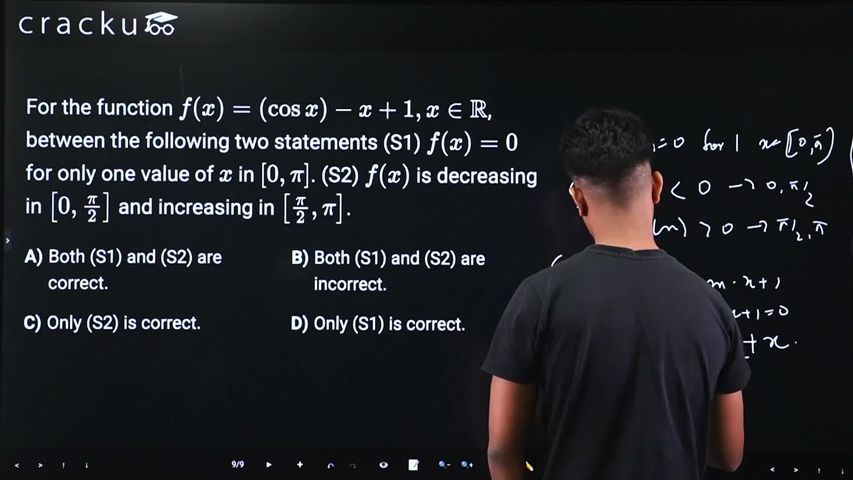
For the function $$f(x) = (\cos x) - x + 1, x \in \mathbb{R}$$, between the following two statements (S1) $$f(x) = 0$$ for only one value of $$x$$ in $$[0, \pi]$$. (S2) $$f(x)$$ is decreasing in $$\left[0, \frac{\pi}{2}\right]$$ and increasing in $$\left[\frac{\pi}{2}, \pi\right]$$.
Given ( $$f(x)=\cos x-x+1$$) on$$([0,\pi])$$
(S1): (f(x)=0) has only one solution in ([0,\pi])
Check endpoints:
$$f(0)=1-0+1=2>0,\quad f(\pi)=\cos\pi-\pi+1=-1-\pi+1=-\pi<0$$
Since (f) is continuous, there is at least one root.
Now derivative:
$$f'(x)=-\sin x-1$$
$$Since(\sin x\ge0)on([0,\pi]),$$
$$f'(x)=-(\sin x+1)<0$$
So (f) is strictly decreasing, hence it can cross zero only once.
(S1) is true
(S2): decreasing in ([0,\pi/2]) and increasing in ([\pi/2,\pi])
But we already have:
$$f'(x)<0\quad\text{for all }x\in[0,\pi]$$
So (f) is decreasing everywhere — never increasing.
(S2) is false
Only (S1) is correct
Was this solution helpful?
Click on the Email ☝️ to Watch the Video Solution
Create a FREE account and get:
_1.webp)

Educational materials for JEE preparation

Ask our AI anything

AI can make mistakes. Please verify important information.
AI can make mistakes. Please verify important information.
