
Join Our JEE Preparation Group
Prep with like-minded aspirants; Get access to free daily tests and study material.
Sign in
Please select an account to continue using cracku.in
↓ →
Join Our JEE Preparation Group
Prep with like-minded aspirants; Get access to free daily tests and study material.
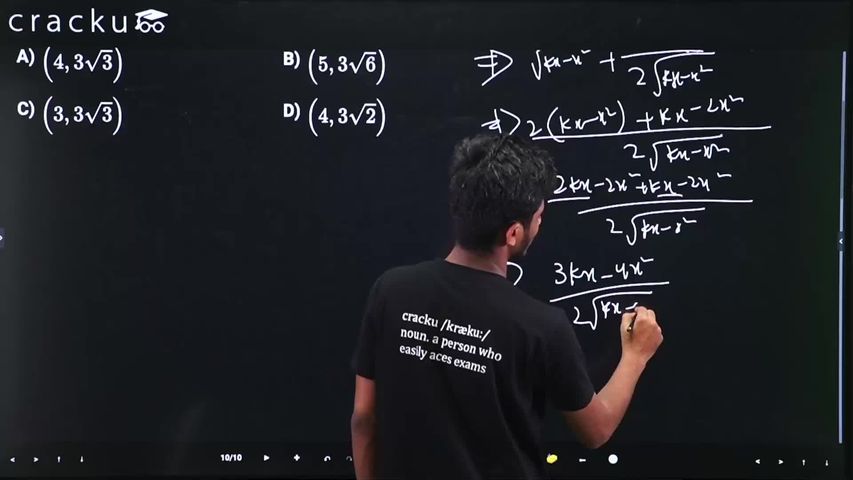
If m is the minimum value of k for which the function $$f(x) = x\sqrt{kx - x^2}$$ is increasing in the interval [0, 3] and M is the maximum value of f in [0, 3] when k = m, then the ordered pair (m, M) is equal to:
We have the function $$f(x)=x\sqrt{kx-x^{2}}$$ defined on the closed interval $$[0,\,3]\,. $$
First, the square-root demands non-negativity of its radicand. We write the condition
$$kx-x^{2}\ge 0\; \Longrightarrow\; x(k-x)\ge 0\,. $$
For every $$x\in[0,3]$$ this is true precisely when $$k\ge x$$, and the largest value of $$x$$ that can occur is $$3$$, so domain feasibility gives the preliminary requirement
$$k\ge 3\;.$$
Next we impose monotonicity. A continuously differentiable function is increasing on an interval when its derivative is non-negative there. We therefore differentiate $$f(x)$$.
We recall the product rule: if $$u(x)$$ and $$v(x)$$ are differentiable, then $$(uv)'=u'v+uv'\,.$$
Let
$$u(x)=x,\qquad v(x)=\sqrt{kx-x^{2}}\;.$$
We calculate
$$u'(x)=1,\qquad v'(x)=\frac{1}{2\sqrt{kx-x^{2}}}\,\Bigl(k-2x\Bigr)\;,$$
because we have used the chain rule on $$v(x)$$: the derivative of $$\sqrt{g(x)}$$ is $$\dfrac{g'(x)}{2\sqrt{g(x)}}$$ with $$g(x)=kx-x^{2}$$ giving $$g'(x)=k-2x$$.
Applying the product rule,
$$f'(x)=u'(x)v(x)+u(x)v'(x)=\sqrt{kx-x^{2}}+x\;\frac{k-2x}{2\sqrt{kx-x^{2}}}\;.$$
To combine the two terms, bring them over a common denominator $$2\sqrt{kx-x^{2}}$$:
$$f'(x)=\frac{2(kx-x^{2})+x(k-2x)}{2\sqrt{kx-x^{2}}}\;.$$
Expanding the numerator step by step,
$$2(kx-x^{2})=2kx-2x^{2},$$
$$x(k-2x)=kx-2x^{2},$$
so
$$2kx-2x^{2}+kx-2x^{2}=3kx-4x^{2}\;.$$
Thus the derivative reduces to
$$f'(x)=\frac{3kx-4x^{2}}{2\sqrt{kx-x^{2}}}=\frac{x\,(3k-4x)}{2\sqrt{kx-x^{2}}}\;.$$
For $$x\in(0,3]$$ the denominator is strictly positive, so the sign of $$f'(x)$$ is governed entirely by the numerator $$x(3k-4x)$$. Because $$x>0$$ inside the interval, we must impose
$$3k-4x\ge 0\quad\text{for every }x\in(0,3]\;.$$
The left side is largest at small $$x$$ and smallest at the right end $$x=3$$. Therefore the most stringent requirement occurs at $$x=3$$:
$$3k-4\cdot 3\ge 0\;\Longrightarrow\;3k-12\ge 0\;\Longrightarrow\;3k\ge 12\;\Longrightarrow\;k\ge 4\;.$$
Combining this with the earlier domain condition $$k\ge 3$$, we conclude that the smallest value of $$k$$ ensuring monotonic increase throughout $$[0,3]$$ is
$$m=4\;.$$
Now we fix $$k=m=4$$ and look for the maximum of $$f(x)$$ on $$[0,3]$$. With this choice the derivative becomes
$$f'(x)=\frac{x\bigl(3\cdot 4-4x\bigr)}{2\sqrt{4x-x^{2}}}=\frac{x(12-4x)}{2\sqrt{4x-x^{2}}}=\frac{4x(3-x)}{2\sqrt{4x-x^{2}}}\;.$$
The factor $$3-x$$ is positive for $$x<3$$, zero at $$x=3$$, and negative beyond. Inside our interval $$[0,3]$$, we therefore have
$$f'(x)>0\quad\text{for }0<x<3,\qquad f'(3)=0\;,$$
which means $$f(x)$$ is strictly increasing from $$x=0$$ up to $$x=3$$ and attains its maximum exactly at the right end point $$x=3$$.
Evaluating $$f(x)$$ there,
$$f(3)=3\sqrt{4\cdot 3-3^{2}}=3\sqrt{12-9}=3\sqrt{3}\;.$$
Hence the maximum value is $$M=3\sqrt{3}\;.$$
Collecting the results, the ordered pair is
$$(m,\,M)=\left(4,\;3\sqrt{3}\right)\;.$$
Hence, the correct answer is Option A.
Was this solution helpful?
Click on the Email ☝️ to Watch the Video Solution
Create a FREE account and get:
_1.webp)

Educational materials for JEE preparation

Ask our AI anything

AI can make mistakes. Please verify important information.
AI can make mistakes. Please verify important information.
