
Join Our JEE Preparation Group
Prep with like-minded aspirants; Get access to free daily tests and study material.
Sign in
Please select an account to continue using cracku.in
↓ →
Join Our JEE Preparation Group
Prep with like-minded aspirants; Get access to free daily tests and study material.
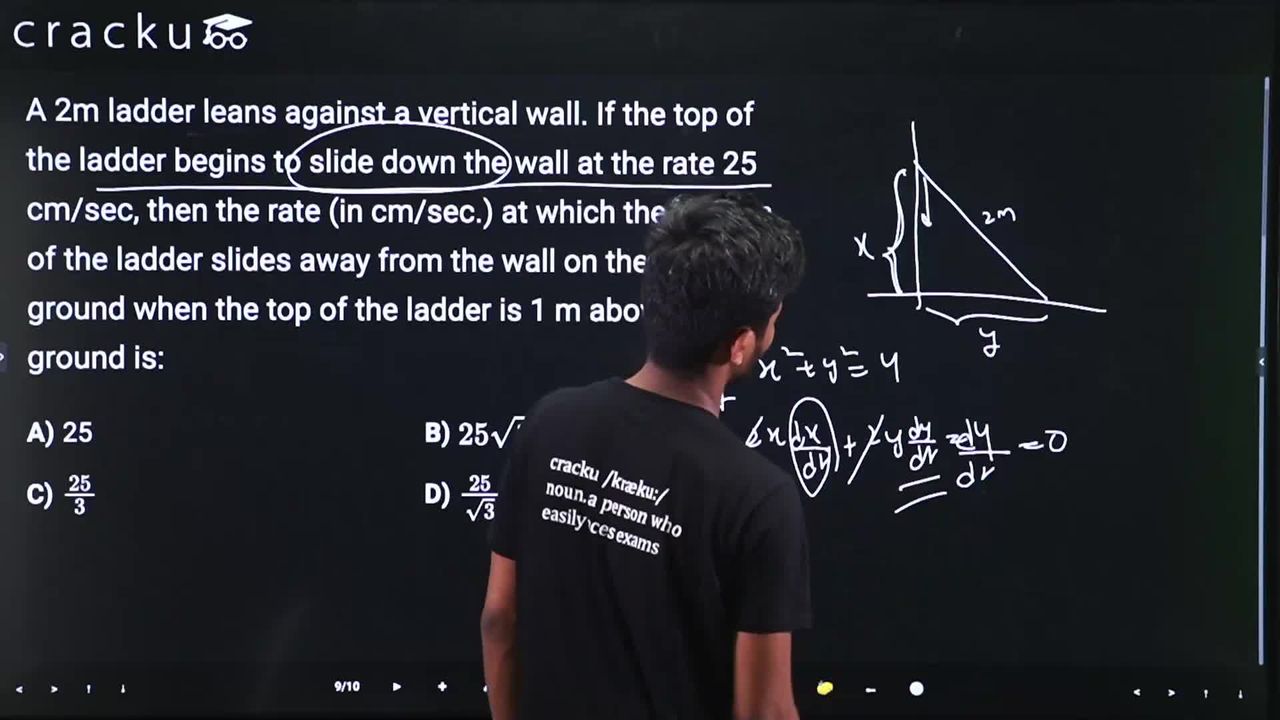
A 2m ladder leans against a vertical wall. If the top of the ladder begins to slide down the wall at the rate 25 cm/sec, then the rate (in cm/sec.) at which the bottom of the ladder slides away from the wall on the horizontal ground when the top of the ladder is 1 m above the ground is:
Let us measure every length in centimetres so that the given rate “25 cm / s” can be used directly. The ladder has a fixed length of $$2\text{ m}=200\text{ cm}$$. Denote
$$x(t)$$ = horizontal distance (bottom of ladder to wall) in cm, $$y(t)$$ = vertical height (top of ladder above ground) in cm.
The ladder, wall and ground form a right-angled triangle, so at every instant we have the Pythagorean relation
$$x^{2}+y^{2}=200^{2}. \quad -(1)$$
To connect the rates of change, differentiate equation (1) with respect to time $$t$$. First state the general rule: “If $$u^{2}+v^{2}=k$$ (where $$k$$ is constant), then differentiating gives $$2u\frac{du}{dt}+2v\frac{dv}{dt}=0.$$” Applying this rule, we obtain
$$2x\frac{dx}{dt}+2y\frac{dy}{dt}=0.$$
Dividing every term by 2 simplifies it to
$$x\frac{dx}{dt}+y\frac{dy}{dt}=0.$$
Now isolate $$\dfrac{dx}{dt}$$:
$$x\frac{dx}{dt}=-y\frac{dy}{dt},$$ $$\frac{dx}{dt}=-\frac{y}{x}\,\frac{dy}{dt}. \quad -(2)$$
The problem tells us that the top of the ladder slides downward at $$25\text{ cm / s}$$. Downward means $$y$$ is decreasing, so mathematically $$\dfrac{dy}{dt}=-25\text{ cm / s}.$$
We are interested in the moment when the top of the ladder is $$y=1\text{ m}=100\text{ cm}.$$ Substituting $$y=100$$ into equation (1) lets us find the corresponding $$x$$:
$$x^{2}+(100)^{2}=200^{2},$$ $$x^{2}=200^{2}-100^{2}=40000-10000=30000,$$ $$x=\sqrt{30000}=100\sqrt{3}\text{ cm}.$$
Now substitute $$y=100\text{ cm},\;x=100\sqrt{3}\text{ cm},\;\dfrac{dy}{dt}=-25\text{ cm / s}$$ into formula (2):
$$\frac{dx}{dt}=-\frac{100}{100\sqrt{3}}\times(-25)=\frac{100}{100\sqrt{3}}\times25=\frac{25}{\sqrt{3}}\text{ cm / s}.$$
The positive sign shows that the bottom of the ladder is indeed sliding away from the wall. Thus the required rate is $$\dfrac{25}{\sqrt{3}}\text{ cm / s}.$$
Hence, the correct answer is Option D.
Was this solution helpful?
Click on the Email ☝️ to Watch the Video Solution
Create a FREE account and get:
_1.webp)

Educational materials for JEE preparation

Ask our AI anything

AI can make mistakes. Please verify important information.
AI can make mistakes. Please verify important information.
