
Join Our JEE Preparation Group
Prep with like-minded aspirants; Get access to free daily tests and study material.
Sign in
Please select an account to continue using cracku.in
↓ →
Join Our JEE Preparation Group
Prep with like-minded aspirants; Get access to free daily tests and study material.
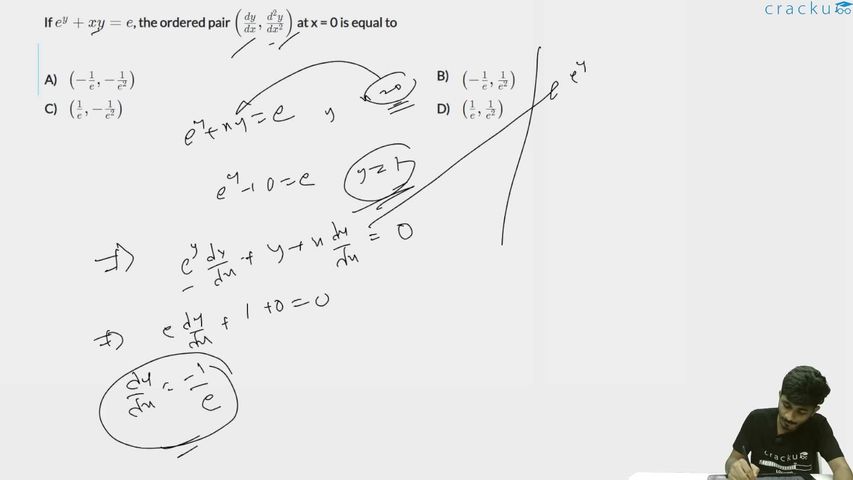
If $$e^y + xy = e$$, the ordered pair $$\left(\frac{dy}{dx}, \frac{d^2y}{dx^2}\right)$$ at x = 0 is equal to
We are given the implicit relation $$e^{y}+x\,y=e.$$
First we find the value of $$y$$ at the point where $$x=0.$$ Substituting $$x=0$$ gives
$$e^{y}+0\cdot y=e\;\;\Longrightarrow\;\;e^{y}=e\;\;\Longrightarrow\;\;y=1.$$
So, at $$x=0$$ we have the point $$(0,1).$$
Now we need the first derivative $$\dfrac{dy}{dx}.$$ We differentiate the original equation with respect to $$x$$. Using the chain rule for $$e^{y}$$ and the product rule for $$x\,y$$ we have
$$\frac{d}{dx}(e^{y})+\frac{d}{dx}(x\,y)=\frac{d}{dx}(e).$$
The derivative of $$e^{y}$$ is $$e^{y}\dfrac{dy}{dx}$$ (chain rule). The derivative of $$x\,y$$ is $$y+x\dfrac{dy}{dx}$$ (product rule). The derivative of the constant $$e$$ is $$0.$$ Hence
$$e^{y}\frac{dy}{dx}+y+x\frac{dy}{dx}=0.$$
Collecting the $$\dfrac{dy}{dx}$$ terms yields
$$(e^{y}+x)\frac{dy}{dx}+y=0.$$
Solving for $$\dfrac{dy}{dx}$$ gives
$$\frac{dy}{dx}=-\frac{y}{\,e^{y}+x\,}.$$
At $$x=0,\;y=1$$ we obtain
$$\left.\frac{dy}{dx}\right|_{(0,1)}=-\frac{1}{e^{1}+0}=-\frac{1}{e}.$$
Thus the first component of the ordered pair is $$-\dfrac1e.$$
Next we find the second derivative $$\dfrac{d^{2}y}{dx^{2}}.$$ We start from the differentiated equation
$$e^{y}\frac{dy}{dx}+y+x\frac{dy}{dx}=0$$
and differentiate it once more with respect to $$x$$. Each term is handled carefully:
Adding these pieces we get
$$e^{y}\left(\frac{dy}{dx}\right)^{2}+e^{y}\frac{d^{2}y}{dx^{2}}+\frac{dy}{dx}+\frac{dy}{dx}+x\frac{d^{2}y}{dx^{2}}=0.$$
That is
$$e^{y}\left(\frac{dy}{dx}\right)^{2}+e^{y}\frac{d^{2}y}{dx^{2}}+2\frac{dy}{dx}+x\frac{d^{2}y}{dx^{2}}=0.$$
Factor the second‐derivative terms:
$$(e^{y}+x)\frac{d^{2}y}{dx^{2}}+e^{y}\left(\frac{dy}{dx}\right)^{2}+2\frac{dy}{dx}=0.$$
Now solve for $$\dfrac{d^{2}y}{dx^{2}}:$$
$$\frac{d^{2}y}{dx^{2}}=-\frac{e^{y}\left(\dfrac{dy}{dx}\right)^{2}+2\dfrac{dy}{dx}}{e^{y}+x}.$$
We evaluate this at $$x=0,\;y=1.$$ We already know $$\dfrac{dy}{dx}=-\dfrac1e.$$ Hence
$$e^{y}=e,\qquad\left(\frac{dy}{dx}\right)^{2}=\left(-\frac1e\right)^{2}=\frac1{e^{2}}.$$
Compute the numerator:
$$e^{y}\left(\frac{dy}{dx}\right)^{2}+2\frac{dy}{dx}=e\left(\frac1{e^{2}}\right)+2\left(-\frac1e\right)=\frac1e-\frac2e=-\frac1e.$$
The denominator is
$$e^{y}+x=e+0=e.$$
Therefore
$$\left.\frac{d^{2}y}{dx^{2}}\right|_{(0,1)}=-\frac{-\dfrac1e}{e}=\frac1{e^{2}}.$$
Thus the ordered pair is
$$\left(\frac{dy}{dx},\frac{d^{2}y}{dx^{2}}\right)=\left(-\frac1e,\;\frac1{e^{2}}\right).$$
Hence, the correct answer is Option B.
Was this solution helpful?
Click on the Email ☝️ to Watch the Video Solution
Create a FREE account and get:
_1.webp)

Educational materials for JEE preparation

Ask our AI anything

AI can make mistakes. Please verify important information.
AI can make mistakes. Please verify important information.
