
Join Our JEE Preparation Group
Prep with like-minded aspirants; Get access to free daily tests and study material.
Sign in
Please select an account to continue using cracku.in
↓ →
Join Our JEE Preparation Group
Prep with like-minded aspirants; Get access to free daily tests and study material.
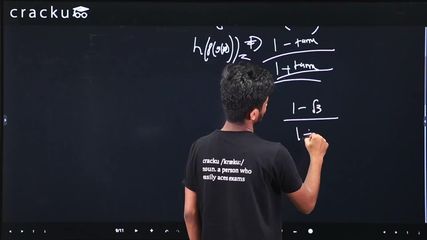
For $$x \in \left(0, \frac{3}{2}\right)$$, let $$f(x) = \sqrt{x}$$, $$g(x) = \tan x$$ and $$h(x) = \frac{1 - x^2}{1 + x^2}$$. If $$\phi(x) = ((h \circ f) \circ g)(x)$$, then $$\phi\left(\frac{\pi}{3}\right)$$ is equal to:
We begin with the three real-valued functions defined on the indicated interval:
$$f(x)=\sqrt{x}, \qquad g(x)=\tan x, \qquad h(x)=\frac{1-x^{2}}{1+x^{2}}, \qquad x\in\left(0,\frac{3}{2}\right).$$
The required function is the composition
$$\phi(x)=((h\circ f)\circ g)(x).$$
By the definition of composition, we first apply $$g$$ to $$x,$$ then apply $$f$$ to the result, and finally apply $$h$$. Symbolically,
$$\phi(x)=h\!\left(f\!\left(g(x)\right)\right).$$
Now, step by step:
• First map $$x$$ through $$g$$:
$$g(x)=\tan x.$$
• Next feed this into $$f$$. Because $$f(u)=\sqrt{u},$$ we have
$$f\!\left(g(x)\right)=\sqrt{\tan x}.$$
• Finally, apply $$h$$, whose formula is $$h(y)=\dfrac{1-y^{2}}{1+y^{2}}.$$ Substituting $$y=\sqrt{\tan x}$$ gives
$$\phi(x)=\frac{1-\bigl(\sqrt{\tan x}\bigr)^{2}}{1+\bigl(\sqrt{\tan x}\bigr)^{2}}.$$
Since $$\bigl(\sqrt{\tan x}\bigr)^{2}=\tan x,$$ this simplifies directly to
$$\phi(x)=\frac{1-\tan x}{1+\tan x}.$$
We must now evaluate this expression at $$x=\dfrac{\pi}{3}.$$ Recalling that
$$\tan\left(\dfrac{\pi}{3}\right)=\sqrt{3},$$
we substitute:
$$\phi\!\left(\frac{\pi}{3}\right)=\frac{1-\sqrt{3}}{1+\sqrt{3}}.$$
To recognise this value, we rationalise the denominator. Multiply numerator and denominator by the conjugate $$1-\sqrt{3}$$:
$$ \phi\!\left(\frac{\pi}{3}\right)= \frac{(1-\sqrt{3})(1-\sqrt{3})}{(1+\sqrt{3})(1-\sqrt{3})} =\frac{(1-\sqrt{3})^{2}}{1-3}. $$
Expanding the square in the numerator using $$(a-b)^{2}=a^{2}-2ab+b^{2},$$ we obtain
$$ (1-\sqrt{3})^{2}=1-2\sqrt{3}+3=4-2\sqrt{3}. $$
The denominator simplifies to $$1-3=-2.$$ Therefore,
$$ \phi\!\left(\frac{\pi}{3}\right)=\frac{4-2\sqrt{3}}{-2}. $$
Dividing numerator and denominator by $$-2$$ yields
$$ \phi\!\left(\frac{\pi}{3}\right)=-(2-\sqrt{3})=\sqrt{3}-2. $$
Now we compare this value with the tangents listed in the options. We recall the well-known exact values:
$$ \tan\frac{\pi}{12}=2-\sqrt{3}, \qquad \tan\frac{11\pi}{12}=\tan\!\left(\pi-\frac{\pi}{12}\right)=-\tan\frac{\pi}{12}=-(2-\sqrt{3})=\sqrt{3}-2. $$
Thus
$$ \phi\!\left(\frac{\pi}{3}\right)=\sqrt{3}-2=\tan\frac{11\pi}{12}. $$
Hence, the correct answer is Option D.
Click on the Email ☝️ to Watch the Video Solution
Create a FREE account and get:
_1.webp)

Educational materials for JEE preparation

Ask our AI anything

AI can make mistakes. Please verify important information.
AI can make mistakes. Please verify important information.


