
Join Our JEE Preparation Group
Prep with like-minded aspirants; Get access to free daily tests and study material.
Sign in
Please select an account to continue using cracku.in
↓ →
Join Our JEE Preparation Group
Prep with like-minded aspirants; Get access to free daily tests and study material.
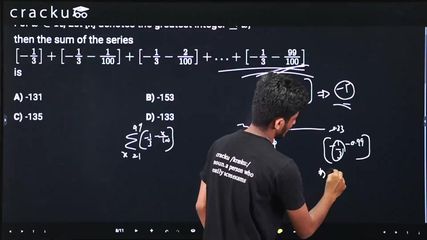
For $$x \in R$$, Let [x] denotes the greatest integer $$\leq x$$, then the sum of the series $$\left[-\frac{1}{3}\right] + \left[-\frac{1}{3} - \frac{1}{100}\right] + \left[-\frac{1}{3} - \frac{2}{100}\right] + \ldots + \left[-\frac{1}{3} - \frac{99}{100}\right]$$ is
We begin by recalling the definition of the greatest-integer (floor) function. By definition, for any real number $$x$$
$$[x]=n \quad\text{if and only if}\quad n\le x<n+1,$$
where $$n$$ is an integer. In words, $$[x]$$ is the largest integer that is not greater than $$x$$.
The series to be summed is
$$\left[-\frac13\right]+\left[-\frac13-\frac1{100}\right]+\left[-\frac13-\frac2{100}\right]+\ldots+\left[-\frac13-\frac{99}{100}\right].$$
To handle all the terms uniformly, let us label the general (k-th) term:
$$T_k=\left[-\frac13-\frac{k}{100}\right], \qquad k=0,1,2,\ldots ,99.$$
Our task is to find $$T_k$$ for every integer $$k$$ in the stated range and then add all the $$T_k$$.
First, convert $$\displaystyle -\frac13$$ into its decimal form for easy comparison:
$$-\frac13=-0.333333\ldots$$
Next, observe that
$$-\frac13-\frac{k}{100}=-0.333333\ldots-\frac{k}{100}.$$
Because $$\dfrac{k}{100}$$ varies from $$0$$ (when $$k=0$$) to $$\dfrac{99}{100}=0.99$$ (when $$k=99$$), the expression
$$\alpha_k=-\frac13-\frac{k}{100}$$
will move from
$$\alpha_0=-0.333333\ldots$$
down to
$$\alpha_{99}=-0.333333\ldots-0.99=-1.323333\ldots$$
Thus each $$\alpha_k$$ lies in the interval
$$-1.323333\ldots\le\alpha_k\le-0.333333\ldots$$
Within this interval the only integers that can serve as greatest integers are $$-1$$ and $$-2$$, because
$$-2<-1.323333\ldots\le\alpha_k\le-0.333333\ldots<0.$$
So every term $$T_k$$ equals either $$-1$$ or $$-2$$. To decide which, locate the point where $$\alpha_k$$ crosses $$-1$$. We need
$$\alpha_k<-1\quad\Longleftrightarrow\quad -\frac13-\frac{k}{100}<-1.$$
Rearranging, add $$\dfrac13$$ to both sides:
$$-\frac{k}{100}<-1+\frac13=-\frac23.$$
Multiplying by $$-1$$ reverses the inequality:
$$\frac{k}{100}>\frac23.$$
Now convert $$\dfrac23$$ to a decimal:
$$\frac23=0.666666\ldots$$
Hence
$$\frac{k}{100}>0.666666\ldots\quad\Longleftrightarrow\quad k>66.6666\ldots$$
Since $$k$$ is an integer, the inequality becomes
$$k\ge 67.$$
We have therefore obtained two cases.
• If $$0\le k\le 66$$, then $$\alpha_k\ge-1$$, so
$$T_k=[\alpha_k]=-1.$$
• If $$67\le k\le 99$$, then $$\alpha_k<-1$$, but always $$\alpha_k>-2$$, so
$$T_k=[\alpha_k]=-2.$$
Count how many times each value occurs.
• For $$k=0,1,2,\ldots,66$$ we have $$67$$ integers, giving $$67$$ occurrences of $$-1$$.
• For $$k=67,68,\ldots,99$$ we have $$99-67+1=33$$ integers, giving $$33$$ occurrences of $$-2$$.
Now add all the terms:
$$\text{Sum}=67(-1)+33(-2).$$
Simplify step by step:
$$67(-1)=-67,$$
$$33(-2)=-66,$$
and finally
$$-67-66=-133.$$
Hence, the correct answer is Option D.
Was this solution helpful?
Click on the Email ☝️ to Watch the Video Solution
Create a FREE account and get:
_1.webp)

Educational materials for JEE preparation

Ask our AI anything

AI can make mistakes. Please verify important information.
AI can make mistakes. Please verify important information.
