
Join Our JEE Preparation Group
Prep with like-minded aspirants; Get access to free daily tests and study material.
Sign in
Please select an account to continue using cracku.in
↓ →
Join Our JEE Preparation Group
Prep with like-minded aspirants; Get access to free daily tests and study material.
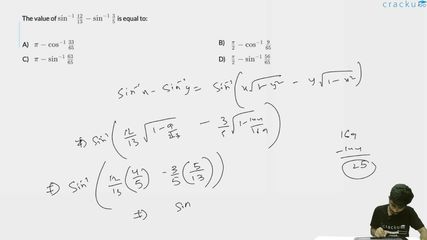
The value of $$\sin^{-1}\frac{12}{13} - \sin^{-1}\frac{3}{5}$$ is equal to:
Let us introduce two acute angles so that the inverse-sine symbols disappear and we can work with ordinary trigonometry.
We put $$\alpha=\sin^{-1}\frac{12}{13}$$ and $$\beta=\sin^{-1}\frac{3}{5}\;.$$
Because $$\frac{12}{13}\lt1$$ and $$\frac{3}{5}\lt1$$, both angles lie in the first quadrant, that is, $$0\lt \alpha\lt \frac{\pi}{2}$$ and $$0\lt \beta\lt \frac{\pi}{2}\;.$$ By the definition of the arcsine, we have
$$\sin\alpha=\frac{12}{13},\qquad \sin\beta=\frac{3}{5}\;.$$
Now we need the cosines of the same angles. We state the Pythagorean identity first: for any angle $$\theta$$, $$\sin^{2}\theta+\cos^{2}\theta=1\;.$$ Using it for $$\alpha$$ we obtain
$$\cos\alpha=\sqrt{1-\sin^{2}\alpha}=\sqrt{1-\Bigl(\frac{12}{13}\Bigr)^{2}} =\sqrt{1-\frac{144}{169}} =\sqrt{\frac{25}{169}} =\frac{5}{13}\;.$$
Applying the same identity to $$\beta$$ gives
$$\cos\beta=\sqrt{1-\sin^{2}\beta}=\sqrt{1-\Bigl(\frac{3}{5}\Bigr)^{2}} =\sqrt{1-\frac{9}{25}} =\sqrt{\frac{16}{25}} =\frac{4}{5}\;.$$
Our required expression is $$\alpha-\beta\;.$$ To find it we use the sine of the difference of two angles. We first recall the formula:
$$\sin(\alpha-\beta)=\sin\alpha\cos\beta-\cos\alpha\sin\beta\;.$$
Substituting the values already obtained, we have
$$\sin(\alpha-\beta)=\Bigl(\frac{12}{13}\Bigr)\Bigl(\frac{4}{5}\Bigr) -\Bigl(\frac{5}{13}\Bigr)\Bigl(\frac{3}{5}\Bigr) =\frac{48}{65}-\frac{15}{65} =\frac{33}{65}\;.$$
Because $$\alpha-\beta$$ is the difference of two first-quadrant angles with $$\alpha \gt \beta,$$ the result is still an acute angle. Hence the principal value of $$\sin^{-1}$$ applies and we may write
$$\alpha-\beta=\sin^{-1}\frac{33}{65}\;.$$
So far we have $$\sin^{-1}\frac{12}{13}-\sin^{-1}\frac{3}{5} =\sin^{-1}\frac{33}{65}\;.$$
This exact form does not appear among the options, therefore we transform it. We make use of the co-function relation that links sine and cosine:
For any angle $$\theta$$ in $$[-\tfrac{\pi}{2},\tfrac{\pi}{2}],$$ $$\sin\theta=\cos\Bigl(\frac{\pi}{2}-\theta\Bigr)\;,$$ and, taking inverses, $$\sin^{-1}x=\frac{\pi}{2}-\cos^{-1}x\quad\text{for }-1\le x\le1\;.$$
Instead of rewriting $$\sin^{-1}\frac{33}{65}$$ in terms of $$\cos^{-1},$$ we notice there is an option of the form $$\tfrac{\pi}{2}-\sin^{-1}(\text{something})$$. Hence we try to express $$\sin^{-1}\frac{33}{65}$$ as $$\tfrac{\pi}{2}-\sin^{-1}\!y$$ for a suitable $$y$$.
Set $$\theta=\sin^{-1}\frac{33}{65}\;.$$ Then $$\sin\theta=\frac{33}{65}$$ and $$0\lt\theta\lt\frac{\pi}{2}\;.$$ Using the Pythagorean identity once again, we compute
$$\cos\theta=\sqrt{1-\sin^{2}\theta} =\sqrt{1-\Bigl(\frac{33}{65}\Bigr)^{2}} =\sqrt{1-\frac{1089}{4225}} =\sqrt{\frac{3136}{4225}} =\frac{56}{65}\;.$$
But $$\cos\theta=\sin\!\Bigl(\frac{\pi}{2}-\theta\Bigr)\;,$$ so
$$\frac{\pi}{2}-\theta=\sin^{-1}\frac{56}{65}\;.$$
Solving for $$\theta,$$ we get
$$\theta=\frac{\pi}{2}-\sin^{-1}\frac{56}{65}\;.$$
Remembering that $$\theta=\alpha-\beta,$$ we have proved
$$\sin^{-1}\frac{12}{13}-\sin^{-1}\frac{3}{5} =\frac{\pi}{2}-\sin^{-1}\frac{56}{65}\;.$$
This expression is exactly the one listed in Option 4.
Hence, the correct answer is Option 4.
Click on the Email ☝️ to Watch the Video Solution
Create a FREE account and get:
_1.webp)

Educational materials for JEE preparation

Ask our AI anything

AI can make mistakes. Please verify important information.
AI can make mistakes. Please verify important information.


