
Join Our JEE Preparation Group
Prep with like-minded aspirants; Get access to free daily tests and study material.
Sign in
Please select an account to continue using cracku.in
↓ →
Join Our JEE Preparation Group
Prep with like-minded aspirants; Get access to free daily tests and study material.
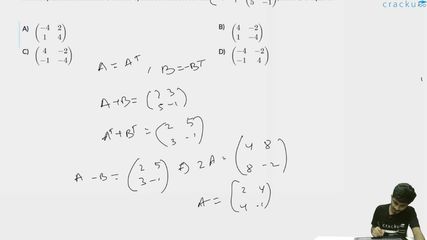
If A is a symmetric matrix and B is skew-symmetric matrix such that $$A + B = \begin{pmatrix} 2 & 3 \\ 5 & -1 \end{pmatrix}$$, then AB is equal to:
We are told that $$A$$ is a symmetric matrix and $$B$$ is a skew-symmetric matrix, and together they satisfy the relation
$$A+B=\begin{pmatrix}2&3\\5&-1\end{pmatrix}.$$
First, we recall the defining properties of the two kinds of matrices involved:
• For a symmetric matrix we have the formula $$A^T=A$$, which, in the $$2\times2$$ case, forces the off-diagonal entries to be equal.
• For a skew-symmetric matrix we have the formula $$B^T=-B$$, which, in the $$2\times2$$ case, forces the diagonal entries to be zero and the off-diagonal entries to be negatives of each other.
So we write the most general forms respecting these facts. Let
$$A=\begin{pmatrix}a&c\\c&d\end{pmatrix},\qquad B=\begin{pmatrix}0&x\\-x&0\end{pmatrix}.$$
Adding the two matrices, we have
$$A+B=\begin{pmatrix}a&c+x\\c-x&d\end{pmatrix}.$$
The question gives this sum explicitly, so we equate corresponding entries:
$$\begin{aligned} a &= 2,\\ c+x &= 3,\\ c-x &= 5,\\ d &= -1. \end{aligned}$$
Now we solve for the unknowns $$c$$ and $$x$$. Adding the second and third equations eliminates $$x$$:
$$ (c+x)+(c-x)=3+5 \;\Longrightarrow\; 2c=8 \;\Longrightarrow\; c=4. $$
Substituting $$c=4$$ into $$c+x=3$$, we obtain
$$ 4 + x = 3 \;\Longrightarrow\; x = -1. $$
With all the variables known, the individual matrices are
$$A=\begin{pmatrix}2&4\\4&-1\end{pmatrix},\qquad B=\begin{pmatrix}0&-1\\1&0\end{pmatrix}.$$
Our objective is the product $$AB$$. Using standard matrix multiplication, whose formula is $$\bigl(AB\bigr)_{ij}=\sum_{k=1}^{2}A_{ik}B_{kj},$$ we compute each entry one by one.
• First-row, first-column entry:
$$ (AB)_{11}=A_{11}B_{11}+A_{12}B_{21}=2\cdot0+4\cdot1=4. $$
• First-row, second-column entry:
$$ (AB)_{12}=A_{11}B_{12}+A_{12}B_{22}=2\cdot(-1)+4\cdot0=-2. $$
• Second-row, first-column entry:
$$ (AB)_{21}=A_{21}B_{11}+A_{22}B_{21}=4\cdot0+(-1)\cdot1=-1. $$
• Second-row, second-column entry:
$$ (AB)_{22}=A_{21}B_{12}+A_{22}B_{22}=4\cdot(-1)+(-1)\cdot0=-4. $$
Collecting these results, we find
$$AB=\begin{pmatrix}4&-2\\-1&-4\end{pmatrix}.$$
This matches exactly with Option C.
Hence, the correct answer is Option C.
Was this solution helpful?
Click on the Email ☝️ to Watch the Video Solution
Create a FREE account and get:
_1.webp)

Educational materials for JEE preparation

Ask our AI anything

AI can make mistakes. Please verify important information.
AI can make mistakes. Please verify important information.
