
Join Our JEE Preparation Group
Prep with like-minded aspirants; Get access to free daily tests and study material.
Sign in
Please select an account to continue using cracku.in
↓ →
Join Our JEE Preparation Group
Prep with like-minded aspirants; Get access to free daily tests and study material.
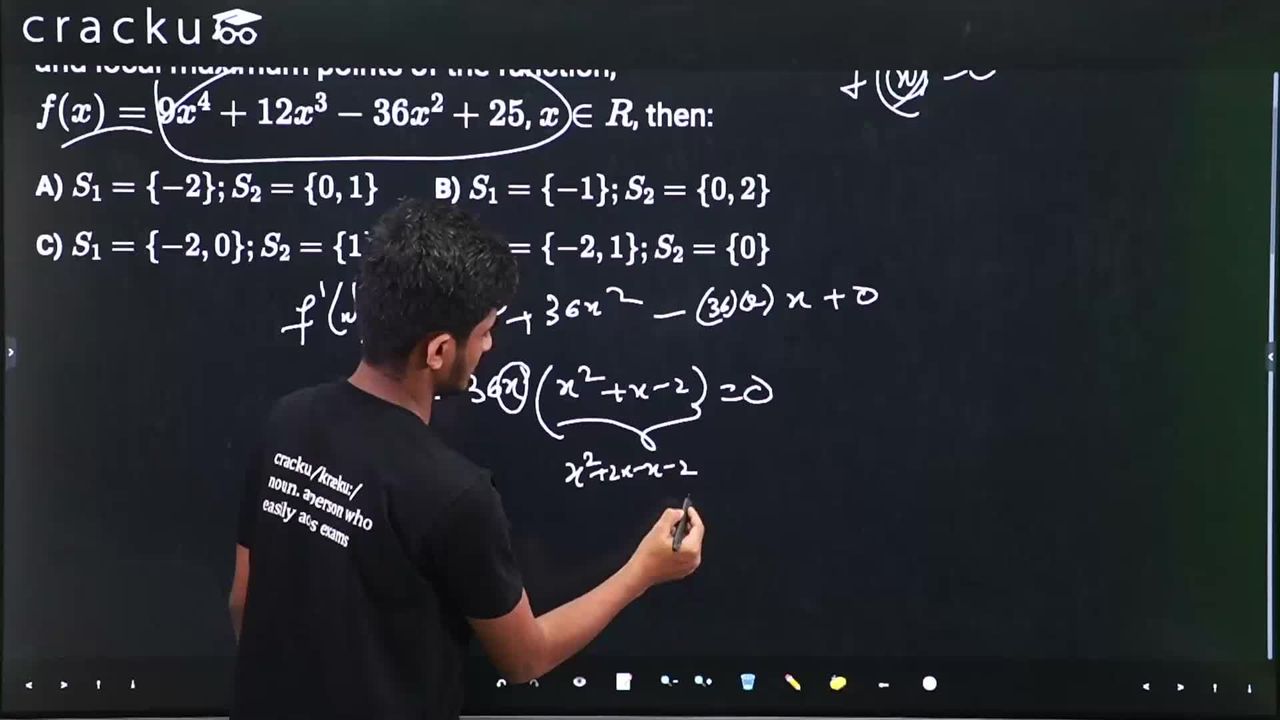
If $$S_1$$ and $$S_2$$ are respectively the sets of local minimum and local maximum points of the function, $$f(x) = 9x^{4} + 12x^{3} - 36x^{2} + 25$$, $$x \in R$$, then:
We have the quartic polynomial function $$f(x)=9x^{4}+12x^{3}-36x^{2}+25,\; x\in\mathbb{R}.$$
To locate its local extrema, we first need the first derivative. Using the rule $$\dfrac{d}{dx}\bigl(x^{n}\bigr)=nx^{\,n-1},$$ we differentiate term-by-term:
$$\begin{aligned} f'(x) &= \dfrac{d}{dx}\bigl(9x^{4}\bigr)+\dfrac{d}{dx}\bigl(12x^{3}\bigr)-\dfrac{d}{dx}\bigl(36x^{2}\bigr)+\dfrac{d}{dx}(25) \\ &= 9\cdot4x^{3}+12\cdot3x^{2}-36\cdot2x+0 \\ &= 36x^{3}+36x^{2}-72x. \end{aligned}$$
Now we factor $$f'(x)$$ completely. First we take out the common factor $$36x$$:
$$f'(x)=36x\bigl(x^{2}+x-2\bigr).$$
The quadratic $$x^{2}+x-2$$ factors further because its discriminant is $$1^{2}-4(1)(-2)=9=3^{2}.$$ So,
$$x^{2}+x-2=(x+2)(x-1).$$
Substituting this back,
$$f'(x)=36x(x+2)(x-1).$$
Critical points occur where $$f'(x)=0$$, i.e.
$$36x(x+2)(x-1)=0 \;\Longrightarrow\; x=0,\;x=-2,\;x=1.$$
Next, to determine the nature of each critical point, we use the Second Derivative Test. First, we compute the second derivative. Differentiating $$f'(x)=36x^{3}+36x^{2}-72x$$ once more, we apply the same power rule:
$$\begin{aligned} f''(x) &= \dfrac{d}{dx}\bigl(36x^{3}\bigr)+\dfrac{d}{dx}\bigl(36x^{2}\bigr)-\dfrac{d}{dx}\bigl(72x\bigr) \\ &= 36\cdot3x^{2}+36\cdot2x-72 \\ &= 108x^{2}+72x-72. \end{aligned}$$
The Second Derivative Test says: if $$f''(c)>0$$ the point $$x=c$$ is a local minimum, while if $$f''(c)<0$$ it is a local maximum.
We evaluate $$f''(x)$$ at each critical point:
1. For $$x=-2$$,
$$f''(-2)=108(-2)^{2}+72(-2)-72 =108\cdot4-144-72 =432-216 =216>0.$$
So $$x=-2$$ gives a local minimum.
2. For $$x=0$$,
$$ f''(0)=108\cdot0^{2}+72\cdot0-72 =-72<0. $$
Thus $$x=0$$ yields a local maximum.
3. For $$x=1$$,
$$ f''(1)=108(1)^{2}+72(1)-72 =108+72-72 =108>0. $$
Hence $$x=1$$ is also a local minimum.
Collecting our results, the set of local minima is $$S_{1}=\{-2,\,1\}$$ and the set of local maxima is $$S_{2}=\{0\}.$$
Comparing with the given options, this corresponds to Option D.
Hence, the correct answer is Option D.
Was this solution helpful?
Click on the Email ☝️ to Watch the Video Solution
Create a FREE account and get:
_1.webp)

Educational materials for JEE preparation

Ask our AI anything

AI can make mistakes. Please verify important information.
AI can make mistakes. Please verify important information.
