
Join Our JEE Preparation Group
Prep with like-minded aspirants; Get access to free daily tests and study material.
Sign in
Please select an account to continue using cracku.in
↓ →
Join Our JEE Preparation Group
Prep with like-minded aspirants; Get access to free daily tests and study material.
Let $$f: [0, 2] \rightarrow R$$ be a twice differentiable function such that $$f''(x) > 0$$, for all $$x \in [0, 2]$$. If $$\phi(x) = f(x) + f(2 - x)$$, then $$\phi$$ is:
We are given a twice-differentiable function $$f:[0,2]\to\mathbb R$$ that satisfies $$f''(x)>0\; \text{for all}\;x\in[0,2].$$
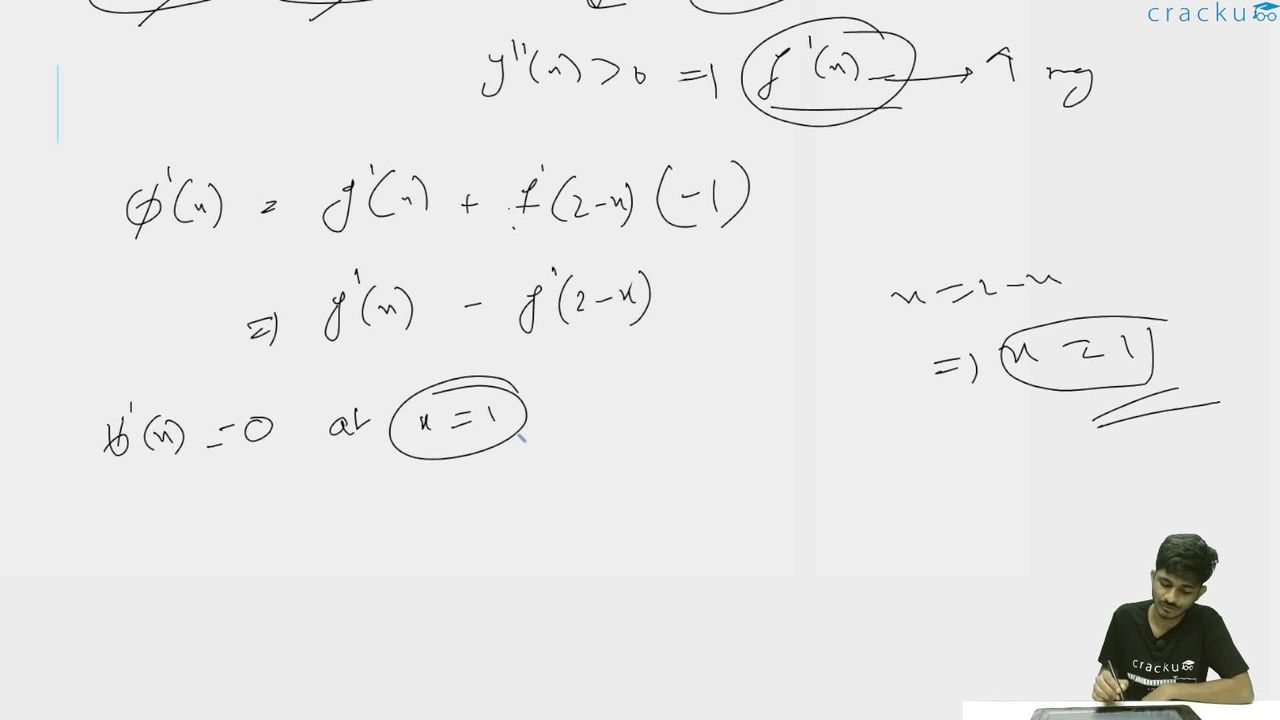
First, recall the basic fact: if $$f''(x)>0$$ on an interval, then $$f'(x)$$ is strictly increasing on that interval because the derivative of $$f'(x)$$ is positive everywhere inside it. We shall use this monotonicity of $$f'(x)$$ repeatedly.
Now we define a new function
$$\phi(x)=f(x)+f(2-x),\qquad x\in[0,2].$$
To study whether $$\phi(x)$$ is increasing or decreasing, we compute its first derivative. Using the sum rule and the chain rule:
$$ \phi'(x)=\frac{d}{dx}\bigl[f(x)\bigr]+\frac{d}{dx}\bigl[f(2-x)\bigr] =f'(x)+f'(2-x)\cdot\frac{d}{dx}(2-x). $$
The derivative of $$2-x$$ with respect to $$x$$ is $$-1$$, so we get
$$ \phi'(x)=f'(x)+f'(2-x)(-1)=f'(x)-f'(2-x). $$
Thus
$$ \phi'(x)=f'(x)-f'(2-x). $$
We must now determine the sign of $$\phi'(x)$$ on the interval $$(0,2)$$. For that, we compare the two numbers $$f'(x)$$ and $$f'(2-x).$$ Because $$f'(x)$$ is strictly increasing, the inequality between their arguments will decide the inequality between their function values.
Take any $$x\in(0,1).$$ Then $$x<1$$ implies $$x<2-x$$ (since adding $$x$$ to both sides of $$x<1$$ gives $$2x<1+x,$$ i.e. $$x<2-x$$). Because $$f'(x)$$ is increasing and the input on the right, $$2-x,$$ is larger, we have
$$ x<2-x\quad\Longrightarrow\quad f'(x)<f'(2-x). $$
Therefore, for $$x\in(0,1)$$,
$$ \phi'(x)=f'(x)-f'(2-x)<0, $$
so $$\phi(x)$$ is decreasing on $$(0,1).$$
Next take any $$x\in(1,2).$$ This time $$x>1$$ gives $$x>2-x$$ (since subtracting $$x$$ from both sides of $$x>1$$ yields $$0>1-x,$$ i.e. $$x-1>0,$$ hence $$x>2-x$$). Because $$f'(x)$$ is increasing, the larger input $$x$$ now produces the larger output, so
$$ x>2-x\quad\Longrightarrow\quad f'(x)>f'(2-x). $$
Thus, for $$x\in(1,2)$$,
$$ \phi'(x)=f'(x)-f'(2-x)>0, $$
which means $$\phi(x)$$ is increasing on $$(1,2).$$
At the point $$x=1$$ itself we have
$$ \phi'(1)=f'(1)-f'(2-1)=f'(1)-f'(1)=0, $$
so $$x=1$$ is the transition point where the function changes from decreasing (on the left) to increasing (on the right).
Putting everything together, we have shown:
• $$\phi(x)$$ is decreasing on $$(0,1).$$
• $$\phi(x)$$ is increasing on $$(1,2).$$
This behavior matches exactly the description in Option D.
Hence, the correct answer is Option D.
Was this solution helpful?
Click on the Email ☝️ to Watch the Video Solution
Create a FREE account and get:
_1.webp)

Educational materials for JEE preparation

Ask our AI anything

AI can make mistakes. Please verify important information.
AI can make mistakes. Please verify important information.
