
Join Our JEE Preparation Group
Prep with like-minded aspirants; Get access to free daily tests and study material.
Sign in
Please select an account to continue using cracku.in
↓ →
Join Our JEE Preparation Group
Prep with like-minded aspirants; Get access to free daily tests and study material.
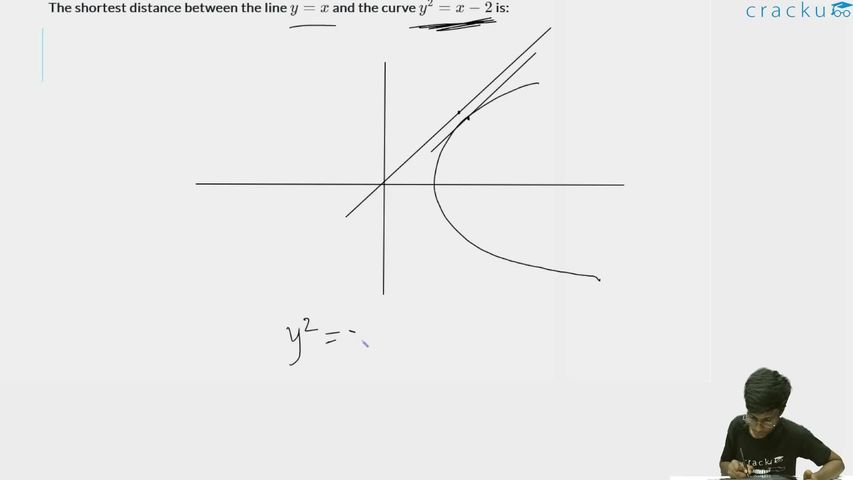
The shortest distance between the line $$y = x$$ and the curve $$y^{2} = x - 2$$ is:
We are asked to find the shortest (minimum) distance between the straight line $$y = x$$ and the curve $$y^{2} = x - 2$$. To do this we shall pick an arbitrary point on the curve, write the distance of that point from the line, and then minimise that distance with respect to the variable coordinate.
An arbitrary point on the curve $$y^{2} = x - 2$$ can be written as $$ (x,\;y)\quad\text{with}\quad y^{2} = x - 2. $$ From this relation we immediately get $$ x = y^{2} + 2. $$
Next we recall the distance formula for a point $$(x_{1},y_{1})$$ from a straight line written in the form $$ax + by + c = 0$$: $$ \text{Distance} = \frac{|ax_{1} + by_{1} + c|}{\sqrt{a^{2} + b^{2}}}. $$ The given line is $$y = x$$, which can be rewritten as $$x - y = 0$$. Comparing with $$ax + by + c = 0$$, we identify $$ a = 1,\; b = -1,\; c = 0. $$
Substituting the coordinates $$(x,y) = (y^{2} + 2,\,y)$$ of the general point on the curve into the distance formula, we have $$ D \;=\; \frac{|1\cdot(x) + (-1)\cdot(y) + 0|}{\sqrt{1^{2} + (-1)^{2}}} \;=\; \frac{|(y^{2} + 2) - y|}{\sqrt{1 + 1}} \;=\; \frac{|\,y^{2} - y + 2\,|}{\sqrt{2}}. $$
We wish to minimise $$D$$. Because the denominator $$\sqrt{2}$$ is a positive constant, the task reduces to minimising the numerator $$ |\,y^{2} - y + 2\,|. $$ To understand the sign of the quadratic inside the absolute value, we examine $$ y^{2} - y + 2. $$ Its discriminant is $$ \Delta = (-1)^{2} - 4\cdot1\cdot2 \;=\; 1 - 8 \;=\; -7 < 0, $$ so the quadratic is always positive for all real $$y$$. Hence the absolute value can be dropped without changing the expression, and we have $$ D \;=\; \frac{y^{2} - y + 2}{\sqrt{2}}. $$
To find the minimum, we now treat $$ h(y) = y^{2} - y + 2 $$ as a function of the single variable $$y$$ and differentiate:
$$ \frac{dh}{dy} = 2y - 1. $$ Setting the derivative equal to zero for an extremum gives $$ 2y - 1 = 0 \;\;\Longrightarrow\;\; y = \frac{1}{2}. $$ The second derivative is $$ \frac{d^{2}h}{dy^{2}} = 2 > 0, $$ so $$h(y)$$ (and hence $$D$$) attains a minimum at $$y = \tfrac12$$.
Substituting $$y = \tfrac12$$ back into $$h(y)$$: $$ h\!\left(\tfrac12\right) = \left(\tfrac12\right)^{2} - \left(\tfrac12\right) + 2 = \frac14 - \frac12 + 2 = -\frac14 + 2 = \frac{7}{4}. $$ Therefore the minimum distance is $$ D_{\min} = \frac{\,\dfrac{7}{4}\,}{\sqrt{2}} = \frac{7}{4\sqrt{2}}. $$
Hence, the correct answer is Option A.
Was this solution helpful?
Click on the Email ☝️ to Watch the Video Solution
Create a FREE account and get:
_1.webp)

Educational materials for JEE preparation

Ask our AI anything

AI can make mistakes. Please verify important information.
AI can make mistakes. Please verify important information.
