
Join Our JEE Preparation Group
Prep with like-minded aspirants; Get access to free daily tests and study material.
Sign in
Please select an account to continue using cracku.in
↓ →
Join Our JEE Preparation Group
Prep with like-minded aspirants; Get access to free daily tests and study material.
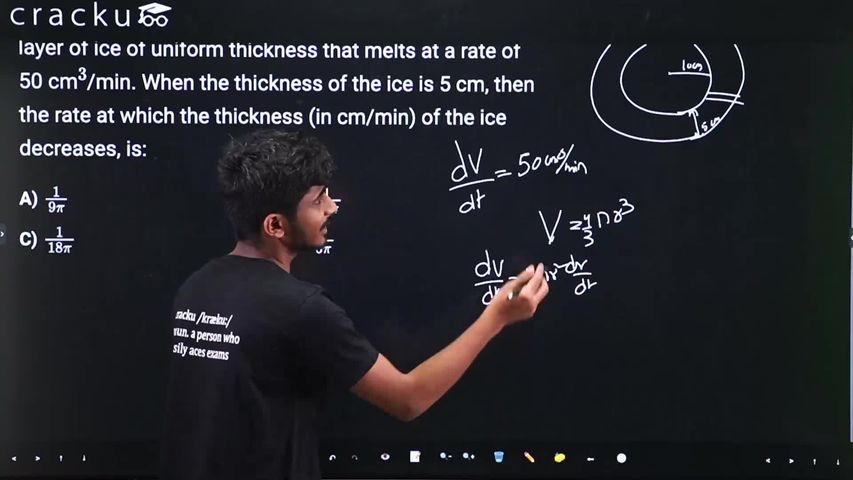
A spherical iron ball of radius 10 cm is coated with a layer of ice of uniform thickness that melts at a rate of 50 cm$$^3$$/min. When the thickness of the ice is 5 cm, then the rate at which the thickness (in cm/min) of the ice decreases, is:
Let the constant radius of the solid iron ball be $$r_0 = 10\text{ cm}$$. We wrap this ball with a uniform ice layer whose variable thickness at time $$t$$ minutes is $$x\text{ cm}$$. Thus, the outer radius of the combined iron + ice sphere is
$$R = r_0 + x = 10 + x.$$
The volume of ice alone equals the difference between the volume of the large sphere of radius $$R$$ and the volume of the iron core of radius $$r_0$$. Using the standard volume‐of‐a‐sphere formula $$V = \dfrac{4}{3}\pi r^{3}$$, we have
$$\begin{aligned} V(x) &= \frac{4}{3}\pi R^{3} \;-\; \frac{4}{3}\pi r_0^{3} \\[4pt] &= \frac{4}{3}\pi\bigl[(10 + x)^{3} - 10^{3}\bigr]. \end{aligned}$$
To relate the rate of melting to the rate of decrease of thickness, we differentiate $$V(x)$$ with respect to time. First write
$$V(x) = \frac{4}{3}\pi\bigl[(10 + x)^{3} - 1000\bigr].$$
Now differentiate both sides with respect to $$t$$, remembering that $$x = x(t)$$:
$$\frac{dV}{dt} = \frac{4}{3}\pi \cdot 3(10 + x)^{2}\frac{d}{dt}(10 + x).$$
Since $$\dfrac{d}{dt}(10 + x) = \dfrac{dx}{dt}$$, the factor of 3 in the numerator cancels with the denominator, giving the compact relation
$$\frac{dV}{dt} = 4\pi (10 + x)^{2}\frac{dx}{dt}.$$
The problem states that ice melts at a constant rate of $$50\text{ cm}^{3}\!/\text{min}$$, meaning volume is decreasing:
$$\frac{dV}{dt} = -50\ \text{cm}^{3}\!/\text{min}.$$
We are asked for the rate when the ice is $$x = 5\text{ cm}$$ thick. At that instant, the outer radius is
$$R = 10 + 5 = 15\text{ cm}.$$
Substituting $$x = 5$$ and $$\dfrac{dV}{dt} = -50$$ into the differentiated formula:
$$-50 \;=\; 4\pi (15)^{2}\frac{dx}{dt}.$$
Simplify the numerical factors:
$$\begin{aligned} -50 &= 4\pi \times 225 \times \frac{dx}{dt} \\[4pt] -50 &= 900\pi\,\frac{dx}{dt}. \end{aligned}$$
Now isolate $$\dfrac{dx}{dt}$$:
$$\frac{dx}{dt} = \frac{-50}{900\pi} = -\frac{1}{18\pi}\ \text{cm/min}.$$
The negative sign merely indicates that the thickness is decreasing. Therefore, the magnitude of the rate at which the ice layer thins is
$$\left|\frac{dx}{dt}\right| = \frac{1}{18\pi}\ \text{cm/min}.$$
Hence, the correct answer is Option C.
Was this solution helpful?
Click on the Email ☝️ to Watch the Video Solution
Create a FREE account and get:
_1.webp)

Educational materials for JEE preparation

Ask our AI anything

AI can make mistakes. Please verify important information.
AI can make mistakes. Please verify important information.
