
Join Our JEE Preparation Group
Prep with like-minded aspirants; Get access to free daily tests and study material.
Sign in
Please select an account to continue using cracku.in
↓ →
Join Our JEE Preparation Group
Prep with like-minded aspirants; Get access to free daily tests and study material.
The local maximum value of the function, $$f(x) = \left(\frac{2}{x}\right)^{x^2}$$, $$x \gt 0$$, is:
We have the function $$f(x)=\left(\dfrac{2}{x}\right)^{x^{2}},\;x\gt 0.$$
To locate a local maximum we first study its logarithm, because the natural logarithm is strictly increasing and therefore preserves the location of maxima.
Put $$y=\ln f(x).$$ Then
$$y=\ln\!\left(\left(\dfrac{2}{x}\right)^{x^{2}}\right)=x^{2}\,\ln\!\left(\dfrac{2}{x}\right).$$
Using the law $$\ln\!\left(\dfrac{a}{b}\right)=\ln a-\ln b,$$ we get
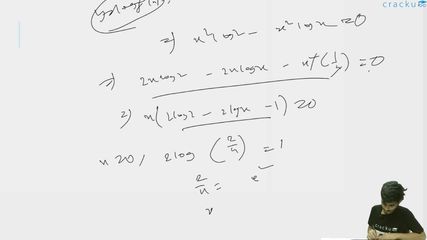
$$y=x^{2}\bigl(\ln 2-\ln x\bigr).$$
Now we differentiate $$y$$ with respect to $$x$$. Remember the product rule $$\dfrac{d}{dx}[u(x)\,v(x)]=u'(x)\,v(x)+u(x)\,v'(x).$$ Taking $$u=x^{2},\;v=\ln 2-\ln x,$$ we find
$$\dfrac{dy}{dx}=2x\bigl(\ln 2-\ln x\bigr)+x^{2}\Bigl(0-\dfrac{1}{x}\Bigr).$$
Simplifying step by step,
$$\dfrac{dy}{dx}=2x\ln 2-2x\ln x-x.$$
Factorising the common $$x$$ gives
$$\dfrac{dy}{dx}=x\bigl(2\ln 2-2\ln x-1\bigr).$$
For a critical point we set $$\dfrac{dy}{dx}=0.$$ Since $$x\gt 0$$, the factor $$x$$ cannot vanish, so we must have
$$2\ln 2-2\ln x-1=0.$$
Re-arranging,
$$2\bigl(\ln 2-\ln x\bigr)=1\;\;\Longrightarrow\;\;\ln\!\left(\dfrac{2}{x}\right)=\dfrac{1}{2}.$$
Exponentiating both sides with the base $$e$$ (using the rule $$\ln a=b\Longrightarrow a=e^{b}$$) we obtain
$$\dfrac{2}{x}=e^{1/2}=\sqrt{e},\quad\text{so}\quad x=\dfrac{2}{\sqrt{e}}.$$
To confirm that this critical point gives a maximum, we compute the second derivative. Starting from
$$\dfrac{dy}{dx}=x\bigl(2\ln 2-2\ln x-1\bigr),$$
differentiate again with the product rule:
$$\dfrac{d^{2}y}{dx^{2}}=1\cdot\bigl(2\ln 2-2\ln x-1\bigr)+x\Bigl(-\dfrac{2}{x}\Bigr).$$
Simplifying,
$$\dfrac{d^{2}y}{dx^{2}}=2\ln 2-2\ln x-1-2=2\ln 2-2\ln x-3.$$
At $$x=\dfrac{2}{\sqrt{e}}$$ we have $$\ln x=\ln 2-\dfrac{1}{2},$$ hence
$$\dfrac{d^{2}y}{dx^{2}}\Bigg|_{x=\frac{2}{\sqrt{e}}}=2\ln 2-2\Bigl(\ln 2-\dfrac{1}{2}\Bigr)-3 =2\ln 2-2\ln 2+1-3=-2\lt 0.$$
Because the second derivative is negative, the point is indeed a local maximum.
Now we compute the maximum value itself. Substitute $$x=\dfrac{2}{\sqrt{e}}$$ into the original function:
$$f_{\text{max}}=\left(\dfrac{2}{\dfrac{2}{\sqrt{e}}}\right)^{\left(\dfrac{2}{\sqrt{e}}\right)^{2}} =\bigl(\sqrt{e}\bigr)^{\frac{4}{e}}.$$
Recall that $$\sqrt{e}=e^{1/2}.$$ Therefore
$$f_{\text{max}}=\left(e^{1/2}\right)^{\frac{4}{e}}=e^{\frac{1}{2}\cdot\frac{4}{e}}=e^{\frac{2}{e}}.$$
This value matches Option C.
Hence, the correct answer is Option C.
Was this solution helpful?
Click on the Email ☝️ to Watch the Video Solution
Create a FREE account and get:
_1.webp)

Educational materials for JEE preparation

Ask our AI anything

AI can make mistakes. Please verify important information.
AI can make mistakes. Please verify important information.
