
Join Our JEE Preparation Group
Prep with like-minded aspirants; Get access to free daily tests and study material.
Sign in
Please select an account to continue using cracku.in
↓ →
Join Our JEE Preparation Group
Prep with like-minded aspirants; Get access to free daily tests and study material.
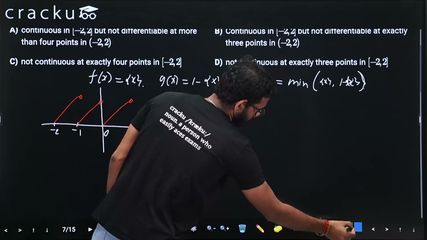
Let $$[t]$$ denote the greatest integer less than or equal to $$t$$. Let $$f(x) = x - [x]$$, $$g(x) = 1 - x + [x]$$, and $$h(x) = \min\{f(x), g(x)\}$$, $$x \in [-2, 2]$$. Then $$h$$ is:
We begin with the three functions that have been defined:
$$f(x)=x-[x],\qquad g(x)=1-x+[x],\qquad h(x)=\min\{f(x),g(x)\},\qquad x\in[-2,2].$$
Here $$[t]$$ denotes the greatest integer less than or equal to $$t$$ (the floor function). For every real number $$x$$ we can write $$x=[x]+\{x\},$$ where $$\{x\}=x-[x]$$ is the fractional part of $$x$$ and satisfies $$0\le\{x\}\lt 1.$$ Hence, for every $$x,$$
$$f(x)=\{x\}\qquad\text{and}\qquad g(x)=1-\{x\}.$$
Because $$0\le\{x\}\lt 1,$$ it follows that
$$0\le f(x)\lt 1,\qquad 0\lt g(x)\le1,\qquad f(x)+g(x)=1.$$
Let us examine the behaviour of $$f(x)$$ and $$g(x)$$ on a typical integral interval. Fix an integer $$n$$; then for every $$x$$ in the half-open interval $$n\le x\lt n+1$$ we have $$[x]=n$$ and hence
$$f(x)=x-n,\qquad g(x)=1-(x-n)=1-f(x).$$
Inside this interval $$f(x)$$ increases linearly from $$0$$ up to $$1^{-}$$ while $$g(x)$$ decreases linearly from $$1$$ down to $$0^{+}.$$ Now we find where the two graphs meet. We solve
$$f(x)=g(x)\;\;\Longrightarrow\;\;x-n=1-(x-n)\;\;\Longrightarrow\;\;2(x-n)=1\;\;\Longrightarrow\;\;x=n+\tfrac12.$$
So the only point of intersection in the interval $$[n,n+1)$$ is at $$x=n+\dfrac12,$$ where both $$f$$ and $$g$$ take the value $$\dfrac12.$$ Therefore, in that interval
$$\begin{cases} f(x)\lt g(x)&\text{for}\;n\le x\lt n+\dfrac12,\\[4pt] f(x)=g(x)&\text{for}\;x=n+\dfrac12,\\[4pt] f(x)\gt g(x)&\text{for}\;n+\dfrac12\lt x\lt n+1. \end{cases}$$
Because $$h(x)=\min\{f(x),g(x)\},$$ we deduce the explicit description
$$ h(x)= \begin{cases} f(x)=x-n,& & n\le x\le n+\dfrac12,\\[6pt] g(x)=1-x+n,& & n+\dfrac12\le x\lt n+1. \end{cases} $$
Thus, on each integral interval $$[n,n+1)$$ the graph of $$h$$ is a “V”-shaped line: it rises with slope $$+1$$ from $$0$$ up to $$\dfrac12$$ and then falls with slope $$-1$$ back to $$0.$$ Next we study continuity.
Continuity at interior points of an interval $$ (n,n+1) $$. Inside $$ (n,n+1) $$ the formula for $$ h $$ is linear, so $$ h $$ is continuous there.
Continuity at the midpoint $$ n+\tfrac12 $$. The left-hand limit equals the common value $$\dfrac12,$$ the right-hand limit also equals $$\dfrac12,$$ and $$h(n+\tfrac12)=\dfrac12.$$ Hence the function is continuous at the midpoint.
Continuity at an integer $$ n $$.
Approaching $$ n $$ from the left we are in the interval $$ (n-\tfrac12,n) $$ where $$h(x)=g(x)=1-(x-n)=n+1-x.$$ Taking the limit as $$ x\to n^- $$ gives $$\displaystyle\lim_{x\to n^-}h(x)=1-(n-n)=0.$$
Approaching $$ n $$ from the right we are in the interval $$ (n,n+\tfrac12) $$ where $$h(x)=f(x)=x-n.$$ Taking the limit as $$ x\to n^+ $$ gives $$\displaystyle\lim_{x\to n^+}h(x)=n-n=0.$$
The value of the function at the integer itself is $$h(n)=\min\bigl\{f(n)=0,\;g(n)=1\bigr\}=0.$$ Since the left-hand limit, the right-hand limit and the value are all equal, $$ h $$ is continuous at every integer.
Because the above discussion covers every point in the domain, we conclude that $$h(x)$$ is continuous on the whole closed interval $$[-2,2].$$
Now we analyse differentiability. We first compute the derivative in the open sub-intervals where the formula is linear.
For $$n\lt x\lt n+\dfrac12,\qquad h(x)=x-n\;\Longrightarrow\;h'(x)=1.$$ For $$n+\dfrac12\lt x\lt n+1,\qquad h(x)=1-x+n\;\Longrightarrow\;h'(x)=-1.$$
Thus, inside each linear segment the derivative exists and equals $$\pm1.$$ Possible points of non-differentiability are therefore the junction points, namely
• all midpoints $$x=n+\dfrac12,$$ • all integers $$x=n.$$ Let us check each of these.
At a midpoint $$ n+\tfrac12 $$. Left-hand derivative $$h'_- = 1,$$ right-hand derivative $$h'_+ = -1.$$ Since the one-sided derivatives are unequal, $$ h $$ is not differentiable here.
At an integer $$ n $$. Left-hand derivative (coming from the segment with slope $$-1$$) equals $$-1,$$ right-hand derivative (coming from the segment with slope $$+1$$) equals $$+1.$$ Again the derivatives are unequal, so $$ h $$ is not differentiable here either.
Within the open interval $$(-2,2)$$ the integers that occur are $$-1,\,0,\,1$$ (three points). The midpoints that occur are
$$-1.5,\;-0.5,\;0.5,\;1.5$$
(four points). Hence, inside $$(-2,2)$$ the total number of non-differentiable points is
$$3+4=7,$$
which is certainly “more than four.”
Combining the two conclusions we have:
• $$ h $$ is continuous on $$[-2,2].$$ • $$ h $$ fails to be differentiable at seven points of $$(-2,2).$$
This description matches exactly Option A, which states “continuous in $$[-2,2]$$ but not differentiable at more than four points in $$(-2,2).$$”
Hence, the correct answer is Option A.
Was this solution helpful?
Click on the Email ☝️ to Watch the Video Solution
Create a FREE account and get:
_1.webp)

Educational materials for JEE preparation

Ask our AI anything

AI can make mistakes. Please verify important information.
AI can make mistakes. Please verify important information.
