For the following questions answer them individually
Consider that the coordinating atoms of the ligands in cis-[Co(NH$$_3$$)$$_4$$Cl$$_2$$]Cl and mer-[Co(NH$$_3$$)$$_3$$Cl$$_3$$] octahedral complexes are at the vertices of an octahedron. The sum of total number of the triangular faces in both the complexes having one N atom and two Cl atoms at their corners is ___.
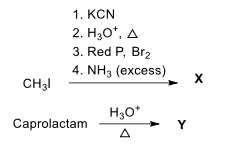
In the following reaction sequence, major products X and Y are acyclic monomers.
500 mol of X completely reacts with 500 mol of Y to give 1 mol of a single biodegradable acyclic copolymer Z as the only product. The amount of Z formed in grams is ___.
Given: Atomic mass (in amu): H : 1, C : 12, N : 14, O : 16, Br : 80
Question Stem (Q15 & Q16): Two volatile liquids A and B form an ideal solution. Consider a 5 molal solution of B in A inside a closed container having a total vapour pressure of 100 mm Hg at 300 K. The vapour pressure of pure A at 300 K is 105 mm Hg. Assume that A and B behave as ideal gases in the vapour phase.
Given: The gas constant $$R=0.08$$ L atm K$$^{-1}$$ mol$$^{-1}$$;
Molar mass of A is 50 g mol$$^{-1}$$;
Molar mass of B is 57 g mol$$^{-1}$$;
Density of liquid B at 300 K is 0.5 g/mL; 1 atm $$=760$$ mm Hg.
At 300 K, the ratio of the molar volume of pure B in vapour phase to its molar volume in liquid phase is ___.
Question Stem (Q15 & Q16): Two volatile liquids A and B form an ideal solution. Consider a 5 molal solution of B in A inside a closed container having a total vapour pressure of 100 mm Hg at 300 K. The vapour pressure of pure A at 300 K is 105 mm Hg. Assume that A and B behave as ideal gases in the vapour phase.
Given: The gas constant $$R=0.08$$ L atm K$$^{-1}$$ mol$$^{-1}$$;
Molar mass of A is 50 g mol$$^{-1}$$;
Molar mass of B is 57 g mol$$^{-1}$$;
Density of liquid B at 300 K is 0.5 g/mL; 1 atm $$=760$$ mm Hg.
The mole fraction of B in vapour phase which is in equilibrium with this solution is ___.
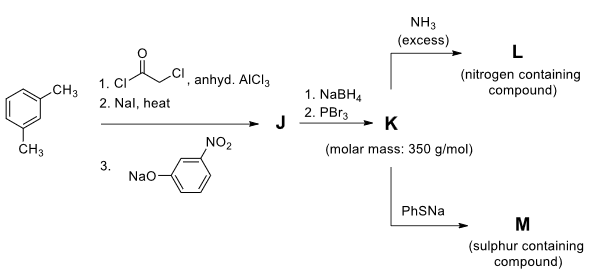
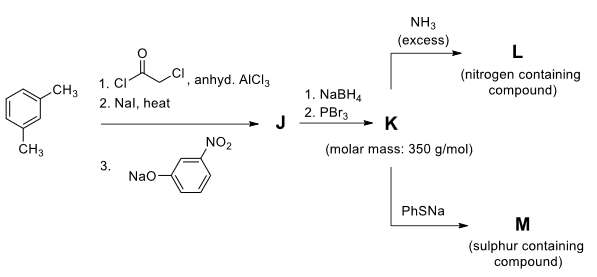
Question Stem (Q17 & Q18): Consider the following reaction sequence in which J, K, L and M are the major products.
Given: Atomic mass (in amu): H : 1, C : 12, N : 14, O : 16, S : 32, Br : 80, Ba : 137
The volume of 1 M aqueous $$\mathrm{H_2SO_4}$$ required to completely neutralize the ammonia evolved from 5.72 g of L in Kjeldahl's method of nitrogen estimation is ___ mL.
Question Stem (Q17 & Q18): Consider the following reaction sequence in which J, K, L and M are the major products.
Given: Atomic mass (in amu): H : 1, C : 12, N : 14, O : 16, S : 32, Br : 80, Ba : 137
In sulphur estimation by Carius method, the amount of $$\mathrm{BaSO_4}$$ formed from 3.79 g of M is ___ g.
Let $$\vec{a},\vec{b}$$ be two vectors, and let $$P,Q$$ and $$R$$ be the points with position vectors $$\vec{a}$$, $$\vec{b}$$ and $$\vec{a}+\vec{b}$$, respectively, with respect to the origin $$O$$. If $$|\vec{a}+\vec{b}|=\sqrt{21}$$, $$|\vec{a}-\vec{b}|=3$$, and $$\vec{a}$$ and $$(\vec{a}-\vec{b})$$ are perpendicular to each other, then the area of the triangle $$OPR$$ is
Let $$T$$ be the tangent to the parabola $$y^2=16x$$ at the point $$(64,32)$$. Let $$L$$ be the tangent to the same parabola at another point $$(x_1,\,y_1)$$ on the parabola. If $$L$$ and $$T$$ are perpendicular to each other, then the distance between the point $$(x_1,\,y_1)$$ and the focus of the parabola, is
Let $$y:(-\infty,\infty)\to(0,\infty)$$ be the solution of the differential equation
$$\dfrac{dy}{dx}=\dfrac{e^{5x}y^3+y^3}{e^x+e^x y^4},$$
satisfying $$y(0)=\dfrac{1}{\sqrt{2}}$$. Then the value of $$y(\log_e 2)$$ is
The value of the definite integral
$$\int_{0}^{2}\dfrac{1}{3^x+3}\,dx$$
is