
Join Our JEE Preparation Group
Prep with like-minded aspirants; Get access to free daily tests and study material.
Sign in
Please select an account to continue using cracku.in
↓ →
Join Our JEE Preparation Group
Prep with like-minded aspirants; Get access to free daily tests and study material.
Question Stem for Question Nos. 15 and 16
A container of height $$2\,\mathrm{m}$$, length $$2\,\mathrm{m}$$ and breadth $$1\,\mathrm{m}$$ is made of insulating vertical walls and two large area horizontal metal plates ($$M_1$$ and $$M_2$$) which extend far beyond the vertical walls in all directions. The container is partitioned into two equal chambers with a thin insulating vertical wall. The partition wall contains a small hole of cross-sectional area $$\sqrt{10}\,\mathrm{cm^2}$$ near its bottom edge. Initially the hole is closed and the left chamber of the container is completely filled with a liquid of dielectric constant $$\epsilon_r=15$$ and the right chamber is empty ($$\epsilon_r=1$$). At time $$t=0$$, the hole is opened and the liquid flows from the left chamber to the right chamber. In both the chambers, the space above the liquid has $$\epsilon_r=1$$ and is maintained at atmospheric pressure. The schematic of the container at a time $$t>0$$ is shown in the figure.
[Given: acceleration due to gravity is $$10\,\mathrm{ms^{-2}}$$.]
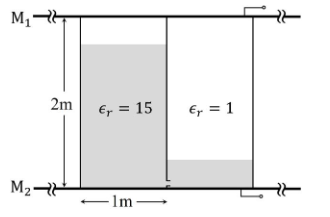
The difference in the capacitance (in F) between the metal plates at $$t=0$$ and that at $$t=500\,\mathrm{s}$$ is $$(8-n)\epsilon_0$$, where $$\epsilon_0$$ is the permittivity of free space. The value of $$n$$ is:
Correct Answer: 1.97
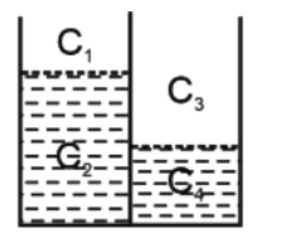
Initial equivalent capacitance calculation:
$$C_0 = \left(\frac{1 \times 1 \times \epsilon_0}{2}\right)15 + \frac{\epsilon_0}{1} = 8\epsilon_0$$
Equivalent series capacitances for the individual chambers at the final state:
$$C_1 = \frac{4}{3}\epsilon_0, \quad C_2 = 12\epsilon_0 \implies \frac{C_1 C_2}{C_1 + C_2} = \frac{6\epsilon_0}{5}$$
$$C_3 = \frac{4\epsilon_0}{5}, \quad C_4 = 20\epsilon_0 \implies \frac{C_3 C_4}{C_3 + C_4} = \frac{10}{13}\epsilon_0$$
Total combined new parallel capacitance:
$$C_{\text{new}} = \left(\frac{6}{5} + \frac{10}{13}\right)\epsilon_0 = \frac{128}{65}\epsilon_0$$
$$\left(8 - \frac{128}{65}\right)\epsilon_0 \approx 1.97\epsilon_0$$
Was this solution helpful?
Create a FREE account and get:
_1.webp)

Educational materials for JEE preparation

Ask our AI anything

AI can make mistakes. Please verify important information.
AI can make mistakes. Please verify important information.
