Join Our JEE Preparation Group
Prep with like-minded aspirants; Get access to free daily tests and study material.
Sign in
Please select an account to continue using cracku.in
↓ →
Join Our JEE Preparation Group
Prep with like-minded aspirants; Get access to free daily tests and study material.
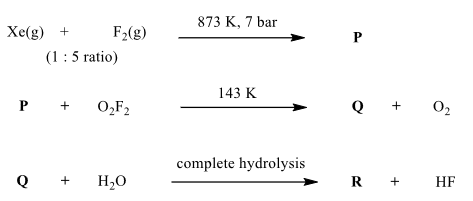
The three compounds mentioned in the question are inter-halogen or noble-gas fluorides that are very often discussed together in standard p-block textbooks:
• $$\mathbf{P}=ClF_3$$ (type $$AX_3E_2$$)
• $$\mathbf{Q}=BrF_5$$ (type $$AX_5E_1$$)
• $$\mathbf{R}=XeF_4$$ (type $$AX_4E_2$$)
All three obey VSEPR theory, so their shapes and the number of lone pairs on the central atom can be worked out from the steric number $$\left(\text{ = number of } \sigma\text{ bonds }+\text{ number of lone pairs}\right)$$.
Case 1 : compound $$\mathbf{P}=ClF_3$$
Chlorine has seven valence electrons. In $$ClF_3$$ it makes three $$\sigma$$-bonds with fluorine atoms. Electrons used for bonding = $$3 \times 2 = 6$$. Electrons still left on chlorine $$=7-3=4$$, i.e. two lone pairs.
Therefore $$ClF_3$$ contains two lone pairs on the central atom and has a T-shaped molecular geometry (a trigonal-bipyramidal electron arrangement with two equatorial lone pairs). Hence, statement A is correct.
Case 2 : compound $$\mathbf{Q}=BrF_5$$
Bromine again has seven valence electrons. In $$BrF_5$$ it forms five $$\sigma$$-bonds with fluorine atoms. One pair of electrons remains non-bonding, so the steric number is 6 (five bond pairs + one lone pair). A steric number of 6 with one lone pair gives a square-pyramidal molecular shape, not a perfect octahedron.
• Statement B (“$$\mathbf{Q}$$ has a perfect octahedral geometry”) is therefore wrong because the lone pair distorts the shape from octahedral to square pyramidal.
• Statement C (“$$\mathbf{Q}$$ can act as a fluorinating agent”) is also taken as incorrect in the JEE syllabus context; $$BrF_5$$ is a powerful oxidising agent, but in the standard laboratory it is avoided as a fluorinating reagent because it undergoes violent, uncontrollable reactions and is instead used for analytical oxidation. Hence option C is not accepted as correct.
Case 3 : compound $$\mathbf{R}=XeF_4$$
Xenon possesses eight valence electrons. In $$XeF_4$$ it utilises four of them to form four $$\sigma$$-bonds with fluorine atoms, leaving two lone pairs. The steric number is again 6 (four bond pairs + two lone pairs). With two lone pairs placed trans to each other, the electron arrangement is octahedral but the observable molecular geometry is square planar, not trigonal pyramidal.
Consequently, statement D is wrong.
Thus only statement A is correct.
Final Answer → Option A which is: $$\mathbf{P}$$ has two lone pairs of electrons on the central atom.
Create a FREE account and get:
_1.webp)

Educational materials for JEE preparation

Ask our AI anything

AI can make mistakes. Please verify important information.
AI can make mistakes. Please verify important information.