
Join Our JEE Preparation Group
Prep with like-minded aspirants; Get access to free daily tests and study material.
Sign in
Please select an account to continue using cracku.in
↓ →
Join Our JEE Preparation Group
Prep with like-minded aspirants; Get access to free daily tests and study material.
At 300 K, the molar conductivities of the aqueous solutions of three salts at two different concentrations are given below:
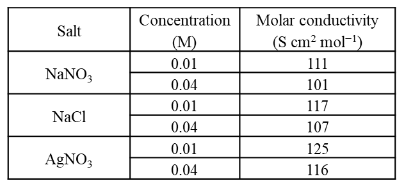
The conductivity of a saturated aqueous solution of AgCl is $$1.40\times 10^{-6}$$ S cm$$^{-1}$$ at 300 K. If the solubility of AgCl in water at 300 K is $$X$$ mol L$$^{-1}$$, then $$\log_{10}(X^{-1})$$ is
(Assume that AgCl dissolved in water ionizes completely and that the molar conductivity of saturated AgCl solution is equal to its limiting molar conductivity.)
In the context of the data table provided, $$A$$ (sometimes written as $$b$$) represents the Kohlrausch constant in the Debye-Hückel-Onsager relation for strong electrolytes:
$$\Lambda_m=\Lambda_m^\circ-A\sqrt{c}$$
Where:
$$\Lambda_m$$ = Molar conductivity at a given concentration
$$\Lambda_m^\circ$$ = Limiting molar conductivity (at infinite dilution)
$$c$$ = Molar concentration of the solution
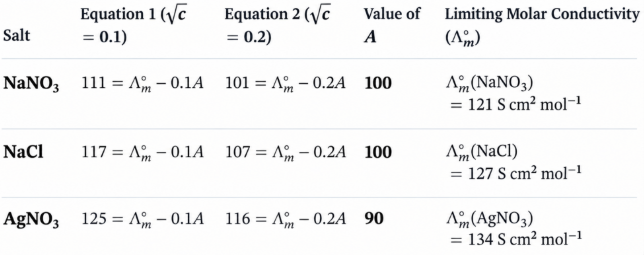
1. Find $$\Lambda_m^\circ$$ for $$\text{AgCl}$$ using Kohlrausch's Law:
$$\Lambda_m^\circ(\text{AgCl})=\Lambda_m^\circ(\text{AgNO}_3)+\Lambda_m^\circ(\text{NaCl})-\Lambda_m^\circ(\text{NaNO}_3)$$
$$\Lambda_m^\circ(\text{AgCl})=134+127-121=140\text{ S cm}^2\text{ mol}^{-1}$$
2. Calculate Molar Solubility ($$X$$):
Using the formula discussed earlier:
$$X=\frac{\kappa\times1000}{\Lambda_m^\circ}=\frac{(1.40\times10^{-6}\text{ S cm}^{-1})\times1000}{140\text{ S cm}^2\text{ mol}^{-1}}=10^{-5}\text{ mol L}^{-1}$$
3. Compute the final log value:
$$X^{-1}=\frac{1}{10^{-5}}=10^5$$
$$\log_{10}(X^{-1})=\log_{10}(10^5)=5$$
Was this solution helpful?
Click on the Email ☝️ to Watch the Video Solution
Create a FREE account and get:


Educational materials for JEE preparation

Ask our AI anything

AI can make mistakes. Please verify important information.
AI can make mistakes. Please verify important information.
