
Join Our JEE Preparation Group
Prep with like-minded aspirants; Get access to free daily tests and study material.
Sign in
Please select an account to continue using cracku.in
↓ →
Join Our JEE Preparation Group
Prep with like-minded aspirants; Get access to free daily tests and study material.
Question Stem for Question Nos. 17 and 18
A uniform circular disk of radius $$0.2\,\mathrm{m}$$ and mass $$1\,\mathrm{kg}$$ is pivoted at its top point $$C$$ such that it can rotate freely around $$C$$ in the $$XY$$ plane, as shown in the figure. Initially, when the disk is at rest, a particle of mass $$20\,\mathrm{g}$$, travelling along negative $$x$$ direction in the $$XY$$ plane with speed $$100\,\mathrm{ms^{-1}}$$, hits the circumference of the disk at a point $$P$$. After collision the particle moves along negative $$y$$ direction at a speed of $$90\,\mathrm{ms^{-1}}$$.
[Given: the acceleration due to gravity $$(g)=-10\hat{j}\,\mathrm{ms^{-2}}$$]
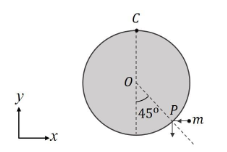
Amount of energy loss (in J) in the collision is:
Correct Answer: 17.47
Angular momentum about the pivot point $$C$$ is conserved during the collision, and the mechanical energy loss is the difference between initial and final kinetic energies of the system.
Using coordinates relative to center $$O(0,0)$$:
$$C = (0, R) = (0, 0.2)$$
$$P = (R\sin 45^\circ, -R\cos 45^\circ) = \left(0.2\frac{1}{\sqrt{2}}, -0.2\frac{1}{\sqrt{2}}\right)$$
Finding the position vector from $$C$$ to $$P$$:
$$\vec{r}_{P/C} = \vec{r}_P - \vec{r}_C = 0.2\frac{1}{\sqrt{2}}\hat{i} - \left(0.2 + 0.2\frac{1}{\sqrt{2}}\right)\hat{j}$$
Finding the initial and final angular momentum of the particle about $$C$$:
$$\vec{L}_{i,p} = \vec{r}_{P/C} \times (m\vec{u}) = \left[0.2\frac{1}{\sqrt{2}}\hat{i} - \left(0.2 + 0.2\frac{1}{\sqrt{2}}\right)\hat{j}\right] \times (-0.02 \times 100\hat{i})$$
$$\vec{L}_{i,p} = -\left(0.2 + 0.2\frac{1}{\sqrt{2}}\right)(2)\hat{k} = -0.4\left(1 + \frac{1}{\sqrt{2}}\right)\hat{k}$$
$$\vec{L}_{f,p} = \vec{r}_{P/C} \times (m\vec{v}) = \left[0.2\frac{1}{\sqrt{2}}\hat{i} - \left(0.2 + 0.2\frac{1}{\sqrt{2}}\right)\hat{j}\right] \times (-0.02 \times 90\hat{j})$$
$$\vec{L}_{f,p} = \left(0.2\frac{1}{\sqrt{2}}\right)(-1.8)\hat{k} = -\frac{0.36}{\sqrt{2}}\hat{k}$$
Using parallel axis theorem for the disk about pivot $$C$$:
$$I_C = \frac{1}{2}MR^2 + MR^2 = \frac{3}{2}(1)(0.2)^2 = 0.06\text{ kg}\cdot\text{m}^2$$
From conservation of angular momentum about $$C$$:
$$L_{i,p} = L_{f,p} + I_C\omega$$
$$-0.4 - \frac{0.4}{\sqrt{2}} = -\frac{0.36}{\sqrt{2}} + 0.06\omega$$
$$0.06\omega = -0.4 - \frac{0.04}{\sqrt{2}} = -0.4 - 0.02828 = -0.42828 \implies \omega \approx -7.138\text{ rad}\cdot\text{s}^{-1}$$
Finding kinetic energies:
$$K_i = \frac{1}{2}mu^2 = \frac{1}{2}(0.02)(100)^2 = 100\text{ J}$$
$$K_f = \frac{1}{2}mv^2 + \frac{1}{2}I_C\omega^2 = \frac{1}{2}(0.02)(90)^2 + \frac{1}{2}(0.06)(-7.138)^2 = 81 + 1.53 = 82.53\text{ J}$$
Finding energy loss: $$\Delta K = K_i - K_f = 100 - 82.53 = 17.47\text{ J}$$
Was this solution helpful?
Create a FREE account and get:
_1.webp)

Educational materials for JEE preparation

Ask our AI anything

AI can make mistakes. Please verify important information.
AI can make mistakes. Please verify important information.
