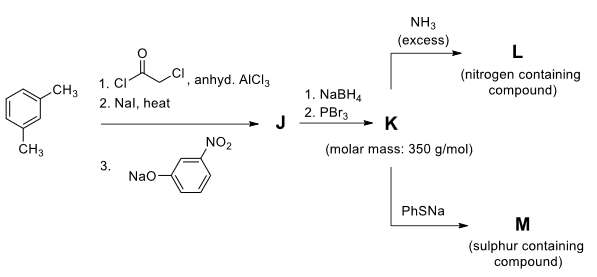
For the following questions answer them individually
Natural rubber on complete ozonolysis ($$\mathrm{O_3}$$/Zn-$$\mathrm{H_2O}$$) gives compound X as the major product. X gives positive iodoform and Tollen's tests. X on heating with aqueous NaOH gives Y as the major product. Y is
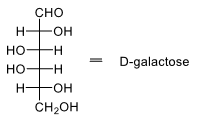
A known artificial sweetener X is composed of 4-chloro-4-deoxy-$$\alpha$$-D-galactose and 1,6-dichloro-1,6-dideoxy-$$\beta$$-D-fructose joined by a glycosidic linkage. Structure of D-galactose is given below (Fischer projection):
The correct structure of X is
For a first-order reaction $$\mathrm{R}\rightarrow\mathrm{P}$$ at a given temperature, $$k$$ is the rate constant. For this reaction, at the given temperature, the concentrations of $$\mathrm{R}$$ and $$\mathrm{P}$$ at a time $$t$$ are $$[\mathrm{R}]$$ and $$[\mathrm{P}]$$, respectively. The correct graphical representation(s) for this reaction is(are)
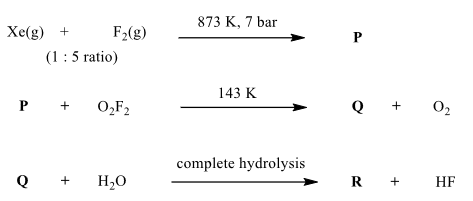
Correct statement(s) about the compounds P, Q and R is(are)
The correct statement(s) regarding the periodic properties of elements is(are)
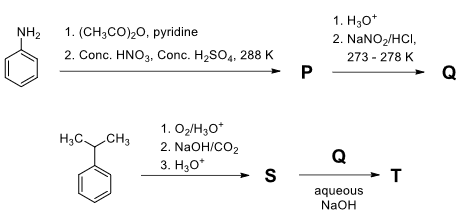
In the following reaction sequence, P, Q, S and T are the major products.
The correct statement(s) about P, Q, S and T is(are)
The correct statement(s) regarding sugars is(are)
Given: Specific rotations of L-($$-$$)-glucose and L-(+)-fructose are $$-52.5^\circ$$ and $$+92.5^\circ$$, respectively.
$$\mathbf{X}^{a+}$$ and $$\mathbf{Y}^{b+}$$ are hydrogen-like species. The wavelength of light absorbed during the transition between the states with principal quantum numbers $$n=1$$ and $$n=2$$ of $$\mathbf{X}^{a+}$$ is $$\lambda$$. The wavelength of light absorbed during the transition between the states with principal quantum numbers $$n=2$$ and $$n=4$$ of $$\mathbf{Y}^{b+}$$ is $$9\lambda$$. The lowest possible value of $$(a+b)$$ is ___.
At a given temperature, 0.45 g of acetic acid in 50 mL of water is shaken with 1.0 g of charcoal and the pH of the resulting solution is 3.0. Assume, the adsorption of acetic acid from the aqueous solution by charcoal follows Freundlich isotherm,
$$\dfrac{x}{m}=kC^{1/n}$$
If the plot of $$\log_{10}(x/m)$$ against $$\log_{10}C$$ gives a straight line with slope 1, the value of $$k$$ in L mol$$^{-1}$$ is ___.
Given: The molar mass of acetic acid is 60 g mol$$^{-1}$$.
The acid dissociation constant of acetic acid is $$1.0\times 10^{-5}$$ at the given temperature.
$$x$$ is the mass (in grams) of acetic acid adsorbed. $$m$$ is the mass (in grams) of charcoal.
$$C$$ is the equilibrium concentration of acetic acid in the solution after the adsorption is complete.
$$k$$ and $$n$$ are constants for acetic acid$$-$$charcoal system at the given temperature.
In a solvent S, a compound B is partially dissociated into C and D as given below:
$$\mathbf{B}\rightleftharpoons 2\mathbf{C}+2\mathbf{D}$$
B, C and D are non-volatile in nature. The molar mass of B is 10 times the molar mass of S. The standard boiling point and the standard enthalpy of vaporization of S are 400 K and $$10R$$ J mol$$^{-1}$$, respectively ($$R$$ is the gas constant in J K$$^{-1}$$ mol$$^{-1}$$). A solution of B in S with an initial concentration of B as 0.25% (mass/mass) has a boiling point of 408 K at 1 bar pressure. In this solution, the mole percent of B that has been dissociated is ___.