91- 6303239042


 Group
Group


 Preferred Source

 Google Discover
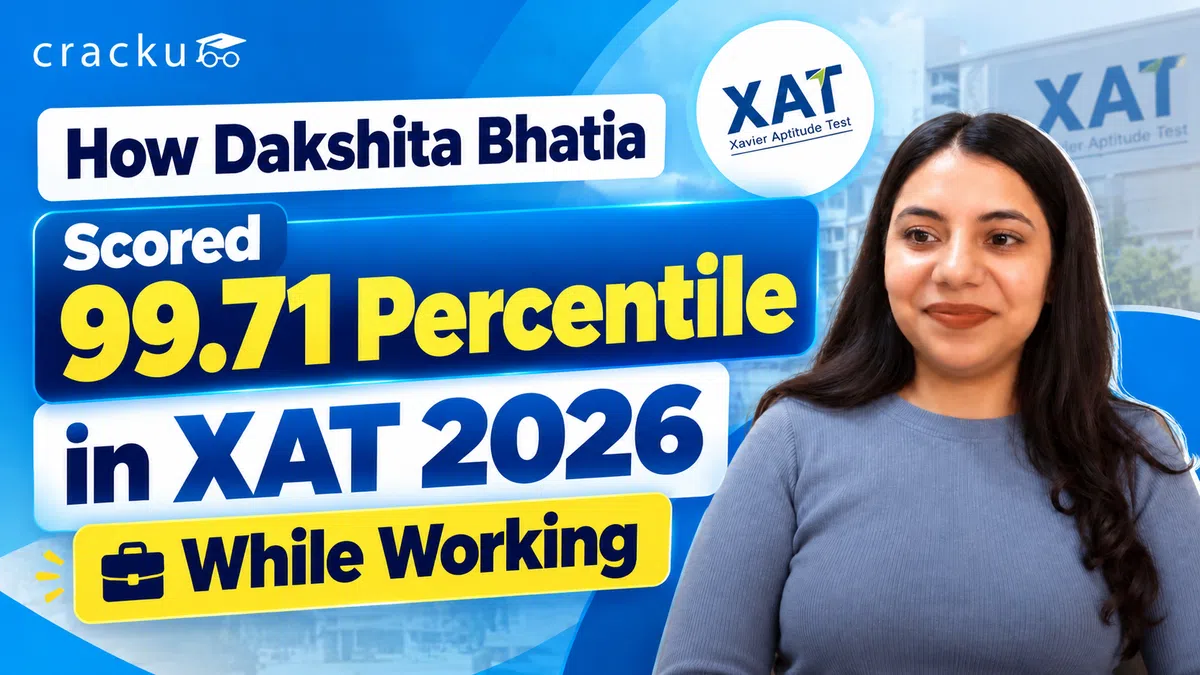
How Dakshita Bhatia Scored 99.71 Percentile in XAT 2026
Dakshita Bhatia’s XAT journey shows how steady preparation can turn a difficult exam into a manageable one. She scored 99.71 percentile in XAT 2026 while working as a Business Statistician at a startup and also working as a freelance content writer for Cracku.
Dakshita started thinking about an MBA around February 2024. Instead of following a fixed preparation plan from the beginning, she used free resources, solved questions regularly, studied XAT previous year papers, and slowly understood which methods worked for her. Her XAT preparation became stronger after she focused on Decision Making and learned how to manage the exam without sectional time limits.
XAT 2026 Section | Dakshita’s Percentile |
Verbal Ability & Logical Reasoning | 96.5 |
Quantitative Ability | 98.7 |
Decision Making | 98.9 |
Overall | 99.71 |
Institute | MDI Gurgaon |
How Dakshita Bhatia Prepared for XAT 2026 with Cracku
Dakshita’s MBA journey started around February 2024. She discovered Cracku through a YouTube video while looking for content writing opportunities. Working with Cracku also helped her understand the MBA entrance exam space better.
- She initially wanted to understand whether an MBA was suitable for her. During this phase, she explored the subjects tested in CAT and XAT and slowly started preparing for them.
- She mainly used free Cracku videos during her early preparation. She also watched videos by Maruti Sir and Sayli Ma’am.
- These helped her understand different topics without immediately joining a full-time coaching programme.
- For Verbal Ability, Dakshita watched Sayli Ma’am’s videos because she felt that Verbal was not her strongest area. She also used the Study Room questions for regular practice.
Dakshita mentioned that the Verbal Rush and Quant Rush resources were introduced towards the later part of CAT 2025. She felt that she could have used them more extensively if they had been available earlier.
For XAT preparation, she found it useful to have different resources available on one platform. Her preparation included:
- XAT Study Material for understanding and practising different topics.
- Cracku videos for Quantitative Ability, Verbal Ability and Decision Making.
- XAT Previous Year Questions to understand the actual question types.
- Study Room questions for regular practice.
- XAT Mock Tests to understand exam performance and time management.
- Flashcard-based practice for Grammar and Vocabulary.
She especially found the Decision Making videos useful because she could understand how a question was approached rather than only looking at the final answer.
Dakshita Bhatia’s XAT Preparation Strategy and Mock Test Experience
Dakshita did not follow a complicated preparation strategy. She focused on regular practice and tried to understand her strengths and weaknesses.
She gave around 10 XAT mock tests during her preparation. Apart from the mocks, she relied heavily on previous year questions available on the portal.
According to Dakshita, previous year questions helped her understand what type of questions could appear in XAT. They also helped her decide how she should approach different questions during the exam.
Her XAT exam strategy was based on giving more time to Quant first because she was comparatively less confident in Mathematics.
Exam Section | Dakshita’s Approx. Time | Approach |
Quantitative Ability | 60 minutes initially | Solved the questions she felt comfortable attempting |
Decision Making | 45 minutes | Attempted all questions |
Verbal Ability & Logical Reasoning | Remaining time | Attempted most questions and left 3 questions |
Quantitative Ability | Final review | Returned to questions that needed more time |
She started with around one hour for Quantitative Ability. She then moved to Decision Making and spent around 45 minutes completing the section.
After that, she moved to Verbal Ability. She attempted almost all the questions but left three questions, including questions from one poem-based RC.
She then returned to Quant and tried a few questions that she had left earlier.
Dakshita’s approach shows that mock tests are not only about increasing scores. They can also help identify which questions should be attempted and which ones should be left.
How Dakshita Prepared for XAT Decision Making
Decision Making was an important part of Dakshita’s XAT preparation. She believed that DM was different from Quant or Verbal because it required understanding how to approach a situation.
- She mainly watched Sayli Ma’am’s Decision Making videos and tried to understand her thinking process.
- Instead of simply remembering answers, Dakshita focused on how a particular problem was analysed.
- She also discussed Decision Making sets with her father, who had around 20–30 years of professional experience.
- She would give him different situations and ask what he would do if he were a manager. When his approach matched the correct answer, she felt that practical thinking could also help in these questions.
- For students preparing for XAT after CAT, Dakshita felt that one month can be enough to build a base in Decision Making.
- However, she recommended first understanding the basic frameworks.
She spent around one to one-and-a-half weeks understanding how to approach different Decision Making situations. She tried to identify whether a problem involved an ethical dilemma, a broad-to-narrow approach or a narrow-to-broad approach.
After understanding the basic frameworks, she spent more time practising XAT Decision Making Previous Year Questions.
Her key approach was simple:
- Understand the basic Decision Making frameworks.
- Watch how an experienced teacher approaches different sets.
- Identify the type of dilemma in each question.
- Practise previous year questions regularly.
- Understand why an option is correct instead of only checking the answer.
- Apply the same thinking process to new situations.
She also used XAT Decision Making Study Material and videos as part of her preparation.
How Dakshita Balanced Her Job and XAT Preparation
Balancing work and exam preparation was another important part of Dakshita’s journey. She worked full-time until May 2025 and also worked part-time as a content writer for Cracku.
She informed her employer about her MBA plans, which gave her some flexibility with her schedule.
Dakshita used different parts of the day for different types of preparation. Before 9:00 AM, she tried to complete a few daily targets. During travel, she used the time to solve RCs.
Her lunch breaks were useful for shorter practice sessions. She often solved puzzles and Decision Making questions during this time because these activities did not always require a long, uninterrupted study session.
Quant required more concentration for her. Therefore, she usually studied Quant after work, around 10:00–11:00 PM.
She also analysed her mistakes regularly. Instead of only checking her score, she looked at:
- Questions she could solve correctly.
- Questions where she made mistakes.
- Her strengths and weak areas.
- Questions she should attempt in the actual exam.
- Questions that were taking too much time.
Dakshita also made time for her hobbies. She enjoys baking and writing poetry and tried to spend at least one hour each day doing something she liked.
Writing also helped her handle exam pressure. If she performed badly in a mock, she would write about it and reflect on what went wrong. This helped her put her thoughts on paper instead of carrying the pressure throughout the day.
Dakshita Bhatia’s Advice for XAT 2027 Aspirants
Dakshita’s biggest advice is to find your own strategy. She does not believe that one preparation plan can work for everyone.
She pointed out that aspirants can find hundreds of preparation strategies online. However, a method that works for one person may not work for another.
Her advice for XAT 2027 aspirants is:
- Experiment with different methods: Try different study schedules and question-solving methods before finalising one.
- Understand your strengths: Do not spend all your preparation time copying someone else’s strategy.
- Practise regularly: Use XAT Study Material and practice questions to build consistency.
- Solve previous year questions: XAT Previous Year Papers can show the types of questions and situations asked in the exam.
- Take mocks: Around 10 mocks helped Dakshita understand her performance and exam strategy.
- Analyse mistakes: A mock is useful only when you understand what went wrong.
- Give extra attention to Decision Making: Understand the frameworks first and then practise different sets.
- Use available resources: Dakshita specifically recommended Cracku’s Verbal Rush, Quant Rush and Study Room resources.
- Take help when needed: Mentors can help when you are unable to identify a suitable preparation strategy.
- Maintain your mental peace: Keep time for hobbies or activities that help you relax.
Conclusion
Dakshita’s XAT 2026 journey was not based on studying all day. She balanced her work, preparation, practice and personal interests. Her 99.71 percentile came from understanding her own strengths, practising consistently and making changes based on her performance. Her journey also shows that working professionals can prepare for XAT with a practical schedule instead of trying to follow someone else’s routine exactly.