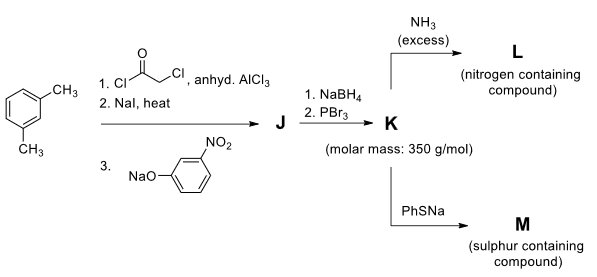
In the previous question (Q 17) we have already identified the structure of compound $$L$$. It contains exactly one nitrogen atom per molecule and its molar mass is $$286 \,\text{g mol}^{-1}$$.
Moles of $$L$$ taken in Kjeldahl’s estimation:
$$n_L=\frac{5.72\ \text{g}}{286\ \text{g mol}^{-1}}=0.020\ \text{mol}$$
Because each molecule of $$L$$ has a single nitrogen atom, the moles of nitrogen (and therefore of the ammonia that will be liberated) are also
$$n_{\mathrm N}=n_{\mathrm{NH_3}}=0.020\ \text{mol}$$
The neutralisation step in Kjeldahl’s method follows
$$2\mathrm{NH_3}+ \mathrm{H_2SO_4}\;\longrightarrow\;(\mathrm{NH_4})_2\mathrm{SO_4}$$
Thus, $$2$$ mol of $$\mathrm{NH_3}$$ are neutralised by $$1$$ mol of $$\mathrm{H_2SO_4}$$.
Therefore, moles of $$\mathrm{H_2SO_4}$$ required are
$$n_{\mathrm{H_2SO_4}}=\frac{n_{\mathrm{NH_3}}}{2}
=\frac{0.020}{2}=0.010\ \text{mol}$$
The acid supplied is $$1\ \text{M}$$, i.e. $$1\ \text{mol L}^{-1}$$.
Volume needed:
$$V=\frac{n_{\mathrm{H_2SO_4}}}{C}
=\frac{0.010\ \text{mol}}{1\ \text{mol L}^{-1}}
=0.010\ \text{L}=10.0\ \text{mL}$$
Hence the volume of $$1\ \text{M}\;\mathrm{H_2SO_4}$$ required is 10.00 mL.
 91- 6303239042