 91- 6303239042
Calculates sulphur percentage from barium sulphate formed. Molar masses: S = 32 g/mol, BaSO4 = 233 g/mol.
Sign in
Please select an account to continue using cracku.in
↓ →
Calculates sulphur percentage from barium sulphate formed. Molar masses: S = 32 g/mol, BaSO4 = 233 g/mol.
Question Stem (Q17 & Q18): Consider the following reaction sequence in which J, K, L and M are the major products.
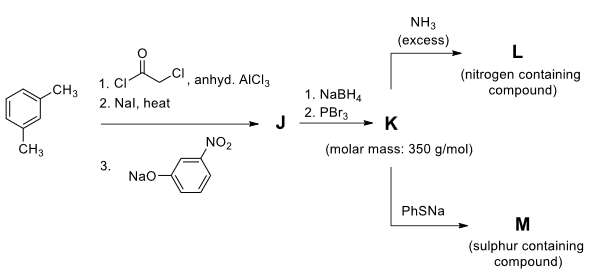
Given: Atomic mass (in amu): H : 1, C : 12, N : 14, O : 16, S : 32, Br : 80, Ba : 137
In sulphur estimation by Carius method, the amount of $$\mathrm{BaSO_4}$$ formed from 3.79 g of M is ___ g.
Start your IIM journey with the right preparation and crack CAT 2026.

Educational materials for CAT preparation
