91- 6303239042


 Group
Group
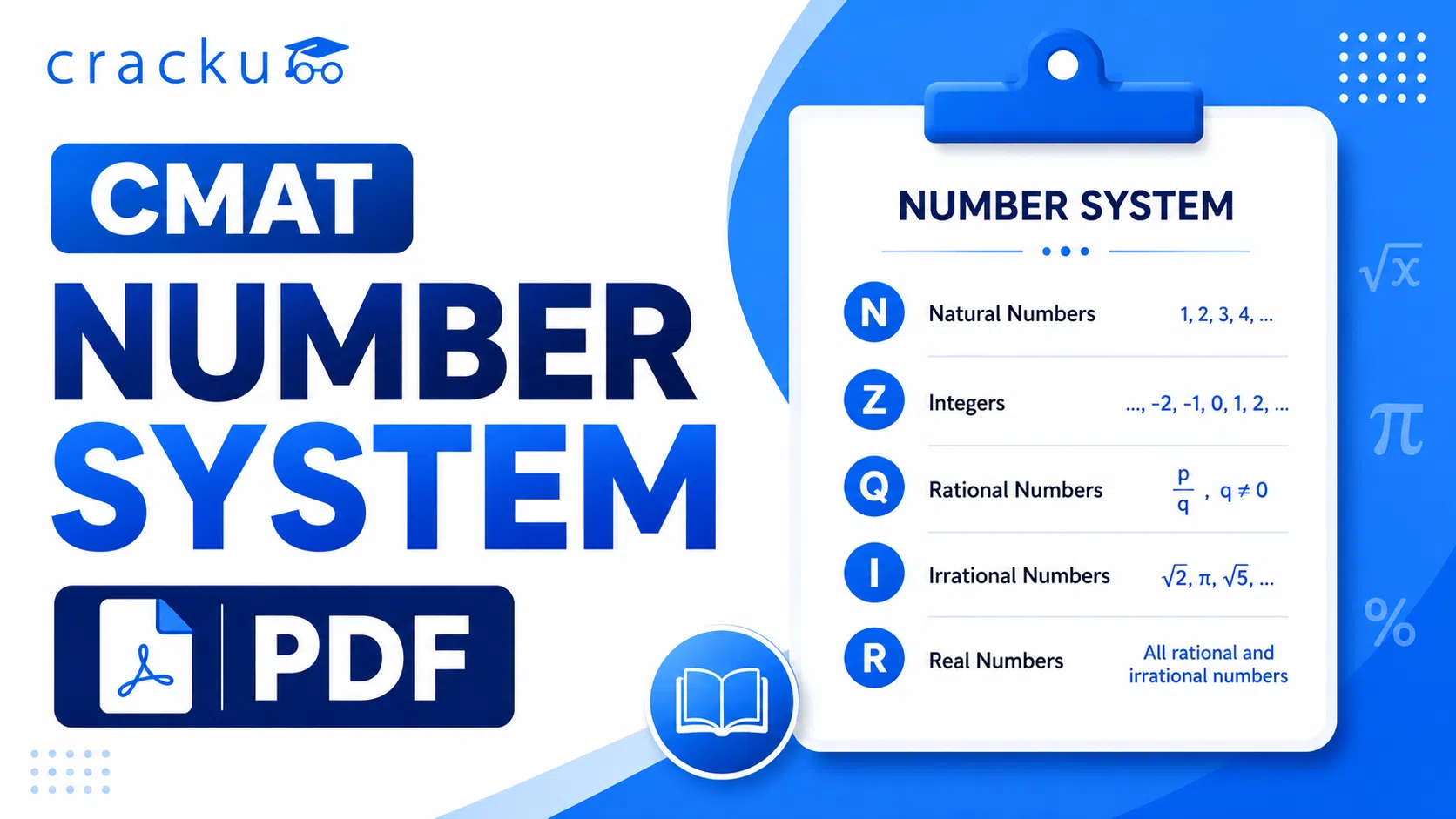
CMAT Number System Formulas PDF
The CMAT Number System Formulas PDF is a useful revision material for students preparing for the Quantitative Techniques and Data Interpretation section of the CMAT exam. Number System is one of the most fundamental topics in the CMAT syllabus, and questions are regularly asked from fractions, decimals, divisibility rules, factors, multiples, LCM and HCF, prime numbers, remainders, and series. Students who have a strong understanding of these concepts and formulas can solve questions more quickly and accurately. Regular revision of Number System formulas, along with practice of mock tests and previous year questions, can significantly improve calculation speed, accuracy, and overall performance in the CMAT exam.
Importance of CMAT Number System Formulas
A CMAT Number System Formula PDF is an essential resource for effective preparation and last-minute revision.
Quick Revision
A single PDF contains all important Number System formulas and concepts in one place, making revision easier and more organized.
Improves Speed
Mastering divisibility rules, factors, multiples, LCM-HCF concepts, and series formulas helps candidates solve questions quickly during the exam.
Better Accuracy
Regular revision and application of Number System formulas reduce calculation mistakes and improve overall accuracy.
Strengthens Fundamentals
Consistent practice helps build a strong foundation in fractions, decimals, factors, multiples, prime numbers, and number properties.
Enhances Problem-Solving Skills
A clear understanding of Number System formulas enables candidates to solve a variety of CMAT questions confidently and efficiently.
Read Also, CMAT Formulas PDF, Download Quant Important Formulas
Complete CMAT Number System Formula List
Below is a detailed list of important Number System formulas covered in the CMAT Number System Formulas PDF.
Fractions
Fraction to Percentage
Percentage = Fraction × 100
Addition of Fractions
a/b + c/d = (ad + bc)/bd
Fraction of a Quantity
Part = (m/n) × Whole
Decimals
Finite Decimal to Fraction
Fraction = Number without decimal point / 10ᵏ
where k is the number of digits after the decimal.
Recurring Decimal to Fraction
Fraction = (N − P)/(9...9 0...0)
where:
- N = all digits without the decimal point
- P = non-repeating part
Decimal to Percentage
Percentage = Decimal × 100
Divisibility Rules
Divisibility by 2
Last digit must be even
Divisibility by 3
Sum of digits must be divisible by 3
Divisibility by 4
Last two digits must be divisible by 4
Divisibility by 5
Last digit must be 0 or 5
Divisibility by 6
Number must be divisible by both 2 and 3
Divisibility by 8
Last three digits must be divisible by 8
Divisibility by 9
Sum of digits must be divisible by 9
Divisibility by 11
Difference between sums of alternate digits must be divisible by 11
Remainders
Remainder on Division by 9
Remainder = (Sum of Digits) mod 9
Factors
Number of Factors
If:
n = p₁ᵉ¹ × p₂ᵉ² × p₃ᵉ³ ...
then
Total Factors = (e₁ + 1)(e₂ + 1)(e₃ + 1)...
Sum of Factors
Sum = [(p₁^(e₁+1) − 1)/(p₁ − 1)] × [(p₂^(e₂+1) − 1)/(p₂ − 1)] ...
LCM and HCF
Product Relation
LCM(a,b) × HCF(a,b) = a × b
LCM of Fractions
LCM of Fractions = LCM of Numerators / HCF of Denominators
HCF of Fractions
HCF of Fractions = HCF of Numerators / LCM of Denominators
Euclidean Algorithm
HCF(a,b) = HCF(b, a mod b)
Prime Numbers
Prime Number Condition
A prime number has exactly two factors:
1 and itself
Prime Number Test
To check whether a number n is prime, test divisibility only up to:
√n
Sum of Series
Sum of First n Natural Numbers
Sum = n(n + 1)/2
Sum of Squares
Sum = n(n + 1)(2n + 1)/6
Sum of Cubes
Sum = [n(n + 1)/2]²
Arithmetic Progression (AP)
Sum of an AP
S = n/2 [2a + (n − 1)d]
or
S = n(a + l)/2
where:
- a = first term
- d = common difference
- l = last term
Geometric Progression (GP)
Sum of a Finite GP
S = a(1 − rⁿ)/(1 − r)
where:
- a = first term
- r = common ratio
- n = number of terms
Odd Number Series
Sum of First n Odd Numbers
1 + 3 + 5 + ... + (2n − 1) = n²
CMAT Number System Question Distribution Over the Years
Number System is one of the most important topics in the CMAT Quantitative Techniques section. Questions are frequently asked from divisibility rules, factors and multiples, LCM and HCF, prime numbers, remainders, fractions, decimals, and series. A strong understanding of these concepts and formulas can help candidates solve questions quickly and accurately during the exam.
Read Also, CMAT Syllabus 2027, Section-Wise Important Topics
Tips to Master Important Number System Formulas for CMAT
CMAT Number System Formula PDF can be used effectively to improve speed, accuracy, and conceptual understanding. Rather than memorizing formulas alone, candidates should focus on understanding their applications through regular practice.
The following tips can help candidates master important Number System formulas:
Create a one-page formula sheet for quick revision before mock tests and the actual exam.
Revise Number System formulas daily and dedicate weekly revision sessions for better retention.
Practice divisibility, remainder, LCM-HCF, and prime number questions regularly.
Solve previous year CMAT questions to understand common question patterns.
Take sectional and full-length mock tests to improve speed and accuracy.
Focus on understanding the logic behind formulas rather than memorizing them mechanically.
Read Also, CMAT Score vs Percentile 2027, Check Previous Year Analysis
Download Cracku's Free CMAT Number System Formulas PDF
Cracku has compiled all the important CMAT Number System formulas into a single PDF to simplify your preparation. Download this free CMAT Number System Formulas PDF to revise important concepts quickly, improve calculation speed, strengthen conceptual understanding, and maximize your score in the CMAT Quantitative Techniques and Data Interpretation section.
CMAT Number System Formulas PDF: Conclusion
The CMAT Number System Formulas PDF is an essential resource for candidates aiming to strengthen their Quantitative Techniques preparation. Since Number System concepts form the basis of many aptitude questions, having all important formulas in one place makes revision faster and more efficient. Topics such as fractions, decimals, divisibility rules, factors, multiples, LCM-HCF, prime numbers, remainders, and series frequently appear in CMAT and require strong conceptual clarity.
Regular revision using the CMAT Number System Formulas PDF, combined with mock tests and previous year question practice, can significantly improve speed and accuracy. Candidates who focus on understanding the logic behind formulas rather than memorizing them mechanically are more likely to perform well in the exam. Consistent practice and smart revision remain the key to maximizing your CMAT score