91- 6303239042


 Group
Group
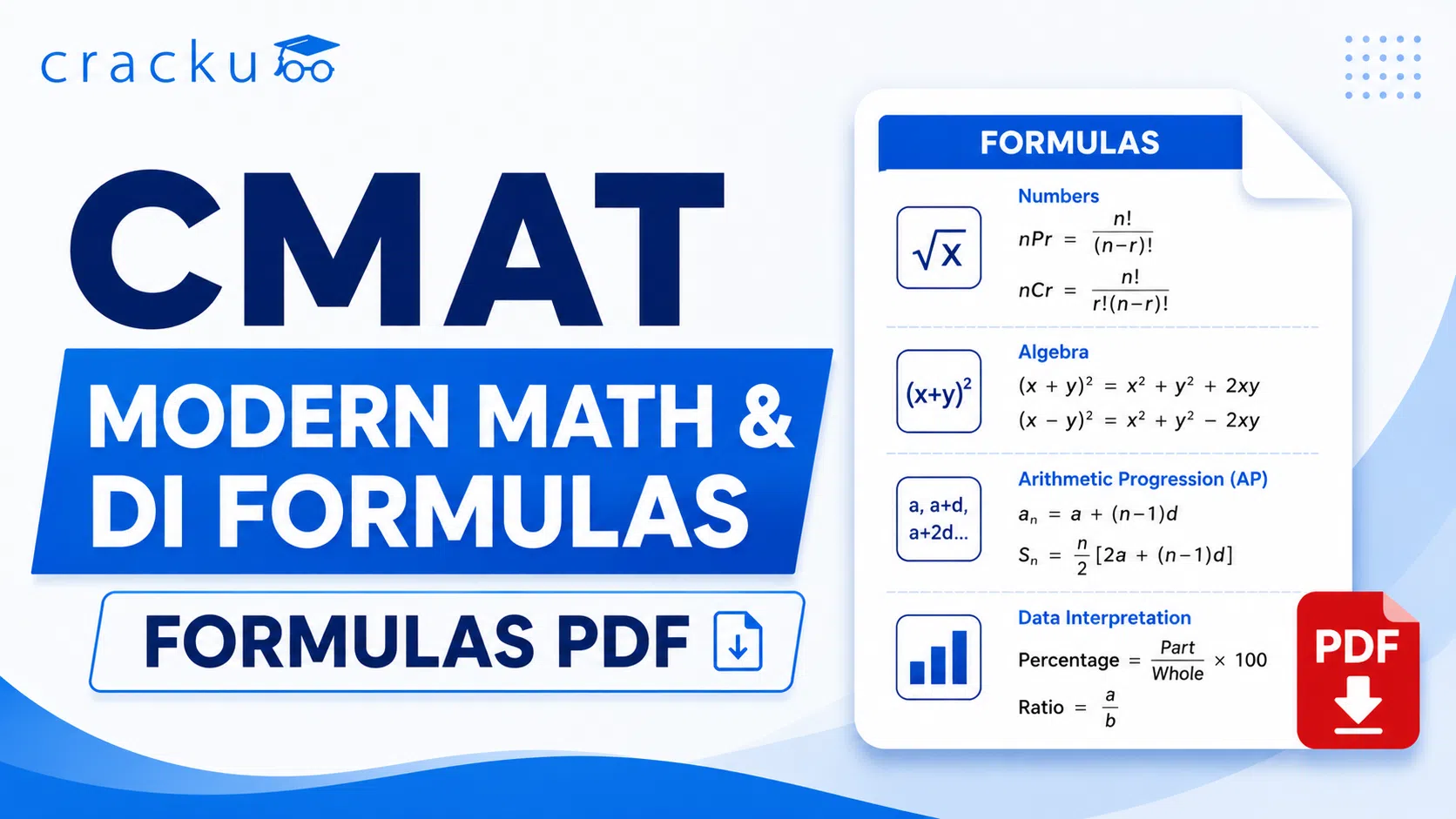
CMAT Modern Math & DI Formulas PDF
The CMAT Modern Math & DI Formulas PDF is a comprehensive study material designed for candidates preparing for the Quantitative Techniques and Data Interpretation section. Modern Math and DI are core components of the CMAT syllabus, frequently featuring in the exam through complex counting, probability, set-based logic, and data analysis tasks. Consistent revision of these concepts allows students to approach these problems with greater confidence, speed, and accuracy.
Importance of CMAT Modern Math & DI Formulas
Having a structured PDF of these formulas is vital for high-stakes exam preparation.
Quick Revision: A centralized resource allows you to review complex topics like permutations, Venn diagrams, and DI calculations in one place
Improves Speed: Familiarity with shortcuts, such as the "10% mental anchor" or "at least one" probability trick, significantly reduces time spent on calculation-heavy questions.
Better Accuracy: Mastering the specific formulas for mutually exclusive events or circular permutations helps avoid common pitfalls in logic-based questions.
Strengthens Fundamentals: Regular review ensures you can distinguish between scenarios requiring Permutations vs. Combinations, which is a common point of confusion.
Read Also, CMAT Formulas PDF, Download Quant Important Formulas
Complete CMAT Modern Math & DI Formula List
CMAT Formula Sheet
Permutations & Combinations
Factorial: n! = n × (n-1) × (n-2) × ... × 1
Permutations: nPr = n! / (n-r)!
Combinations: nCr = n! / [r!(n-r)!]
Circular Permutations: (n-1)!
Identical Items: n! / (p! × q! × r! ...)
Probability
Basic Probability: P(E) = Favourable Outcomes / Total Outcomes
Complement Rule: P(E') = 1 - P(E)
Addition Rule: P(A ∪ B) = P(A) + P(B) - P(A ∩ B)
Multiplication Rule: P(A ∩ B) = P(A) × P(B)
Conditional Probability: P(A|B) = P(A ∩ B) / P(B)
At Least One: 1 - P(No Success)
Set Theory
Union of Two Sets: n(A ∪ B) = n(A) + n(B) - n(A ∩ B)
Union of Three Sets: n(A ∪ B ∪ C) = n(A) + n(B) + n(C) - n(AB) - n(BC) - n(CA) + n(ABC)
Complement: n(A') = n(U) - n(A)
Tabulation
Average: Total / Number of Observations
Percentage Change: ((New - Old) / Old) × 100
Ratio: Quantity A / Quantity B
Pie Charts
Slice Value: (Angle / 360) × Grand Total
Percentage Share: (Category Value / Grand Total) × 100
Angle: Percentage Share × 3.6
Common Angle Conversions
- 10% = 36°
- 25% = 90°
- 50% = 180°
- 75% = 270°
Bar Charts
Difference: |Value A - Value B|
Percentage Increase: ((Later - Earlier) / Earlier) × 100
Segment Percentage: (Segment Height / Full Bar Height) × 100
Line Graphs
Slope: (Value2 - Value1) / (Time2 - Time1)
CAGR: (Final / Initial)^(1/n) - 1
Percentage Change: ((Later - Earlier) / Earlier) × 100
Read Also, CMAT Score vs Percentile 2027, Check Previous Year Analysis
Download Cracku's Free CMAT Modern Math & DI PDF
Cracku has consolidated these vital formulas and concepts into a single, high-yield PDF. This resource is designed to streamline your revision process, helping you master these complex topics and boost your performance in the CMAT exam.
Read Also, CMAT Syllabus 2027, Section-Wise Important Topics
CMAT Modern Math & DI Formulas PDF: Conclusion
Securing a competitive percentile in the CMAT exam requires a strong tactical approach to the Quantitative Techniques and Data Interpretation section. The CMAT Modern Math & DI Formulas PDF serves as a strategic asset for students, consolidating formulas for advanced permutations, probability distribution rules, and set logic into a single scannable resource. By emphasizing visual aids like Venn diagrams alongside mental estimation shortcuts, this guide helps candidates transform tedious calculations into quick, accurate analytical solutions.
Ultimately, speed and accuracy on exam day depend on how well you convert conceptual knowledge into fast execution. Incorporating the CMAT Modern Math & DI Formulas PDF into your regular revision track—paired with rigorous mock test practice—ensures you remain familiar with every essential logic rule. Download your free PDF copy today, master the application of these shortcuts, and approach the analytical challenges of the CMAT exam with complete confidence.