Group
Group
The National Testing Agency (NTA) conducts CMAT every year. Quantitative Techniques and Data Interpretation is one of the most difficult sections in the CMAT exam. Students studying for CMAT quants should refer to important formulas that will help them prepare.
Important CMAT Quant formulas include methods that help students get the correct answer quickly. Students can use the CMAT quat formula sheet throughout the revision phase. The CMAT quant formula PDF works similarly to short notes, allowing students to quickly revise the topics.
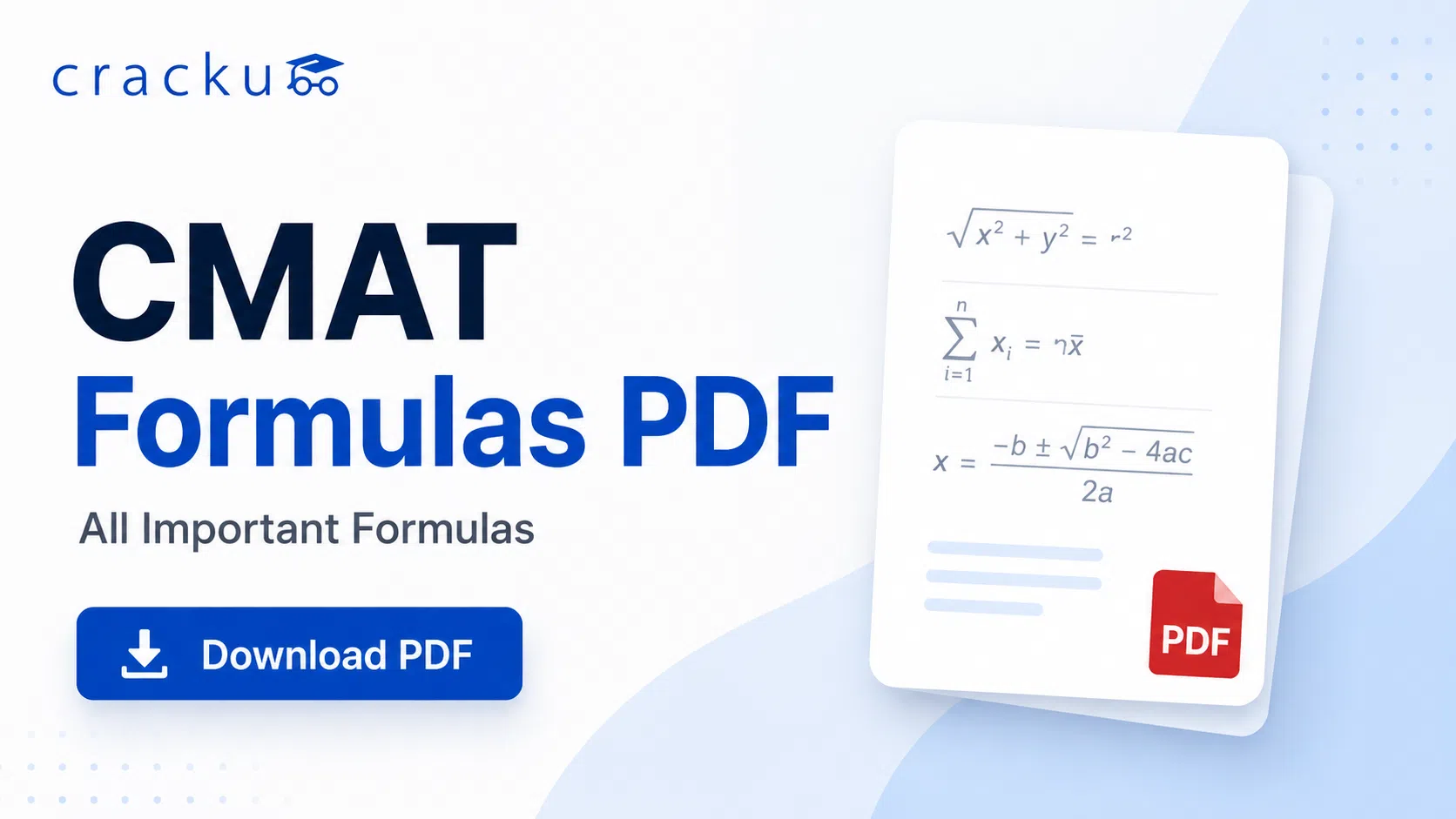
CMAT Formulas PDF
Preparing for the CMAT Quantitative Techniques and Data Interpretation section might be difficult due to the wide range of formulas and shortcut Techniques used in Arithmetic, Algebra, Geometry, Number System, Modern Maths, and Data Interpretation topics. To help in revision, a number of the most important CMAT formulas and mathematical shortcuts have been organised in one place.
This CMAT Formulas PDF is a complete quick-revision guide that will help students improve their speed, accuracy, and problem-solving abilities throughout preparation and in mock tests. The PDF contains important formulas, shortcut tricks, and important concepts usually asked in the CMAT exam, helping students to revise efficiently and minimise calculations on exam day.
CMAT Quant Topic-wise Formula PDFs
| CMAT Topic-wise Formula Pages | CMAT Topic-wise Formula PDF Link |
|---|---|
| CMAT Algebra PDF | Download PDF |
| CMAT Arithmetic PDF | Download PDF |
| CMAT Clocks & Calendars PDF | Download PDF |
| CMAT Geometry & Mensuration PDF | Download PDF |
| CMAT Modern Math & DI PDF | Download PDF |
| CMAT Number System PDF | Download PDF |
Read Also, CMAT Marking Scheme 2027, Exam Pattern, Duration
Important CMAT Formulas for Quant Preparation
Important CMAT Quant formulas can help students improve their speed, accuracy, and problem-solving skills in the Quantitative Techniques and Data Interpretation section. Regular revision of formulas from Arithmetic, Algebra, Geometry, Number System, and DI will help students to solve CMAT questions faster and score in the high percentile in the CMAT exam.
Important CMAT Formulas for Quant Preparation | |
Percentage | Percentage = (Value / Total Value) × 100 |
Profit & Loss | Profit = SP - CP, Loss = CP - SP |
Profit Percentage | Profit% = (Profit / CP) × 100 |
Discount | Discount% = (Discount / MP) × 100 |
Simple Interest | SI = (P × R × T) / 100 |
Compound Interest | CI = P(1 + R/100)^T - P |
Average | Average = Sum of Observations / Number of Observations |
Ratio & Proportion | a : b = c : d ⇒ ad = bc |
Time & Work | Work Done = Time × Efficiency |
Speed, Time & Distance | Speed = Distance / Time |
Train Problems | Time = Train Length / Speed |
Boats & Streams | Downstream = B + S, Upstream = B − S |
Mixtures & Allegations | Mean Value = Total Quantity / Total Items |
Partnership | Profit Share ∝ Investment × Time |
Permutation | nPr = n! / (n−r)! |
Combination | nCr = n! / r!(n−r)! |
Probability | Probability = Favorable Outcomes / Total Outcomes |
Quadratic Equation | x = [-b ± √(b²−4ac)] / 2a |
Logarithm | log(ab) = log a + log b |
Geometry - Area of Triangle | Area = 1/2 × Base × Height |
Area of Circle | Area = πr² |
Circumference of Circle | 2πr |
Volume of Cylinder | πr²h |
Volume of Sphere | (4/3)πr³ |
Pythagoras Theorem | a² + b² = c² |
HCF & LCM | Product of Numbers = HCF × LCM |
Data Interpretation | Percentage Change = [(New - Old) / Old] × 100 |
Topic-Wise CMAT Formula Sheet for Quick Revision
The CMAT Formula Sheet provides an overview of all the formulas required for the CMAT Examination. This formula sheet covers all of the Quants Section's important topics and their formulas. The goal of this formula sheet is to provide candidates with a short yet explanatory revision of formulas. This sheet not only provides formulas but also briefly explains them, which may help students revise more effectively. CMAT topic-wise formulas are given below:
Percentages
What you need | Formula |
x% of y | (x/100) × y |
% increase | ((New - Old) / Old) × 100 |
% decrease | ((Old - New) / Old) × 100 |
New value after +x% | Old × (1 + x/100) |
New value after −x% | Old × (1 − x/100) |
Successive % change | a + b + (ab/100) |
Ratio, Proportion & Variation
Concept | Formula |
a:b = c:d | ad = bc |
If a:b = m:n | a = km, b = kn |
Direct variation | y ∝ x ⇒ y = kx |
Inverse variation | y ∝ 1/x ⇒ y = k/x |
Split in ratio a:b | Total T ⇒ Parts = (a/(a+b))T and (b/(a+b))T |
Averages & Weighted Average
Concept | Formula |
Average | Sum of observations / Number of observations |
New average after adding x | (Old Sum + x) / (n+1) |
Weighted average | (w1x1 + w2x2 + …) / (w1 + w2 + …) |
Profit, Loss & Discount
What | Formula |
Profit | SP - CP |
Loss | CP - SP |
Profit % | (Profit/CP) × 100 |
Loss % | (Loss/CP) × 100 |
SP (Profit p%) | CP × (100 + p)/100 |
SP (Loss l%) | CP × (100 - l)/100 |
Discount | MP - SP |
Discount % | (Discount/MP) × 100 |
MP from SP & discount d% | MP = SP × 100/(100 − d) |
Simple Interest & Compound Interest
Type | Formula |
Simple Interest (SI) | (P × R × T)/100 |
Amount (SI) | P + SI |
Compound Amount | A = P(1 + R/100)^T |
Compound Interest | CI = A - P |
Time, Speed & Distance
Topic | Formula |
Speed | Distance / Time |
Distance | Speed × Time |
Time | Distance / Speed |
Relative speed (same direction) | |v1 − v2| |
Relative speed (opposite direction) | v1 + v2 |
Avg speed (equal distances) | 2xy/(x+y) |
The train crosses the pole | Time = Train length / Speed |
The train crosses the platform | Time = (Train + Platform length) / Speed |
Time & Work
Concept | Formula |
Work | Rate × Time |
If A finishes in x days | A’s 1-day work = 1/x |
Combined work (A+B) | 1/x + 1/y |
Time together | xy/(x+y) |
Number System Essentials
Concept | Formula |
Sum 1 to n | n(n+1)/2 |
Sum of squares | n(n+1)(2n+1)/6 |
Sum of cubes | [n(n+1)/2]^2 |
HCF × LCM | Product of two numbers |
If a and b are coprime | LCM = a×b |
Algebra Identities
Identity | Formula |
(a+b)² | a² + 2ab + b² |
(a−b)² | a² − 2ab + b² |
(a+b)(a−b) | a² − b² |
(a+b+c)² | a²+b²+c² + 2(ab+bc+ca) |
a³-b³ | (a−b)(a²+ab+b²) |
a³+b³ | (a+b)(a²-ab+b²) |
Logarithms
Rule | Formula |
log(ab) | log a + log b |
log(a/b) | log a - log b |
log(a^b) | b log a |
log_a(a) | 1 |
log_a(1) | 0 |
Change of base | log_b a = (log_c a)/(log_c b) |
Probability
Concept | Formula |
Probability | Favourable / Total |
Range | 0 ≤ P ≤ 1 |
P(A ∪ B) | P(A)+P(B)-P(A ∩ B) |
Independent events | P(A ∩ B) = P(A)P(B) |
Geometry & Mensuration (2D)
Shape | Area | Perimeter |
Square | s² | 4s |
Rectangle | l×b | 2(l+b) |
Triangle | ½bh | a+b+c |
Circle | πr² | 2πr |
Parallelogram | b×h | 2(a+b) |
Trapezium | ½(a+b)h | a+b+c+d |
Mensuration
Solid | Volume | Surface Area |
Cube | s³ | 6s² |
Cuboid | lbh | 2(lb+bh+lh) |
Cylinder | πr²h | 2πr(r+h) |
Sphere | (4/3)πr³ | 4πr² |
Cone | (1/3)πr²h | πr(l+r) |
Coordinate Geometry
Concept | Formula |
Distance | √[(x2-x1)²+(y2-y1)²] |
Midpoint | ((x1+x2)/2, (y1+y2)/2) |
Slope | (y2-y1)/(x2-x1) |
Line | y = mx + c |
Trigonometry Basics
Concept | Formula |
sinθ | Perpendicular / Hypotenuse |
cosθ | Base / Hypotenuse |
tanθ | Perpendicular / Base |
Identity | sin²θ + cos²θ = 1 |
Read Also, CMAT Score vs Percentile 2027, Check Previous Year Analysis
How to Use CMAT Formula Sheets Effectively During Preparation
Below are some of the uses of this CMAT formula sheet:
Understand how each formula is derived and applied rather than just memorising it.
Every day, spend 15 minutes writing formulas to increase recall speed.
Arrange similar formulas according to topics to improve conceptual understanding.
Solve 15 CMAT-level questions right after each revision session.
Maintain a basic formula list and revise it daily for seven days.
Analyse CMAT mock tests on a regular basis to identify formulas that have been forgotten or applied incorrectly.
Read Also, CMAT Syllabus 2027, Section-Wise Important Topics
CMAT Formulas PDF: Conclusion
The CMAT Formulas PDF serves as a comprehensive revision resource for candidates preparing for the Quantitative Techniques and Data Interpretation section. By regularly revising important formulas from Arithmetic, Algebra, Geometry, Mensuration, Probability, and Data Interpretation, aspirants can significantly improve their problem-solving speed and accuracy.
Success in CMAT Quant depends not only on knowing formulas but also on applying them efficiently during practice and mock tests. Consistent revision of the CMAT Formula Sheet, combined with regular question-solving, can help candidates maximise their score and achieve a high percentile in the CMAT examination.