91- 6303239042


 Group
Group
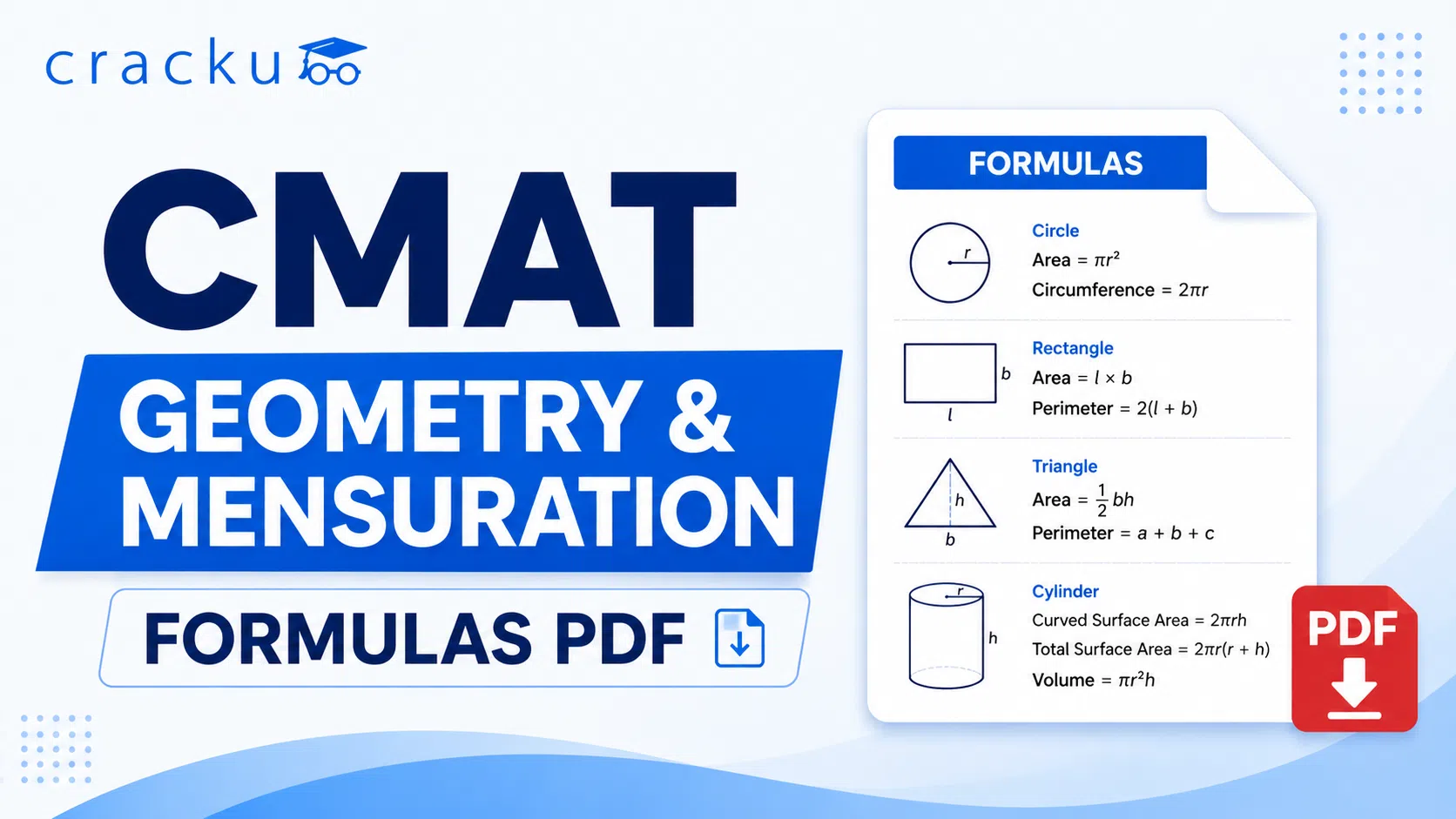
CMAT Geometry & Mensuration Formulas PDF
The CMAT Geometry & Mensuration Formulas PDF is a useful revision material for students preparing for the Quantitative Techniques and Data Interpretation section of the CMAT exam. Geometry and Mensuration are among the most important topics in the CMAT syllabus, and questions are frequently asked from coordinate geometry, triangles, quadrilaterals, circles, polygons, area, volume, and surface area concepts. Students who have a strong understanding of these formulas can solve questions more quickly and accurately. Regular revision of Geometry and Mensuration formulas, along with practice of mock tests and previous year questions, can significantly improve speed, accuracy, and overall performance in the CMAT exam.
Importance of CMAT Geometry & Mensuration Formulas
A CMAT Geometry & Mensuration Formula PDF is an essential resource for effective preparation and last-minute revision.
Quick Revision
A single PDF contains all important Geometry and Mensuration formulas and concepts in one place, making revision easier and more organized.
Improves Speed
Mastering formulas related to triangles, circles, coordinate geometry, area, volume, and surface area helps candidates solve questions quickly during the exam.
Better Accuracy
Regular revision and application of formulas reduce calculation mistakes and improve overall accuracy.
Strengthens Fundamentals
Consistent practice helps build a strong foundation in geometric properties, coordinate geometry, and mensuration concepts.
Enhances Problem-Solving Skills
A clear understanding of Geometry and Mensuration formulas enables candidates to solve a variety of CMAT questions confidently and efficiently.
Read Also, CMAT Formulas PDF, Download Quant Important Formulas
Complete CMAT Geometry & Mensuration Formula List
Below is a detailed list of important Geometry & Mensuration formulas covered in the CMAT Geometry & Mensuration Formulas PDF.
Coordinate Geometry
Distance Between Two Points
Distance = √[(x₂ − x₁)² + (y₂ − y₁)²]
Internal Section Formula
P = ((mx₂ + nx₁)/(m + n), (my₂ + ny₁)/(m + n))
Slope of a Line
m = (y₂ − y₁)/(x₂ − x₁)
Midpoint Formula
Midpoint = ((x₁ + x₂)/2, (y₁ + y₂)/2)
Equation of a Line
y − y₁ = m(x − x₁)
Angles
Angles Around a Point
Sum = 360°
Linear Pair
Angle A + Angle B = 180°
Angle Sum of a Triangle
Sum = 180°
Exterior Angle of a Triangle
Exterior Angle = Remote Interior Angle 1 + Remote Interior Angle 2
Angle Bisector Theorem
BD/DC = AB/AC
Triangles
Heron's Formula
Area = √[s(s − a)(s − b)(s − c)]
where
s = (a + b + c)/2
Area of a Right Triangle
Area = (1/2) × Base × Height
Area of an Equilateral Triangle
Area = (√3/4)a²
Pythagoras Theorem
Hypotenuse² = Base² + Perpendicular²
Area Ratio of Similar Triangles
Area₂/Area₁ = (Side₂/Side₁)²
Area Using Inradius
Area = r × s
where:
- r = Inradius
- s = Semi-perimeter
Circumradius of a Right Triangle
R = Hypotenuse/2
Altitude Formula
Height = b sin C
Quadrilaterals
Sum of Interior Angles
Sum = 360°
Area of a Parallelogram
Area = Base × Height
Area of a Rectangle
Area = Length × Breadth
Area = l × b
Diagonal of a Square
d = a√2
Area of a Rhombus
Area = (1/2)d₁d₂
Area of a Trapezium
Area = (1/2)(a + b)h
Area of a Kite
Area = (1/2)d₁d₂
Polygons
Sum of Interior Angles
Sum = (n − 2) × 180°
Each Interior Angle of a Regular Polygon
[(n − 2) × 180°]/n
Each Exterior Angle of a Regular Polygon
360°/n
Number of Diagonals
n(n − 3)/2
Area of a Regular Polygon
Area = (1/2) × Perimeter × Apothem
Circles
Circumference of a Circle
C = 2πr
Area of a Circle
A = πr²
Area of a Sector
Area = (θ/360) × πr²
Arc Length
Arc Length = (θ/360) × 2πr
Area of a Segment
Segment Area = Sector Area − (1/2)r²sinθ
Chord Length
l = 2r sin(θ/2)
Power of a Point
PA × PB = PC × PD
Mensuration
Volume of a Cuboid
V = l × b × h
Surface Area of a Cube
SA = 6a²
Volume of a Cube
V = a³
Volume of a Cylinder
V = πr²h
Curved Surface Area of a Cylinder
CSA = 2πrh
Total Surface Area of a Cylinder
TSA = 2πrh + 2πr²
Volume of a Cone
V = (1/3)πr²h
Slant Height of a Cone
l = √(r² + h²)
Curved Surface Area of a Cone
CSA = πrl
Volume of a Sphere
V = (4/3)πr³
Surface Area of a Sphere
SA = 4πr²
Hemisphere Formulas
CSA = 2πr²
TSA = 3πr²
V = (2/3)πr³
Volume of a Frustum of a Cone
V = (1/3)πh(r₁² + r₂² + r₁r₂)
CMAT Geometry & Mensuration Question Distribution Over the Years
Geometry and Mensuration are important topics in the CMAT Quantitative Techniques section. Questions are generally asked from triangles, circles, coordinate geometry, polygons, and mensuration concepts. A strong understanding of formulas can help candidates solve these questions quickly and accurately during the exam.
Read Also, CMAT Syllabus 2027, Section-Wise Important Topics
Tips to Master Important Geometry & Mensuration Formulas for CMAT
CMAT Geometry & Mensuration Formula PDF can be used effectively to improve speed, accuracy, and conceptual understanding. Rather than memorising formulas alone, candidates should focus on understanding their applications through regular practice.
The following tips can help candidates master important Geometry & Mensuration formulas:
Create a one-page formula sheet for quick revision before mock tests and the actual exam.
Revise Geometry and Mensuration formulas daily and dedicate weekly revision sessions for better retention.
Practice diagram-based questions regularly to improve visualization skills.
Solve previous year CMAT questions to understand common question patterns.
Take sectional and full-length mock tests to improve speed and accuracy.
Focus on understanding the concepts behind formulas rather than memorising them mechanically.
Read Also, CMAT Score vs Percentile 2027, Check Previous Year Analysis
Download Cracku's Free CMAT Geometry & Mensuration Formulas PDF
Cracku has compiled all the important CMAT Geometry & Mensuration formulas into a single PDF to simplify your preparation. Download this free CMAT Geometry & Mensuration Formulas PDF to revise important concepts quickly, improve calculation speed, strengthen conceptual understanding, and maximize your score in the CMAT Quantitative Techniques and Data Interpretation section.
CMAT Geometry & Mensuration Formulas PDF: Conclusion
Achieving a high percentile in the CMAT Quantitative Techniques and Data Interpretation section requires a perfect blend of conceptual clarity and quick execution. The CMAT Geometry & Mensuration Formulas PDF serves as the ultimate companion for candidates aiming to streamline their revision, minimize silly calculation errors, and build strong problem-solving fundamentals. By compiling everything from Coordinate Geometry basics to complex 3D Mensuration equations in a single, scannable document, this resource eliminates the stress of searching through multiple textbooks right before the exam.
Ultimately, consistent application is what transforms formula memorization into exam-day success. By integrating the CMAT Geometry & Mensuration Formulas PDF into your daily preparation routine alongside Cracku's mock tests and previous year papers, you will naturally notice an upgrade in your calculation speed and accuracy. Download your free copy today, stay disciplined with your daily revisions, and approach every geometry question in the CMAT exam with complete confidence