91- 6303239042


 Group


 Preferred Source

 Google Discover
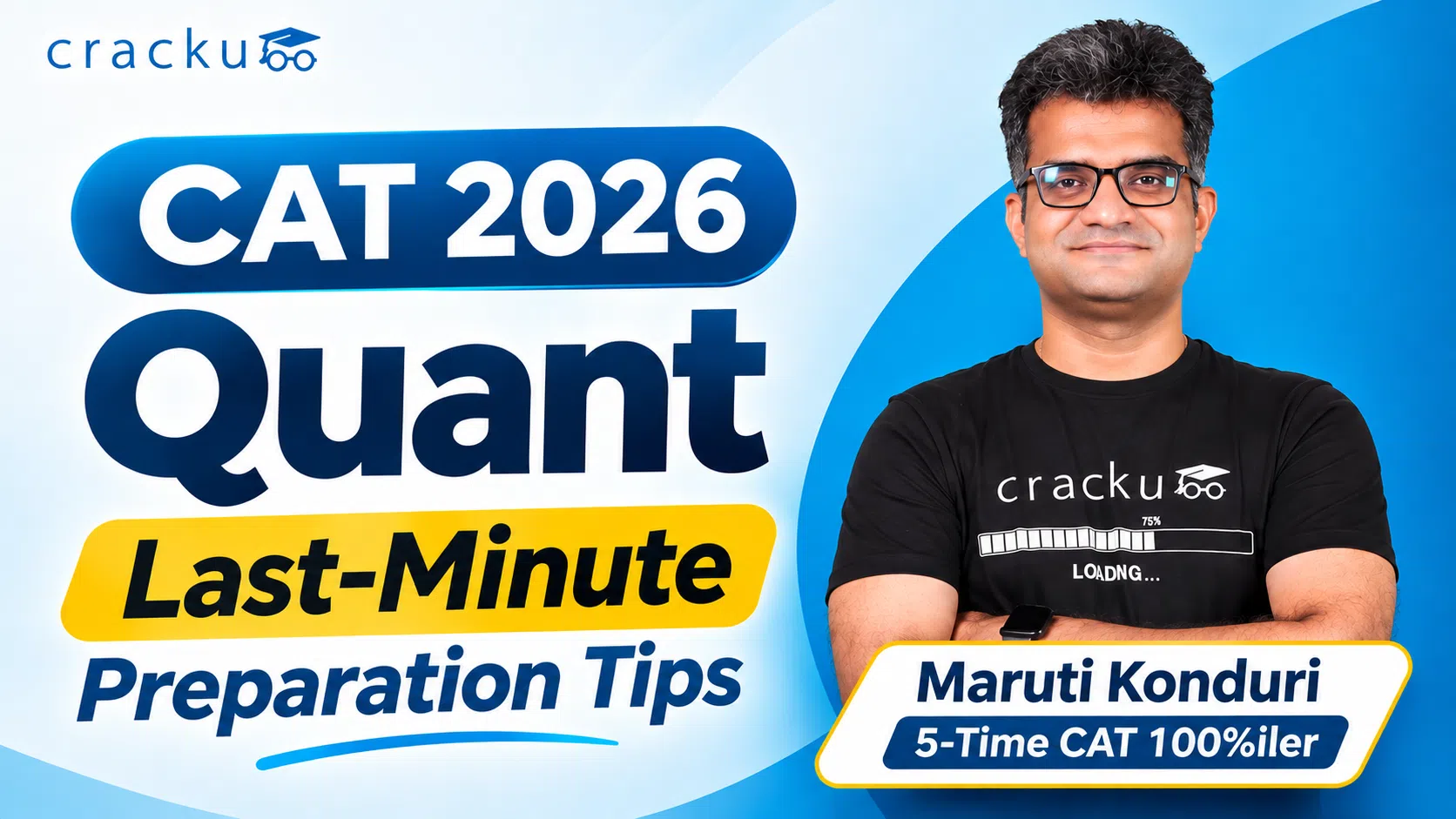
CAT 2026 Quant Last-Minute Strategy
Revising hundreds of formulas and problem-solving tricks at the last minute can make you stressed and bring nervousness that might result in bas Quant performance in CAT 2026. So, instead of revising everything on the last day, start your revision 5 days before. CAT quant is all about practice, so instead of just memorising the formulas, solve the questions. Use CAT previous year questions to boost your confidence. Along with PYQs, solve CAT quant sectional tests for quick revision.
CAT Quant consists of 22 questions to be attempted within 40 minutes. A well-planned strategy can help candidates maximise their scores without wasting time on unnecessarily difficult questions.
Download 100+ CAT Expected Questions PDF
CAT 2026 Quant Last-Minute Preparation Tips
The final stage of CAT 2026 now-or-never preparation should focus on improving execution rather than learning everything from scratch.
Start by analysing your last five to ten CAT mock tests. Identify your strong topics, frequently missed questions and areas where you spend excessive time.
Divide your preparation into three categories:
Category | Preparation strategy |
Strong topics | Revise concepts and practise mixed questions |
Average topics | Strengthen applications through CAT-level practice |
Weak topics | Cover fundamentals and prioritise easy-to-moderate questions |
Avoid spending several hours on a completely unfamiliar topic if you cannot reasonably master it before the examination. Instead, improve your ability to solve questions from topics you already understand.
CAT Mock analysis is equally important. Identify whether your mistakes result from conceptual gaps, calculation errors, incorrect question selection or time pressure. Work on correcting these patterns before taking another mock.
Also Read, CAT Quant Sample Papers 2026 with Video Solutions PDF
CAT 2026 Quant Important Topics to Revise Before the Exam
CAT Quant important topics broadly covers Arithmetic, Algebra, Geometry, Number System and Modern Mathematics. Although the distribution changes every year, candidates should prioritise topics based on their importance and individual strengths.
Topic | Important areas to revise |
Percentages Averages Profit and Loss Time and Work TSD Mixtures | |
Quadratic Equations Inequalities, Logarithms AP and GP | |
Triangles Circles Quadrilaterals, Mensuration | |
Factors Divisibility HCF&LCM; Remainders | |
Permutations Combinations Probability Set Theory |
CAT 2026 Quant Formula Revision and Practice Questions
CAT Quant Formulas revision should be combined with timed problem-solving. Reading formulas without practising their applications is unlikely to improve your examination performance.
Revise Arithmetic relationships, Algebraic identities, quadratic properties, Geometry theorems, mensuration concepts and Number System fundamentals.
For Geometry, pay particular attention to triangle similarity, angle bisectors, circle tangents, chord properties and cyclic quadrilaterals. For Mensuration, revise volume and surface-area relationships, especially questions involving changes in dimensions and conversion of solids.
Level | Practice | Objective |
Level 1 | Direct concept-based questions | Strengthen fundamentals |
Level 2 | Moderate CAT-level questions | Improve application |
Level 3 | Multi-concept questions | Develop problem-solving flexibility |
Solve previous year CAT questions under timed conditions. Maintain a separate record of questions solved correctly, questions taking excessive time, incorrect answers and unattempted but solvable questions.
Also Read, CAT 2026 Quant Expected Questions PDF with Video Solutions
How Many Quant Questions Should You Attempt in CAT 2026?
There is no fixed number of attempts that guarantees a particular percentile. Your target should depend on the difficulty of the paper, your accuracy and the time required to solve each question. However, you can check the CAT score vs percentile to know your scaled score.
Previous five-year CAT Quant score versus percentile
The following table presents approximate reported QA scaled-score benchmarks.
CAT year | 99 percentile | 95 percentile | 90 percentile |
2025 | 34 | 22 | 15 |
2024 | 33 | 22 | 17 |
2023 | 25.2 | 16.87 | 13.63 |
2022 | 32.51 | 22.37 | 17.03 |
2021 | 35 | 24 | 18 |
These are approximate post-examination estimates, not official IIM score-to-percentile guarantees. Actual scaled scores and percentiles depend on paper difficulty and normalisation.
The variation is significant. CAT 2023 required considerably fewer marks for a high QA percentile than several other years. Therefore, candidates should not follow a fixed score or attempt target based on a single examination.
Recommended attempts and accuracy
For a 22-question section, the following are practical preparation targets:
Target percentile | Suggested attempts | Accuracy target |
90 percentile | 10–12 | 80–85% |
95 percentile | 12–14 | 80–85% |
99 percentile | 14–16 | 85–90% |
These are indicative preparation targets, not guaranteed percentile conversions.
How accuracy affects your score
CAT awards +3 for a correct answer, -1 for an incorrect MCQ and zero for an incorrect TITA or unattempted question.
Attempts | Correct | Wrong | Accuracy | Score |
10 | 8 | 2 | 80% | 22 |
12 | 10 | 2 | 83.30% | 28 |
14 | 12 | 2 | 85.70% | 34 |
15 | 12 | 3 | 80% | 33 |
16 | 14 | 2 | 87.50% | 40 |
Notice that attempting 15 questions with 12 correct answers gives fewer marks than attempting 14 questions with 12 correct answers.
For most candidates, maintaining 80 - 85% accuracy is a sensible target. Those aiming for higher percentiles should work towards 85 - 90% accuracy while increasing attempts where possible.
CAT 2026 Quant Exam-Day Strategy: Time Management and Accuracy
The 40-minute Quant section requires disciplined time management. Avoid spending too much time on one question, even if you believe you are close to solving it.
Time | Activity |
0 - 5 minutes | Scan questions and identify familiar ones |
5 - 20 minutes | Solve easy and direct questions |
20 - 32 minutes | Attempt moderate questions |
32 - 38 minutes | Revisit selected questions |
38 - 40 minutes | Check calculations and answers |
Round 1: Attempt easy and familiar questions. Prioritise questions where the approach is immediately clear.
Round 2: Move to moderate questions requiring additional calculations or multiple concepts.
Round 3: Revisit questions marked for review. Attempt only those where you have a reasonable chance of arriving at the correct answer.
Avoid blind guessing in MCQs because incorrect answers attract negative marking. TITA questions do not have negative marking, but they should still be attempted intelligently without wasting excessive time.
Most importantly, do not get emotionally attached to difficult questions. CAT rewards the final score, not the time spent solving an individual problem.
CAT 2026 Quant Last-Minute Strategy: Conclusion
The final days before CAT should be dedicated to revision, previous-year questions and mock analysis. Focus on improving your strongest topics while addressing the weaknesses that repeatedly affect your scores. Use the CAT quant sample papers 2026 for quick revision.
- Prioritise Arithmetic and Algebra while maintaining coverage of other topics.
- Revise Geometry properties and theorems through actual questions.
- Aim for 80 - % accuracy and improve towards 85 - 90%.
- Build your attempt strategy around mock-test performance, not a fixed number.
- Use the 40 minutes wisely and avoid spending excessive time on difficult questions.
You do not need to solve all 22 questions to achieve a strong Quant score. Selecting the right questions and solving them accurately can make a significant difference.